

Summary Highlights
- Importance of overcurrent and earth protection relay maintenance: selective detection of faults, prevention of false trips and maintaining system safety
- Basic maintenance steps: visual inspection, setting verification, secondary injection, pickup and time test, trip circuit check
- Main checks to be made: I>, I>>, I0>, I0>> stages, IDMT and definite time behavior, CT/CBCT polarity and ratio verification
- Advanced verifications: directional phase or directional ground protection testing, binary input-output control, event logs and oscillography inspection
- Logging and trend tracking: comparison of trip times, pickup results, alarm history, setting revisions and maintenance reports
Content
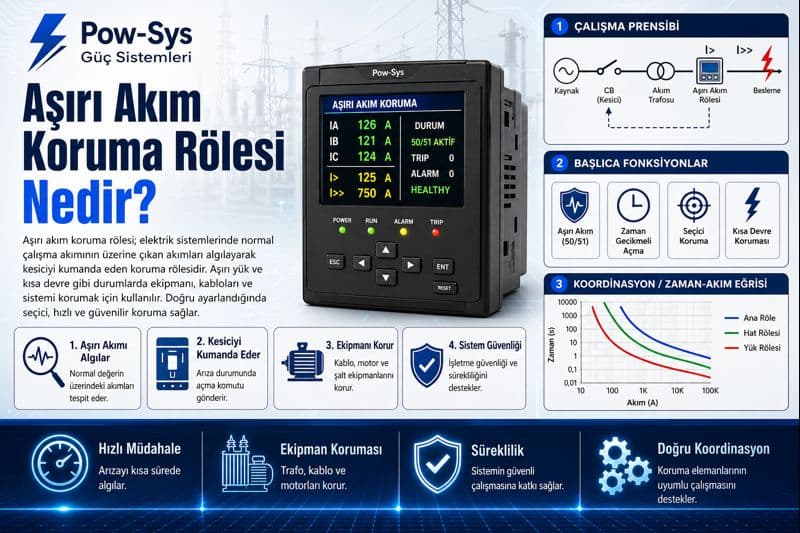
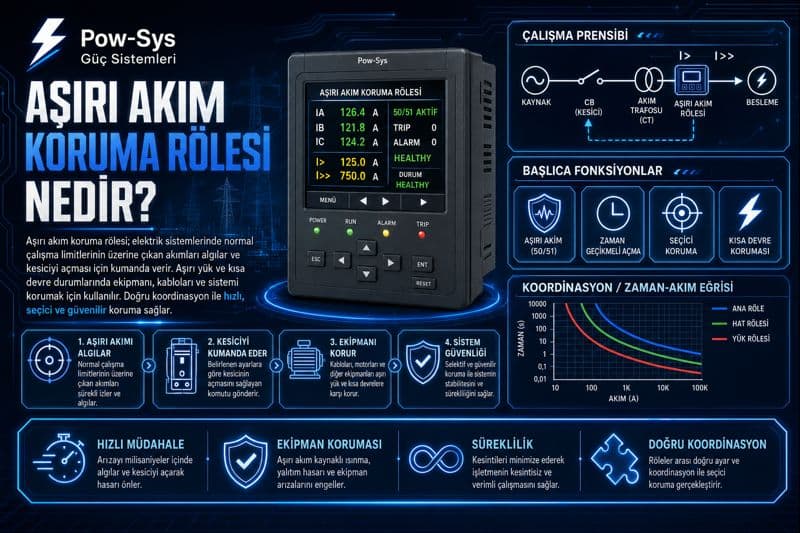
Overcurrent and earth protection relays are among the most commonly used basic protection devices in MV and HV distribution systems. For this reason, the tests and maintenance that must be done on overcurrent and earth protection relays are not done only to see whether the relay is energized or not. The main purpose is to verify that the relay detects phase short circuits, heavy current increases and ground faults at the correct stage, at the correct time and with the correct selectivity logic. Because a small adjustment error or measurement chain problem may cause either late clearance of the actual fault or unnecessary tripping.
The first step in maintenance is always safety. Before working on the relay, the relevant feeder, cell or protection system must be placed in a safe test state, test blocks must be used correctly and CT secondary circuits must be managed in a controlled manner. Especially in relays operating with CT secondary, the rule of not leaving an open circuit is vital. In systems where external CBCT or residual connection is used in ground protection circuits, incorrect separation or reverse connection of the secondary chain may cause serious test errors.
Visual inspection is the basis of maintenance. Relay front panel, display, LED indicators, alarm records, auxiliary supply terminals, terminal connections, sealed or covered sections, communication ports and binary input-output modules should be visually inspected. If there are signals such as internal error alarm, self-supervision warning, time synchronization loss or VT fail, these should be made a maintenance priority. Many modern relays can already indicate problems with them in alarm recordings.
One of the first technical tasks in overcurrent and ground protection relay maintenance is setting verification. The active setting file installed in the relay should be compared with the approved protection coordination file. I>, I>>, I0>, I0>> pickup values, IDMT or definite time selection, curve type, time multiplier or time dial settings, instantaneous opening stages, binary output assignments and directional protection parameters, if any, must be compatible with the project data. Even a small setting change in the field can significantly change protection behavior.
Secondary injection testing is the basic method of periodic maintenance. In this test, controlled current and, if necessary, voltage signals are applied to the relay to verify whether the functions work as expected. In overcurrent and ground protection relays, this is not just about seeing the relay trip. It should also be checked that the pickup level is correct, the time curve works as expected when the relevant step is selected, and the trip time is compatible with the setting logic.
Phase overcurrent stages must be tested separately. For the I> stage, it should be verified above which threshold the relay detects low level overcurrent and how long it takes to operate according to IDMT or definite time selection. I>> or, if available, at higher levels, fast behavior against more severe fault conditions should be tested. In relays that use instantaneous opening, it should be ensured that this stage is set at a level that will not accidentally cause normal load or starting-like situations, as well as that it should open at the expected speed in case of really severe faults.
Earth protection levels must be tested separately. The pickup levels, time delays and directional behavior, if any, of the I0> and I0>> stages should be examined one by one. Since ground fault currents may not be as high as phase short circuits in most cases, these functions operate more sensitively. For this reason, it is not enough to just get trip during earth fault tests; It should also be noted that it does not become susceptible to noise or transient instability due to incorrect sensitivity.
It is very important to verify the time-current characteristic of relays using the IDMT curve. By applying test points at different current levels, it should be checked that the relay operates in the expected time according to the selected normal inverse, very inverse, extremely inverse or other curve type used. In functions with definite time selected, it should be measured that the fixed delay is actually at the expected value after the pickup is exceeded. These tests are critical to see if conservation coordination is breaking down in the field.
In systems where directional phase or directional earth protection is used, directional testing must be performed separately. In ring networks, parallel sources and bidirectional powered structures, the relay must evaluate not only the fault current magnitude but also its direction correctly. Therefore, forward and reverse direction scenarios should be applied and it should be verified that the relay only provides protection in the correct direction. Especially in systems where directional earth fault is used, VT polarity and current-voltage phase relationship are decisive in this test.
CT, VT and CBCT chain are among the most critical field titles of maintenance. CT ratio, polarity, phase sequence, secondary circuit resistance, ground point and excitation control, if any, directly affect relay behavior. If the residual current in ground protection is obtained from the sum of three phase CTs, it must be seen that this sum is made correctly, and if an external core-balance CT is used, the direction and connection logic must be correct. Incorrect polarity or faulty CBCT connection can render the earth protection unusable.
Trip circuit and binary input-output tests are also an indispensable part of maintenance. It is not enough for the relay to make the correct pickup and time decision alone; This decision must be fully communicated to the relevant breaker, shunt trip coil or protection chain. For this reason, trip outputs, alarm contacts, blocking inputs, binary input functions and, if necessary, breaker fail and reclosing relationships must be verified separately.
Event logs and oscillography review are an important part of maintenance. The stage at which the relay opened in the past, whether a wrong trip occurred, what measurement it saw during a ground fault, and how the binary input-output timings behaved can be examined through event records. Especially if there are recurring feeder trips, earth fault alarms of unknown origin or instantaneous pick-up events, record analysis is very valuable in understanding the real field behavior of the relay.
In relays with communication and time synchronization, these infrastructures should also be checked. In systems using SCADA, IEC 61850, Modbus, event transfer or central monitoring, communication breakdown is not only data loss; In some projects, it also affects remote alarm and log review. In relays whose time synchronization is out of order, it becomes difficult to analyze the event sequence correctly. Therefore, in modern digital relay maintenance, the communication chain is as important as protection.
At the end of the maintenance, all results should be recorded. Which pickup points were tested, I> and I0> time results, direction test scenarios, CT/CBCT control findings, trip output verifications, alarm history and setting revisions should be archived regularly. Because overcurrent and ground protection problems often do not occur suddenly; It grows into pickup drift, measure chain corruption, or incorrect binary logic. If trend monitoring is done, weak points can be noticed before the actual failure occurs. In summary, the tests and maintenance that must be done on overcurrent and earth protection relays; Safe test preparation requires adjustment verification, secondary injection, pickup and time curve tests, separate verification of phase and ground stages, CT/VT/CBCT chain control, direction function verification if there is a direction test, trip circuit and event recording analysis. This approach is the most important step to prove that the relay is indeed ready to clear faults in the field with the correct selectivity.
Frequently Asked Questions
Why is maintenance necessary for overcurrent and earth protection relays?
Because these relays are the basic devices of feeder and distribution protection. A small error in the setting, CT/CBCT connection or trip circuit can cause false tripping or delayed clearance of the actual fault.
What tests are performed on these relays?
Setting verification, secondary injection, pickup test of phase and ground stages, IDMT or definite time test, directional verification if there is a directional test, CT/VT/CBCT chain control and trip circuit tests can be performed.
Why is secondary injection used in periodic maintenance?
Because secondary injection allows to safely verify the measurement and decision chain of the relay and is considered the basic method for periodic testing.
What does the pickup test confirm?
The pickup test verifies whether stages such as I>, I>>, I0> and I0>> are activated at the set threshold. Thus, the sensitivity level of the relay is controlled.
Why is IDMT curve testing important?
Because the coordination of overcurrent and ground protection depends not only on the pickup level but also on the tripping time. Curve testing shows that the relay operates for the expected time at different current levels.
Why are CT and CBCT checks performed separately?
Because if the CT ratio, polarity or CBCT connection is incorrect, the relay will see wrong current. Especially in soil protection, these errors can lead to serious false openings or blind areas.
What should be tested separately if there is directional earth protection?
It should be verified that the relay operates only in faults in the correct direction by applying forward and reverse direction scenarios. For this, current and voltage phase relationship are tested together.
Why is trip circuit testing considered critical?
Because it is not enough for the relay to make the right decision alone; The decision must reach the cutter reliably. The trip circuit, binary outputs and auxiliary relay chain are therefore separately verified.
Why are incident records reviewed in maintenance?
Because event records show from which stage the relay has opened in the past, which currents it has seen and whether wrong opening has occurred. This data shapes the care plan more accurately.
Why is it important to keep records on these relays?
Because pickup drift, time drift, CT circuit distortion or binary logic errors may develop over time. If regular records are kept, weak points will be noticed before actual failure occurs.