
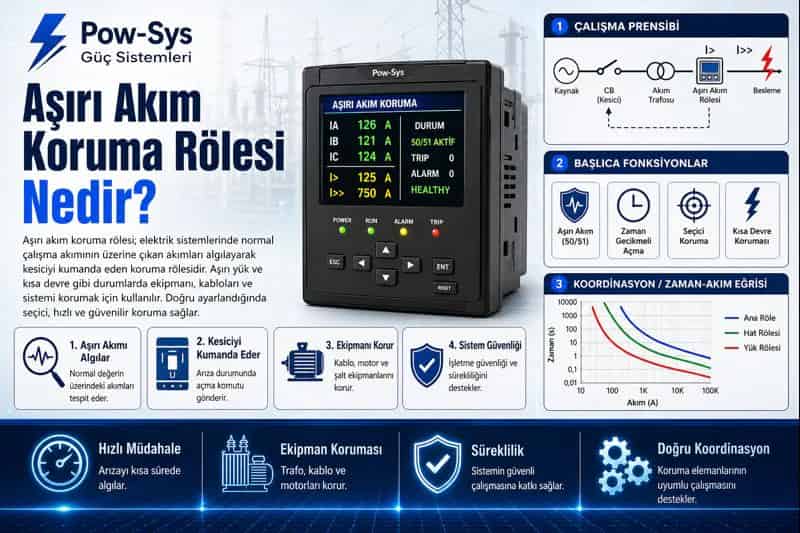
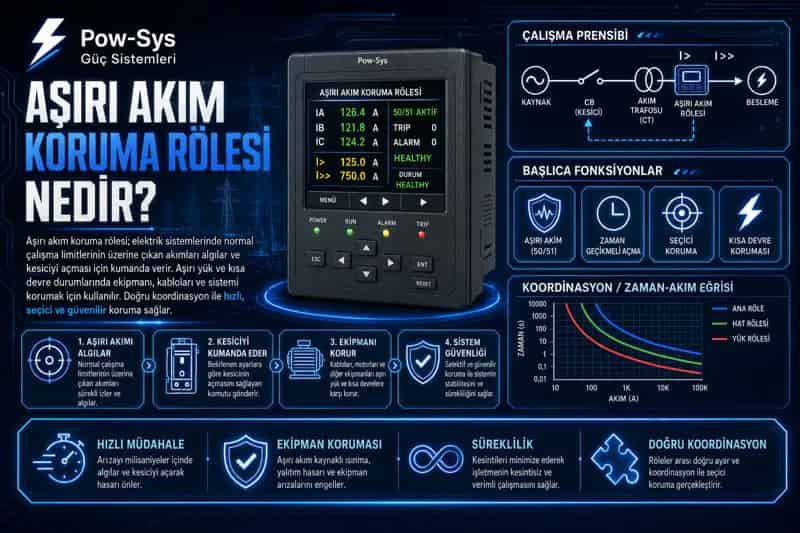
Summary Highlights
- Importance of overcurrent and earth fault protection relay maintenance: preserving selective fault detection, preventing incorrect trips and maintaining system safety
- Basic maintenance steps: visual inspection, setting verification, secondary injection, pickup and time test, trip circuit check
- Main checks to be performed: I>, I>>, I0>, I0>> stages, IDMT and definite time behavior, CT/CBCT polarity and ratio verification
- Advanced verifications: directional phase or directional earth fault protection test, binary input-output check, event records and oscillography review
- Recording and trend tracking: comparison of trip times, pickup results, alarm history, setting revisions and maintenance reports
Article Details
Overcurrent and earth fault protection relays are among the most widely used basic protection devices in MV and HV distribution systems. Therefore, the tests and maintenance required for overcurrent and earth fault protection relays are not performed only to see whether the relay is energized. The main purpose is to verify that the relay detects phase short circuits, heavy current increases and earth faults at the correct stage, in the correct time and with correct selectivity logic. A small setting error or measurement chain problem can cause either delayed clearing of a real fault or unnecessary trips.
The first step of maintenance is always safety. Before working on the relay, the related feeder, cubicle or protection system should be placed in a safe test condition, test blocks should be used correctly and CT secondary circuits should be managed in a controlled way. The rule of not leaving the CT secondary open is vital especially in relays operating with CT secondaries. In earth fault protection circuits using external CBCT or residual connection, incorrect isolation or reverse connection of the secondary chain can cause serious test errors.
Visual inspection is the basis of maintenance. The relay front panel, display, LED indicators, alarm records, auxiliary supply terminals, terminal connections, sealed or covered sections, communication ports and binary input-output modules should be visually inspected. If there are internal fault alarms, self-supervision warnings, time synchronization loss or VT fail type signals, these should become maintenance priorities. Many modern relays can show problems related to themselves beforehand in alarm records.
One of the first technical tasks in overcurrent and earth fault relay maintenance is setting verification. The active setting file loaded in the relay should be compared with the approved protection coordination file. I>, I>>, I0>, I0>> pickup values, IDMT or definite time selection, curve type, time multiplier or time dial settings, instantaneous trip stages, binary output assignments and directional protection parameters if present should be compatible with project data. A small setting change made in the field can seriously alter protection behavior.
Secondary injection testing is the basic method of periodic maintenance. In this test, controlled current and, when required, voltage signals are applied to the relay to verify whether functions operate as expected. In overcurrent and earth fault protection relays, this is not limited to seeing that the relay trips. It should also be checked that the pickup level is correct, the time curve operates as expected when the related stage is selected and the trip time is compatible with the setting logic.
Phase overcurrent stages should be tested separately. For the I> stage, it should be verified above which threshold the relay detects low-level overcurrent and how long it takes to operate according to IDMT or definite time selection. For I>> or higher stages, if present, fast behavior against heavier fault conditions should be tested. In relays using instantaneous tripping, it should be verified both that this stage is not set low enough to operate during normal load or starting-like conditions and that it trips with the expected speed for real severe faults.
Earth fault protection stages should also be tested separately. Pickup levels, time delays and directional behavior, if present, of the I0> and I0>> stages should be examined one by one. Since earth fault currents may often be lower than phase short-circuit currents, these functions operate more sensitively. Therefore, during earth fault tests, receiving a trip alone is not enough; it should also be confirmed that the relay has not become vulnerable to noise or temporary unbalance due to incorrect sensitivity.
In relays using an IDMT curve, verification of the time-current characteristic is very important. Test points at different current levels should be applied to check whether the relay operates in the expected time according to the selected normal inverse, very inverse, extremely inverse or other curve type. In functions selected as definite time, it should be measured whether the fixed delay after pickup is really at the expected value. These tests are critical for seeing whether protection coordination has deteriorated in the field.
If directional phase or directional earth fault protection is used, the direction test should also be performed. In ring networks, parallel sources and structures fed from two directions, the relay must evaluate not only the magnitude of fault current but also its direction correctly. Therefore, forward and reverse direction scenarios should be applied, and it should be verified that the relay provides protection only in the correct direction. Especially in systems using directional earth fault, VT polarity and current-voltage phase relationship are decisive in this test.
The CT, VT and CBCT chain is one of the most critical field headings in maintenance. CT ratio, polarity, phase sequence, secondary circuit resistance, grounding point and excitation check if present directly affect relay behavior. If residual current for earth protection is obtained from the sum of three phase CTs, it should be verified that this summation is made correctly; if an external core-balance CT is used, its direction and connection logic should be confirmed. Incorrect polarity or faulty CBCT connection can make earth fault protection unusable.
Trip circuit and binary input-output tests are indispensable parts of maintenance. It is not sufficient for the relay to make the correct pickup and time decision; this decision must be delivered completely to the related circuit breaker, shunt trip coil or protection chain. Therefore, trip outputs, alarm contacts, blocking inputs, binary input functions and, when required, relationships with breaker failure and reclosing should be verified separately.
Event records and oscillography review are important parts of maintenance. From event records, it can be examined from which stage the relay tripped in the past, whether incorrect trips occurred, what measurement it saw during an earth fault and how binary input-output timings behaved. Event analysis is very valuable for understanding real field behavior of the relay, especially if repeated feeder trips, unexplained earth fault alarms or momentary pickup events exist.
Communication and time synchronization should also be checked in relays that have these features. In systems using SCADA, IEC 61850, Modbus, event transfer or central monitoring, communication loss is not only data loss; in some projects it also affects remote alarm and record review. In relays with incorrect time synchronization, analyzing the event sequence becomes difficult. Therefore, in modern numerical relay maintenance, the communication chain is as important as protection.
At the end of maintenance, all results should be recorded. Which pickup points were tested, I> and I0> time results, direction test scenarios, CT/CBCT check findings, trip output verifications, alarm history and setting revisions should be archived regularly. Because overcurrent and earth fault protection problems usually do not appear suddenly; they grow as pickup drift, measurement chain deterioration or incorrect binary logic. If trend tracking is performed, weak points can be noticed before a real fault occurs. In summary, the tests and maintenance required for overcurrent and earth fault protection relays require safe test preparation, setting verification, secondary injection, pickup and time curve tests, separate verification of phase and earth stages, CT/VT/CBCT chain checks, direction function verification if directional protection exists, trip circuit and event record analysis carried out together. This approach is the most important step proving that the relay is truly ready to clear field faults with correct selectivity.
Related Blog Posts
- What Is an Overcurrent and Earth Fault Protection Relay? What Does It Do, How Does It Work and For What Purpose Is It Used?
- What Tests and Maintenance Are Required for Distance Protection Relays?
- What Tests and Maintenance Are Required for Breaker Failure and Busbar Protection Relays?
- What Are Relay Setting Calculations? How Are They Performed?
Related Services
Frequently Asked Questions
Why is maintenance required on overcurrent and earth fault protection relays?
Maintenance is required because overcurrent and earth fault protection relays are among the most widely used basic protection devices in MV and HV distribution systems. Maintenance is not performed only to see whether the relay is energized; the main purpose is to verify that the relay detects phase short circuits, heavy current increases and earth faults at the correct stage, in the correct time and with the correct selectivity logic. A small setting error or measurement chain problem can cause either delayed clearing of a real fault or unnecessary trips. Because these relays depend on the CT, VT and CBCT chain and on the trip circuit as well as on their settings, a fault in any of these can undermine protection even when the relay itself looks healthy. Regular maintenance verifies pickup, time, direction and the trip chain together, so feeders and distribution equipment stay protected with correct selectivity.
Which tests are performed on these relays?
Setting verification, secondary injection, pickup tests for the phase and earth stages, IDMT or definite time tests, directional verification if present, the CT/VT/CBCT chain check and trip circuit tests can be performed. Setting verification compares the active setting file with the approved coordination file, checking the I>, I>>, I0> and I0>> pickup values, the curve type, the time multiplier and any directional parameters. Secondary injection applies controlled current, and voltage when required, to confirm the functions operate as expected. Phase overcurrent stages and earth fault stages are tested separately, and the IDMT or definite time behavior is measured at different current levels. If directional protection exists, forward and reverse scenarios are applied. The CT, VT and CBCT chain, the trip circuit, binary inputs and outputs, and event records are verified. The exact scope depends on the relay's function set and whether it is directional.
Why is secondary injection used in periodic maintenance?
Secondary injection is used because it allows the relay's measurement and decision chain to be verified safely, and it is the basic method of periodic maintenance. In this test, controlled current and, when required, voltage signals are applied to the relay to verify whether its functions operate as expected. In overcurrent and earth fault protection relays, this is not limited to seeing that the relay trips; it should also be checked that the pickup level is correct, that the time curve operates as expected when the related stage is selected, and that the trip time is compatible with the setting logic. By injecting known signals, maintenance can confirm each stage behaves correctly without waiting for a real fault on the feeder. For this reason secondary injection sits at the center of periodic testing for these relays, and it is combined with separate verification of the phase and earth stages, the direction function and the trip circuit.
What does the pickup test verify?
The pickup test verifies whether stages such as I>, I>>, I0> and I0>> operate at their set thresholds, so the relay's sensitivity level is checked. For the I> stage, it is verified above which threshold the relay detects a low-level overcurrent, and for I>> or higher stages the behavior against heavier fault conditions is confirmed. On the earth side, the pickup levels of the I0> and I0>> stages are examined, and because earth fault currents may often be lower than phase short-circuit currents, these functions operate more sensitively. For this reason, during earth fault tests, receiving a trip alone is not enough; it should also be confirmed that the relay has not become vulnerable to noise or temporary unbalance due to incorrect sensitivity. In instantaneous stages, it is verified that the stage is not set low enough to operate during normal load or starting-like conditions, while still tripping quickly for real severe faults.
Why is the IDMT curve test important?
The IDMT curve test is important because overcurrent and earth fault protection coordination depends not only on the pickup level but also on the trip time. In relays using an IDMT curve, test points at different current levels should be applied to check whether the relay operates in the expected time according to the selected normal inverse, very inverse, extremely inverse or other curve type. In functions selected as definite time, it should be measured whether the fixed delay after pickup is really at the expected value. These tests are critical for seeing whether protection coordination has deteriorated in the field, because a curve that no longer matches the intended settings can break selectivity between upstream and downstream devices. By confirming the relay operates in the expected time at several current levels, the curve test verifies that the time-current characteristic still holds.
Why are CT and CBCT checks performed separately?
CT and CBCT checks are performed separately because if the CT ratio, polarity or CBCT connection is wrong, the relay sees an incorrect current and its decisions become unreliable. The CT, VT and CBCT chain is one of the most critical field headings in maintenance: the CT ratio, polarity, phase sequence, secondary circuit resistance, grounding point and, when present, the excitation check directly affect relay behavior. If the residual current for earth protection is obtained from the sum of three phase CTs, it should be verified that this summation is made correctly, and if an external core-balance CT is used, its direction and connection logic should be confirmed. Especially in earth fault protection, an incorrect polarity or a faulty CBCT connection can cause serious incorrect trips or leave blind spots where a real earth fault is not detected.
What should be tested if directional earth fault protection exists?
If directional earth fault protection exists, the direction test should be performed by applying forward and reverse direction scenarios to verify that the relay operates only for faults in the correct direction. In ring networks, parallel sources and structures fed from two directions, the relay must evaluate not only the magnitude of the fault current but also its direction correctly, otherwise it could trip for a fault behind it or fail to trip for one in front. Especially in systems using directional earth fault, the VT polarity and the current-voltage phase relationship are decisive in this test, so they are checked together. By confirming that the relay provides protection only in the intended direction, the test protects both security and selectivity in networks where current can flow more than one way.
Why is the trip circuit test considered critical?
The trip circuit test is considered critical because it is not sufficient for the relay to make the correct pickup and time decision; that decision must be delivered completely to the related circuit breaker, shunt trip coil or protection chain. For this reason the trip outputs, alarm contacts, blocking inputs, binary input functions and, when required, the relationships with breaker failure and reclosing should be verified separately. Even if the relay picks up at the right current and times out correctly, the real protection function does not occur if the trip chain is faulty, because the breaker would not actually open. Trip circuit and binary input-output tests are therefore indispensable parts of maintenance. By confirming that a correct decision reliably reaches the circuit breaker and the auxiliary relay chain, this test proves that the relay can actually clear a fault, not just detect it. It closes the gap between a correct measurement and a real interruption of the faulted feeder.
Why are event records examined during maintenance?
Event records are examined because they show from which stage the relay tripped in the past, which currents it saw, whether incorrect trips occurred, what measurement it saw during an earth fault and how the binary input-output timings behaved. This event analysis is very valuable for understanding the real field behavior of the relay, especially if repeated feeder trips, unexplained earth fault alarms or momentary pickup events exist. Because these records capture how the relay actually responded to real disturbances rather than only to injected test signals, they help distinguish a genuine protection operation from a nuisance one. Reviewing them during maintenance shapes the maintenance plan more accurately, pointing to which stages, measurement chains or binary logic need closer attention. In modern numerical relays, event records and oscillography turn each past disturbance into useful data, so studying them can reveal a developing pickup, timing or connection problem before it leads to a wrong operation on a real fault.
Why is record keeping important on these relays?
Record keeping is important because overcurrent and earth fault protection problems usually do not appear suddenly; they grow as pickup drift, measurement chain deterioration or incorrect binary logic. At the end of maintenance, which pickup points were tested, the I> and I0> time results, the direction test scenarios, the CT/CBCT check findings, the trip output verifications, the alarm history and any setting revisions should all be archived regularly. When this data is kept, pickup drift, time deviation, CT circuit deterioration or binary logic errors can be compared from one visit to the next. With regular records and trend tracking, weak points can be noticed before a real fault occurs, rather than being discovered only when the relay misoperates. Because these relays sit in a coordinated protection scheme, keeping a clear history of their pickup and time results also makes it easier to confirm that a setting change has not disturbed the grading with neighboring devices.