

Summary Highlights
- What is a power transformer: basic electrical equipment that raises or lowers the voltage level of electrical energy
- What does a power transformer do? It ensures that energy is converted to the appropriate voltage level in the production, transmission and distribution stages.
- How does a power transformer work: it transfers energy between the primary winding, magnetic core and secondary winding by the principle of electromagnetic induction
- Power transformer types: oil-filled power transformer, dry type transformer, distribution transformer, step-up transformer, step-down transformer and special application transformers
- Things to consider when choosing a power transformer: power rating, voltage level, impedance, cooling type, insulation class, protection equipment and operating conditions
Content
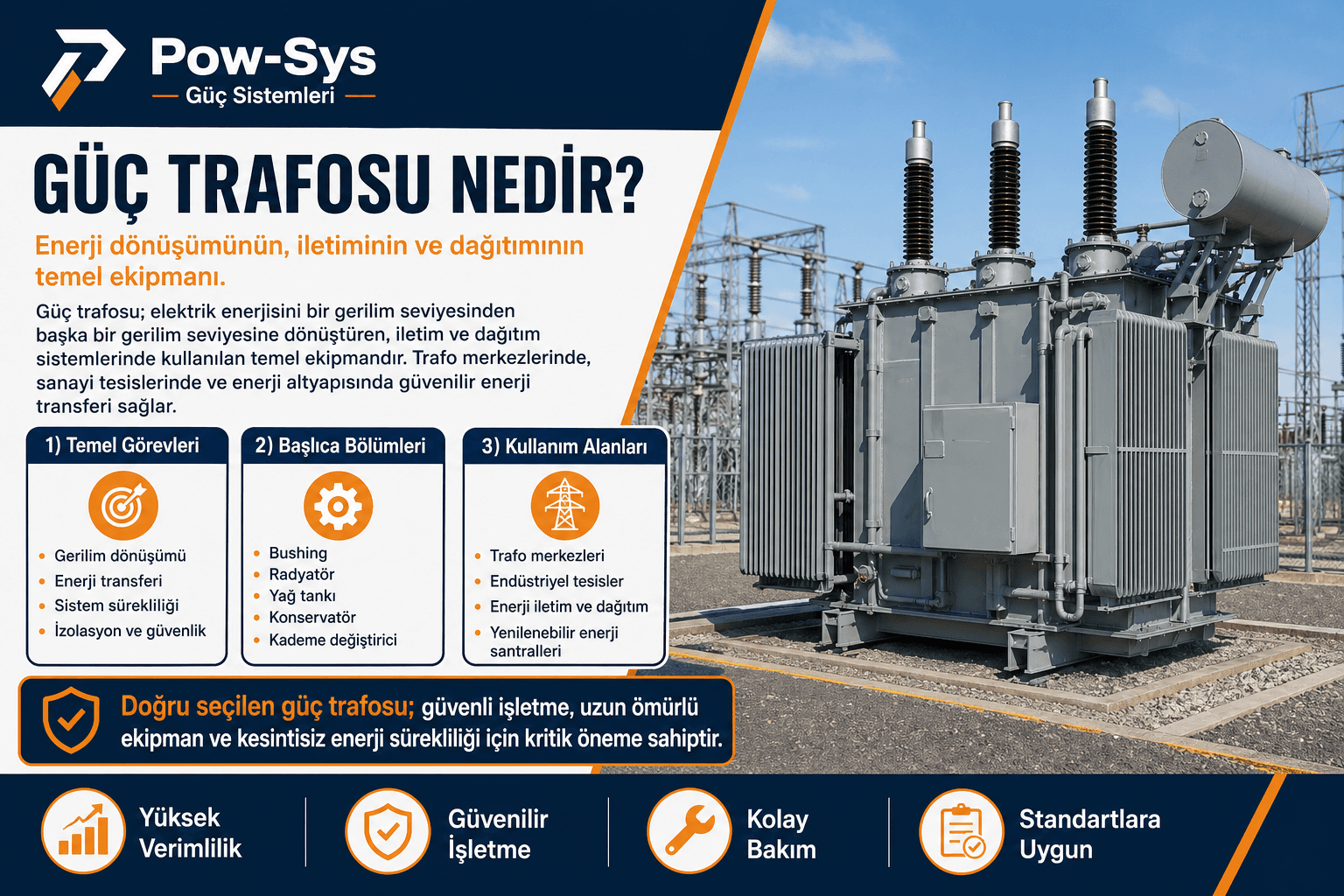
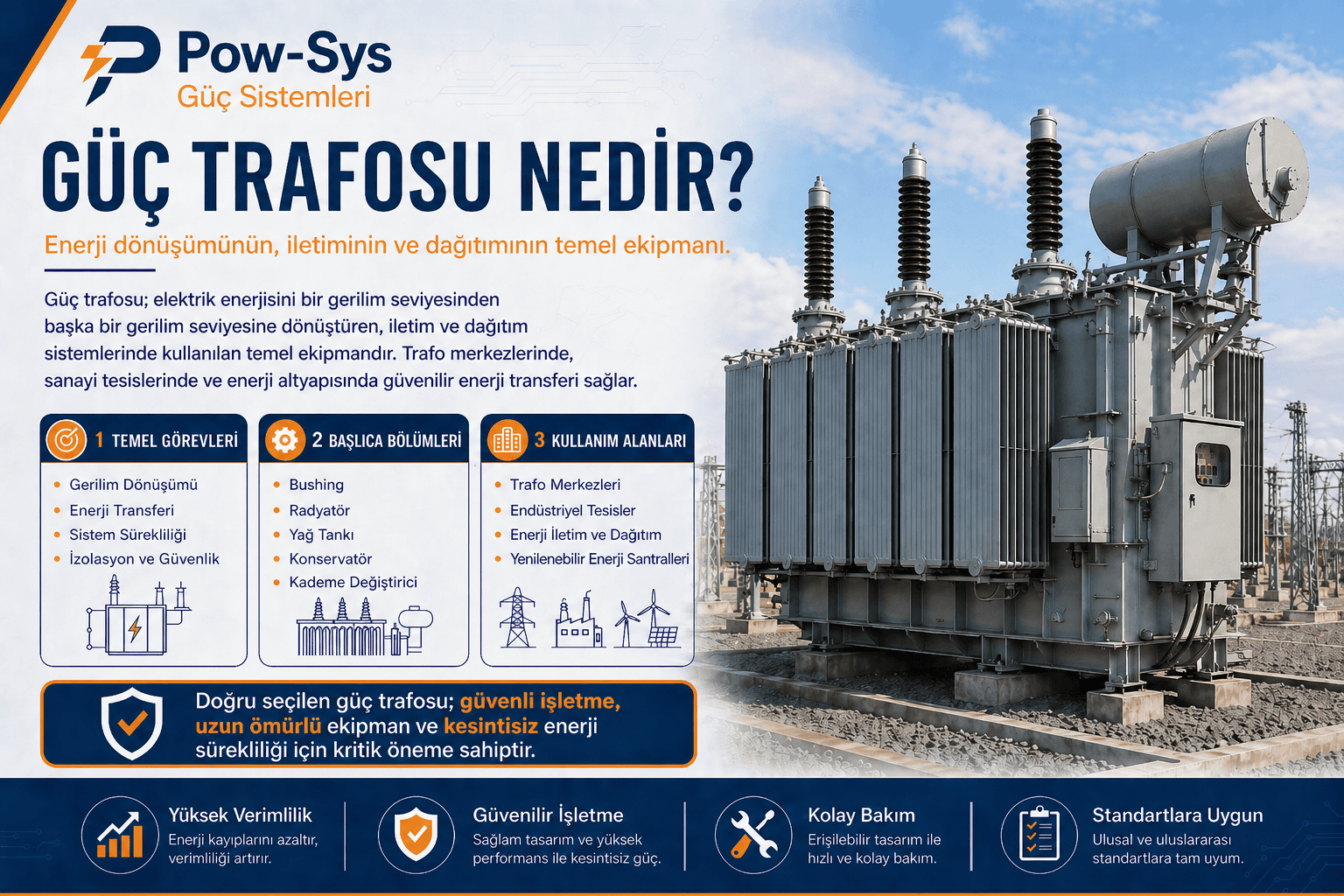
Power transformer is the basic electrical equipment used to change the voltage level of electrical energy. Briefly, the answer to the question of what is a power transformer is; It is a transformer that converts electrical energy from one voltage level to another voltage level while remaining at the same frequency. During this transformation, energy is transferred from the primary winding to the secondary winding via the magnetic core. Power transformers are one of the most critical parts of the electrical infrastructure, from energy production facilities to industrial facilities, from substations to distribution systems.
Voltage transformation is at the center of the question of what a power transformer does. When electrical energy is transported over long distances with high voltage, losses are reduced. At the point of use, this voltage level is lowered to a level that facilities, machines and distribution systems can use. The power transformer provides this transformation. In an industrial facility, medium voltage energy can be reduced to low voltage, in a power plant, the generator output voltage can be increased to transmission level by using a power transformer.
The basic answer to the question of how a power transformer works is electromagnetic induction. When alternating voltage is applied to the primary winding, variable magnetic flux occurs in the magnetic core. This magnetic flux induces voltage in the secondary winding. The ratio between the number of turns of the primary and secondary windings determines the voltage transformation ratio. When the number of windings and connection structure are selected correctly, the transformer converts the energy to the desired voltage level.
The main parts of the power transformer consist of windings, magnetic core, insulation system, tank, transformer oil or insulation medium, bushings, cooling elements and protection equipment. The magnetic core is the center of energy transfer. Windings provide voltage conversion. The insulation system ensures safe separation of conductive parts from each other and from the body. Each of these parts is of particular importance for the reliable operation of the transformer.
Oil-filled power transformers are among the most commonly used transformer types. In these transformers, transformer oil serves as both insulation and cooling. The heat generated in the winding and core during operation is carried to the radiators through the oil and released to the external environment. The dielectric strength of the oil, humidity level, gas formation and aging level provide important information about the health of the transformer. Therefore, oil tests and temperature monitoring are very important in oil-filled transformers.
Dry type transformers are transformers that operate with a solid insulation system instead of oil. It is generally preferred in indoor applications, in facilities where fire safety expectations are high and in areas where the use of oil is not desired. Cooling of dry type transformers is provided by air. The maintenance approach is different compared to oil-filled transformers, but temperature, insulation, ventilation and cleaning should be monitored regularly in these transformers.
Power transformers can be classified as step-up or step-down depending on their intended use. Step-up transformers are used to step up the voltage to transmission level at the point of generation. Step-down transformers reduce high or medium voltage to lower levels, making them suitable for use in facilities. The most common structure in industrial facilities is step-down power transformers, which provide energy from medium voltage to low voltage.
Transformer power selection must be made correctly. The kVA or MVA rating of the transformer must comply with the load requirement of the facility. Transformer chosen smaller than necessary may cause overload, heating and shortening of life. If a transformer is chosen larger than necessary, it may increase the investment cost and operate inefficiently at low load. Therefore, when choosing a power transformer, installed power, simultaneity, motor starts, harmonic effects, spare capacity and future growth possibility should be evaluated together.
Impedance value is also very important in the power transformer. Transformer impedance directly affects short circuit current and voltage drop. The short circuit behavior of two transformers of the same power may differ depending on the impedance value. For this reason, the power transformer is not selected only by its kVA value. Voltage level, impedance, connection group, short circuit resistance, cooling type and operating conditions should be considered together.
Tap changer is an important structure used for voltage adjustment in power transformers. Some transformers have OLTC, which allows tap changing under load. Some of them have an off-circuit tap changer that is used in a de-energized state. Thanks to the tap changer, the output voltage can be adjusted within certain limits in response to mains voltage or load changes. The stage system is of great importance, especially in facilities where voltage regulation is important.
The cooling system in power transformers is a critical issue for reliable operation. Natural oil circulation can be used in oil-filled transformers, radiators, fans and pumped systems can be used in some large transformers. In dry type transformers, air circulation and ambient ventilation come to the fore. If the cooling is insufficient, the winding temperature increases, insulation aging accelerates and transformer life is shortened. Therefore, the cooling capacity should be monitored as well as the transformer loading.
Protection equipment in power transformers is used to reduce the risk of failure. Oil-filled transformers may have Buchholz relay, pressure relief device, oil level indicator, oil and winding temperature indicators, fan control system and alarm contacts. On the electrical side, functions such as overcurrent, earth fault, differential protection, temperature protection and gas protection can be used. These protection structures help early detection of internal and external faults that may occur in the transformer.
The concepts of power transformer and distribution transformer are sometimes used together. Distribution transformer is the transformer that generally serves as voltage reduction at points close to the end user. Power transformer, in a broader sense, refers to transformers that provide energy conversion at high power levels. In practice, medium voltage-low voltage transformers used in industrial facilities are often referred to as power transformers. What is important here is the function of the transformer, its power and the system in which it is used.
Regular maintenance and testing must be carried out for correct operation of power transformers. Oil analysis, insulation resistance measurement, winding resistance test, turns ratio test, tan delta and capacitance measurement, thermal camera inspection, protection equipment check and general visual inspection are part of this maintenance approach. Even if the transformer looks solid from the outside, internal insulation, connection points or oil quality may deteriorate over time. That's why trend following is of great importance.
Power transformer selection and project design directly affects the energy continuity of the facility. Incorrect power selection, improper connection group, insufficient short circuit resistance, poor cooling or missing protection equipment may cause serious operating problems in the future. Therefore, the power transformer should be considered not just as equipment to be purchased, but as the main component of the facility's energy strategy.
In summary, power transformer; It is the basic equipment that increases or decreases the voltage level of electrical energy and plays a critical role in all electrical systems from energy production to distribution. Magnetic core, primary and secondary windings, insulation system, cooling system and protection equipment work together to ensure safe energy conversion. A correctly selected, correctly designed and regularly tested power transformer is indispensable for the facility to use safe, efficient and uninterrupted energy.
Frequently Asked Questions
What is a power transformer?
Power transformer is the basic electrical equipment that increases or decreases the voltage level of electrical energy and transfers the energy by electromagnetic induction.
What does a power transformer do?
It ensures that electrical energy is converted to the appropriate voltage level during the production, transmission and distribution stages.
How does a power transformer work?
AC voltage applied to the primary winding creates variable flux in the magnetic core. This flux induces voltage in the secondary winding and energy conversion occurs.
What are the main parts of power transformer?
Primary winding, secondary winding, magnetic core, insulation system, tank, transformer oil or insulation medium, bushings, cooling elements and protection equipment are the main parts.
What is an oil-filled power transformer?
Oil-filled power transformer is a type of transformer that uses transformer oil for both insulation and cooling purposes.
What is a dry type power transformer?
Dry type power transformer is a type of transformer that works with solid insulation and air cooling without using oil.
What to consider when choosing a power transformer?
Transformer power, voltage level, impedance, connection group, cooling type, short circuit resistance, operating conditions and future load increase should be evaluated together.
Why is transformer impedance important?
Transformer impedance affects short-circuit current, voltage drop and system behavior. For this reason, power value alone is not sufficient in transformer selection.
What does a tap changer do in a power transformer?
Tap changer is used to adjust the transformer output voltage within certain limits. There are types that operate under load or without energy.
Does the power transformer require maintenance?
Yes. Oil analysis, insulation measurement, winding resistance, turning ratio, protection equipment control, thermal inspection and visual maintenance should be performed regularly.