

Summary Highlights
- The importance of power transformer maintenance: ensuring safe, efficient and long-lasting operation of the transformer
- Basic maintenance steps: visual inspection, cleaning, checking for oil leaks, bushing inspection, checking of cooling system and ground connections
- Main tests to be performed: insulation resistance, polarization index, winding resistance, turning ratio, tan delta, capacitance and transformer oil tests
- Further evaluation topics: DGA dissolved gas analysis, OLTC control, thermal camera inspection, evaluation of protection equipment and event records
- Logging and trend tracking: regular comparison of oil analyses, temperature values, test results, alarm history and maintenance reports
Content
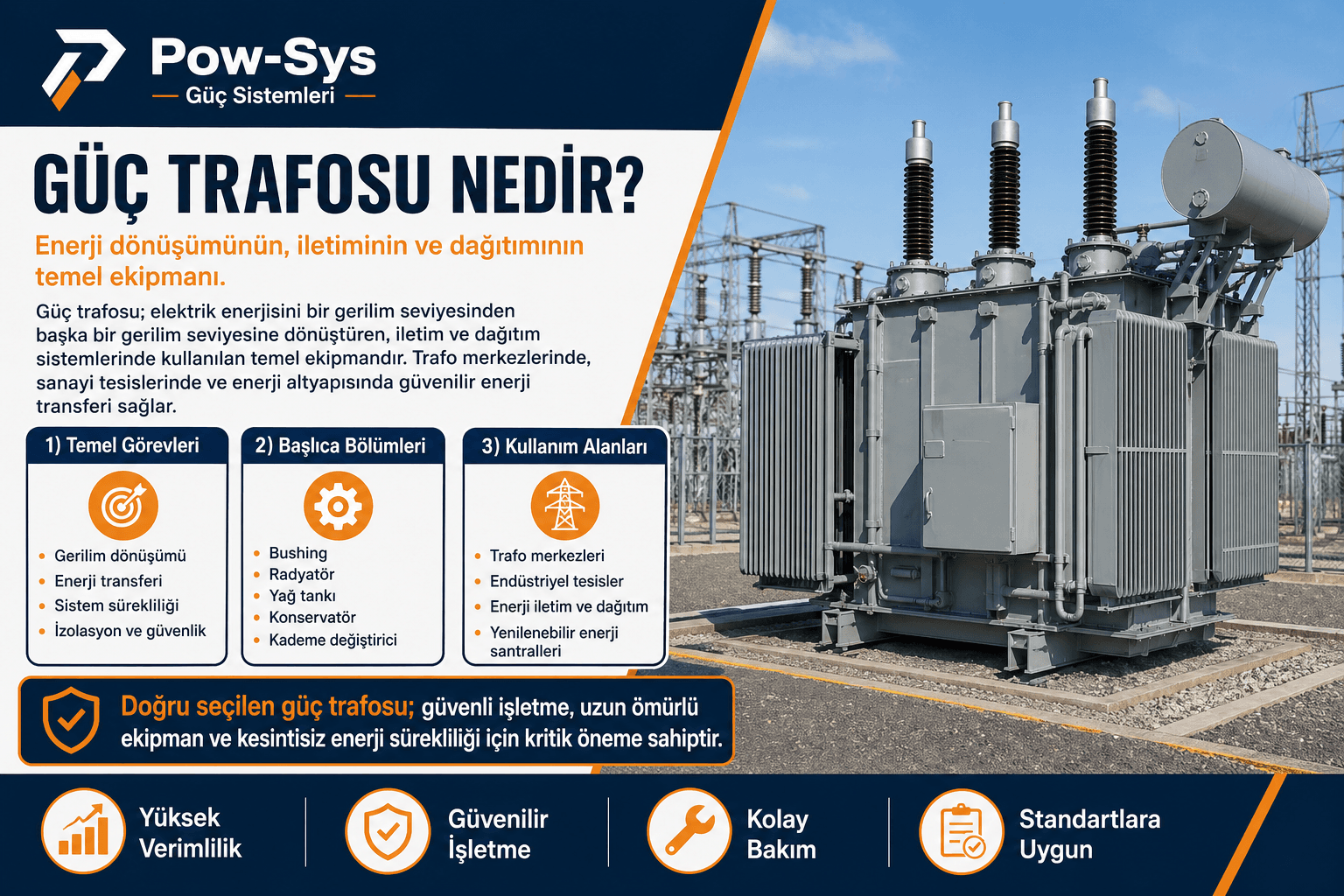
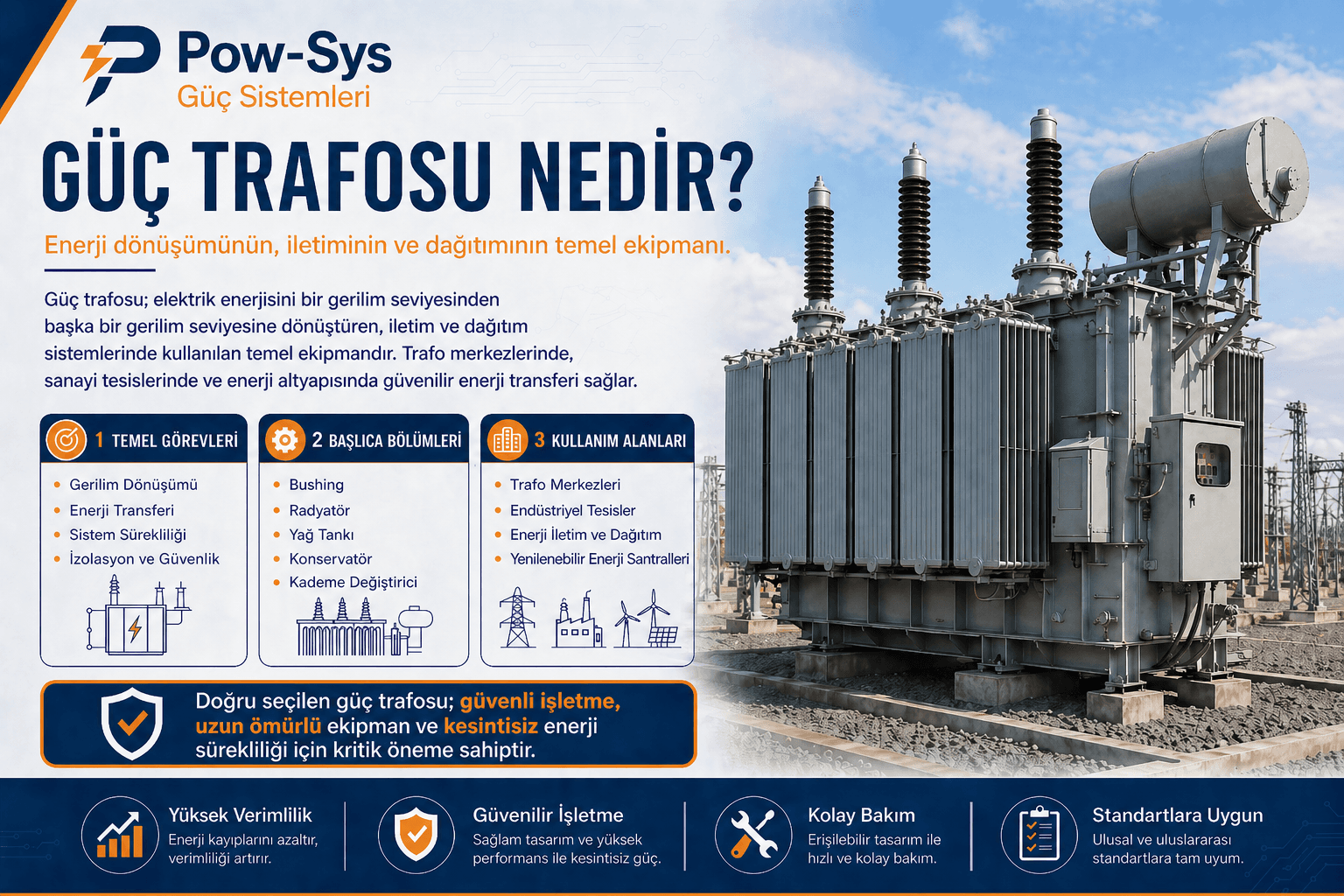
Power transformers are systems that transform the voltage level of electrical energy and are among the most critical equipment of the facility in terms of energy continuity. For this reason, the tests and maintenance that need to be done on power transformers are not just about checking for external leaks. The main purpose is to ensure safe operation by evaluating the transformer's windings, magnetic core, insulation system, oil, bushings, cooling system, protection equipment and connection points together. The correct approach to power transformer maintenance is not to intervene after the fault occurs, but to notice the fault tendency early.
The first step in maintenance is always safety. Before working on the power transformer, the transformer must be de-energized, the relevant MV and LV sides must be safely separated, the absence of voltage must be verified and the necessary grounding procedures must be carried out. Since the transformer is an equipment that carries serious energy on both the medium voltage and low voltage sides, incorrect maneuvering, incomplete grounding or faulty connection during maintenance may pose serious personnel and equipment risks. Therefore, the testing and maintenance process must be carried out with the correct occupational safety procedure.
Visual inspection is the basis of power transformer maintenance. Transformer tank, radiators, bushings, oil level indicator, thermometers, fans, cable connections, seal areas, grounding connections and protection equipment should be visually inspected. Findings such as oil leakage, rust, corrosion, paint blistering, bushing cracks, insulator contamination, loose connections, darkening, abnormal noise or odor should be taken seriously. A seemingly small leak or loose connection in the transformer may turn into a major malfunction over time.
In oil-filled power transformers, transformer oil serves as both insulation and cooling. Therefore, the oil level, oil color, oil leakage and general condition of the oil should be checked regularly. Low oil level may cause the winding and core heat not to be transferred sufficiently and the insulation security to be weakened. Oil leakage is not just a problem of oil loss; It can also lead to moisture and air ingress. Therefore, oil condition in oil-filled transformers is one of the most critical issues in maintenance.
Transformer oil tests provide invaluable information about the internal health of the power transformer. Parameters such as dielectric strength test, moisture content, acidity, interfacial tension and overall oil quality help evaluate the insulating properties of the oil. Deterioration in oil values may indicate aging or contamination in the internal insulation system of the transformer. For this reason, oil analysis is not a one-time maintenance data that should be monitored at regular intervals.
DGA, or dissolved gas analysis, is one of the most important advanced diagnostic methods in oil-filled power transformers. Thermal stresses within the transformer, arcing events, partial discharge or insulation deterioration may cause the formation of different gases in the oil. The type and quantity of these gases helps to understand what kind of fault tendency the transformer has. The DGA result should not be evaluated alone to make a hasty decision, but should be evaluated together with past values and other tests.
Bushing checks are of special importance in power transformer maintenance. Bushings enable the energized ends of the transformer to be safely removed from the tank. If there are cracks, contamination, oil leaks, surface marks, signs of partial discharge, loose connections or abnormal heating in these areas, a serious risk may occur. Bushing failures can often lead to sudden and severe consequences. Therefore, bushing health should be monitored both by visual inspection and, when appropriate, by capacitance and tan delta measurements.
Insulation resistance measurement is a basic check in power transformer tests. The general condition of the insulation is evaluated by measuring the insulation resistance at winding-ground, between windings and at appropriate connection points. This test provides preliminary information about moisture, contamination or insulation weakness. In large power transformers the polarization index can also be monitored. However, since the insulation resistance result is affected by temperature, humidity and previous test conditions, it should not be interpreted alone, but together with trend monitoring.
Winding resistance testing is done to evaluate the condition of transformer windings and connection points. A significant resistance difference between phases can warn about a loose connection, winding problem, tap changer contact or connection error. Especially in transformers with OLTC or tap changers, winding resistance measurement at different tap positions provides valuable information. This test helps to understand whether the main current-carrying paths of the transformer are healthy.
The turns ratio test checks whether the primary and secondary voltage ratio of the transformer is correct. This process, also known as TTR testing, is used to evaluate the accuracy of winding ratio, connection group and tap locations. Incorrect turns ratio could mean winding problem, connection error or tap changer mismatch. Conversion ratio testing is an important verification step during commissioning, maintenance and post-fault control processes.
Tan delta and capacitance measurement are used to further evaluate the insulation system of the power transformer. This test reveals dielectric losses and capacitive behavior within the insulation. Windings, bushings and some insulation sections can be examined with this method. Increase in tan delta value; It may warn of moisture, aging, contamination or insulation deterioration. This test is an important diagnostic method that strengthens maintenance decisions, especially in critical transformers.
OLTC maintenance is a separate topic for power transformers with on-load tap changers. OLTC works to regulate the output voltage of the transformer under load and contains a mechanical-electrical contact structure. OLTC may wear out over time due to arcing and mechanical movement occurring during step transitions. For this reason, the contact condition, transition resistors, mechanical operation, engine mechanism, oil condition and control circuit should be checked regularly. OLTC faults can directly affect the operation of the transformer.
The cooling system must be checked during maintenance. Radiators, fans, oil pumps, fan contactors, temperature relays, thermostats and wiring should be examined. It should be evaluated whether the fans are activated, the cleanliness of the radiator surfaces, the adequacy of oil circulation and the correct operation of temperature indicators. Lack of cooling increases the winding temperature and accelerates insulation aging. Therefore, the cooling system is one of the most important auxiliary systems that determine the life of the transformer.
Protection equipment must be tested separately for power transformer maintenance. Buchholz relay, pressure relief device, oil level indicator, oil temperature indicator, winding temperature indicator, fan control system, alarm contacts and trip outputs should be checked. On the electrical protection side, differential protection, overcurrent, earth fault and temperature protections must work correctly. If the protection equipment is not working, the transformer may not be able to isolate the fault from the system before it escalates.
Thermal camera inspection is a very useful method in power transformer maintenance. In thermal control under load, bushing connections, cable lugs, busbar connections, radiators, fan areas and panel connections can be examined. Significant temperature difference between phases or abnormal heating at the connection point may mean loose connection or increased contact resistance. Thermal camera helps detect unnoticeable heating problems early.
Ground connections should be checked regularly. Transformer tank, neutral point, cable shields, surge arrester connections and protection grounding must have a safe and low resistance connection. A loose or broken ground connection can compromise personnel and equipment safety in the event of a fault. In particular, the continuity of equipotential connections within the substation should be reviewed.
The maintenance approach in dry type power transformers is different from that of oil-filled transformers. Oil analysis is not performed in these transformers; Instead, winding surface cleanliness, ventilation, temperature sensors, fan system, insulation resistance, connection tightness and dust-moisture effect come to the fore. Accumulation of dirt and dust in dry type transformers can cause superficial leaks and overheating. For this reason, cleanliness and air circulation of the environment where dry type transformers are located are of great importance.
Connection tightness and mechanical controls in power transformers should not be neglected. Primary and secondary connections, bushing terminals, busbar connections, cable lugs, fan circuits, control cables and protection contact connections should be checked. Loose connections can cause heating, arcing and equipment damage over time. Proper torque control and joint integrity should be evaluated during maintenance.
At the end of maintenance, all test results should be recorded. Insulation resistance, polarization index, winding resistance, turning ratio, tan delta, capacitance, oil tests, DGA results, thermal camera findings, temperature records, alarm history and interventions should be archived regularly. The most valuable approach to power transformer maintenance is trend following. Because rather than a single measurement, the change in values over time shows the real health of the transformer.
In summary, the tests and maintenance that must be done on power transformers are; It consists of safe work preparation, visual control, oil level and leakage control, transformer oil tests, DGA analysis, insulation resistance measurement, winding resistance test, turning ratio test, tan delta and capacitance measurement, OLTC maintenance, bushing control, cooling system control, protection equipment tests, thermal camera inspection and verification of ground connections. When this maintenance approach is applied regularly, transformer faults are detected earlier, equipment life is extended and the energy continuity of the facility becomes safer.
Frequently Asked Questions
Why is maintenance necessary for power transformers?
Because power transformers are critical equipment for the energy continuity of the facility. If regular maintenance is not performed, insulation deterioration, oil quality decrease, connection overheating, OLTC failure or protection system problem may cause major damage.
What tests are performed on power transformers?
Insulation resistance, polarization index, winding resistance, turning ratio, tan delta, capacitance, transformer oil tests, DGA analysis, thermal camera control and protection equipment tests can be performed.
Why is transformer oil testing done?
It is done to see whether the transformer oil performs its insulation and cooling function properly. Humidity, acidity, dielectric strength and general oil quality are evaluated in this context.
What does DGA analysis do?
DGA analysis helps to detect early fault tendencies in the transformer such as thermal stress, arcing, partial discharge or insulation deterioration by examining gases dissolved in oil.
What does the insulation resistance test show?
It shows the general condition of winding-ground and inter-winding insulation. It gives preliminary information about moisture, contamination or insulation weakness.
Why is winding resistance testing important?
It helps evaluate problems such as winding connections, phase balance, tap changer contact and connection looseness.
What does the conversion rate test check?
It checks whether the primary and secondary voltage ratio, connection group and tap positions are correct.
Why are tan delta and capacitance tests performed?
It is performed to evaluate dielectric losses, moisture effect and aging tendency in transformer and bushing insulation.
Why is OLTC maintenance important?
Since OLTC changes taps under load, contact wear, mechanical problems, oil contamination or control failure may occur. Therefore it should be checked regularly.
Why is it important to keep records in power transformer maintenance?
Because transformer health is best understood by trend following. When oil analyses, DGA results, insulation values and thermal findings are compared regularly, failure tendency is noticed early.