
Summary Highlights
- What a distance protection relay is: the basic definition of a line protection relay that operates by evaluating the apparent impedance to the fault point
- What a distance protection relay does: supports system continuity by isolating the faulty line section quickly and selectively
- How a distance protection relay works: calculates apparent impedance through the V/I ratio by using voltage and current information
- Main structures and zones: Zone 1, Zone 2, Zone 3, direction determination, mho and quadrilateral characteristics
- Application areas and selection: transmission and distribution lines, cable applications, parallel supplies and backup protection scenarios
Article Details
A distance protection relay is a protection relay that evaluates a fault on an electrical line not directly according to current magnitude, but according to the apparent impedance seen from the relay location to the fault. In short, the answer to the question of what a distance protection relay is: it is a line protection device that uses voltage and current information to determine whether the fault remains inside the set protection zone. Therefore, a distance relay works with a different logic from a conventional overcurrent relay and provides a major advantage especially in line protection.
Fast and selective tripping is at the center of the question of what a distance protection relay does. When a fault occurs on a transmission or distribution line, the aim is to disconnect only the faulty section and keep the healthy sections energized. Distance protection does this by evaluating how far the fault point is electrically from the relay. In this way, instead of looking only at current magnitude, it also considers the impedance structure of the line and provides more controlled protection.
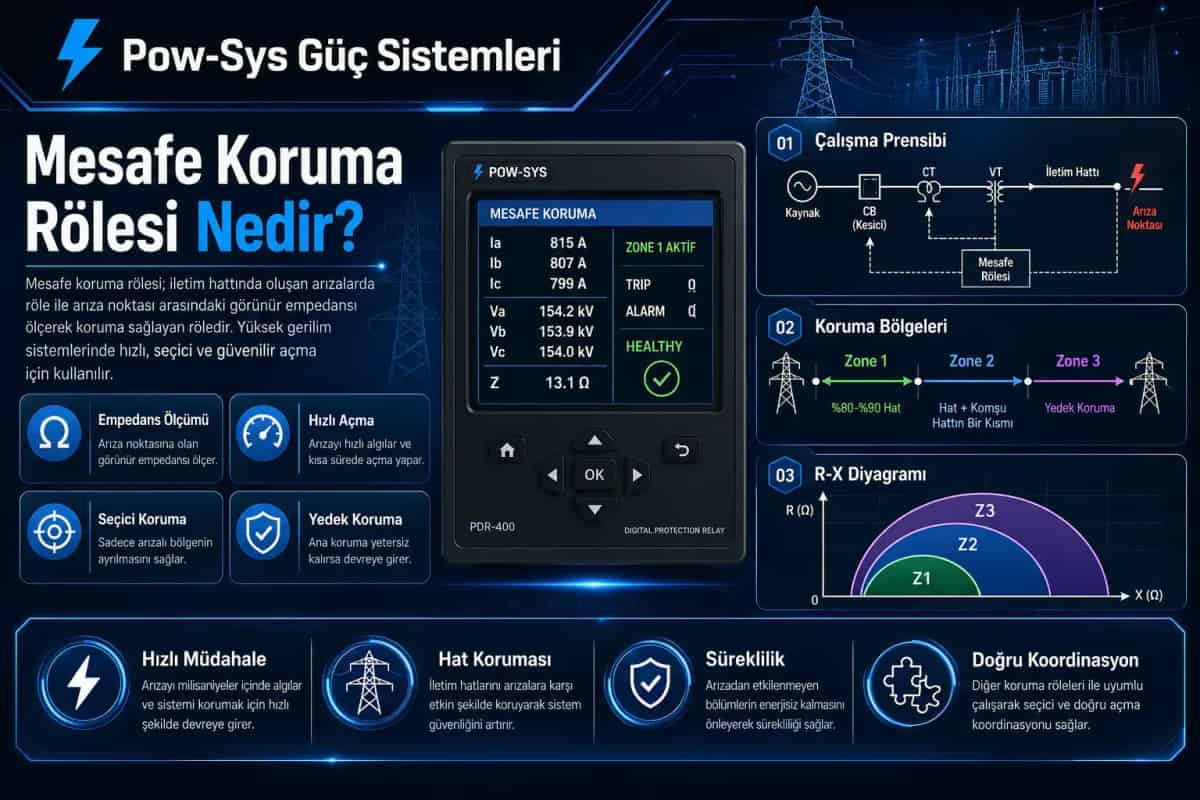
The basic answer to how a distance protection relay works is the V/I ratio. The relay measures the voltage and current at its location and calculates apparent impedance from them. If the calculated apparent impedance is inside the set reach limit, the relay interprets this as a fault inside the protection zone. If the impedance is outside the set zone, the relay does not operate or switches to delayed backup protection logic. Therefore, distance protection is a structure that evaluates the electrical distance of the fault through impedance.
The important point here is that the impedance seen by the relay is not always exactly equal to the real line length. Because the apparent impedance seen by the relay may change especially in multi-terminal lines, parallel supplies or systems with remote-end current contribution. Therefore, a distance relay is not a device that measures physical distance in meters; it is a protection element that evaluates electrical apparent distance. The word distance in its name essentially describes this impedance-based electrical distance.
The most common structure in distance protection is Zone 1, Zone 2 and Zone 3 zoning. Zone 1 generally covers a large part of the protected line and in most applications operates without delay or very quickly. Its purpose is to clear close-in faults within the line as fast as possible. Zone 2 is set to cover the entire line and, to a certain extent, part of the next line; however, it operates with a time delay for selectivity. Zone 3 undertakes the duty of more remote backup protection and usually operates with a longer delay.
The answer to why Zone 1 is usually set not to 100 percent of the line but to approximately 80-90 percent is the safety margin. Due to current transformer and voltage transformer errors, line impedance uncertainties, system operating changes and measurement tolerances, the relay should not overreach the remote busbar. For this reason, Zone 1 is generally selected to cover slightly less than the entire protected line. Zone 2 undertakes delayed backup protection for the remaining section.
Direction information is also very important in a distance protection relay. Because it is not enough for the relay only to know that it sees a fault; it must also distinguish whether this fault is in the forward direction or reverse direction. Especially in parallel-fed, ring-type or multi-terminal systems, if direction determination is not made correctly, the relay may trip incorrectly for an external-zone fault. Therefore, the distance relay operates with directional control in most applications.
Among distance protection characteristics, the two most well-known structures are mho and quadrilateral characteristics. The mho characteristic is recognized by its circular structure in the impedance plane and provides strong behavior especially on the directional side. The quadrilateral characteristic may provide advantages under some resistive fault conditions because it allows resistive and reactive reach to be set more independently. Which characteristic is more suitable is determined according to line type, expected fault resistance and protection philosophy.
The difference between a distance protection relay and an overcurrent relay is often confused. An overcurrent relay basically looks at current magnitude. A distance protection relay evaluates voltage information together with current and makes a decision through apparent impedance. Therefore, while overcurrent protection may be sufficient in some cases in short and strong networks, a distance relay can provide much more selective and faster solutions especially in line protection. This advantage becomes particularly clear in transmission and sub-transmission lines.
Although distance protection relays are mostly considered for transmission lines, they can also be used for cables and some medium-voltage lines in suitable applications. Modern products can provide distance functions for overhead line and power cable protection. However, in cable applications, the setting approach must be made carefully because factors such as line impedance, capacitive effects and system topology are different. In other words, the same function can be used on both overhead lines and cables, but the setting logic is not always the same.
Fault resistance is an important subject in distance protection applications. Especially in earth faults or high-resistance faults, the impedance seen by the relay may shift beyond the line impedance. This may cause some faults to appear as if they have moved outside the zone limits. This is why characteristic selection, reach setting and, when necessary, the use of more resistance-tolerant structures such as quadrilateral characteristics become important.
Infeed and outfeed effects are also sensitive points of distance protection. If additional current contribution comes into the system from the remote end, the relay may see the fault as farther away than it actually is. Conversely, in some special flow conditions, it may perceive the fault as closer. Therefore, distance protection settings must be made more carefully in three-terminal or parallel-fed systems compared with simple two-terminal lines. This feature also shows that distance relay protection is a powerful type of protection, but one that can become complex if applied incorrectly.
Modern distance protection relays do not operate only with basic zone logic. Many relays also include additional functions such as power swing blocking, load encroachment limitation, single-pole tripping, communication-assisted pilot protection, fault locator and oscillography records. In this way, the device is no longer only a relay that gives a tripping decision; it becomes a protection and control platform that also helps analyze system events.
In summary, a distance protection relay is a special line protection relay that evaluates faults through apparent impedance by using the line's voltage and current information and provides fast and selective protection with Zone 1-Zone 2-Zone 3 logic. It can operate with characteristics such as mho and quadrilateral, determine direction and deliver strong results especially in line and cable protection. When selected and set correctly, it significantly strengthens system continuity by isolating only the faulty section. In the next stage, distance protection relay setting calculations, testing and maintenance processes, or the difference between distance protection and overcurrent protection can be detailed under separate headings.
Related Blog Posts
- What Is a Protection Relay? How It Works and Types
- What Is an Overcurrent and Earth Fault Protection Relay? What Does It Do, How Does It Work and For What Purpose Is It Used?
- What Are Breaker Failure Protection and Busbar Protection Relays? What Do They Do, How Do They Work and Why Are They Used?
- What Is a Unit Protection Relay? How It Works
Related Services
Frequently Asked Questions
What is a distance protection relay?
A distance protection relay is a protection relay that evaluates a fault on an electrical line not directly according to current magnitude, but according to the apparent impedance seen from the relay location to the fault point. It is a line protection device that uses voltage and current information to determine whether the fault remains inside the set protection zone, and it is widely known as a distance relay. It works with a different logic from a conventional overcurrent relay and provides a major advantage especially in line protection. The most common structure is Zone 1, Zone 2 and Zone 3 zoning, which allows the faulty section to be isolated quickly and selectively while healthy sections remain energized. It can operate with characteristics such as mho and quadrilateral, determine direction and, when selected and set correctly, significantly strengthen system continuity.
What does a distance protection relay do?
A distance protection relay helps disconnect the faulty line section quickly and selectively while keeping healthy sections energized. When a fault occurs on a transmission or distribution line, the aim is to disconnect only the faulty section and keep the rest of the system operating. Distance protection does this by evaluating how far the fault point is electrically from the relay, so instead of looking only at current magnitude, it also considers the impedance structure of the line and provides more controlled protection. Thanks to zone logic, close-in faults are cleared very quickly while more remote zones provide delayed backup protection. Overcurrent protection may be sufficient in some cases in short and strong networks, but especially in transmission and sub-transmission lines a distance relay offers much more selective and faster solutions, which directly supports system continuity.
How does a distance protection relay work?
The basis of how a distance protection relay works is the V/I ratio. The relay measures the voltage and current at its location and calculates the apparent impedance from them. If the calculated apparent impedance is inside the set reach limit, the relay interprets this as a fault inside the protection zone and makes a tripping decision. If the impedance is outside the set zone, the relay does not operate or switches to delayed backup protection logic. Distance protection is therefore a structure that evaluates the electrical distance of the fault through impedance. An important point is that the impedance seen by the relay is not always exactly equal to the real line length: in multi-terminal lines, parallel supplies or systems with remote-end current contribution the apparent impedance may change, and fault resistance may shift it beyond the line impedance, so reach settings must be made carefully.
What do Zone 1, Zone 2 and Zone 3 mean in a distance relay?
Zone 1, Zone 2 and Zone 3 are the stepped protection zones used in distance protection. Zone 1 generally covers a large part of the protected line and in most applications operates without delay or very quickly; its purpose is to clear close-in faults within the line as fast as possible. Zone 2 is set to cover the entire line and, to a certain extent, part of the next line, but it operates with a time delay for selectivity. Zone 3 undertakes the duty of more remote backup protection and usually operates with a longer delay. Thanks to this stepped structure, a fault is first cleared by the fastest and closest zone, and if the primary protection does not operate, the delayed zones act as backup. In this way, speed and selectivity are provided together and only the faulty section is disconnected.
Why is Zone 1 generally not set to 100 percent of the line?
Zone 1 is usually set to approximately 80-90 percent of the protected line because of the safety margin. Due to current transformer and voltage transformer errors, line impedance uncertainties, system operating changes and measurement tolerances, the relay should not overreach the remote busbar. If Zone 1 were set to 100 percent of the line, these tolerances and uncertainties could make the relay see a fault on the neighboring line as if it were inside its own zone and trip unnecessarily. For this reason, Zone 1 is generally selected to cover slightly less than the entire protected line, and Zone 2 undertakes delayed backup protection for the remaining section. This approach establishes the balance between fast protection and selectivity: close-in faults are cleared without delay, while faults near the end of the line are cleared with a short but secure delay.
What is the difference between a distance protection relay and an overcurrent relay?
An overcurrent relay basically looks at current magnitude, while a distance protection relay evaluates voltage information together with current and makes a decision through apparent impedance. This difference is often confused in the field. Overcurrent protection may be sufficient in some cases in short and strong networks, but especially in line protection a distance relay can provide much more selective and faster solutions, and this advantage becomes particularly clear in transmission and sub-transmission lines. Because the distance relay evaluates the electrical distance of the fault from the relay location, it can isolate only the faulty section and provide stepped backup protection with its zone logic. It can also determine direction and distinguish whether the fault is in the forward or reverse direction. Which protection approach is suitable is determined according to the network structure, the line type and the protection philosophy adopted in the facility.
What are mho and quadrilateral characteristics?
Mho and quadrilateral are the two most well-known operating characteristics of a distance relay in the impedance plane. The mho characteristic is recognized by its circular structure and provides strong behavior especially on the directional side. The quadrilateral characteristic allows resistive and reactive reach to be set more independently, so it may provide advantages under some resistive fault conditions. Especially in earth faults or high-resistance faults, the impedance seen by the relay may shift beyond the line impedance due to fault resistance, and in such situations more resistance-tolerant structures such as the quadrilateral characteristic become important. Which characteristic is more suitable is determined according to line type, expected fault resistance and protection philosophy, so characteristic selection is an engineering evaluation rather than a simple preference. When the correct characteristic and reach setting are considered together, distance protection provides both fast and reliable line protection.
Where is a distance protection relay used?
Distance protection relays are used especially on transmission and sub-transmission lines and, in suitable applications, they can also be preferred for cables and some medium-voltage lines. Modern products can provide distance functions for overhead line and power cable protection. However, in cable applications the setting approach must be made carefully, because factors such as line impedance, capacitive effects and system topology are different; the same function can be used on both overhead lines and cables, but the setting logic is not always the same. In parallel-fed, ring-type or multi-terminal systems, settings must be made more carefully because of infeed and outfeed effects. Modern distance relays also include additional functions such as power swing blocking, load encroachment limitation, single-pole tripping, communication-assisted pilot protection, fault locator and oscillography records, which turn the device into a protection and control platform.
Why is direction determination important in a distance protection relay?
Direction determination is important because it is not enough for the relay only to know that it sees a fault; it must also distinguish whether the fault is in the forward direction or the reverse direction. Especially in parallel-fed, ring-type or multi-terminal systems, if direction determination is not made correctly, the relay may trip incorrectly for an external-zone fault, which means a healthy line is disconnected unnecessarily. This is why the distance relay operates with directional control in most applications, and the mho characteristic provides strong behavior on the directional side. Infeed and outfeed effects should also be included in the evaluation: if additional current contribution comes into the system from the remote end, the relay may see the fault as farther away than it actually is, and in some special flow conditions it may perceive it as closer. Direction and reach settings must therefore be determined together with the system topology.
Does a distance protection relay measure physical distance?
No, a distance protection relay does not measure physical distance in meters. The relay evaluates the apparent impedance and determines whether the fault is electrically inside or outside the protection zone; the word distance in its name essentially describes this impedance-based electrical distance. The impedance seen by the relay is not always exactly equal to the real line length: in multi-terminal lines, parallel supplies or systems with remote-end current contribution, the apparent impedance may change. Especially in earth faults or high-resistance faults, the impedance may shift beyond the line impedance because of fault resistance, and some faults may appear as if they have moved outside the zone limits. This is why characteristic selection, reach setting and, when necessary, more resistance-tolerant structures such as the quadrilateral characteristic become important. The fault locator function found in modern relays also helps analyze the fault location.