
Summary Highlights
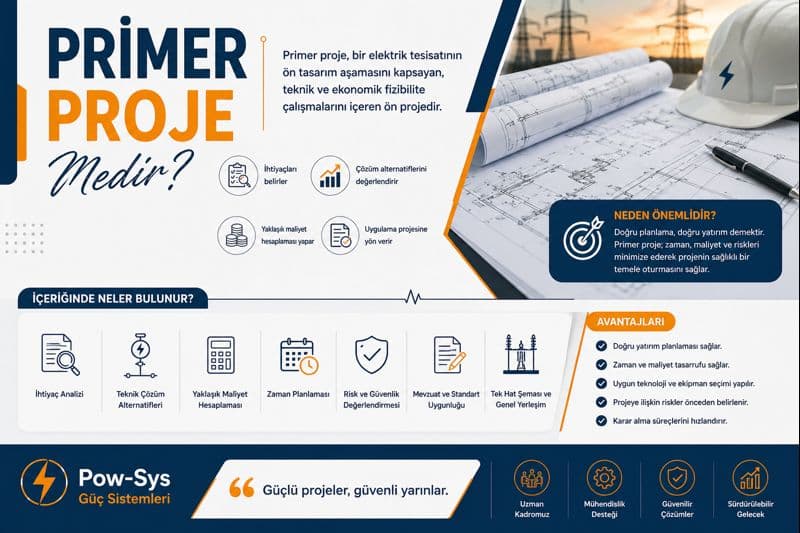
- What is a primary project: engineering project work showing the main power circuit, primary equipment and site layout in electrical facilities
- What does the primary project do? It ensures the safe installation of the substation, MV/HV switchgear and energy distribution infrastructure with the right equipment.
- How to prepare a primary project: It is created with a single line diagram, equipment selection, short circuit calculation, busbar-cable layout, grounding and layout plan.
- Main project topics: breaker, disconnector, current transformer, voltage transformer, surge arrester, power transformer, busbar system, cable connections and field safety
- Areas of use: transformer centers, high voltage switchyards, medium voltage distribution centers, industrial facilities and energy production facilities
Content
Primary project is an engineering project study showing the selection, connection layout and field layout of primary equipment that forms the main power circuit in an electrical facility. Briefly, the answer to the question of what is a primary project is; It is a project document that determines how the main energy-carrying electrical equipment will be connected, where it will be located and according to what technical values it will be selected. This study is of critical importance especially in substations, MV switchyards, HV switchyards and energy distribution facilities.
At the center of the question of what the primary project is for is safe and correct power transfer. In electrical installations, the main energy flow occurs through primary elements such as breaker, disconnector, busbar, current transformer, voltage transformer, surge arrester, power transformer, cable and grounding system. Incorrect selection or incorrect placement of these equipment directly affects the operational safety of the facility. The primary project is prepared to ensure that these equipment operate in harmony and safely with each other.
Primary project and secondary project are not the same thing. The primary project deals mostly with the main circuit carrying energy, power equipment, site layout and main connection layout. The secondary project includes protection, control, measurement, relay, signal, locking and auxiliary circuits. In other words, while the primary project shows the power backbone of the facility, the secondary project shows how to control and protect this backbone. In a good substation design, these two projects complement each other.
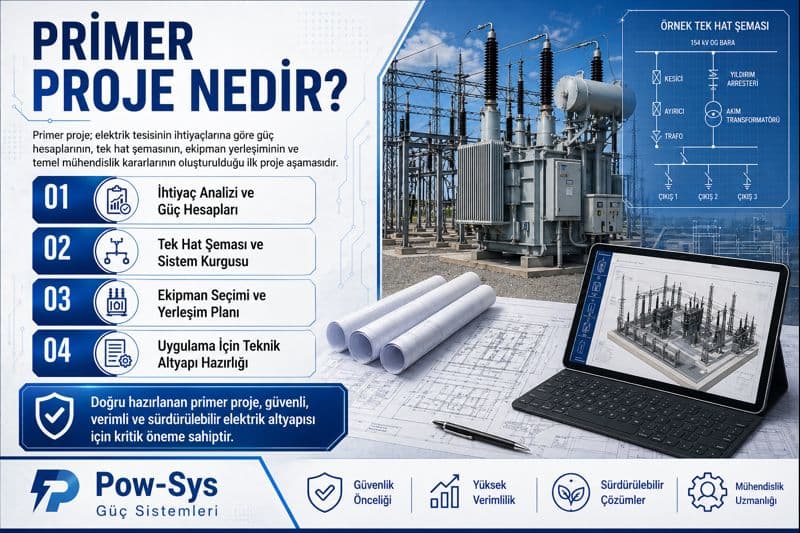
The first answer to the question of how to prepare a primary project is to determine the system need. The voltage level of the facility, installed power, connection type, network structure, short circuit level, operating scenario and expansion possibility are evaluated. Then, the primary equipment to be used is determined. Breakers, disconnectors, earth separators, measurement transformers, surge arresters, busbars, cables and power transformers are included in the scope of the project. These choices should be made based on the actual needs of the system, not just the catalog information.
Primary single line diagram is one of the main documents of this project. The single line diagram shows in a simple but technical way where the energy comes from, which equipment it passes through and to which points it is distributed. MV input cell, measurement cell, breaker cell, transformer output, busbar structure, coupling connection, backup feed and output feeders should be clearly located on a single line. This diagram is the basic reference for both project approval and field operation.
Primary equipment selection directly determines project quality. Rated voltage, rated current, short circuit breaking capacity and mechanical strength of a breaker must be compatible with the system. Disconnectors should be used for safe separation purposes, not for tripping under load. Current transformers should be selected according to measurement and protection needs, and voltage transformers should be determined with the correct class and connection structure. Surge arrester selection should be made according to system voltage and overvoltage risks.
Short circuit calculation is one of the basic technical inputs for the primary project. Because the breaker, busbar, cable, insulator, switchgear and other equipment to be used must withstand the fault current. Without short circuit analysis, it cannot be clearly known whether the equipment is truly sufficient or not. For this reason, short circuit level, thermal resistance and dynamic resistance values should be taken into consideration in the primary project.
Busbar system is one of the most important parts of the primary project. Busbar cross-section, rated current, short circuit resistance, insulator distances, connection points and mechanical carrier arrangement must be planned correctly. In MV and HV systems, the busbar is not just a conductive part; It is also the main energy pathway that must be designed to be safe against mechanical and thermal stress. Incorrect busbar design can cause serious damage in case of failure.
Cable connections and cable routes are also evaluated within the scope of the primary project. MV cable headers, transformer connection cables, cable ducts, cable trays, cable up-and-down points and screen grounding must be planned correctly. Cable cross-section should be selected not only according to current carrying capacity, but also according to voltage drop, short circuit resistance, laying conditions and ease of field application.
The grounding system is directly related to safety within the primary project. Metal structures, switchgear bodies, power transformer tank, cable screens, surge arrester grounding, neutral point and equipotential connections in the switchyard must be designed correctly. Transferring the fault current to ground through a safe path is essential for personnel safety and equipment protection. For this reason, the primary project should not be considered independently of the grounding project.
The site layout plan is not just a drawing layout for the primary project. Breakers, disconnectors, transformers, busbars, cable connections and other equipment must be safely accessible on site. Maneuvering areas, maintenance distances, approach limits, cable ducts, crane or service access and fire safety should be evaluated together. If electrically correctly selected equipment is positioned incorrectly in the field, it may cause serious difficulties during operation.
The primary project should be prepared in accordance with standards, legislation and distribution company requirements, especially in high voltage and medium voltage facilities. Voltage level, insulation distances, equipment classes, measurement layout, connection conditions and protection structure must meet the relevant technical expectations. In order to avoid problems during the approval process, the project must be both technically correct and feasible.
Business scenarios should also be taken into account when preparing the primary project. Normal supply situation, disconnection scenario during maintenance, possibility of backup supply, transformer failure, use of coupling and post-fault energy recovery scheme should be considered. Just drawing equipment side by side is not enough. The project should also show how the facility will be used in real operating life.
There is a strong relationship between the primary project and conservation coordination. If the current transformer ratio, protection class, voltage transformer connection, breaker selection and short circuit level are not determined correctly, the secondary protection system cannot be installed properly. Therefore, the primary project produces basic data for relay setting calculations and the secondary project. An error on the primary side cannot always be corrected by correct adjustment on the secondary side.
In summary, the primary project; It is the basic engineering study that determines the main power circuit, primary equipment selection, single line diagram, busbar-cable connections, grounding scheme and field layout in electrical installations. It is one of the starting points of safe operation in transformer centers, MV distribution centers, HV switchyards and industrial electrical infrastructures. A correctly prepared primary project ensures that the equipment works harmoniously, behaves safely in case of malfunction, and the long-term operability of the facility. An incomplete or incorrectly prepared primary project may cause costly problems that are difficult to fix later.
Frequently Asked Questions
What is the primary project?
Primary project is an engineering project study showing the main power circuit, primary equipment, connection layout and field layout in electrical facilities.
What does the primary project do?
It ensures that the main energy flow is established with safe and correct equipment in structures such as substations, MV or HV switchgear.
How to prepare a primary project?
System needs are determined, a single line diagram is created, equipment selection is made, short circuit and connection values are evaluated, field layout and grounding scheme are planned.
What is the difference between primary project and secondary project?
The primary project covers the main power circuit and primary equipment. The secondary project covers protection, control, measurement, signal and auxiliary circuits.
What equipment is included in the primary project?
It may include breaker, disconnector, current transformer, voltage transformer, surge arrester, power transformer, busbar system, cable connections and grounding elements.
Why is the primary single line diagram important?
It is the basic technical document that shows how energy flows within the system, through which equipment it passes and how the main connection scheme is established.
Why is short circuit calculation necessary in the primary project?
It is necessary to determine whether the equipment can withstand fault currents and to choose the right breaker, busbar, cable and cell.
In which facilities is the primary project prepared?
It is prepared in transformer centers, medium voltage distribution centers, high voltage switchyards, industrial facilities and energy production facilities.
Does the primary project include site layout?
Yes. The location of the equipment in the field, maintenance access, maneuvering distances, cable routes and safe working areas are evaluated within the scope of the primary project.
Why should the primary project be prepared correctly?
Because a fault in the main power circuit can cause equipment incompatibility, safety risk, operational difficulty and costly field overhauls.