

Summary Highlights
- What is AC insulation testing with tan delta and capacitance measurement: an AC-based dielectric diagnostic method that evaluates the insulation condition via capacitance and tan delta
- What it does: To help detect aging, moisture and insulation deterioration early in transformers, bushings, measurement transformers and similar high voltage equipment.
- How to do it: logic of applying AC test voltage to the test object and measuring capacitance and dissipation factor/power factor values
- Areas of use: power transformers, bushings, measurement transformers, rotating machines and suitable high voltage insulation systems
- Important distinction: unlike the classical AC withstand test, it diagnoses not only the strength but also the dielectric loss and capacitive behavior
Content
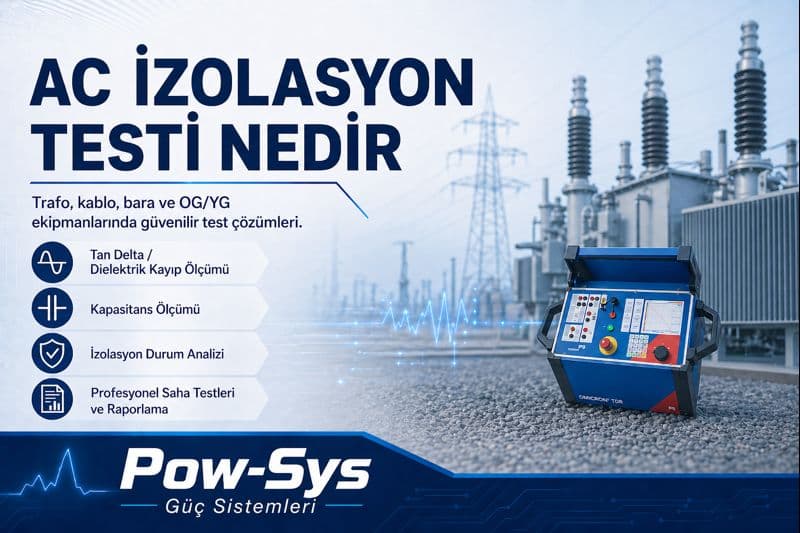
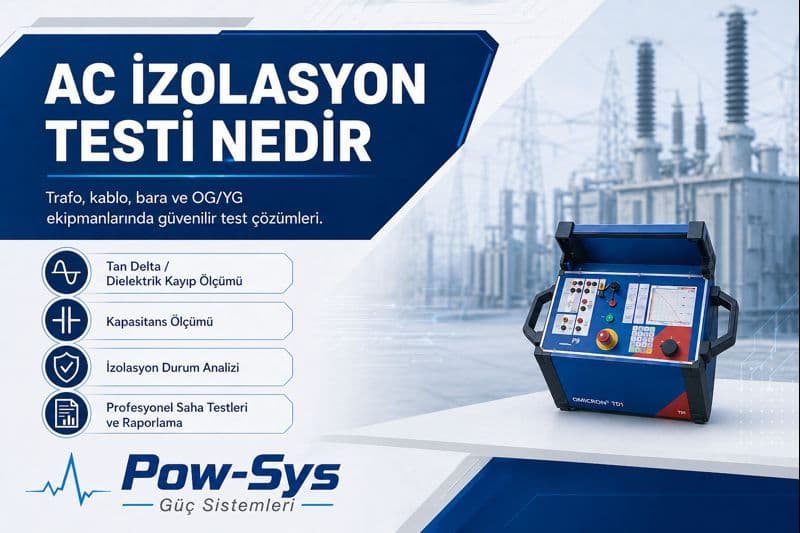
Although the expression AC insulation test performed with tan delta and capacitance measurement is frequently used in the field, technically the process performed here is often not an AC hypotension test in the classical sense. More accurately, this process is an AC-based diagnostic test that evaluates the insulation status of the equipment through capacitance and tan delta, that is, dissipation factor/power factor. Briefly, the answer to the question of what AC insulation testing is done with tan delta and capacitance measurement; It is an advanced testing approach that provides insight into the health of the insulation by measuring the dielectric behavior of high voltage equipment.
The purpose of this test is not just to see whether the equipment can withstand the stress. The main goal is to detect losses in the insulation structure, aging effects, moisture ingress, contamination, structural deterioration and, in some cases, initial failure tendencies earlier. For this reason, the test performed on tan delta and capacitance has an important place in maintenance and condition evaluation studies as well as acceptance testing. It becomes especially valuable when you want to see signs of early failure, not just late failure.
This test is performed with the appropriate AC test source and measurement module. Thanks to this structure, a controlled AC voltage is applied to the test object and the capacitance of the equipment and the loss factor are evaluated together. One of the main quantities measured here is tan delta. It is thought that as the tan delta increases, dielectric losses within the insulation increase and there may be a tendency for the insulation structure to deteriorate. For this reason, the test result is interpreted not only with a pass-fail logic, but with a diagnostic logic.
At the heart of the question of how this test works is the separation of capacitive current and loss current. In an ideal insulation structure, the current has a largely capacitive character. However, as actual equipment ages, absorbs moisture, or develops structural deterioration, the loss component increases. This measurement approach helps evaluate this missing component. After all, it is not only important to check whether there is voltage in the equipment; The electrical quality level of the insulation is examined in more depth.
Therefore, the test performed with tan delta and capacitance measurement is not the same as the classic AC hypot test. The main purpose of the classic AC hypotension test is to see whether the equipment can withstand a certain high voltage level. The main purpose of the tan delta and capacitance test is to evaluate the dielectric condition. In other words, one carries more withstand logic, while the other carries condition assessment logic. In the field, both can be called insulation testing, but the technical approach is not the same.
This test is especially meaningful in power transformers, bushings, measurement transformers and some high voltage insulation systems. Because insulation deterioration in these equipment can often manifest itself as an increase in dielectric losses before sudden puncture. When capacitance change and tan delta behavior are monitored together, it can be better understood whether there is an abnormal development in the insulation structure. Therefore, this test provides important data not only for field control but also for asset management.
Tan delta and capacitance measurements are particularly valuable in bushing tests. Because moisture, layer deterioration, internal structure problems or tap connection problems in bushings can change the dielectric behavior. In power transformers, the insulation condition between windings, between windings and earth, and on the bushing side can benefit significantly from this test approach. Similar logic applies to instrument transformers and some rotating machines. So this test is not just for one class of equipment.
One of the important aspects of this test is that it can also be used with a variable frequency approach. Seeing the change in dielectric behavior at different frequencies rather than just looking at one frequency can make some types of distortion more visible. Especially the effect of moisture, aging and some internal changes in the insulation structure may give more obvious signs of frequency change. Therefore, this measurement approach may offer greater diagnostic depth than a classical single-point test.
Capacitance measurement is at least as important as tan delta. Because it provides information not only about the loss level but also about the geometric and electrical integrity of the dielectric structure of the equipment. Deviation of the measured capacitance from the expected value may indicate issues such as tap connection problems, internal structure changes or abnormalities in the insulation layers. Therefore, when tan delta and capacitance are interpreted together, a stronger technical result is obtained.
Another advantage of this AC-based diagnostic test is its field applicability. The ability to use the equipment with portable test systems provides great convenience in applications outside the laboratory. This is a serious advantage, especially for large transformers, field bushings and high voltage equipment that needs to be taken out of service and tested. Thus, maintenance teams can make effective measurements not only after failure but also during planned condition evaluation processes.
However, correct interpretation is very important in this test. A single tan delta value may not always be enough to make a decision. The type of equipment, age, temperature, previous measurement values, comparison between phases, comparison with similar equipment and test connection layout should be evaluated together. Especially in bushing and transformer tests, trend tracking is often more valuable than a single instantaneous measurement. In other words, the test is powerful, but reading the result correctly requires special expertise.
Surface conditions and test connection can also seriously affect the result. Dirty surface, faulty guarding, tap connection problem, poor grounding or strong electromagnetic interactions may disrupt the measurement. Therefore, in this test, merely working the device is not enough; Connection discipline must also be established correctly. Good testing depends on the right field application as well as the right device.
The difference between this test and the DC meger or DC hypot test becomes especially clear here. Meger test mostly looks at insulation resistance. DC hypot test evaluates the strength under high direct voltage. This AC-based test, based on tan delta and capacitance measurement, provides more diagnostic results by measuring dielectric losses and capacitive behavior. Therefore, these methods are not tests that can be used interchangeably; The purpose of each is different.
From a maintenance and asset management perspective, these measurements help understand not only whether equipment is working today, but also how it may behave in the future. This is a great advantage, especially in facilities with critical transformers, expensive bushings and planned maintenance programs. So this test is not only a fault finding tool, but also a powerful monitoring method that supports preventive maintenance decisions.
In summary, the term AC insulation testing with tan delta and capacitance measurement describes an advanced dielectric diagnostic approach that evaluates insulation health through capacitance and tan delta in practice. This method provides information not only about the strength, but also about the insulation quality and loss behavior, like the classic AC hypot test. It provides very valuable results in power transformers, bushings, measurement transformers and similar high voltage equipment. When applied on the right equipment, with the right connection and with the right interpretation, it is a very powerful testing method that helps detect insulation deterioration before a fault occurs.
Frequently Asked Questions
What is the AC insulation test performed with tan delta and capacitance measurement?
In practice, this process is an AC-based dielectric diagnostic test that evaluates the insulation condition of the equipment through capacitance and tan delta.
What does this test do?
It helps to detect insulation aging, moisture effect, increase in dielectric loss and some internal structure deteriorations early.
How is this test done?
With the appropriate AC test source and measurement module, AC voltage is applied to the test object, then capacitance and dissipation factor/power factor values are measured.
Is this test a classic AC hypot test?
No. Classic AC hypot focuses more on strength verification. This test is mostly for dielectric diagnosis and condition evaluation purposes.
What does the tan delta indicate?
Tan delta indicates the level of dielectric losses within the insulation. As the value increases, effects such as deterioration in insulation quality or moisture are considered.
Why is capacitance important?
Capacitance change may indicate that there may be something abnormal in the equipment's dielectric structure or internal connections. Therefore, tan is evaluated together with delta.
Which equipment is most commonly tested with this test?
Power transformers, bushings, measurement transformers and appropriate high voltage insulation systems are the most common application areas.
Is this test the same as the meger test?
No. Meger testing focuses on insulation resistance. This test gives more diagnostic results based on capacitance and dielectric loss behavior.
Why is it important to measure at different frequencies?
Because some insulation deteriorations, moisture effects and aging behaviors may become more evident with frequency change.
Is a single measurement result sufficient?
Not always. For the most accurate evaluation, past measurements, temperature, phase-to-phase comparison and equipment type should be considered together.