
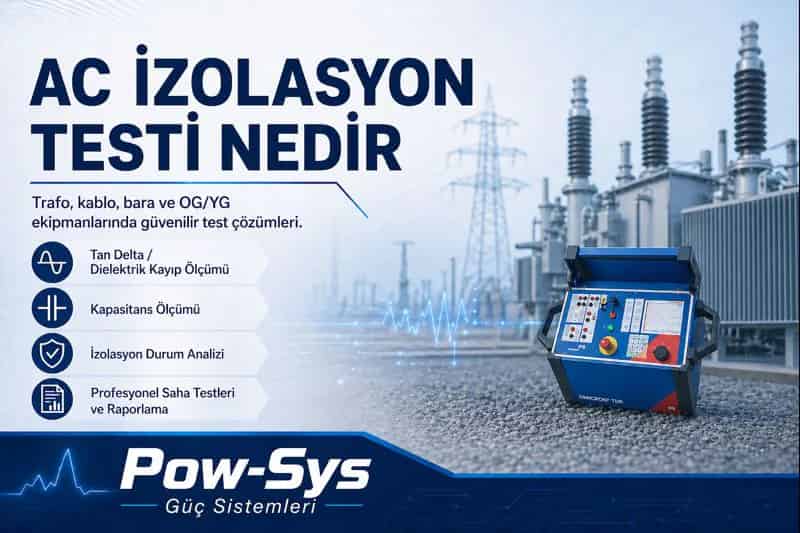
Summary Highlights
- What an AC insulation test performed with tan delta and capacitance measurement is: an AC-based dielectric diagnostic method that evaluates insulation condition through capacitance and tan delta
- What it does: helps detect aging, moisture and insulation deterioration early in transformers, bushings, instrument transformers and similar high-voltage equipment
- How it is performed: applying AC test voltage to the test object and measuring capacitance and dissipation factor/power factor values
- Application areas: power transformers, bushings, instrument transformers, rotating machines and suitable high-voltage insulation systems
- Important distinction: unlike a conventional AC withstand test, it diagnoses not only withstand but also dielectric loss and capacitive behavior
Article Details
Although the expression AC insulation test performed with tan delta and capacitance measurement is used frequently in the field, technically the process performed here is often not a conventional AC hipot withstand test. More accurately, this process is an AC-based diagnostic test that evaluates the insulation condition of equipment through capacitance and tan delta, meaning dissipation factor/power factor. In short, the answer to the question of what an AC insulation test performed with tan delta and capacitance measurement is: it is an advanced test approach that gives an idea about insulation health by measuring the dielectric behavior of high-voltage equipment.
The purpose of this test is not only to see whether the equipment can withstand voltage. The main purpose is to detect losses in the insulation structure, aging effects, moisture ingress, contamination, structural deterioration and, in some cases, early-stage fault tendencies earlier. Therefore, testing through tan delta and capacitance has an important place not only in acceptance testing but also in maintenance and condition assessment studies. It becomes very valuable especially when the aim is to see early signs of deterioration, not only faults that have already progressed.
This test is applied with a suitable AC test source and measurement module. Thanks to this structure, a controlled AC voltage is applied to the test object and the equipment's capacitance and loss factor are evaluated together. One of the main quantities measured here is tan delta. As tan delta increases, it is considered that dielectric losses inside the insulation have increased and that there may be a tendency toward deterioration in the insulation structure. Therefore, the test result is interpreted not only with a pass-fail logic but with a diagnostic logic.
At the center of how this test works is the separation of capacitive current and loss current. In an ideal insulation structure, current shows a largely capacitive character. However, as real equipment ages, absorbs moisture or develops structural deterioration, the loss component increases. This measurement approach helps evaluate this loss component. As a result, the test does not only check whether voltage exists on the equipment; it examines the electrical quality level of the insulation more deeply.
For this reason, the test performed with tan delta and capacitance measurement and the conventional AC hipot test are not the same thing. In a conventional AC hipot test, the main aim is to see whether the equipment can withstand a defined high-voltage level. In a tan delta and capacitance test, the main aim is to evaluate dielectric condition. In other words, one carries more of a withstand logic, while the other carries a condition assessment logic. Both may be called insulation tests in the field, but the technical approach is not the same.
This test is especially meaningful on power transformers, bushings, instrument transformers and some high-voltage insulation systems. Because in this equipment, insulation deterioration can often show itself as an increase in dielectric losses before sudden breakdown occurs. When capacitance change and tan delta behavior are monitored together, whether there is an abnormal development in the insulation structure can be understood better. Therefore, this test provides important data not only for field checks but also for asset management.
Tan delta and capacitance measurements are especially valuable in bushing tests. Because moisture, layer deterioration, internal structure problems or tap connection problems in bushings can change dielectric behavior. In power transformers, insulation condition between windings, between winding and earth and on the bushing side can benefit significantly from this test approach. Similar logic applies to instrument transformers and some rotating machines. In other words, this test is not directed at only one equipment class.
One important aspect of this test is that it can also be used with a variable frequency approach. Instead of looking only at one frequency, seeing the change of dielectric behavior at different frequencies can make some deterioration types more visible. Especially moisture effect, aging and some internal changes in the insulation structure can give more distinct signs during frequency variation. Therefore, this measurement approach can provide more diagnostic depth than a conventional single-point test.
Capacitance measurement is at least as important as tan delta. Because it provides information not only about the loss level but also about the geometric and electrical integrity of the equipment's dielectric structure. Deviation of the measured capacitance from the expected value may indicate issues such as tap connection problem, internal structure change or abnormality in insulation layers. Therefore, when tan delta and capacitance are interpreted together, a stronger technical result is obtained.
Another advantage of this AC-based diagnostic test is field applicability. The ability to use it with portable test systems provides great convenience in applications outside the laboratory. This is a serious advantage especially for large transformers, field bushings and high-voltage equipment that must be taken out of service and tested. Thus, maintenance teams can perform effective measurements not only after a fault but also during planned condition assessment processes.
However, correct interpretation is very important in this test. A single tan delta value may not always be sufficient by itself to make a decision. Equipment type, age, temperature, previous measurement values, phase-to-phase comparison, comparison with similar equipment and test connection arrangement should be evaluated together. Especially in bushing and transformer tests, trend tracking is often more valuable than a single instantaneous measurement. In other words, the test is powerful, but reading the result correctly requires separate expertise.
Surface conditions and test connection can also seriously affect the result. Dirty surface, incorrect guarding, tap connection problem, poor grounding or strong electromagnetic interactions can disturb the measurement. Therefore, in this test, it is not enough for only the device to operate; connection discipline must also be established correctly. A good test depends on correct field application as much as the correct device.
The difference between this test and DC megger or DC hipot testing becomes especially clear here. Megger testing looks more at insulation resistance. DC hipot testing performs withstand assessment under high direct voltage. This AC-based test based on tan delta and capacitance measurement gives a more diagnostic result by measuring dielectric losses and capacitive behavior. Therefore, these methods are not tests to be used randomly in place of one another; each has a different purpose.
From the perspective of maintenance and asset management, these measurements help understand not only whether the equipment operates today, but also how it may behave in the future. This is a major advantage especially in critical transformers, expensive bushings and facilities with planned maintenance programs. In other words, this test is not only a fault-finding tool but also a strong monitoring method that supports preventive maintenance decisions.
In summary, the expression AC insulation test performed with tan delta and capacitance measurement practically describes an advanced dielectric diagnostic approach that evaluates insulation health through capacitance and tan delta. Unlike a conventional AC hipot test, this method provides information not only about withstand but also about insulation quality and loss behavior. It provides very valuable results on power transformers, bushings, instrument transformers and similar high-voltage equipment. When applied on the correct equipment, with the correct connection and correct interpretation, it is a very strong test method that helps detect insulation deterioration before a fault occurs.
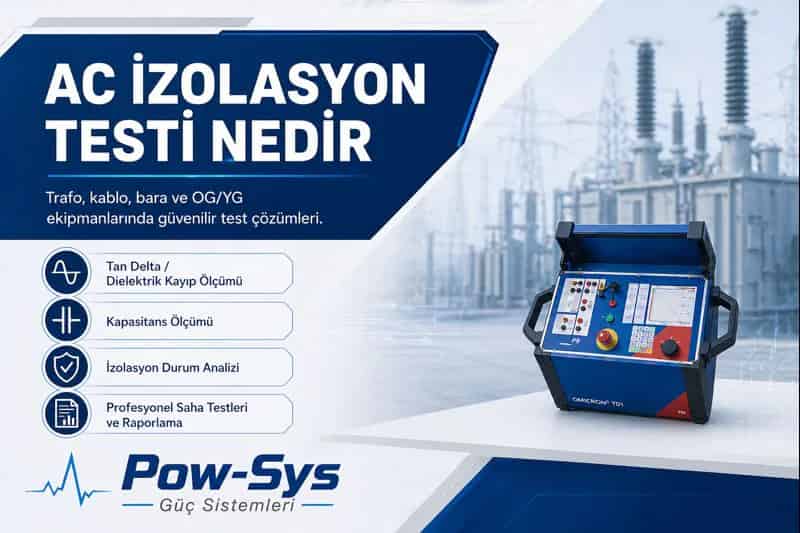
Related Blog Posts
- What Is a DC Insulation (Megger) Test? What Does It Do, How Is It Performed and Why Is It Used?
- What Is a VLF Test? What Does It Do, How Is It Performed and Why Is It Used?
- What Is a DC Hipot Test? What Does It Do, How Is It Performed and Why Is It Used?
- What Is a Line Trap? What Does It Do, How Does It Work and Where Is It Used?
Related Services
Frequently Asked Questions
What is an AC insulation test performed with tan delta and capacitance measurement?
In practice, an AC insulation test performed with tan delta and capacitance measurement is an AC-based dielectric diagnostic test that evaluates the insulation condition of high-voltage equipment through capacitance and tan delta, meaning dissipation factor or power factor. Although the expression is used frequently in the field, the process performed here is often not a conventional AC hipot withstand test. Instead, a controlled AC voltage is applied to the test object with a suitable test source and measurement module, and the equipment's capacitance and loss factor are evaluated together. The result gives an idea about insulation health: the test looks at the electrical quality level of the insulation, not only at whether the equipment can hold voltage. It is applied mainly to power transformers, bushings, instrument transformers and similar high-voltage insulation systems.
What does this test do?
This test helps detect insulation aging, moisture ingress, contamination, increases in dielectric losses, structural deterioration and, in some cases, early-stage fault tendencies before they progress. The purpose is broader than confirming that the equipment can withstand voltage: it makes early signs of deterioration visible, which is why it has an important place not only in acceptance testing but also in maintenance and condition assessment studies. In equipment such as power transformers, bushings and instrument transformers, insulation deterioration often shows itself as an increase in dielectric losses before sudden breakdown occurs, so monitoring capacitance change and tan delta behavior together reveals abnormal developments in good time. From a maintenance and asset management perspective, these measurements help understand not only whether the equipment operates today but also how it may behave in the future.
How is this test performed?
The test is performed with a suitable AC test source and measurement module. A controlled AC voltage is applied to the test object, and the capacitance and dissipation factor, also called power factor or tan delta, are measured together. At the core of the method is the separation of capacitive current and loss current: in an ideal insulation structure the current is largely capacitive, but as real equipment ages, absorbs moisture or develops structural deterioration, the loss component grows, and the measurement quantifies this. The approach can also be used with variable frequency, observing dielectric behavior at different frequencies to make some deterioration types more visible. Field applicability is a further advantage, since portable test systems allow effective measurements on large transformers, field bushings and other equipment taken out of service.
Is this test a conventional AC hipot test?
No, this test is not a conventional AC hipot test, even though both may be called insulation tests in the field. In a conventional AC hipot test, the main aim is to see whether the equipment can withstand a defined high-voltage level, so it carries a withstand, pass-fail logic. In a tan delta and capacitance test, the main aim is to evaluate dielectric condition: the level of losses in the insulation, the capacitive behavior and the signs of aging or moisture. One verifies withstand, the other assesses condition, and the technical approach is not the same. This is why the result of a tan delta and capacitance measurement is interpreted diagnostically rather than as a simple pass or fail, and why the two methods serve different points in testing and maintenance programs.
What does tan delta show?
Tan delta shows the level of dielectric losses inside the insulation. In an ideal insulation structure, the current under AC voltage shows a largely capacitive character; as the insulation ages, absorbs moisture or develops structural deterioration, the loss component of the current increases, and tan delta rises with it. An increasing tan delta is therefore read as a sign that dielectric losses have grown and that there may be a tendency toward deterioration in the insulation structure. This is why the result is interpreted with diagnostic logic rather than a simple pass-fail check. A single tan delta value, however, may not be sufficient on its own: equipment type, age, temperature, previous measurements, phase-to-phase comparison and comparison with similar equipment should be evaluated together, and trend tracking is often more valuable than one instantaneous reading.
Why is capacitance important?
Capacitance is at least as important as tan delta because it provides information not only about the loss level but about the geometric and electrical integrity of the equipment's dielectric structure. If the measured capacitance deviates from the expected value, this may indicate issues such as a tap connection problem, an internal structure change or an abnormality in the insulation layers. Tan delta alone describes how lossy the insulation is, while capacitance describes whether the physical dielectric arrangement still looks as it should. When the two quantities are interpreted together, a much stronger technical result is obtained, which is why the method always treats them as a pair. This combined reading is particularly valuable in bushings and power transformers, where internal changes can alter dielectric behavior well before an outright failure occurs.
Which equipment is most commonly tested with this test?
The most common application areas are power transformers, bushings, instrument transformers and suitable high-voltage insulation systems, and the same logic also applies to some rotating machines. The test is especially meaningful on this equipment because insulation deterioration there often shows itself as an increase in dielectric losses before sudden breakdown occurs. Bushing testing benefits particularly, since moisture, layer deterioration, internal structure problems or tap connection problems in bushings change dielectric behavior in measurable ways. In power transformers, the insulation between windings, between winding and earth and on the bushing side can all be assessed with this approach. Because portable systems make the test applicable in the field, it serves large transformers and field bushings during planned condition assessment processes as well as in checks performed after faults.
Is this test the same as a megger test?
No, this test is not the same as a megger test. A megger test focuses on insulation resistance: it applies DC voltage and reads how much resistance the insulation offers against leakage current. The tan delta and capacitance approach is AC-based and provides more diagnostic results by measuring dielectric losses and capacitive behavior, revealing aging, moisture and structural deterioration in a different and often deeper way. DC hipot testing is different again, performing withstand assessment under high direct voltage. These methods are not tests to be used randomly in place of one another; each has a distinct purpose, and a complete insulation assessment may draw on several of them. Choosing the right method depends on the equipment type and on whether the goal is resistance measurement, withstand verification or dielectric diagnosis.
Why is measuring at different frequencies important?
Measuring at different frequencies is important because some deterioration types become more visible when the frequency is varied. Instead of looking at dielectric behavior at a single point, the variable frequency approach observes how capacitance and tan delta change across a range, and this change pattern carries diagnostic information. Moisture effects, aging and some internal changes in the insulation structure can give more distinct signs during frequency variation than they would at one fixed frequency alone. As a result, this measurement approach can provide more diagnostic depth than a conventional single-point test. It strengthens exactly what this method is for: detecting early deterioration in transformers, bushings and instrument transformers before it develops into a fault, and giving maintenance teams a richer picture of insulation condition for planning purposes.
Is a single measurement result sufficient?
Not always. A single measurement result may not be sufficient by itself to make a sound decision, because dielectric readings are influenced by many factors. Equipment type, age, temperature, previous measurement values, phase-to-phase comparison, comparison with similar equipment and the test connection arrangement should all be evaluated together. In bushing and transformer testing especially, trend tracking over time is often more valuable than a single instantaneous value. Field conditions add another layer of caution: a dirty surface, incorrect guarding, a tap connection problem, poor grounding or strong electromagnetic interactions can disturb the measurement, so connection discipline matters as much as the device itself. The test is powerful, but reading the result correctly requires expertise, and the strongest conclusions come from consistent measurements compared across time and across equipment.