

Summary Highlights
- What is DC insulation megger testing: basic electrical testing method that measures the insulation resistance of an equipment with a direct current test voltage
- What does the DC insulation megger test do: helping to detect early insulation weakness, moisture, contamination and aging effects
- How to perform DC insulation megger test: the logic of applying the test voltage to the equipment and evaluating the leakage current as a very high resistance value
- Areas of use: motors, cables, transformers, generators, switchgear equipment and interior insulation control
- Important evaluation topics: test voltage selection, temperature effect, surface cleaning, recording tracking and safe discharge process after test
Content
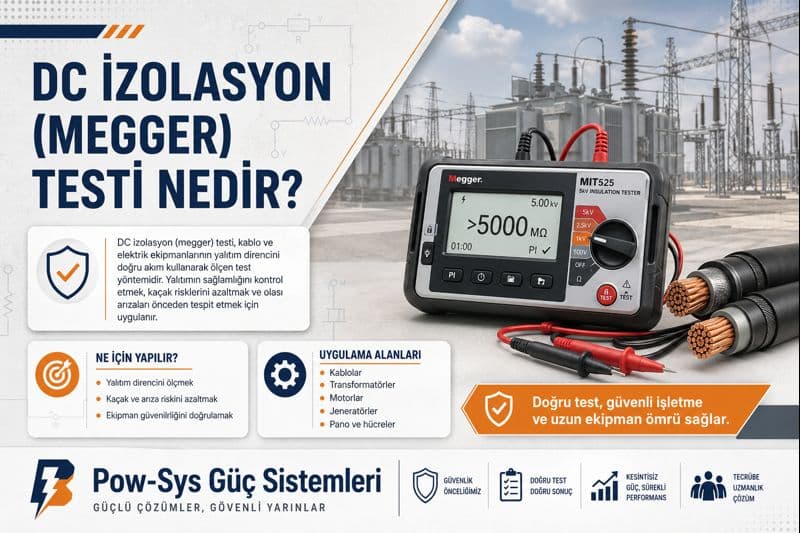
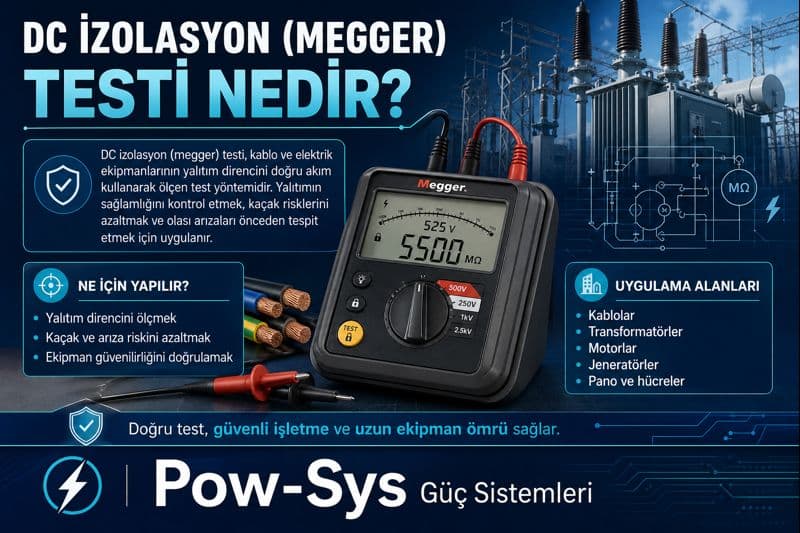
DC insulation testing is a basic maintenance and evaluation method that measures the insulation resistance of an electrical equipment using direct current. Briefly, the answer to the question of what is DC insulation Megger test is; It is a test that measures the resistance of the insulation between conductor and ground, winding and body or phases. The device used in this test is often called meger in everyday language. In fact, what is measured here is how strong the insulation is against electrical leakage.
Insulation health is at the center of the question of what DC insulation megger test is for. One of the most critical layers of defense in electrical equipment is insulation. Moisture, dirt, aging, thermal stress, vibration, chemical exposure and mechanical damage can weaken this structure over time. The Meger test helps detect this deterioration at an early stage. Thus, maintenance decisions can be made before the equipment malfunctions.
The logic of this test is quite clear. The device applies a certain level of DC test voltage to the equipment under test and evaluates the leakage current passing through the insulation and displays it as a very high resistance value. If the insulation is healthy, the leakage current will be low and the measured resistance will be high. If the insulation is weak, the leakage current increases and the measured resistance decreases. Therefore, the Meger test interprets the insulation quality indirectly through leakage current.
The main reason for using DC voltage is measurement stability. When direct current is applied, the behavior of the insulation can be monitored over a period of time and very high resistances can be measured more meaningfully. This approach gives practical results, especially in maintenance tests. It is also widely used in motor, transformer, cable and panel tests as it can be applied in the field with portable devices.
A Meger test is not the same as a normal multimeter measurement. The multimeter measures overall resistance with much lower voltages. Meger, on the other hand, applies special test voltage and measures very high resistance levels in order to evaluate the insulation more realistically. Therefore, even if a piece of equipment does not show a problem on a multimeter, insulation weakness may occur in the Megger test.
To explain the question of how to perform a DC isolation test simply, the equipment to be tested is first de-energized and isolated safely. Appropriate test points are then selected. For example, measurements can be made between the winding and body, between phase and ground, or between phases. After the device is connected, the selected test voltage is applied and the measurement result is read. At the end of the test, the equipment must be discharged safely.
This test is most commonly used on motors, cables, transformers, generators, switchgear and various panel circuits. It is very useful to see the insulation weakness in motor windings, evaluate the earth leakage tendency in cables, pre-check the winding-body insulation in transformers and monitor the general insulation status in switchgear equipment. That's why the Meger test is one of the most essential diagnostic tools for care teams.
Megger measurement is especially important for preliminary evaluation in cable tests. Although this alone does not always prove that a cable is completely healthy, it can indicate serious insulation weaknesses or significant moisture-dirt effects. It is frequently used in motors and generators to monitor the change of winding insulation over time. When the megger results of the same equipment at different times are compared, the tendency to deteriorate is more clearly understood.
In the Meger test, a single number alone is not always sufficient. The measurement result may be affected by temperature, humidity, surface contamination and the physical condition of the equipment. Therefore, measuring the same equipment under similar conditions on different dates and following the trend provides a healthier approach. In other words, how the result changes compared to the past is as important as the test result.
Surface contamination can be misleading in the meger test. If the surface of the equipment under test is dirty, oily or damp, surface leakage currents may give a worse result than the actual internal insulation condition. It is therefore important to properly clean the equipment before measurement and, if possible, test it in a dry state. Otherwise, the test may have measured surface condition rather than internal insulation.
DC insulation megger test and DC hypot test are not the same thing. Meger testing mainly focuses on measuring insulation resistance and serves diagnostic purposes in most maintenance applications. DC hypot test, on the other hand, focuses on verification of strength under higher electrical stress. So one is more of a condition indicator, the other is more of a strength verification approach. Therefore, the two tests are not direct synonyms of each other.
Meger test and VLF test are not the same thing. In the Meger test, insulation resistance is read with DC voltage. In the VLF test, very low frequency AC voltage is applied and the strength or condition behavior of the cable system is evaluated differently. Especially when it comes to medium voltage cables, which test is appropriate should be determined according to the structure of the equipment and the purpose of the test.
Some maintenance programs only perform a single spot test. In some cases, the behavior of the insulation over time is examined by taking measurements for one minute, ten minutes or a certain period of time. This approach can help evaluate polarization behavior. Especially in critical equipment such as large motors, generators and transformers, not only the instantaneous resistance value but also the change behavior over time may be important.
It is very important to choose the test voltage correctly. The same DC test voltage is not used for all equipment. The equipment's voltage class, age, manufacturer's recommendation, and test purpose should be taken into account. Excessively high test voltage may create unnecessary stress on inappropriate equipment. Test voltage that is lower than necessary may not yield meaningful results. For this reason, since it is a Megger test device, it should not automatically be applied to every piece of equipment in the same way.
Safe discharge must be performed at the end of the test. Because, especially in wound and capacitive structures, the equipment can hold an electrical charge after the test. Even if the measurement is finished, controlled discharge is required before touching the leads. This step is very important for both personnel safety and equipment protection.
In summary, DC insulation Megger test; It is a basic test method that gives an idea about the insulation health of electrical equipment by measuring the insulation resistance of electrical equipment with direct current test voltage. It is widely used for maintenance, commissioning and pre-failure evaluation in motors, cables, transformers, generators and switchgear equipment. When applied correctly, it provides valuable information; however, results need to be interpreted in conjunction with temperature, humidity, surface condition, and historical records. Therefore, the Meger test is not just about reading numbers, but about correctly interpreting insulation behavior.
Frequently Asked Questions
What is DC insulation megger test?
DC insulation megger testing is a basic maintenance test that measures the insulation resistance of an electrical equipment using a direct current test voltage.
What is the Meger test used for?
It helps to detect insulation weakness, moisture, contamination, aging and leakage current tendency early.
How is the Meger test done?
The equipment is de-energized, the device is connected to the appropriate test points, the selected DC test voltage is applied, the resistance value is read and safe discharge is performed at the end of the test.
On which equipment is the Meger test used?
It is widely used in motors, cables, transformers, generators, switchgear equipment and in-panel circuits.
Are Meger test and multimeter measurement the same?
No. A multimeter measures general resistance with a low voltage, while a megger applies a special DC test voltage to evaluate insulation and measures very high levels of resistance.
Are Meger test and DC hypot test the same thing?
No. Meger testing focuses more on evaluating insulation resistance and condition. DC hypot test is a strength verification approach under higher stress.
Are the Meger test and the VLF test the same?
No. DC voltage is used in the Meger test. In the VLF test, very low frequency AC voltage is applied.
Why is temperature important in the Meger test?
Because insulation resistance is affected by temperature. Therefore, when comparing measurements, results taken under similar conditions are more meaningful.
Does surface contamination affect the outcome?
Yes. Damp, dirty or oily surfaces can increase the superficial leakage current, resulting in worse results than the actual insulation condition.
Why is discharge necessary at the end of the test?
Because the equipment under test can hold an electrical charge, especially in wound or capacitive structures. It should not be contacted without safe discharge.