
Summary Highlights
- Importance of breaker failure and busbar protection relay maintenance: ensuring rapid clearing of internal busbar faults, backup security against breakers that fail to open and continuity of the switchyard
- Basic maintenance steps: visual inspection, setting verification, secondary injection, busbar zone test, breaker failure timing test and trip chain check
- Main checks to be performed: busbar differential characteristic, check zone verification, CT polarity and ratios, disconnector and circuit breaker status information, retrip and adjacent breaker trip scenarios
- Advanced verifications: dynamic zone selection, binary input-output test, double-busbar and coupler arrangement scenarios, event records and oscillography review
- Recording and trend tracking: comparison of trip times, BF timing, zone selection results, alarm history, setting revisions and maintenance reports
Article Details
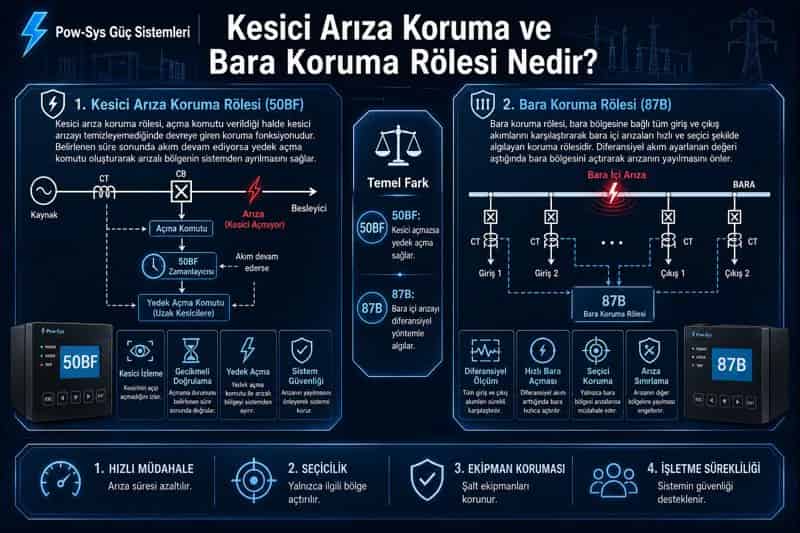
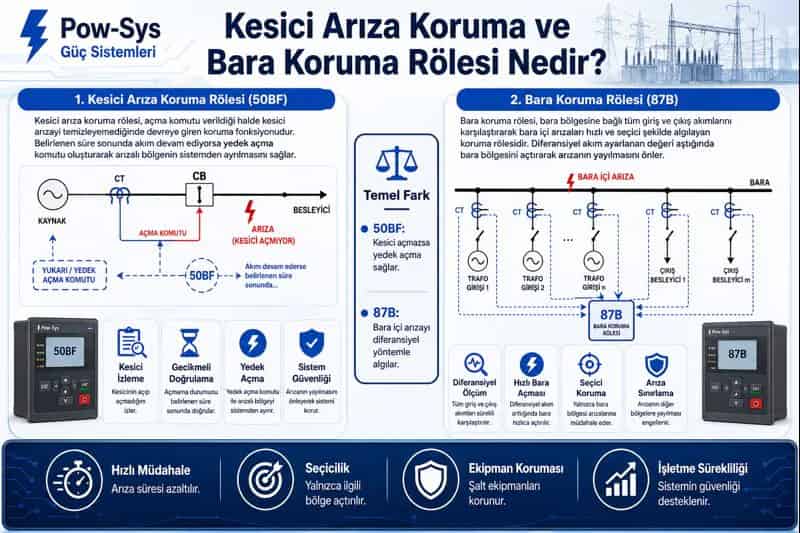
Breaker failure and busbar protection relays are among the most critical protection structures in transformer substations and switchyards. Therefore, the tests and maintenance required for breaker failure and busbar protection relays are not performed only to see whether the relay is energized. The main purpose is to verify that internal busbar faults are detected in the correct zone and very quickly, that the backup security chain works correctly against breakers that do not open despite receiving a trip command, and that the entire switchyard logic is protected selectively. A small setting or wiring error in these systems can cause very wide outages or severe equipment damage.
The first step of maintenance is always safety. When busbar protection and breaker failure systems are tested, the related station section should be placed in a safe test condition, test blocks should be used correctly, CT secondary circuits should be managed in a controlled way and the trip chain should be safely blocked when required. Especially in busbar protection tests, multiple feeder CTs are evaluated within the same logic, so a single secondary connection error can distort the whole test result. Similarly, since breaker failure tests include the risk of unintentionally tripping real breakers, the test setup should be prepared with discipline appropriate for the field.
Visual inspection is the basis of maintenance. Relay front panels, displays, LED indicators, alarm lists, self-supervision warnings, terminal connections, communication ports, binary input-output modules and auxiliary supply circuits should be visually inspected. If warnings such as internal fault alarm, time synchronization loss, disconnector position mismatch, CT circuit alarm or binary input fault exist, they should become maintenance priorities. Modern busbar protection and BF relays often give the first indication of a field problem in their own alarm records.
One of the first technical steps is setting verification. Busbar zone definitions, check zone logic, CT assignments, coupler and disconnector status inputs, breaker failure start inputs, BF times, retrip outputs, adjacent breaker trip lists and dynamic zone selection logic if present should be compared with the approved project. If a disconnector has changed in the switchyard, a new feeder has been added or coupler logic has been revised, the protection settings should be updated accordingly. Otherwise, the relay operates according to the old field topology and may interpret the real system incorrectly.
One of the most basic tests in busbar protection maintenance is differential characteristic verification. Considering all measurement inputs connected to the same busbar zone, it should be verified that the relay operates as expected in differential current scenarios representing an internal fault and remains stable in scenarios representing an external fault or normal load condition. The purpose here is not only for the relay to trip, but to trip in the correct zone and to avoid unnecessary trips in out-of-zone scenarios.
The check zone test should also be performed separately. In busbar protection systems, the check zone provides an additional security layer beyond the main zone definitions. Therefore, during maintenance it should be verified that the check zone logic is actually effective, that the relationship between the main zone and check zone operates correctly and that the relay makes decisions compatible with status information coming from the field during zone selection. If the check zone does not operate correctly, the system may either issue an incorrect trip or unnecessarily delay an internal fault when disconnector information is wrong or zone assignment is faulty.
In systems with dynamic zone selection, disconnector and circuit breaker status information requires special attention. Which feeder belongs to which busbar section is often determined by disconnector position information. Therefore, during maintenance it should be verified that open-closed disconnector states reach the relay correctly, that the zone structure updates correctly depending on whether the coupler is active and that incorrect position information is handled by alarm or blocking logic. A busbar protection relay must correctly understand not only current but also the field topology.
The CT chain is one of the most critical field subjects in these systems. Busbar differential protection is based on the combined evaluation of many feeder CTs. Therefore, CT polarity, ratios, secondary circuit continuity, grounding points and related zone assignments should be checked one by one. If a single CT is connected with reversed polarity or assigned to the wrong busbar zone, false differential current may occur even under normal load. In busbar protection, CT accuracy is the backbone of the system.
The stability test is also very important. The relay must not trip incorrectly during severe faults outside the busbar or under high through-fault currents. Therefore, test scenarios representing high through-current conditions should be applied and it should be verified that the relay maintains differential stability. Especially in facilities where many feeders are connected to the same busbar system, external fault stability is one of the main criteria determining the reliability of busbar protection.
The first basic test in breaker failure protection maintenance is the start logic. It should be clearly verified under which conditions the relay starts the breaker failure function. It should be tested whether it starts only when a trip command is received, when the related phase current is present or together with auxiliary contact status. If BF starts under the wrong condition, unnecessary wide-area trips may occur; if it does not start at all, the fault remains in the system because the breaker has failed to open.
Breaker failure timing should also be tested separately. It should be measured that the BF function waits for the set time after starting and, if the breaker does not open during this time, activates the retrip or backup trip logic. If this time is selected too short, normal breaker opening delay may be incorrectly interpreted as BF. If it is selected too long, the fault remains in the field longer than necessary. Therefore, BF timing should not only be read from the setting; it should be verified by testing.
Retrip logic and the backup trip chain should also be tested separately. In many systems, when BF starts, a trip command is first sent once more to the related breaker. If this also does not succeed, adjacent breakers, the coupler breaker or upstream supply breakers are tripped. It should be confirmed which output becomes active and when, which feeders are included in this logic and whether the tripping sequence is compatible with the expected project logic. Especially in multi-busbar stations, this chain can be complex and should not be accepted as reliable without field testing.
Binary input-output tests are indispensable for both busbar protection and the BF function. Disconnector position inputs, circuit breaker open-closed information, trip start inputs, BF start signals, retrip outputs, zone selection signals and alarm contacts should be verified one by one. Even if the internal relay logic is correct, the real field behavior can be completely different if binary wiring is faulty. Therefore, secondary testing should not be limited to analog current tests.
The trip circuit test is considered especially critical. Busbar protection often trips more than one breaker at the same time. Breaker failure often has to trip several other breakers instead of a single breaker. Therefore, it should be verified that all trip outputs actually reach the related coils and interposing relay chains. It should not be considered sufficient only for the trip LED on the relay display to turn on. The real trip chain should be tested together with the field connections.
Event records and oscillography review are important parts of maintenance. Past busbar differential events, BF starts, retrip attempts, incorrect zone alarms, disconnector position mismatches and binary input timings should be examined. Especially if unexpected BF start events or unexplained bus differential pickup records exist, they can directly shape the test plan. Modern relays not only provide protection; they also provide detailed event analysis data.
Communication and time synchronization should also be checked. In large switchyards, busbar protection and BF relays may be associated with the station automation system, GOOSE messages or a central event recording infrastructure. If time synchronization is faulty, the event sequence may be interpreted incorrectly. If there is a communication problem, zone status, alarm transfer or central analysis processes become weaker. Therefore, in modern numerical protection systems, the data chain is also part of the protection chain.
At the end of maintenance, all results should be recorded. Which busbar zones were tested, check zone behavior, BF start and trip times, CT and binary input verifications, retrip scenarios, alarm history and setting revisions should be archived regularly. Errors in these systems often grow not suddenly but through field revisions, wiring changes or binary information flow that deteriorates over time. If trend tracking is performed, weak points can be seen before a real station fault occurs. In summary, the tests and maintenance required for breaker failure and busbar protection relays require safe test preparation, setting verification, busbar differential and zone tests, check zone and dynamic zone selection verification, breaker failure timing and retrip scenarios, CT and binary input-output checks, trip circuit testing and event record analysis to be carried out together. This approach is the basic verification showing that the most critical protection layers of the switchyard are truly ready for duty.
Related Blog Posts
- What Are Breaker Failure Protection and Busbar Protection Relays? What Do They Do, How Do They Work and Why Are They Used?
- What Tests and Maintenance Are Required for Transformer Differential Protection Relays?
- What Is a Circuit Breaker? What Does It Do, How Does It Work and What Types Are There?
- What Tests and Maintenance Are Required for Circuit Breakers?
Related Services
Frequently Asked Questions
Why is maintenance required on breaker failure and busbar protection relays?
Maintenance is required because breaker failure and busbar protection relays are among the most critical protection structures in transformer substations and switchyards. Maintenance is not performed only to see whether the relay is energized; the main purpose is to verify that internal busbar faults are detected in the correct zone and very quickly, that the backup security chain works correctly against breakers that do not open despite receiving a trip command, and that the entire switchyard logic is protected selectively. A small setting or wiring error in these systems can cause very wide outages or severe equipment damage. Because busbar protection combines many feeder CTs and BF protection may have to trip several breakers, an error in zone selection, the CT chain, binary inputs or BF timing can cause very wide-area trips or delayed fault clearing. Regular maintenance verifies zone behavior, BF timing and the trip chain together, so the switchyard's most critical protection stays ready for duty.
Which tests are performed on these relays?
Setting verification, the busbar differential test, zone and check zone verification, the breaker failure start and timing test, retrip and adjacent breaker trip scenarios, CT and binary input-output checks, and trip circuit tests can be performed. Setting verification compares busbar zone definitions, check zone logic, CT assignments, coupler and disconnector status inputs, BF start inputs, BF times and adjacent breaker trip lists with the approved project. The busbar differential test checks that the relay trips in the correct zone for internal faults and stays stable for external ones, and a stability test represents high through-current conditions. Dynamic zone selection is verified against disconnector and breaker status information. The BF start logic, BF timing, retrip and backup trip chain are tested, along with the CT chain, binary inputs and outputs, the trip circuit and event records. The exact scope depends on the busbar arrangement and the relay's function set.
What does the busbar differential test verify?
The busbar differential test verifies that the relay trips in the correct zone for internal busbar faults and remains stable for external faults or normal load conditions. It is one of the most basic tests in busbar protection maintenance: considering all the measurement inputs connected to the same busbar zone, it should be confirmed that the relay operates as expected in differential current scenarios representing an internal fault and does not operate in scenarios representing an external fault or normal load. The purpose is not only for the relay to trip, but to trip in the correct zone and to avoid unnecessary trips in out-of-zone scenarios. This is reinforced by the stability test, which applies high through-current conditions to confirm the relay maintains differential stability. Because busbar differential protection combines many feeder CTs, verifying both correct in-zone operation and external-fault stability is what proves the protection will clear a real busbar fault quickly without misoperating for faults elsewhere.
Why is the check zone test important?
The check zone test is important because the check zone provides an additional security layer beyond the main zone definitions in busbar protection. During maintenance it should be verified that the check zone logic is actually effective, that the relationship between the main zone and the check zone operates correctly, and that the relay makes decisions compatible with the status information coming from the field during zone selection. This matters because, if the check zone does not operate correctly, the system may either issue an incorrect trip or unnecessarily delay clearing an internal fault when disconnector information is wrong or a zone assignment is faulty. By requiring agreement between the main zone and the check zone before a bus trip, the logic guards against incorrect zone selection and disconnector position errors. Correct operation of this logic therefore reduces the risk of an incorrect busbar trip.
Why is dynamic zone selection tested separately?
Dynamic zone selection is tested separately because, in multi-busbar and coupled systems, which feeder belongs to which busbar section is often determined by disconnector position information and can change according to disconnector and breaker statuses. For this reason disconnector and circuit breaker status information requires special attention during maintenance. It should be verified that open-closed disconnector states reach the relay correctly, that the zone structure updates correctly depending on whether the coupler is active, and that incorrect position information is handled by alarm or blocking logic. A busbar protection relay must correctly understand not only current but also the field topology, because if this information is wrong, the protection interprets the real system incorrectly and may assign a feeder to the wrong zone. Testing dynamic zone selection confirms that the relay follows the actual switchyard configuration, so that an internal fault is cleared in the correct zone even as disconnectors and couplers change the arrangement.
What does the breaker failure test verify?
The breaker failure test verifies that if a breaker does not open despite receiving a trip command, the relay starts the BF function within the correct time, applies retrip if required and then operates the correct backup trip chain. The first basic check is the start logic: it should be clearly verified under which conditions the relay starts the breaker failure function, for example only when a trip command is received, when the related phase current is present, or together with auxiliary contact status. If BF starts under the wrong condition, unnecessary wide-area trips may occur; if it does not start at all, the fault remains in the system because the breaker has failed to open. BF timing is also measured, confirming that the function waits for the set time after starting and then activates retrip or backup tripping if the breaker has not opened.
Why should retrip and backup trip be tested separately?
Retrip and backup trip should be tested separately because, in many systems, when BF starts a trip command is first sent once more to the related breaker, and only if this also does not succeed are adjacent breakers, the coupler breaker or upstream supply breakers tripped. During maintenance it should be confirmed which output becomes active and when, which feeders are included in this logic, and whether the tripping sequence is compatible with the expected project logic. Especially in multi-busbar stations, this chain can be complex and should not be accepted as reliable without field testing. Because backup tripping deliberately opens several breakers to clear a fault a failed breaker could not, an error here can either widen an outage unnecessarily or leave a fault in the system. Testing retrip and the backup trip chain separately confirms that the second trip attempt and the adjacent-breaker tripping operate in the correct order and reach exactly the breakers the design intends.
Why is CT checking very critical in busbar protection?
CT checking is very critical in busbar protection because busbar differential protection is based on the combined evaluation of many feeder CTs. The CT chain is one of the most critical field subjects in these systems, so CT polarity, ratios, secondary circuit continuity, grounding points and the related zone assignments should be checked one by one. If a single CT is connected with reversed polarity or assigned to the wrong busbar zone, false differential current may occur even under normal load, and this could cause an unnecessary bus trip affecting many feeders. In busbar protection, CT accuracy is the backbone of the system, because the relay decides by summing the currents of all the CTs in a zone; if even one is wrong, the whole differential calculation is corrupted. For this reason the CT chain is verified in addition to the relay logic, since a busbar protection relay can only be as reliable as the many CT signals it combines.
Why is the trip circuit test indispensable?
The trip circuit test is indispensable because the relay decision alone is not sufficient; the decision must actually reach the related breakers. Busbar protection often trips more than one breaker at the same time, and breaker failure often has to trip several other breakers instead of a single one, so there are multiple trip paths to confirm. For this reason it should be verified that all trip outputs actually reach the related coils and interposing relay chains, and it should not be considered sufficient only for the trip LED on the relay display to turn on. The real trip chain should be tested together with the field connections. Because these systems clear faults by simultaneously opening many breakers, a single broken trip path could leave part of a busbar fault energized even though the relay decided correctly.
Why is record keeping important in these systems?
Record keeping is important because errors in breaker failure and busbar protection systems often grow not suddenly but through field revisions, wiring changes or binary information flow that deteriorates over time. At the end of maintenance, which busbar zones were tested, the check zone behavior, the BF start and trip times, the CT and binary input verifications, the retrip scenarios, the alarm history and any setting revisions should all be archived regularly. When this data is kept, zone deviations, BF timing changes, binary information errors and incorrect start events can be compared from one visit to the next. With regular records and trend tracking, weak points can be seen before a real station fault occurs. Because a disconnector change, an added feeder or revised coupler logic in the switchyard can make old settings incorrect, keeping a clear history also helps confirm that the protection still matches the real field topology after each modification.