
Summary Highlights
- Importance of transformer differential protection relay maintenance: detecting internal faults quickly and selectively, preventing incorrect trips and preserving transformer safety
- Basic maintenance steps: visual inspection, setting verification, secondary injection, differential characteristic testing and trip circuit check
- Main checks to be performed: CT polarity, ratios, vector group compensation, bias and restraint behavior, inrush blocking and high-set differential function
- Advanced verifications: stability test, harmonic restraint test, binary input-output check, event records and oscillography review
- Recording and trend tracking: comparison of trip times, test points, alarm history, setting revisions and maintenance reports
Article Details
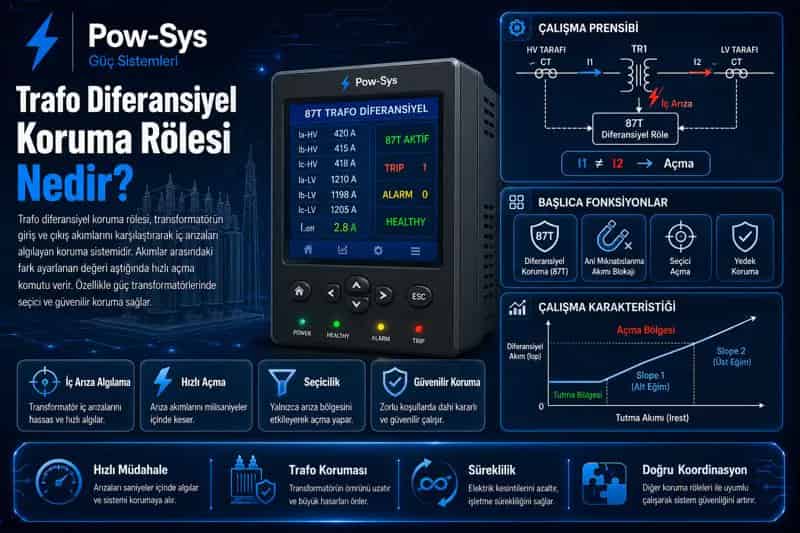
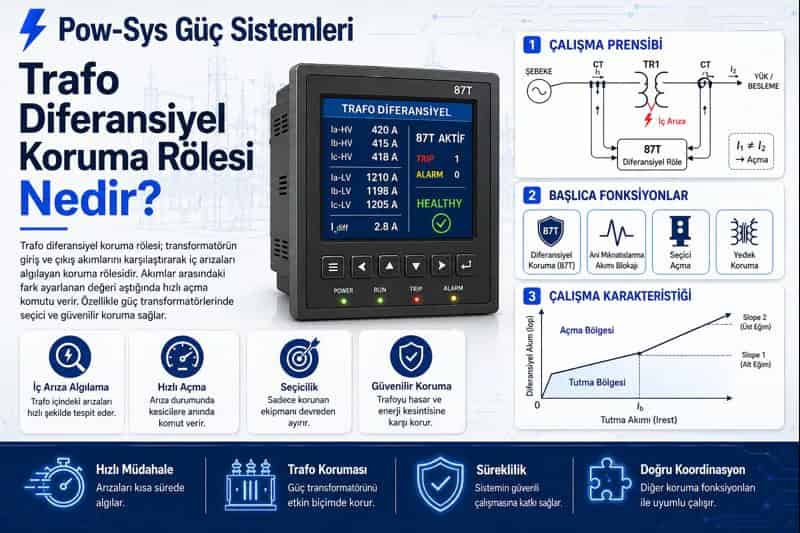
Transformer differential protection relays are the main protection devices expected to detect internal transformer faults in the fastest and most selective way. Therefore, the tests and maintenance required for transformer differential protection relays are not limited to checking whether the device is energized. The main purpose is to verify that the relay correctly compares the transformer input and output currents, trips quickly for internal faults and remains stable during external faults or non-fault conditions such as inrush. A small error in differential protection can either cause a real internal fault to be missed or cause the transformer to trip unnecessarily.
The first step of maintenance is always safety. Before working on the relay, the related transformer and protection system should be placed in a safe test condition, test blocks or test switch arrangements should be used correctly and CT secondary circuits should be managed in a controlled way. Especially in differential protection tests, correct isolation of multiple CT inputs and avoiding incorrect connections are very important. Differential protection evaluates more measurement inputs together than many other relay types.
Visual inspection is the basis of maintenance. The relay front panel, display, LED indicators, alarm records, self-supervision warnings, terminal connections, auxiliary supply terminals and communication ports should be visually inspected. If the relay has internal fault alarms, time synchronization loss, binary input faults or warnings related to the measurement chain, these should be treated as priorities in the maintenance plan. Many modern differential relays provide important clues about their internal condition in their alarm records.
One of the first technical tasks in transformer differential protection relay maintenance is setting verification. The active setting file loaded in the relay should be compared with the approved protection file; transformer rated power, voltages, vector group, CT ratios, reference current data, bias curves, slope settings, high-set differential stage and inrush security parameters should be verified. Since differential protection is set according to the physical characteristics of the transformer, even a small setting change in the field can affect the entire protection logic.
Secondary injection testing is the basic method of differential relay maintenance. In this test, controlled current signals are applied to the relay to verify differential and restraint behavior. The purpose is not only to see that the relay trips; it is to check at which point it operates, at which point it remains under restraint and whether its characteristic is formed as expected. In transformer differential protection, the test approach must verify stability behavior as well as internal fault behavior.
Differential characteristic testing is the core of maintenance. It should be tested at which differential current and restraint current combinations the relay operates according to its biased differential curve. The relay is expected to trip for points representing the internal zone and not trip for points representing the restraint region. This test shows whether the relay slope structure, sensitivity level and expected stability under high through-current conditions are maintained.
The stability test is especially important for representing external fault conditions. During a heavy fault outside the transformer, CT saturation or measurement differences may create a tendency for false operation in the differential relay. Therefore, during maintenance it should be verified that the relay remains stable under high restraint current. Differential protection must not only be fast for internal faults; it must also remain securely blocked for external faults.
CT polarity, ratio and star-point direction are among the most critical field subjects in differential protection maintenance. If CT polarity is reversed, the ratio definition is incorrect or the vector group compensation in the relay does not match the real field connection, the differential protection may see false differential current even under normal load. Therefore, in addition to secondary testing, CT wiring and polarity verification should also be performed. In transformer differential protection, this check is as important as setting verification.
Vector group compensation should also be verified separately. If the transformer has a delta-star or similar phase-shifting structure, differential protection will not operate properly unless the correct vector group definition is made in the relay. Therefore, during maintenance the applied current scenarios should also verify phase relationships and how the relay compensates them. Correct current magnitude alone is not sufficient; the correct phase relationship is also required.
Inrush security should be handled as a separate topic in transformer differential relay testing. The magnetizing current that occurs during transformer energization may behave like differential current, so the relay must distinguish it from a real internal fault. Therefore, harmonic restraint or harmonic blocking tests should be performed to verify that second-harmonic-based security operates correctly. If the relay trips under inrush conditions, unwanted trips during transformer energization become unavoidable.
Overexcitation and some advanced security logic should also be included in the test plan depending on the model. If the relay has fifth harmonic restraint, overexcitation security or waveform-based advanced inrush detection, at least functional verification of these logics should be performed during maintenance. Modern differential relays may not be limited to classic second harmonic blocking; therefore, the test plan should be prepared according to the real function set of the relay being used.
If a high-set differential function exists, it should be tested separately. This stage is used to provide very fast tripping for severe internal faults and often operates with a separate logic independent of the bias characteristic. Therefore, the main differential curve being correct does not mean that the high-set function also operates correctly. Pickup and trip behavior of this stage should be verified with separate test points.
Trip circuit and binary input-output tests are indispensable parts of maintenance. It is not enough for the relay to make the differential decision correctly; that decision must be delivered through the correct binary output to the circuit breaker and, where required, to the related trip chains on the HV and LV sides. Since transformer differential protection may often require simultaneous tripping of multiple breakers, the entire trip chain should be verified separately. Alarm outputs, blocking signals and intertrip relationships should also be examined in this scope.
Event records and oscillography review are important parts of maintenance. The relay records can show which differential events the relay has seen in the past, how it behaved during inrush, whether an incorrect trip or blocking event occurred, signs of instability related to CT saturation, and binary input-output timings. This information is valuable not only for understanding past faults but also for determining future maintenance priorities.
Communication and time synchronization should also be checked in systems that include these functions. If SCADA, IEC 61850, IRIG-B, SNTP or other communication and time sources do not operate correctly, event record analysis can become difficult and incorrect information may be created on the station automation side. Although the differential relay is a main protection device, it is also a data source in modern facilities; when this data chain is disrupted, maintenance and event analysis become weaker.
At the end of maintenance, all results should be recorded. The operating characteristic points tested, bias slope behavior, harmonic restraint results, CT and polarity verification findings, trip circuit tests, binary I/O results and event record reviews should be archived regularly. Differential protection problems often do not appear suddenly; they grow as measurement chain deviation, setting change or stability loss. If trend tracking is performed, weak points can be noticed before a real internal fault occurs. In summary, the tests and maintenance required for transformer differential protection relays require safe test preparation, setting verification, secondary injection, differential and restraint characteristic testing, inrush security verification, CT/VT and trip circuit checks, and event record analysis to be carried out together. This approach is the most important step in verifying that the transformer's main protection is truly ready for duty.
Related Blog Posts
Related Services
Frequently Asked Questions
Why is maintenance required on transformer differential protection relays?
Maintenance is required because transformer differential protection relays are the main protection devices expected to detect internal transformer faults in the fastest and most selective way. Maintenance is not limited to checking whether the device is energized; the main purpose is to verify that the relay correctly compares the transformer input and output currents, trips quickly for internal faults and remains stable during external faults or non-fault conditions such as inrush. A small error in the settings, the CT connection, the harmonic restraint or the trip circuit can either cause a real internal fault to be missed or cause the transformer to trip unnecessarily. Because differential protection evaluates more measurement inputs together than many other relay types, a weakness in any input, in the vector group compensation or in the trip chain undermines it. Regular maintenance verifies sensitivity, stability and the trip chain together, so the transformer's main protection stays ready for duty.
Which tests are performed on transformer differential protection relays?
Setting verification, secondary injection, differential characteristic testing, stability testing, harmonic restraint testing, CT polarity and ratio checks, and trip circuit tests can be performed. Setting verification compares the active setting file with the approved protection file, checking transformer rated power, voltages, vector group, CT ratios, bias curves, slope settings, the high-set differential stage and inrush security parameters. Secondary injection applies controlled current signals to verify differential and restraint behavior, and differential characteristic testing checks where the relay operates and where it restrains. The stability test confirms the relay stays blocked under high through-current, and the harmonic restraint test verifies inrush security. CT polarity, ratio and star-point direction are verified, vector group compensation is checked, and any high-set differential stage is tested separately. The trip circuit, binary inputs and outputs and event records complete the work. The exact plan is prepared according to the real function set of the relay.
Why is secondary injection used in periodic maintenance?
Secondary injection is used because it makes it possible to safely verify the relay's measurement and decision chain, and it is the basic method of differential relay maintenance. In this test, controlled current signals are applied to the relay to verify both differential and restraint behavior. The purpose is not only to see that the relay trips; it is to check at which point it operates, at which point it remains under restraint and whether its characteristic is formed as expected. In transformer differential protection, the test approach must verify stability behavior as well as internal fault behavior, because the relay has to be both sensitive to internal faults and secure against external ones. By injecting known currents, maintenance can confirm the relay behaves correctly without waiting for a real fault or a real inrush event. For this reason secondary injection sits at the center of periodic differential relay testing, alongside setting verification, characteristic testing and the stability test.
What does the differential characteristic test verify?
The differential characteristic test verifies whether the relay operates on its expected biased differential curve for different combinations of differential current and restraint current. It is the core of maintenance: the relay is expected to trip for points representing the internal zone and not to trip for points representing the restraint region. In this way the test shows whether the relay's slope structure, sensitivity level and expected stability under high through-current conditions are maintained. It therefore checks both sides of the protection at once, confirming that the relay is sensitive enough to internal faults while still restrained where it should be. Because differential protection is set according to the physical characteristics of the transformer, verifying the characteristic proves that the configured slopes and thresholds actually form the intended operating and restraint regions. This is more informative than a single trip test, and it is closely linked to the stability test, which specifically represents external fault conditions.
Why is the stability test important?
The stability test is important because it represents external fault conditions, where a differential relay must not trip. During a heavy fault outside the transformer, CT saturation or measurement differences may create a tendency for false operation in the differential relay. For this reason, during maintenance it should be verified that the relay remains stable under high restraint current. Differential protection must not only be fast for internal faults; it must also remain securely blocked for external faults, otherwise it would disconnect a healthy transformer for a fault elsewhere in the system. The stability test verifies exactly this security, confirming that the biased characteristic holds the relay back when a large through-current flows without an internal fault. Because CT saturation during external faults is a common cause of unwanted differential operation, demonstrating stability under high through-current is one of the key checks that separates a secure differential scheme from one that would misoperate.
What is the purpose of the harmonic restraint test?
The purpose of the harmonic restraint test is to verify that differential tripping is blocked or restrained during inrush and similar harmonic transient conditions. The magnetizing current that occurs during transformer energization may behave like differential current, so the relay must distinguish it from a real internal fault. For this reason harmonic restraint or harmonic blocking tests are performed to confirm that second-harmonic-based security operates correctly. If the relay trips under inrush conditions, unwanted trips during transformer energization become unavoidable, which is why this test is critical. Depending on the model, the test plan may also include fifth harmonic restraint, overexcitation security or waveform-based advanced inrush detection, because modern differential relays may not be limited to classic second harmonic blocking. Verifying these security logics ensures the relay stays put during energization and overexcitation, while still being ready to trip quickly for a genuine internal fault. The test is prepared according to the real function set of the relay.
Why is the CT polarity test performed separately?
The CT polarity test is performed separately because a CT polarity or wiring error in differential protection can create false differential current even under normal load. CT polarity, ratio and star-point direction are among the most critical field subjects in differential protection maintenance: if the polarity is reversed, the ratio definition is incorrect or the vector group compensation in the relay does not match the real field connection, the relay may see a differential current that is not really there. For this reason, in addition to secondary testing, CT wiring and polarity verification should also be performed, and in transformer differential protection this check is as important as setting verification. Because the relay works by comparing currents from more than one side of the transformer, correct polarity and direction information are fundamental to the whole scheme. A polarity error can make a healthy transformer look faulted, so verifying the CT connections is essential before trusting any characteristic or stability result.
Why are vector group and ratio compensation verified during maintenance?
Vector group and ratio compensation are verified because the transformer differential relay makes the currents from each side comparable according to the transformer vector group and ratio. If the transformer has a delta-star or similar phase-shifting structure, differential protection will not operate properly unless the correct vector group definition is made in the relay. For this reason, during maintenance, the applied current scenarios should also verify the phase relationships and how the relay compensates them; correct current magnitude alone is not sufficient, the correct phase relationship is also required. If these definitions are incorrect, the relay cannot calculate the differential current correctly. Because a transformer changes both the magnitude and the phase of current between its sides, confirming that the relay's ratio and vector group compensation match the real connection is what allows it to compare the currents fairly and protect only against genuine internal faults.
Why is the trip circuit test considered critical in a differential relay?
The trip circuit test is considered critical because it is not enough for the relay to make the differential decision correctly; that decision must be delivered through the correct binary output to the circuit breaker and, where required, to the related trip chains on the HV and LV sides. Since transformer differential protection may often require simultaneous tripping of multiple breakers, the entire trip chain should be verified separately, not just the relay decision. Alarm outputs, blocking signals and intertrip relationships should also be examined in this scope. Even if the protection relay is healthy and its characteristic is correct, the real protection function does not occur if the trip chain is faulty, because the transformer would not actually be disconnected. For this reason the trip circuit and binary input-output tests are indispensable parts of maintenance, confirming that a correct differential decision reaches every breaker it needs to operate so that an internal fault is cleared completely and quickly.
Why are event records examined during maintenance?
Event records are examined because event records and oscillography show how the relay behaved during inrush, external faults or real differential events. The relay records can reveal which differential events the relay has seen in the past, how it behaved during inrush, whether an incorrect trip or blocking event occurred, signs of instability related to CT saturation, and binary input-output timings. This information is valuable not only for understanding past faults but also for determining future maintenance priorities. Because these records capture how the relay actually responded to real disturbances rather than only to injected test signals, they are especially useful when analyzing incorrect trips or instability. Although the differential relay is a main protection device, it is also a data source in modern facilities, and reviewing its records makes the maintenance plan smarter.