
Summary Highlights
- What breaker failure protection and busbar protection relays are: a special protection structure that quickly detects internal busbar faults in a switchyard and establishes backup tripping logic against a circuit breaker that fails to open
- What they do: clear internal busbar faults very quickly, limit the damage caused by a circuit breaker that fails to open and keep healthy sections energized as much as possible
- How they work: decision-making logic through busbar differential current comparison, zone selection, circuit breaker status information and breaker failure time supervision
- Main functions: busbar differential protection, check zone, dynamic zone selection, retrip, breaker failure initiation and tripping neighboring circuit breakers
- Application areas: MV and HV transformer substations, double-busbar systems, bus-coupled switchyards, multi-feeder switchgear installations and stations requiring critical continuity
Article Details
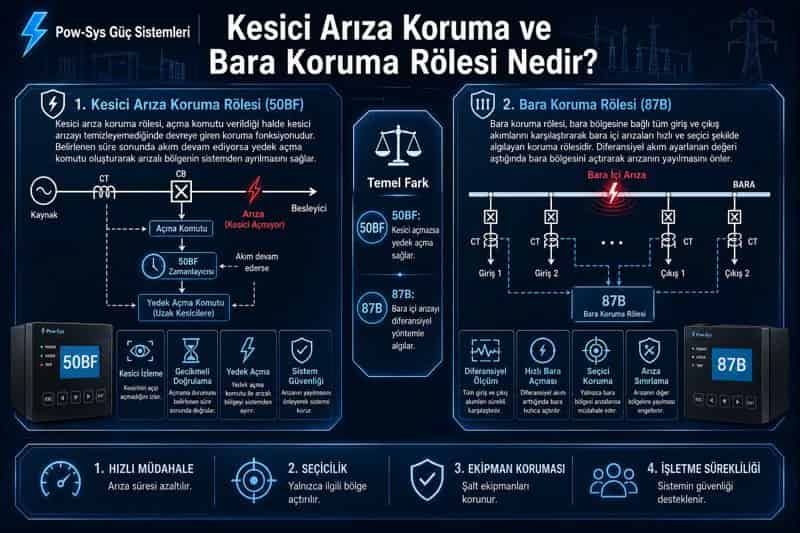
Breaker failure protection and busbar protection relay refers to a special protection structure that performs two of the most critical protection functions together in transformer substations and switchyards. In short, the answer to the question of what breaker failure protection and busbar protection relay is: it is an advanced protection relay that detects internal busbar faults very quickly and establishes backup tripping logic for circuit breakers that receive a trip command but fail to open. This structure is used not only to see a fault but to prevent the fault from growing in the system.
There are two different but directly related protection subjects in this article. The first is busbar protection. Busbar protection evaluates all incoming and outgoing currents connected to the same busbar system together and tries to understand whether there is a fault inside the busbar. The second is breaker failure protection. This protection operates if the related circuit breaker does not clear the fault even though the relay or protection system has sent a trip command to that circuit breaker, and it clears the fault through other circuit breakers. When these two functions work together, switchyard safety increases significantly.
The answer to the question of what a busbar protection relay does is speed. Busbar faults are among the most severe fault types in an electrical system. Because many supplies are connected at the same point and the fault current level can be very high. If a short circuit occurring inside the busbar is cleared late, the busbar, insulators, instrument transformers, disconnectors, circuit breakers and cubicle structure may suffer severe damage. Therefore, the purpose of busbar protection is to clear an internal busbar fault as quickly and selectively as possible.
The answer to what breaker failure protection does is backup security. A circuit breaker should normally clear the fault by opening with the trip command it receives. However, the circuit breaker may fail to open due to mechanical jamming, trip coil problem, auxiliary contact failure, hydraulic-pneumatic problem or similar reasons. In this case, the fault remains in the system and may cause much larger equipment damage. In this scenario, breaker failure protection operates without losing time and trips neighboring circuit breakers according to the busbar or station structure to which it is connected, clearing the fault indirectly.
The basic answer to how a busbar protection relay works is differential logic. The currents of all feeders connected to the same busbar zone are measured and evaluated together. Under normal load or external busbar faults, the currents entering and leaving the busbar zone largely balance each other. If there is a real fault inside the busbar, this balance is disturbed and the relay interprets the differential current as an internal fault. In this way, busbar protection can selectively distinguish whether the fault is inside or outside the busbar's own zone.
The zone concept is very important in busbar protection applications. In large switchyards, there may be more than one busbar zone instead of a single busbar section. In double-busbar, bus-coupled, transfer busbar or sectionalized busbar structures, each section must be evaluated separately. Therefore, modern busbar protection relays can dynamically determine which feeder is included in which busbar zone by also considering disconnector and circuit breaker status information. This logic is often called dynamic zone selection.
Check zone logic is also an important security layer in busbar protection. An additional verification area is created independently of the main zones, covering the entire busbar or a wider section. The purpose is to increase protection security in situations such as incorrect zone selection, disconnector position error or measuring circuit problem. The possibility of unnecessary tripping is reduced by considering the main zone and check zone together. In this way, busbar protection becomes both fast and secure.
Time supervision is at the basis of the question of how breaker failure protection works. The relay or protection system first sends a trip command to the related circuit breaker. Then, whether the breaker opens within a defined time is checked by using current drop, circuit breaker auxiliary contact or both criteria together. If the current is not interrupted within the expected time or the breaker does not move to the open position, breaker failure logic interprets this as a failed-to-open circuit breaker condition. In the next stage, a trip command is sent to predefined neighboring circuit breakers or upstream circuit breakers.
Therefore, breaker failure protection is not an ordinary time relay. The initiation signal, current presence, auxiliary contact information and correct output logic are evaluated together. In some systems, retrip is applied first; in other words, a second trip command is sent to the same circuit breaker. If this also does not produce a result, breaker failure protection trips the upstream or neighboring circuit breakers. Which scenario is applied depends on the station design.
The answer to why busbar protection and breaker failure protection are considered together is switchyard logic. Busbar protection operates very quickly and often trips more than one circuit breaker at the same time. If one of these circuit breakers does not open, the busbar fault continues to remain in the yard. At this point, breaker failure protection operates and compensates for the failed circuit breaker. In other words, busbar protection detects the fault, while breaker failure protection prevents the protection chain from breaking due to a circuit breaker that fails to open.
These structures are especially critical in MV and HV transformer substations. In busbars to which many feeders are connected, bus-coupled systems, generator connections and switchyards with high short-circuit levels, a busbar fault must be cleared quickly. Likewise, a circuit breaker failing to open may create cascading damage. Therefore, in critical stations, busbar protection and breaker failure protection are often among the main safety layers.
Breaker failure protection and overcurrent backup protection are not the same thing. Overcurrent backup protection may be a general backup protection operating with a wider time delay. Breaker failure is a special logic that operates much faster and directly focuses on the failure of the related circuit breaker to open. Similarly, busbar protection is different from ordinary overcurrent protection; it detects an internal busbar fault much more selectively with differential logic.
In modern numerical relays, these two functions may often be found in the same device or between coordinated devices. In addition, additional features such as event records, oscillography, disconnector status monitoring, GOOSE communication, dynamic zone selection and station automation may accompany this structure. In this way, the protection system is no longer only a device that produces trips; it becomes a central structure that provides data for event analysis and station safety.
For these protections to operate reliably, correct CT placement, correct zone definition, correct disconnector position information, circuit breaker auxiliary contact reliability and trip circuit integrity are very important. A small error in settings or field connections may cause either an incorrect busbar trip or delayed intervention during a real fault. Therefore, breaker failure and busbar protection systems should not only be installed, but correctly designed and tested.
In summary, breaker failure protection and busbar protection relay is a critical protection structure that detects internal busbar faults in a switchyard quickly and selectively and establishes backup tripping logic against circuit breakers that receive a trip command but fail to open. Busbar protection operates with differential current logic, while breaker failure protection operates by monitoring the continuation of current after a trip command. When these two functions are used together, both station safety and fault clearing speed are significantly strengthened. In the next step, the tests and maintenance required for breaker failure protection and busbar protection relays can be prepared with the same structure.
Related Blog Posts
Related Services
Frequently Asked Questions
What are breaker failure protection and busbar protection relays?
Breaker failure protection and busbar protection relays form a special protection structure that performs two of the most critical protection functions in transformer substations and switchyards. The busbar protection side detects internal busbar faults very quickly and selectively using differential logic, evaluating all incoming and outgoing currents connected to the same busbar system together. The breaker failure side establishes backup tripping logic for circuit breakers that receive a trip command but fail to open, clearing the fault through neighboring or upstream breakers instead. The purpose of this combined structure is not only to see a fault but to prevent it from growing in the system. In modern numerical relays, these two functions may be found in the same device or between coordinated devices, together with features such as event records, oscillography and dynamic zone selection.
What does a busbar protection relay do?
A busbar protection relay clears internal busbar faults as quickly and selectively as possible by tripping the circuit breakers connected to the affected busbar zone. Speed is the essence of its duty: busbar faults are among the most severe fault types in an electrical system, because many supplies are connected at the same point and the fault current level can be very high. If a short circuit inside the busbar is cleared late, the busbar itself, insulators, instrument transformers, disconnectors, circuit breakers and the cubicle structure may suffer severe damage. By evaluating all incoming and outgoing currents of the zone together, the relay can distinguish an internal fault from an external one and disconnect only the related busbar section, helping healthy parts of the station remain energized as much as possible.
What does breaker failure protection do?
Breaker failure protection provides backup security when a circuit breaker receives a trip command but does not open. Normally a breaker clears the fault as soon as it is commanded, but it may fail to open due to mechanical jamming, a trip coil problem, auxiliary contact failure, hydraulic-pneumatic trouble or similar reasons. In that case the fault remains in the system and may cause much larger equipment damage. Breaker failure protection detects this failed-to-open condition without losing time and trips neighboring or upstream circuit breakers according to the busbar or station structure, clearing the fault indirectly. In some systems a retrip is applied first, meaning a second trip command is sent to the same breaker, and only if that fails is the wider backup trip issued.
How does busbar protection work?
Busbar protection works on differential logic: the currents of all feeders connected to the same busbar zone are measured and evaluated together. Under normal load, and during faults outside the busbar, the currents entering and leaving the zone largely balance each other. When there is a real fault inside the busbar, this balance is disturbed, and the relay interprets the resulting differential current as an internal fault and issues a trip decision for the breakers of that zone. This is what lets busbar protection selectively distinguish whether a fault is inside or outside its own zone. In large switchyards with double-busbar, bus-coupled, transfer or sectionalized arrangements, the relay also uses disconnector and breaker status information for dynamic zone selection, and a check zone adds a further verification layer.
How does breaker failure protection work?
Breaker failure protection works on time supervision. First, the relay or protection system sends a trip command to the related circuit breaker. It then checks whether the breaker actually opens within a defined time, using current drop, the breaker auxiliary contact, or both criteria together. If the current is not interrupted within the expected time, or the breaker does not move to the open position, the logic interprets this as a failed-to-open breaker condition. In the next stage, a trip command is sent to predefined neighboring or upstream circuit breakers so the fault is cleared indirectly. It is not an ordinary time relay: the initiation signal, current presence, auxiliary contact information and correct output logic are evaluated together, and in some station designs a retrip to the same breaker is attempted first.
Why is busbar zone selection important?
Busbar zone selection is important because, in large switchyards, there may be several busbar zones instead of a single busbar section, and protection must know exactly which feeder belongs to which zone. In double-busbar, bus-coupled, transfer busbar or sectionalized busbar structures, each section must be evaluated separately; if a feeder is assigned to the wrong zone, selectivity is disrupted, and the relay may trip the wrong breakers or fail to cover a real internal fault correctly. Modern busbar protection relays therefore determine zone membership dynamically, considering disconnector and circuit breaker status information as the station configuration changes; this logic is often called dynamic zone selection. Correct zone definition, together with correct disconnector position information, is one of the conditions for the whole busbar protection scheme to operate reliably.
What does check zone do?
The check zone is an additional security layer that works alongside the main busbar zones. It is an independent verification area covering the entire busbar or a wider section, created separately from the individual zone measurements. Its purpose is to increase protection security in situations such as incorrect zone selection, a disconnector position error or a measuring circuit problem, any of which could otherwise mislead the main differential logic. A trip is considered together by the main zone and the check zone, which reduces the possibility of unnecessary tripping of a healthy busbar. In this way busbar protection remains both fast and secure: the main zones provide the selectivity needed to isolate only the faulted section, while the check zone confirms that a genuine internal busbar fault really exists.
Are breaker failure protection and overcurrent backup the same thing?
No, breaker failure protection and overcurrent backup protection are not the same thing. Overcurrent backup is a more general protection that typically operates with a wider time delay: it waits long enough for the main protection to act and only then clears the fault from a higher level. Breaker failure is a special logic that operates much faster and focuses directly on one specific event, the failure of the related circuit breaker to open after a trip command. It supervises current drop and breaker position within a defined time and then trips neighboring or upstream breakers. A similar distinction applies on the busbar side: busbar protection is different from ordinary overcurrent protection because its differential logic detects an internal busbar fault much more selectively.
Where are these protections used?
These protections are used especially in MV and HV transformer substations, busbars with many connected feeders, bus-coupled switchyards, double-busbar systems, multi-feeder switchgear installations and stations that require critical continuity. They matter most where the short-circuit level is high, for example in yards with generator connections, because a busbar fault there must be cleared very quickly and a breaker that fails to open may create cascading damage. In such critical stations, busbar protection and breaker failure protection are often among the main safety layers of the whole facility. For them to operate reliably, correct CT placement, correct zone definition, reliable disconnector position information, breaker auxiliary contact reliability and trip circuit integrity are all essential, which is why these systems are not only installed but carefully designed and tested.
Why are these two protections considered together?
They are considered together because of switchyard logic: busbar protection detects an internal fault very quickly and often trips more than one circuit breaker at the same time, but if one of those breakers fails to open, the busbar fault continues to remain in the yard. At that moment breaker failure protection operates and compensates for the failed breaker by tripping the neighboring or upstream breakers, so the fault is still cleared. In other words, busbar protection detects the fault, while breaker failure protection prevents the protection chain from breaking because of a single breaker that does not open. Used together, the two functions significantly strengthen both station safety and fault clearing speed, which is why they are frequently combined in the same device or in coordinated devices in critical stations.