
Summary Highlights
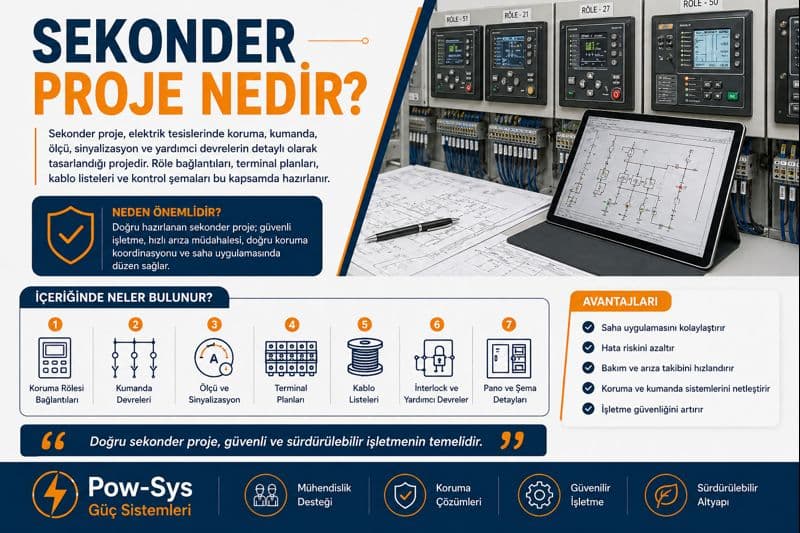
- What is a secondary project: engineering project work showing protection, control, measurement, signal and auxiliary circuits in electrical installations
- What does the secondary project do? It ensures safe control, protection, monitoring and communication of primary equipment with automation systems.
- How to prepare a secondary project: created with relay functions, CT-VT connections, trip circuit, control circuit, terminal plan and cable connection list
- Main project topics: protection relay, on-off circuit, alarm and signal circuits, interlock logic, SCADA connection, DC and AC auxiliary supply
- Areas of use: substations, MV switchgears, HV switchyards, energy production facilities, industrial distribution systems and automated electrical infrastructures
Content
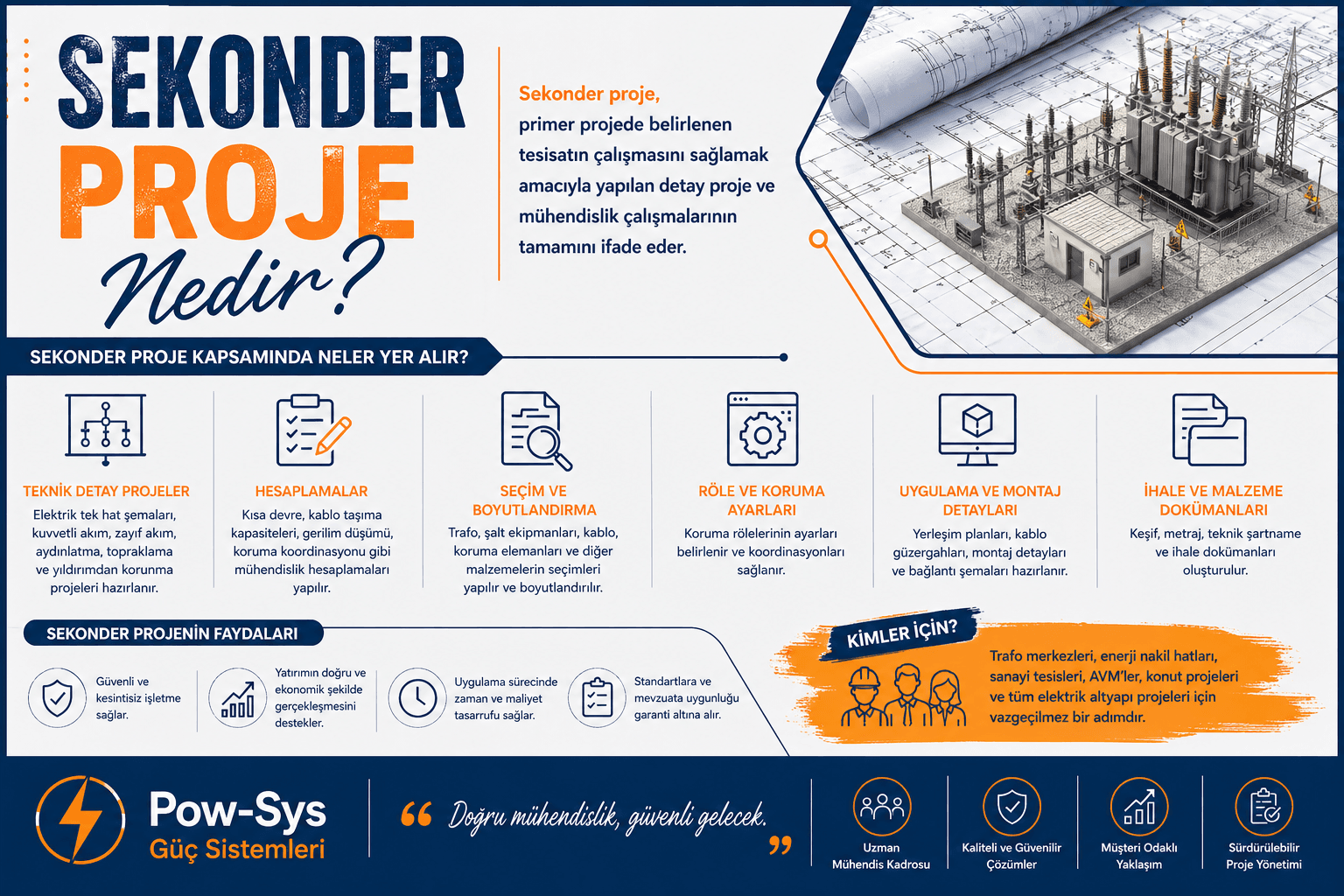
Secondary project is an engineering project study showing protection, control, measurement, signal, alarm, locking and auxiliary supply circuits in an electrical facility. Briefly, the answer to the question of what is a secondary project is; It is a detailed electrical project that explains how the primary equipment will be controlled, which relays it will be protected with, which signals will be monitored and which terminals the cables will be connected to. This project is of critical importance, especially in substations, MV cubicles, HV switchyards and energy production facilities.
At the center of the question of what a secondary project is for is safe control and protection. In the primary project, main power equipment such as breaker, disconnector, current transformer, voltage transformer, power transformer and busbar are shown. In the secondary project, it is determined how these equipment will be turned on and off, which relay will operate in which fault, which signal will go to the panel or SCADA system, and which auxiliary supply will operate which circuit. In other words, the secondary project constitutes the control and security brain of the energy system.
Secondary project and primary project are not the same thing. The primary project shows the main power circuit and primary equipment connections. The secondary project explains the protection, control and monitoring circuits of these primary equipment. For example, while a breaker is shown as a symbol in the primary project, the opening coil, closing coil, auxiliary contacts, trip circuit, control switch and relay output connections of that breaker are detailed in the secondary project. Therefore, the two projects are separate engineering documents that complement each other.
The first answer to the question of how to prepare a secondary project is to determine the system functions. It is clarified which protection functions the facility needs, which equipment will be remote controlled, which signals will be monitored, which alarms will be displayed and which locking conditions will be applied. These functions are then turned into a project with relay, auxiliary relay, terminal, cable and inter-panel connection layout.
Protection relays are among the most important components of the secondary project. It is determined which relay will use functions such as overcurrent, earth fault, differential, distance, voltage, frequency, breaker failure or busbar protection. CT and VT inputs, binary inputs, trip outputs, alarm outputs and communication connections of the relay are shown on the secondary project. Even if the relay selection is correct, if the connection project is incorrect, the protection system will not work reliably.
CT and VT secondary connections are the most sensitive parts of this project. Ratio, polarity, protection-measurement core separation, short-circuiting scheme and grounding point must be displayed correctly in current transformer secondary circuits. In voltage transformer secondary circuits, fuses, automatic breaker, phase sequence, open delta connection, measurement and protection feeds must be clearly stated. Incorrect CT or VT connection may cause faulty measurement of relays and improper operation of the protection.
The trip circuit requires special attention within the secondary project. When a protection relay detects a fault, it must send a trip command to the relevant breaker. It should be clearly drawn from which relay output this command comes out, through which terminal it passes, which auxiliary relay it operates and which trip coil it reaches. A small connection error in the trip circuit may cause the breaker not to trip at the time of the actual fault. Therefore, the trip chain is the most critical safety line of the secondary project.
The closing circuit is at least as important as the opening circuit. Local or remote closing of the breaker, closing coil feeding, spring winding motor, anti-pumping circuit, control switch, locking conditions and closing permissions should be clearly included in the project. If the breaker closing circuit is not designed correctly, closing at the wrong time, re-closing problems or control instability may occur. For this reason, the control circuit should not be seen as just a button connection.
Interlock circuits are an important part of the secondary project in terms of field safety. The correct locking logic must be established between the breaker, disconnector, earth separator, door contact, busbar selection and coupling scenarios. The aim is to prevent equipment from being operated in the wrong order and increase personnel safety. Especially in MV and HV switchgear systems, field maneuvers may pose serious risks if the interlock circuit is designed incorrectly.
Signal and alarm circuits are necessary for business monitoring. Information such as breaker open-close information, disconnector position, earth separator status, relay trip information, spring board signal, DC supply failure, VT fuse failure, protection alarm and intra-cell fault can be displayed on the panel or in the central monitoring system. The secondary project must clearly show which equipment these signals are received from, which terminal they arrive at, and to which point they are transported.
Measurement circuits are also included in the secondary project. Meter, energy analyzer, power meter, voltmeter, ammeter and protection relay measurement inputs can be fed via CT and VT circuits. In these circuits, measurement accuracy, phase sequence, ratio information and connection order must be established correctly. The wrong measurement circuit not only shows the wrong value on the screen; It can also mislead energy monitoring, compensation evaluation and operating decisions.
The terminal plan is one of the most important documents in the implementation field of the secondary project. This plan shows which terminal numbers the in-panel devices, field equipment, cell terminals and external cable connections are connected to. One of the documents most used by technicians during installation, commissioning, troubleshooting and maintenance is the terminal plan. Therefore, terminal numbers must be consistent, readable and suitable for field application.
The wiring list is an integral part of the secondary project. Which cable goes from where to where, how many cores it has, cross-section, cable number, core numbers, shield connection and terminal correspondences are stated in this list. Since there are many secondary cables, especially in substations and switchyards, the installation and testing process becomes seriously difficult if the cable list is not prepared correctly. A well-prepared cable list reduces field errors.
DC and AC auxiliary supply circuits are required for the operation of the secondary system. DC system often feeds on-off, protection relay, alarm and control circuits. AC auxiliary supply can be used for heater, lighting, socket, motor, charger or some auxiliary equipment. The fuses, distribution points, redundancy status and alarm contacts of these feeds should be clearly shown in the secondary project.
SCADA and communication connections are an important part of modern secondary projects. Data transfer can be made via protection relays, energy analyzers, meters, RTU, gateway and communication switches. Breaker location, fault records, measurement values, alarm information and remote control commands are carried through this infrastructure. Therefore, the secondary project is now a document that includes not only the wiring drawing but also the data and automation architecture.
While preparing the secondary project, ease of testing and maintenance should also be considered. If test blocks, short-circuiting terminals, relay test sockets, disconnection terminals and measurement points are planned correctly, commissioning and periodic maintenance are much safer. If these details are neglected, unnecessary risk and loss of time will occur during field relay testing, CT control or trip circuit verification. A good secondary project also makes the job of maintenance teams easier.
In summary, the secondary project; It is the basic engineering study detailing the protection, control, measurement, alarm, signal, locking, terminal, cable and auxiliary supply circuits in electrical installations. While the primary project shows the main power circuit, the secondary project provides safe management of this power circuit. A correctly prepared secondary project ensures that the protection works in the event of a malfunction, the control is reliable during operation, and the circuits can be easily monitored during the maintenance process. An incomplete or incorrectly prepared secondary project can prevent the safe operation of even the highest quality primary equipment.
Frequently Asked Questions
What is a secondary project?
Secondary project is an engineering project study showing protection, control, measurement, signal, alarm, interlock, terminal and cable connection circuits in electrical installations.
What does the secondary project do?
It ensures safe control of primary equipment, protection in case of malfunction, and monitoring of measurement and signal information.
How to prepare a secondary project?
Protection functions are determined, CT-VT connections are arranged, relay inputs and outputs are defined, trip and control circuits are drawn, terminal plan and cable list are prepared.
What is the difference between primary project and secondary project?
The primary project shows the main power circuit and power equipment. The secondary project shows the protection, control, measurement and signal circuits of these equipment.
What circuits are included in the secondary project?
On-off circuits, protection relay connections, CT-VT circuits, alarm and signal circuits, interlock circuits, SCADA connections and auxiliary supply circuits may be present.
Why is the trip circuit important?
Because it ensures that the trip command given by the protection relay reaches the breaker reliably. The fault in the trip circuit may cause the breaker not to open in the event of a real fault.
Why is a terminal plan necessary?
It shows which terminal all connections between the panel and field equipment are made through. It facilitates assembly, testing and troubleshooting processes.
What is the secondary cable list used for?
It streamlines field application by showing which cable goes from where to where, core numbers, cross-sections and terminal connections.
Does the secondary project include SCADA connection?
Yes. In modern facilities, transferring relay, meter, analyzer and control information to the central system can be shown as part of the secondary project.
Why should the secondary project be prepared correctly?
Because wrong connection, missing terminal plan or faulty trip circuit may cause the protection system not to work, wrong trips and operational safety problems.