

Summary Highlights
- What is breaker failure protection and busbar protection relay: a special protection structure that quickly detects internal busbar faults in the switchyard and establishes backup tripping logic against the breaker that does not open.
- What it does: clearing the busbar internal fault very quickly, limiting the damage to the system from a non-opening breaker, and keeping healthy areas energized as much as possible
- How it works: decision logic via busbar differential current comparison, zone selection, breaker status information and breaker failure time monitoring
- Main functions: busbar differential protection, check zone, dynamic zone selection, retrip, breaker failure initiation and tripping of neighboring breakers
- Areas of use: MV and HV substations, double busbar systems, coupled fields, multi-feeder switchgear facilities and stations requiring critical continuity
Content
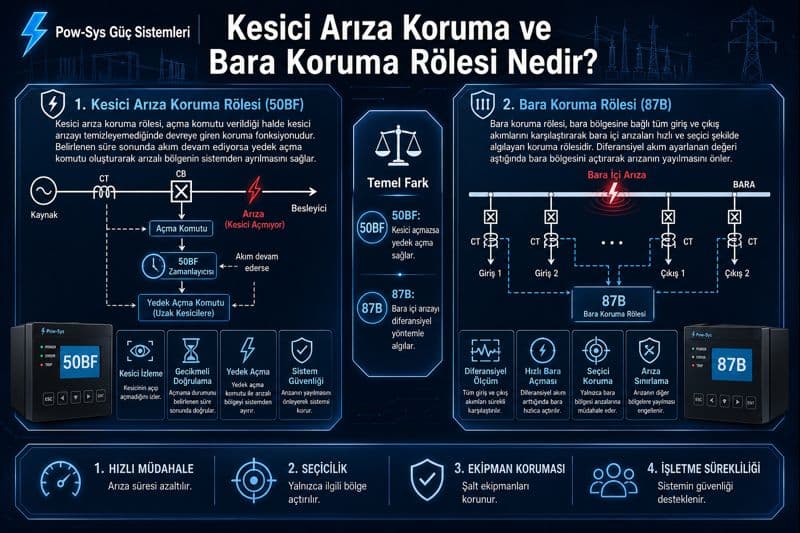
Breaker fault protection and busbar protection relay refers to the special protection structure that carries out the two most critical protection functions together in substations and switchyards. Briefly, the answer to the question of what is breaker failure protection and busbar protection relay; It is an advanced protection relay that detects internal bus faults very quickly and establishes backup tripping logic for breakers that do not open despite receiving a trip command. This structure is used not only to detect a fault, but also to prevent the fault from growing in the system.
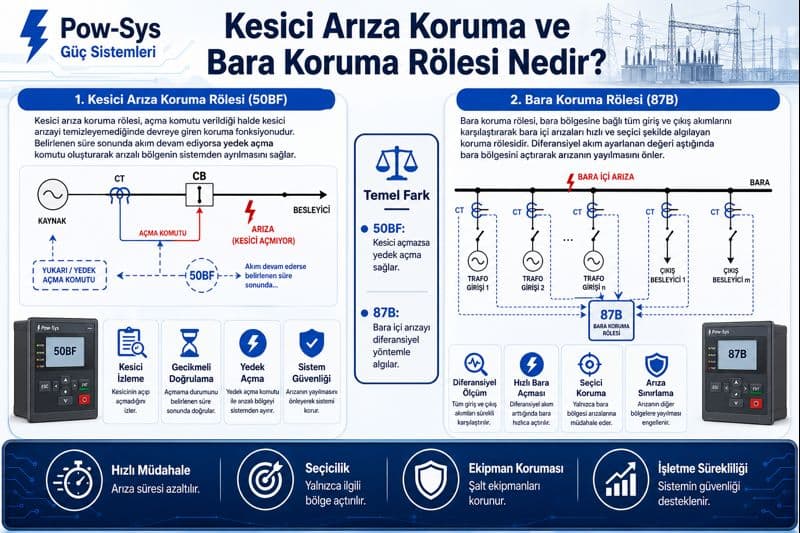
There are two different but directly related conservation topics in this article. The first is bar protection. Busbar protection tries to understand whether there is a fault in the busbar by evaluating all input and output currents connected to the same busbar system. The second is breaker failure protection. This protection comes into play if the relay or protection system gives an opening command to a breaker, but the relevant breaker does not clear the fault, and clears the fault through other breakers. When these two functions work together, the safety of the switchyard is significantly increased.
The answer to the question of what a busbar protection relay does is speed. Busbar faults are among the most severe types of faults in the electrical system. Because many feeds converge at the same point and the fault current level may be very high. If a short circuit in the busbar is cleared too late, the busbar, insulators, measurement transformers, separators, breakers and cell structure may be severely damaged. Therefore, the purpose of busbar protection is to selectively clear the busbar internal fault as quickly and selectively as possible.
The answer to the question of what breaker failure protection does is backup safety. A breaker should normally clear the fault by opening it with the trip command it receives. However, the breaker may not open due to mechanical jamming, opening coil problem, auxiliary contact failure, hydraulic-pneumatic problem or similar reasons. In this case, the fault remains in the system and can cause much greater equipment damage. In this scenario, the breaker failure protection comes into play without wasting any time, opening the neighboring breakers according to the busbar or station structure to which it is connected and indirectly clearing the fault.
The basic answer to the question of how the busbar protection relay works is differential logic. The currents of all feeders connected to the same busbar area are measured and these currents are evaluated together. During normal load or non-busbar faults, the currents entering and exiting the busbar area balance each other to a large extent. If there is a real fault in the busbar, this balance is disrupted and the relay interprets the differential current as an internal fault. The busbar protection can thus selectively distinguish whether the fault is within or outside the busbar's own zone.
The concept of zone is very important in busbar protection applications. In large switchyards, there may be more than one busbar zone instead of a single busbar zone. In double busbar, coupled system, transfer busbar or segmented busbar structures, each zone must be evaluated separately. For this reason, modern busbar protection relays can dynamically determine which feeder is included in which busbar zone, taking into account the separator and breaker status information. This logic is often called dynamic zone selection.
Check zone logic is also an important security layer in busbar protection. An additional verification area is created covering the entire busbar or wider region, independent of the main zones. The aim is to increase the security of the protection in cases such as wrong zone selection, separator location error or measurement circuit problem. By considering the main zone and check zone together, the possibility of unnecessary trips is reduced. In this way, busbar protection becomes both fast and safe.
The basis of the question of how breaker failure protection works is time control. The relay or protection system first sends a trip command to the relevant breaker. Then, whether the breaker opens or not in a certain period of time is checked by using the current drop, the breaker auxiliary contact, or both criteria together. If the current is not interrupted or the breaker does not open within the expected time, the breaker failure logic interprets this as a breaker that does not open. In the next stage, a trip command is sent to predefined neighboring breakers or upper level breakers.
Therefore, breaker failure protection is not an ordinary time relay. Both the start signal, current presence, auxiliary contact information and correct output logic are evaluated together. In some systems, retrip is applied first; That is, the opening command is sent to the same breaker a second time. If this does not work, breaker failure protection trips the upper or neighboring breakers. Which scenario will be implemented depends on the station design.
The answer to the question of why busbar protection and breaker failure protection should be considered together is the switchyard logic. Busbar protection operates very quickly and often trips multiple breakers simultaneously. If one of these breakers does not trip, the busbar fault remains in the field. At this point, breaker failure protection comes into play and compensates for the failed breaker. In other words, busbar protection detects the fault, and breaker fault protection prevents the protection chain from breaking due to the breaker not opening.
These structures are of critical importance especially in MV and HV substations. Rapid cleaning of busbar faults is mandatory in busbars where many feeders are connected, in coupled systems, in generator connections and in areas with high short circuit levels. Likewise, failure to trip a breaker can cause chain damage. For this reason, busbar protection and breaker failure protection are often among the main security layers in critical stations.
Breaker failure protection and overcurrent backup protection are not the same thing. The overcurrent backup protection can be a general backup protection that operates with a larger time delay. Breaker failure, on the other hand, is a special logic that focuses much faster and directly on the failure of the relevant breaker to open. Similarly, busbar protection is different from ordinary overcurrent protection; It detects internal bus faults much more selectively with differential logic.
In modern digital relays, these two functions can often be found within the same device or between coordinated devices. Additionally, additional features such as event recording, oscillography, separator status monitoring, GOOSE communication, dynamic zone selection and station automation can accompany this structure. Thus, the protection system ceases to be just a trip-producing device, but also turns into a central structure that provides data for event analysis and station security.
For the proper functioning of these protections, correct CT placement, correct zone definition, correct disconnector location information, breaker auxiliary contact reliability and trip circuit integrity are very important. A small mistake in the settings or field connections can cause either a wrong busbar trip or a delayed intervention in the event of an actual fault. Therefore, breaker failure and busbar protection systems must not only be installed but also correctly designed and tested.
In summary, breaker failure protection and busbar protection relay; It is a critical protection structure that quickly and selectively detects internal busbar faults in the switchyard and establishes backup tripping logic against breakers that do not open despite receiving a trip command. Busbar protection works with differential current logic, and breaker failure protection works by monitoring the continuation of the current after the trip command. When these two functions are used together, both station security and fault clearance speed are significantly strengthened. In the next step, if you want, I can also prepare an article on the tests and maintenance that should be done in breaker failure protection and busbar protection relays with the same pattern.
Frequently Asked Questions
What is breaker fault protection and busbar protection relay?
This structure is a protection system that detects internal busbar faults with differential logic and creates a backup tripping scenario for breakers that do not open despite the trip command.
What does the busbar protection relay do?
It detects internal busbar faults very quickly and selectively, opens the breakers connected to the relevant busbar area and helps prevent heavy equipment damage.
What does breaker failure protection do?
It detects the breaker that does not open even though it receives a trip command, and provides backup protection by opening neighboring or higher-level breakers to clear the fault.
How does busbar protection work?
It compares all input and output currents connected to the same busbar region. In case of an internal fault, the current balance is disrupted and the differential protection trips.
How does breaker failure protection work?
After the trip command is sent to the relevant breaker, it monitors whether the current is interrupted within a certain period of time and whether the breaker opens or not. In case of failure to open, it initiates a backup trip.
Why is bus zone selection important?
Because in areas with multiple busbars or couplings, it is necessary to determine correctly which busbar zone each feeder belongs to. Wrong zone selection may impair selectivity.
What does the check zone do?
It provides an additional layer of security to main busbar zones. It helps reduce the risk of false trips in case of zone selection or measurement circuit errors.
Are breaker failure protection and overcurrent backup the same thing?
No. Overcurrent backup is a more general and often more delayed backup protection. Breaker failure is a faster protection logic specific to the case of a breaker not opening.
Where are these protections used?
It is especially used in MV and HV substations, multi-feeder busbars, coupled areas, critical switchgear facilities and stations with high short circuit levels.
Why are these two protections considered together?
Because the busbar protection detects the fault very quickly, but if one of the breakers that should open does not open, the fault remains on the field. In this case, breaker failure protection comes into play and completes the protection chain.