
Summary Highlights
- What a DC hipot test is: a test method that applies direct-current high voltage to equipment to evaluate insulation withstand
- What a DC hipot test does: reveals insulation weaknesses and provides technical data for acceptance and maintenance decisions
- How a DC hipot test is performed: applying a controlled ramped DC voltage to the equipment to be tested and monitoring its behavior for a defined duration
- Application areas: cable systems, some electrical equipment and field and maintenance applications requiring insulation checks
- Important evaluation subjects: leakage current, test duration, correct discharge process, equipment suitability and selecting the test method according to the material
Article Details
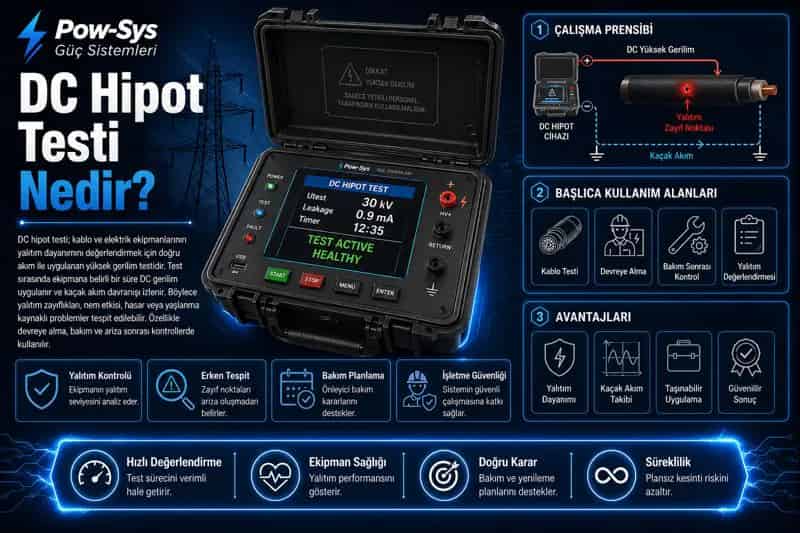
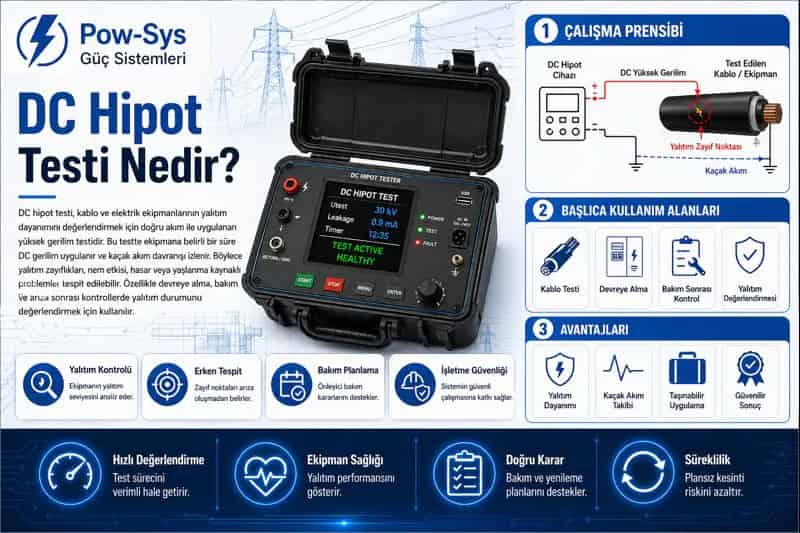
A DC hipot test is a high-voltage withstand test performed using direct current. In short, the answer to the question of what a DC hipot test is: it is a test method that evaluates insulation integrity by exposing an equipment or insulation system to a defined direct voltage level. The term hipot here comes from high potential. The aim is to see how the equipment behaves under electrical stress above normal operating conditions.
Insulation withstand is at the center of the question of what a DC hipot test does. Even if a cable, termination, joint or different high-voltage equipment appears problem-free in operation, weak points may exist inside the insulation. Manufacturing defect, aging, moisture effect, mechanical damage, contamination or installation errors can weaken this structure over time. The DC hipot test helps these weaknesses appear under controlled voltage and supports decisions about commissioning the equipment or keeping it in operation.
The basic logic of the DC hipot test is to apply direct-current voltage to the tested insulation. The voltage is increased step by step according to a defined procedure, held for a defined time when the target value is reached, and leakage current and general behavior are observed during this period. If the insulation system is healthy, stable behavior within certain limits is expected. If the insulation is weak, excessive leakage current, instability or breakdown-like conditions may be seen.
To explain simply how a DC hipot test is performed, the equipment to be tested is first de-energized, safely isolated and suitable grounding procedures are applied. Then the test device is connected and the voltage is increased in a controlled way. During the test, voltage level, current behavior and the response of the equipment are monitored. At the end of the test, the discharge process, one of the most critical stages, must be performed correctly. Because during a direct-current test, the equipment can store energy to a certain extent.
Leakage current is one of the important observation parameters in this test. When direct-current voltage is applied, charging current and polarization effects may be seen at the beginning. Then the current is expected to stabilize at a certain level. If the current rises abnormally, fluctuates or reaches unacceptable levels, this may indicate an insulation problem. In other words, a DC hipot test means not only applying voltage but also interpreting behavior during the test.
A DC hipot test and insulation resistance measurement are not the same thing. In an insulation resistance test, a lower-level DC voltage is generally used and the aim is to measure insulation resistance. In a DC hipot test, much higher voltage is applied and the main focus is withstand verification. Therefore, a hipot test is a heavier test than an insulation resistance test and must be planned more carefully.
A DC hipot test and an AC hipot test are also not the same thing. In an AC hipot test, alternating voltage is applied to the equipment and the electric field behavior may be closer to operating conditions. In a DC hipot test, the field distribution and effect on insulation are different. Therefore, the same test method is not accepted as suitable for every equipment. Which method will be used should be determined according to the insulation structure of the tested equipment and the manufacturer's approach.
The difference between a DC hipot test and a VLF test also becomes important here. In a VLF test, very low frequency AC voltage is applied. In a DC hipot test, direct-current voltage is used. Especially in modern extruded insulated cables, while the VLF approach is considered more suitable in many applications, the use of DC hipot testing may stand out more in some equipment types or certain older cable structures. Therefore, test method selection should be made according to equipment suitability, not habit.
DC hipot testing has historically been used widely in many field applications. It has had an important place especially in some older cable systems, certain insulation structures and some field acceptance processes. However, today it is not a method automatically preferred for all equipment. Especially in modern polymeric cable systems, incorrect method selection may lead to unwanted effects, so the test decision must be made through technical evaluation.
This test is most often considered for cable systems, terminations, joint areas and some high-voltage equipment. However, DC hipot is not applied to every cable or every equipment at the same level and for the same duration. Test voltage, test duration, ramp speed and acceptance approach vary according to the voltage class, age, insulation type and application purpose of the equipment. The test approach considered for newly commissioned equipment and the approach considered for aged equipment may not be the same.
One advantage of the DC hipot test is that its application logic is relatively simple. Device setup and voltage application can be practical in certain field scenarios. It can also be used as an effective method for revealing insulation weaknesses in some equipment types. DC hipot testing may have an important place especially when verification under additional electrical stress is needed for acceptance or maintenance decisions.
However, the DC hipot test also has limitations. Not every equipment may be suitable for this test. Especially an incorrectly selected voltage level, unnecessarily long test duration or application to unsuitable equipment may increase the risk of damage more than the diagnostic benefit of the test. Therefore, a DC hipot test should always be applied with correct equipment, correct procedure and correct engineering decision. The decision whether or not to perform the test carries technical responsibility as much as performing the test.
Safe discharge at the end of the test is vital. Because during a direct-current test, the tested equipment can store energy, especially in capacitive structures such as cables. After the voltage is removed, the equipment must be safely grounded and discharged. If this step is neglected, a serious risk may occur for personnel safety. Therefore, DC hipot testing is not only a measurement but also a disciplined occupational safety process.
DC hipot test results should be interpreted carefully when evaluated alone. Passing the test successfully does not mean the equipment will operate without problems forever. Similarly, failure or high leakage current does not always indicate the same fault type by itself. Results should be evaluated together with the equipment's history, age, field conditions and, if necessary, other diagnostic tests. In this way, healthier maintenance and operation decisions can be made.
In summary, a DC hipot test is an important test method used to evaluate the withstand of an insulation system under high direct voltage. It can be applied for acceptance, commissioning or maintenance purposes on cables and some electrical equipment. Leakage current behavior, test duration, suitable voltage selection and correct discharge are the basic elements of this method. However, because it is not suitable for every equipment, the test decision must be made according to equipment type and technical requirement. When planned correctly, it provides valuable information; when applied incorrectly, it may impose unnecessary stress on the equipment. In the next step, the application steps required in DC hipot testing or the difference between DC hipot testing and VLF testing can be prepared with the same structure.
Related Blog Posts
- What Is a VLF Test? What Does It Do, How Is It Performed and Why Is It Used?
- What Is a DC Insulation (Megger) Test? What Does It Do, How Is It Performed and Why Is It Used?
- What Is an AC Insulation Test Performed with Tan Delta and Capacitance Measurement? What Does It Do, How Is It Performed and Why Is It Used?
- What Is an Earthing Switch? What Does It Do, How Does It Work and Where Is It Used?
Related Services
Frequently Asked Questions
What is a DC hipot test?
A DC hipot test is a high-voltage withstand test performed using direct current, in which an equipment or insulation system is exposed to a defined direct voltage level to evaluate its insulation integrity. The word hipot comes from high potential, and the aim of the test is to see how the equipment behaves under electrical stress above its normal operating conditions. The voltage is raised step by step according to a defined procedure, held for a defined time at the target level, and the leakage current and general behavior are observed. A healthy insulation system is expected to show stable behavior within certain limits, while weak insulation may reveal excessive leakage current, instability or breakdown-like conditions. The method is considered mainly for cable systems, terminations, joint areas and some high-voltage equipment.
What does a DC hipot test do?
A DC hipot test reveals insulation weaknesses under controlled voltage and provides technical data for acceptance, commissioning and maintenance decisions. Equipment that appears problem-free in operation may still contain hidden weak points: manufacturing defects, aging, moisture, mechanical damage, contamination or installation errors can gradually weaken the insulation of a cable, termination, joint or other high-voltage equipment. By applying electrical stress above normal operating conditions, the test lets these weaknesses appear in a controlled setting rather than as an unexpected failure in service. The results support decisions about commissioning new equipment or keeping existing equipment in operation. It can also serve as an effective verification method when additional electrical stress is needed before an acceptance or maintenance decision, provided the equipment type is actually suitable for a direct-current test.
How is a DC hipot test performed?
A DC hipot test is performed on equipment that has first been de-energized, safely isolated and grounded according to suitable procedures. The test device is then connected and the direct voltage is increased in a controlled, stepped way until the target level is reached, after which it is held for a defined duration. During the test, the voltage level, the current behavior and the response of the equipment are monitored. At the end, the discharge process, one of the most critical stages, must be performed correctly: the equipment must be safely grounded and discharged, because capacitive structures such as cables can store energy during a direct-current test. Test voltage, duration, ramp speed and acceptance approach are not universal; they vary with the equipment's voltage class, age, insulation type and the purpose of the application.
Which values are monitored in a DC hipot test?
The most important observation in a DC hipot test is leakage current behavior, evaluated together with the applied voltage level, the test duration and the general stability of the insulation. When direct voltage is first applied, charging current and polarization effects may appear, after which the current is expected to settle at a stable level. If the current rises abnormally, fluctuates or reaches unacceptable levels, this may indicate an insulation problem. In other words, the test is not merely about applying voltage: it is about interpreting how the equipment behaves throughout the test period. A healthy insulation system shows stable behavior within certain limits, while excessive leakage current, instability or breakdown-like conditions point to weakness. These observations are then read together with the equipment's history, age and field conditions before any conclusion is drawn.
Are DC hipot testing and insulation resistance testing the same?
No, a DC hipot test and an insulation resistance test are not the same thing, although both use direct voltage. In an insulation resistance test, a lower-level DC voltage is generally used, and the aim is to measure the resistance of the insulation. In a DC hipot test, a much higher voltage is applied, and the main focus is withstand verification: proving that the insulation can hold a defined stress above normal operating conditions. Because of this, the hipot test is a heavier test than an insulation resistance measurement and must be planned more carefully, with proper attention to voltage level, duration, equipment suitability and safe discharge afterwards. The two methods complement each other but answer different questions, one about resistance level and the other about withstand capability.
Are DC hipot testing and AC hipot testing the same thing?
No, they are not the same thing. In an AC hipot test, alternating voltage is applied to the equipment, and the electric field behavior may be closer to actual operating conditions. In a DC hipot test, direct voltage is used, so the field distribution and the effect on the insulation are different. This difference is why the same test method is not accepted as suitable for every piece of equipment: the choice between AC and DC must be determined according to the insulation structure of the tested equipment and the manufacturer's approach. The voltage character also changes what happens during the test itself, since a direct-current test causes the equipment to store energy, which makes controlled discharge at the end of a DC test especially critical for safety.
What is the difference between DC hipot testing and VLF testing?
The difference is the character of the applied voltage: DC hipot testing uses direct-current voltage, while VLF testing applies alternating voltage at a very low frequency. This distinction matters most for modern extruded insulated cables, where the VLF approach is considered more suitable in many applications, whereas DC hipot testing may stand out more for some equipment types or certain older cable structures. Historically, DC hipot testing was used widely in field applications and older cable systems, but today it is not a method automatically preferred for all equipment; in modern polymeric cable systems, incorrect method selection may lead to unwanted effects. The guiding principle is that the test method should be selected according to equipment suitability and technical evaluation, not according to habit or whichever device happens to be available.
Which equipment is DC hipot testing used on?
DC hipot testing is most often considered for cable systems, terminations, joint areas and some high-voltage equipment, but it is not automatically suitable for every cable or every device. It has historically had an important place in some older cable systems, certain insulation structures and some field acceptance processes. In modern polymeric cable systems, however, incorrect method selection may lead to unwanted effects, so the decision to use DC hipot must come from technical evaluation rather than routine. Even where the method fits, it is not applied at the same level and duration everywhere: test voltage, test duration, ramp speed and the acceptance approach vary with the equipment's voltage class, age, insulation type and application purpose, and new equipment is not approached the same way as aged equipment.
Why should a DC hipot test be planned carefully?
A DC hipot test must be planned carefully because an incorrectly executed test can harm more than it helps. An incorrectly selected voltage level, an unnecessarily long test duration or application to unsuitable equipment may increase the risk of damage beyond the diagnostic benefit the test provides. Not every equipment type is appropriate for direct-current stress, so the decision whether or not to test carries technical responsibility as much as performing the test itself. Correct equipment, correct procedure and a sound engineering decision are all required. Results also demand careful interpretation: passing does not guarantee trouble-free operation forever, and high leakage current does not always indicate the same fault type, so findings should be read together with the equipment's history, age, field conditions and, if necessary, other diagnostic tests.
Why is discharge important at the end of the test?
Discharge is critical because equipment can store energy during a direct-current test, especially capacitive structures such as cables. After the test voltage is removed, that stored energy does not simply disappear: the equipment must be safely grounded and discharged before anyone touches it. If this step is neglected, a serious risk may occur for personnel safety, which is why the discharge process is described as one of the most critical stages of the whole test. For this reason, a DC hipot test is not only a measurement activity but also a disciplined occupational safety process, beginning with de-energizing and isolating the equipment, continuing with controlled voltage application, and ending only when the equipment has been properly discharged and grounded at the end of the test.