

Summary Highlights
- What is an overcurrent and earth protection relay: its basic definition as a combined protection relay that monitors phase currents and earth fault current
- What does the overcurrent and ground protection relay do? Its duty is to selectively detect short circuit, overcurrent and ground fault and open the relevant breaker.
- How does overcurrent and ground protection relay work: Logic of evaluating phase and neutral/residual current from CTs according to pickup and time settings
- Main stages and functions: I>, I>>, I0>, I0>>, IDMT, definite time, instantaneous and, where necessary, directional earth protection structures
- Areas of use and selection: MV feeders, cable outlets, transformer backup, motor feeds and protection coordination in distribution systems
Content
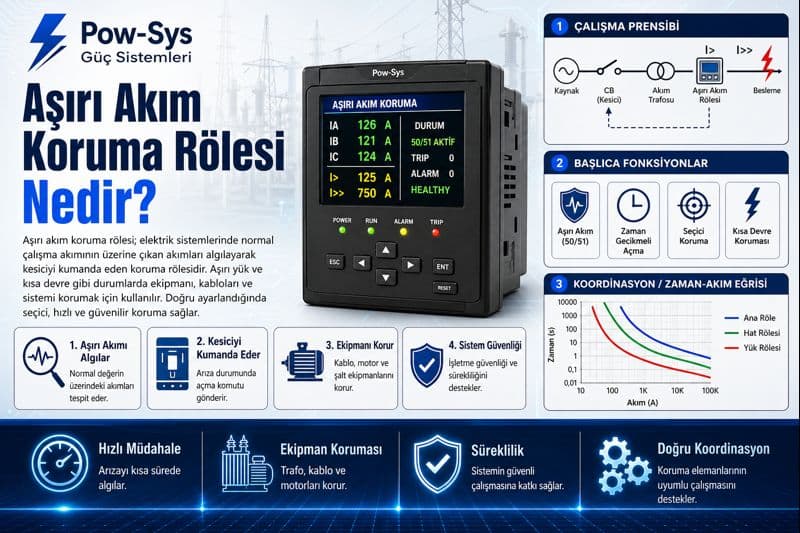
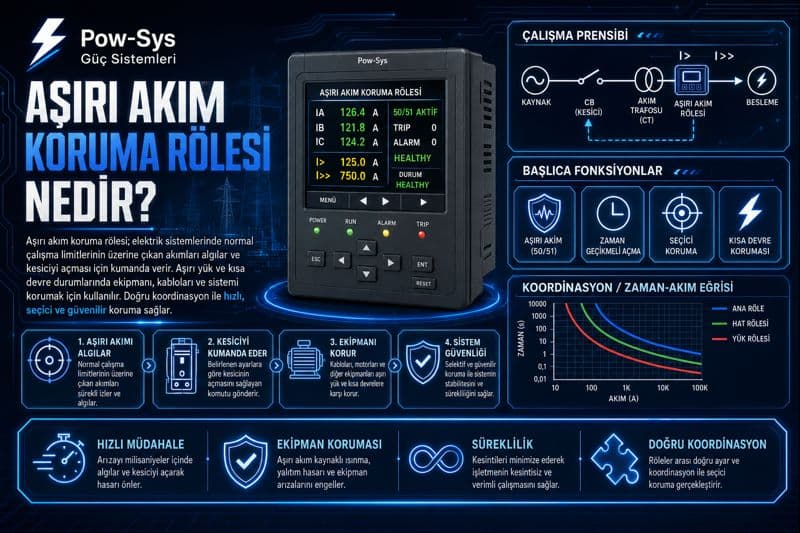
Overcurrent and ground protection relay is a relay that provides protection by monitoring phase currents and residual current indicating ground fault in the electrical system. Briefly, the answer to the question of what is an overcurrent and earth protection relay is; It is a protection device that detects short-circuit, overload-like current increases and phase-ground faults and gives the opening command to the relevant breaker. This relay serves as one of the basic protection elements of the feeder, cable, transformer output or distribution circuit in most applications.
Safety and selectivity are at the heart of the question of what an overcurrent and ground protection relay does. When there is a malfunction in the electrical installation, the aim is not to shut down the entire system, but to disable only the faulty section. While overcurrent protection is activated for phase-to-phase short circuits or faults that produce high currents, the ground protection function acts more sensitively for lower-level but potentially dangerous phase-ground faults. Thus, both equipment is protected and unnecessary large area outages are reduced.
This relay has two main tasks. The first is phase overcurrent protection. This function monitors phase currents and decides to trip in case of short circuit or heavy overcurrent. The second is the earth fault or ground fault, that is, the soil protection function. This part detects phase-ground faults by evaluating the neutral current, residual current or residual component according to the system. Having two functions in the same relay is a practical and common solution, especially in distribution feeders.
To explain the question of how the overcurrent and ground protection relay works simply, the relay constantly measures the currents coming from the CTs and compares them with the set pickup values. If the phase current exceeds the specified I> or I>> level, the phase overcurrent protection operates. If the residual current or neutral current exceeds the specified I0> or I0>> level, the earth fault protection is activated. The relay then produces a trip decision according to the set time curve or fixed delay logic.
The most common stages in overcurrent protection are low stage and high stage. The low stage is usually called I> and often operates with a time delay. The higher stage is expressed as I>> and is used for faster tripping in case of more severe faults. Some relays also have instantaneous opening stages. This structure is used to achieve both selectivity and fast fault clearing.
There is similar logic on the soil conservation side. While the I0> stage is used for more sensitive and often delayed earth fault protection, the I0>> can provide higher level and faster trip logic. The important difference here is that the ground fault current may often not be as high as the phase-to-phase short circuit current. Therefore, the soil protection function needs to be adjusted more precisely. This sensitivity is very important, especially in systems with resistive grounding or limited fault current generation.
This is why the ground protection function is more sensitive than phase protection. Phase overcurrent protection may not detect some low-level ground faults or may not be able to evaluate them quickly enough. Ground protection, on the other hand, helps detect lower magnitude phase-ground faults because it monitors the residual current. For this reason, in the modern protection approach, phase overcurrent and earth fault protection are often considered together.
How the ground fault current is measured is also an important issue. In some applications, the residual sum of three phase CT is used. In some systems, core-balance CT, i.e. toroidal type current transformer, is preferred. The core-balance approach may be especially advantageous for more sensitive monitoring of ground faults. Which method is appropriate is determined by the nature of the system and the desired level of precision.
Time characteristic is one of the most critical adjustment topics of these relays. In IDMT, i.e. inverse definite minimum time structure, as the current increases, the tripping time decreases. In the definite time characteristic, a fixed delay is applied after the threshold is exceeded. In instantaneous or sudden opening logic, above the threshold the relay operates without delay or with a very short delay. Which approach is appropriate depends on the protection coordination and the structure of the circuit.
For this reason, the overcurrent and earth protection relay is not a simple device that only works to check whether there is a fault or not. In fact, the pickup value is adjusted by considering the time curve, instantaneous trip level, earth fault sensitivity and up-down protection coordination. While the same relay operates very safely in one facility, it may cause unnecessary trips in another facility with incorrect setting. The setting is as critical as the device.
Overcurrent and earth protection relays are widely used especially in radial feeders, cable outlets, MV cubicles, transformer feeders, compact centers and motor feeds. In some applications, it acts as the main protection, and in some applications, it acts as backup protection. These relays form the basis of the protection philosophy, especially in distribution systems where the need for simple and reliable protection comes to the fore.
In directional systems, these functions may develop further. If there are ring networks, bi-directional feeds or parallel sources, overcurrent and ground protection can be operated with direction information. Thus, the relay evaluates not only the current magnitude but also the fault current direction. This structure is especially important in preventing false openings in looped distribution systems.
Overcurrent and ground protection relays are not the same as differential relays. Differential protection provides more selective internal zone protection by comparing the input-output currents of a particular equipment. Overcurrent and ground protection offer a more general approach and are often used as primary or backup protection for feeders or equipment. That's why it is a common, economical and powerful protection solution; However, it may not be sufficient on its own in all cases.
In modern digital relays, these functions not only produce a trip decision. Many devices also offer additional protection functions such as event recording, fault current recording, oscillography, communication, measurement and sometimes breaker failure. Thus, the overcurrent and ground protection relay becomes not only a protection element, but also a data source that helps monitor system behavior.
In summary, overcurrent and earth protection relay; It is a basic relay that provides protection in case of short circuit, overcurrent and phase-ground faults by monitoring phase currents and ground fault current. It can work with stages such as I>, I>>, I0>, I0>>, IDMT or definite time curves and directional functions when necessary. A correctly selected, correctly adjusted and correctly tested overcurrent-earth protection relay is one of the most important layers of safe operation in MV and HV distribution systems. In the next step, if you want, I can also prepare an article on the tests and maintenance that should be done in overcurrent and earth protection relays with the same pattern.
Frequently Asked Questions
What is an overcurrent and ground protection relay?
Overcurrent and ground protection relay is a protection relay that monitors phase currents and ground fault currents and issues opening commands in case of short circuit, overcurrent and phase-ground faults.
What does overcurrent and ground protection relay do?
It selectively disables the faulty section, protecting the equipment and helping to keep healthy sections energized as much as possible.
How does overcurrent and ground protection relay work?
Compares phase currents and residual/neutral current from CTs with pickup settings; If the threshold is exceeded, it makes a trip decision according to the set time logic.:contentReference[oaicite:1]{index=1}
What do I>, I>>, I0> and I0>> mean?
I> and I>> refer to phase overcurrent stages, and I0> and I0>> refer to earth fault stages. Lower stages can be selected as more sensitive, while higher stages can be selected as faster or more severe failure-oriented.:contentReference[oaicite:2]{index=2}
Why can earth protection be more sensitive than phase current?
Because in phase-ground faults, the fault current may not always be as high as phase-phase short circuit. Since the ground protection monitors the residual current, it can detect low level ground faults more sensitively.:contentReference[oaicite:3]{index=3}
How is ground fault current measured?
It can be measured by the residual sum of the three-phase CT or via the core-balance current transformer. Which method to use is determined by the system structure.:contentReference[oaicite:4]{index=4}
What does IDMT protection mean?
IDMT is an inverse definite minimum time logic in which the tripping time decreases as the current increases. Different curve types can be used, such as standard, very inverse and extremely inverse.:contentReference[oaicite:5]{index=5}
What does the instantaneous opening stage do?
Instantaneous stage is used for tripping without delay or with very short delay at very high fault current levels. It provides rapid protection, especially in case of imminent and severe faults.:contentReference[oaicite:6]{index=6}
Where are overcurrent and ground protection relays used?
It is used in MV feeders, cable outlets, transformer feeds, radial distribution circuits and many motor or feeder protection applications.:contentReference[oaicite:7]{index=7}
When is directional soil protection required?
If fault current direction is important in ring networks, parallel feeds and looped distribution structures, directional earth protection is preferred. Thus, the relay evaluates not only the fault but also the direction of the fault.:contentReference[oaicite:8]{index=8}