
Summary Highlights
- What an overcurrent and earth fault protection relay is: the basic definition of a combined protection relay that monitors phase currents and earth fault current
- What an overcurrent and earth fault protection relay does: selectively detects short circuits, overcurrents and earth faults and trips the related circuit breaker
- How an overcurrent and earth fault protection relay works: evaluates phase and neutral/residual current from CTs according to pickup and time settings
- Main stages and functions: I>, I>>, I0>, I0>>, IDMT, definite time, instantaneous and, when necessary, directional earth fault protection structures
- Application areas and selection: protection coordination in MV feeders, cable feeders, transformer backup, motor supplies and distribution systems
Article Details
An overcurrent and earth fault protection relay is a relay that provides protection by monitoring phase currents and residual current indicating an earth fault in an electrical system. In short, the answer to the question of what an overcurrent and earth fault protection relay is: it is a protection device that detects short circuits, current increases similar to overload and phase-to-earth faults and sends a trip command to the related circuit breaker. In many applications, this relay serves as one of the main protection elements of a feeder, cable, transformer outgoing feeder or distribution circuit.
Safety and selectivity are at the center of the question of what an overcurrent and earth fault protection relay does. When a fault occurs in an electrical installation, the aim is not to shut down the entire system but to disconnect only the faulty section. While overcurrent protection operates for phase-to-phase short circuits or faults producing high current, the earth fault protection function behaves more sensitively for phase-to-earth faults that may be lower in level but still dangerous. In this way, equipment is protected and unnecessarily wide-area outages are reduced.
This relay has two main duties. The first is phase overcurrent protection. This function monitors phase currents and makes a trip decision during short circuits or severe overcurrent conditions. The second is the earth fault or ground fault protection function. This part evaluates neutral current, residual current or the residual component depending on the system and detects phase-to-earth faults. Having both functions in the same relay is a practical and common solution especially in distribution feeders.
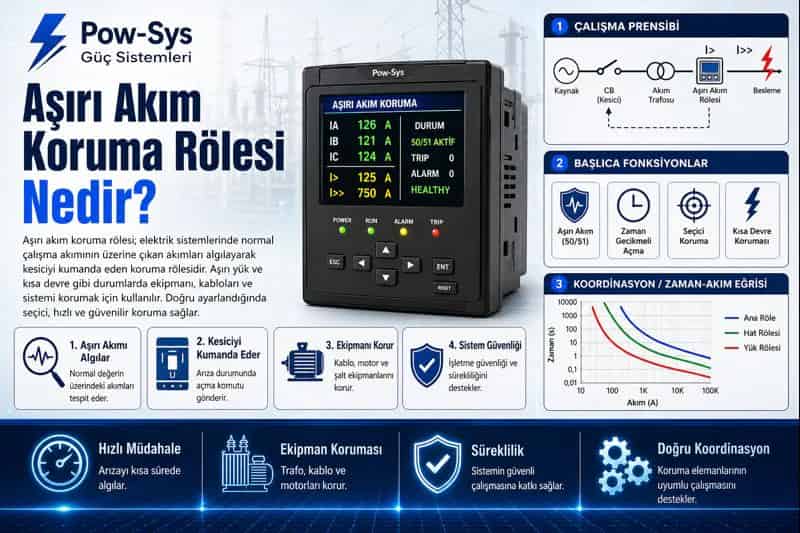
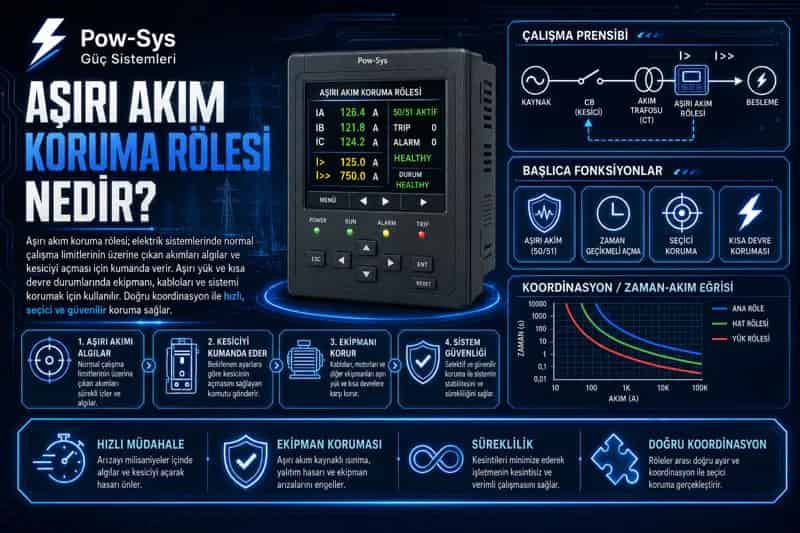
To explain simply how an overcurrent and earth fault protection relay works, the relay continuously measures the currents coming from CTs and compares them with the set pickup values. If phase current exceeds the defined I> or I>> level, phase overcurrent protection operates. If residual current or neutral current exceeds the defined I0> or I0>> level, earth fault protection operates. The relay then produces a trip decision according to the set time curve or fixed delay logic.
The most common stages in overcurrent protection are the low stage and high stage. The low stage is generally called I> and often operates with a time delay. The high stage is expressed as I>> and is used for faster tripping during more severe faults. Some relays also include instantaneous trip stages in addition to this. This structure is used to establish both selectivity and fast fault clearing together.
A similar logic exists on the earth fault protection side. While the I0> stage is used for more sensitive and often delayed earth fault protection, I0>> can provide a higher-level and faster tripping logic. The important difference here is this: earth fault current may often not be as high as phase-to-phase short-circuit current. Therefore, the earth fault protection function must be set more sensitively. This sensitivity is very important especially in resistance-grounded systems or systems that produce limited fault current.
This is why the earth fault protection function is more sensitive than phase protection. Phase overcurrent protection may not detect some low-level earth faults or may not evaluate them fast enough. Earth fault protection helps see lower-magnitude phase-to-earth faults because it monitors residual current. Therefore, in the modern protection approach, phase overcurrent and earth fault protection are often considered together.
How earth fault current is measured is also an important subject. In some applications, the residual sum of three phase CTs is used. In some systems, a core-balance CT, meaning a toroidal-type current transformer, is preferred. The core-balance approach can provide an advantage especially for monitoring earth faults more sensitively. Which method is suitable is determined according to the structure of the system and the desired sensitivity level.
The time characteristic is one of the most critical setting subjects of these relays. In the IDMT, or inverse definite minimum time, structure, tripping time becomes shorter as current increases. In the definite time characteristic, a fixed delay is applied after the threshold is exceeded. In instantaneous trip logic, the relay operates without delay or with a very short delay above the threshold. Which approach is suitable changes according to protection coordination and the structure of the circuit.
Therefore, an overcurrent and earth fault protection relay is not a simple device that only asks whether a fault exists or not. In reality, pickup value, time curve, instantaneous trip level, earth fault sensitivity and upstream-downstream protection coordination are set by considering them together. The same relay may operate very safely in one facility, while with incorrect settings it may cause nuisance trips in another facility. The setting is as critical as the device.
Overcurrent and earth fault protection relays are widely used especially in radial feeders, cable feeders, MV cubicles, transformer feeders, compact substations and motor supplies. In some applications, they serve as main protection, and in some applications as backup protection. These relays form the basis of the protection philosophy especially in distribution systems where simple and reliable protection is a priority.
In directional systems, these functions can become even more advanced. If there are ring networks, bidirectional supplies or parallel sources, overcurrent and earth fault protection can be operated together with direction information. In this way, the relay evaluates not only current magnitude but also the direction of fault current. This structure is especially important in looped distribution systems to prevent false trips.
An overcurrent and earth fault protection relay and a differential relay are not the same thing. Differential protection provides more selective internal-zone protection by comparing the input and output currents of a specific piece of equipment. Overcurrent and earth fault protection provides a more general approach and is often used as basic or backup protection for a feeder or equipment. Therefore, it is a widespread, economical and strong protection solution; however, it may not be sufficient alone in every case.
In modern numerical relays, these functions do not only produce a tripping decision. Many devices also offer additional protection functions such as event records, fault current records, oscillography, communication, measurement and sometimes breaker failure. Thus, the overcurrent and earth fault protection relay becomes not only a protection element but also a data source that helps monitor system behavior.
In summary, an overcurrent and earth fault protection relay is a fundamental relay that provides protection during short circuits, overcurrents and phase-to-earth faults by monitoring phase currents and earth fault current. It can operate with stages such as I>, I>>, I0>, I0>>, IDMT or definite time curves and, when necessary, directional functions. A correctly selected, correctly set and correctly tested overcurrent-earth fault protection relay is one of the most important layers of safe operation in MV and HV distribution systems. In the next step, the tests and maintenance required for overcurrent and earth fault protection relays can be prepared with the same structure.
Related Blog Posts
Related Services
Frequently Asked Questions
What is an overcurrent and earth fault protection relay?
An overcurrent and earth fault protection relay is a protection device that monitors phase currents and the residual current indicating an earth fault, and sends a trip command to the related circuit breaker during short circuits, overload-like current increases and phase-to-earth faults. It combines two main duties in one device: phase overcurrent protection, which makes a trip decision during short circuits or severe overcurrent conditions, and the earth fault protection function, which evaluates neutral current or the residual component to detect phase-to-earth faults. Having both functions in the same relay is a practical and common solution, especially in distribution feeders. In many applications, this relay serves as one of the main protection elements of a feeder, cable, transformer outgoing feeder or distribution circuit in MV and HV systems.
What does an overcurrent and earth fault protection relay do?
An overcurrent and earth fault protection relay selectively disconnects the faulty section of an installation, protects equipment and helps healthy sections remain energized as much as possible. When a fault occurs, the aim is not to shut down the entire system but to isolate only the affected circuit, and this relay makes that possible by tripping the related breaker. Its overcurrent side operates for phase-to-phase short circuits or faults producing high current, while the earth fault side behaves more sensitively for phase-to-earth faults that may be lower in level but still dangerous. In this way, unnecessarily wide-area outages are reduced. In modern numerical relays, the device also acts as a data source, offering event records, fault current records, oscillography, communication, measurement and sometimes breaker failure functions that help monitor system behavior.
How does an overcurrent and earth fault protection relay work?
The relay works by continuously measuring the currents coming from CTs and comparing them with the set pickup values. If a phase current exceeds the defined I> or I>> level, phase overcurrent protection operates; if residual or neutral current exceeds the defined I0> or I0>> level, earth fault protection operates. Once a threshold is exceeded, the relay produces its trip decision according to the set time logic: an IDMT curve where tripping time becomes shorter as current increases, a definite time characteristic with a fixed delay, or instantaneous logic with no delay or a very short one. In directional systems with ring networks, bidirectional supplies or parallel sources, the relay can also evaluate the direction of the fault current together with its magnitude before deciding to trip.
What do I>, I>>, I0> and I0>> mean?
I> and I>> are the phase overcurrent stages, while I0> and I0>> are the earth fault stages of the relay. I> is the low stage of phase protection and often operates with a time delay, whereas I>> is the high stage used for faster tripping during more severe faults; some relays add instantaneous trip stages on top of this. The same logic exists on the earth fault side: I0> is used for more sensitive and often delayed earth fault protection, while I0>> provides a higher-level and faster tripping logic. In general, lower stages are selected for sensitivity and selectivity, and higher stages are focused on severe faults that must be cleared quickly. Setting these stages together is how the relay establishes both selectivity and fast fault clearing.
Why can earth fault protection be more sensitive than phase current protection?
Earth fault protection can be set more sensitively than phase protection because earth fault current is often not as high as phase-to-phase short-circuit current. A phase overcurrent element may not detect some low-level phase-to-earth faults at all, or may not evaluate them fast enough, even though these faults can still be dangerous. Because the earth fault function monitors residual current, it can see lower-magnitude phase-to-earth faults that would stay below the phase pickup settings. This sensitivity is especially important in resistance-grounded systems or systems that produce limited fault current, where a phase-to-earth fault may create only a modest current increase. For this reason, the modern protection approach considers phase overcurrent and earth fault protection together, with the earth fault stages deliberately set to a finer sensitivity level.
How is earth fault current measured?
Earth fault current can be measured in two common ways: through the residual sum of the three phase CTs, or through a core-balance CT, meaning a toroidal-type current transformer. In the first approach, the relay evaluates the residual component obtained from the three phase current transformers and compares it with the I0> and I0>> settings. The core-balance approach can provide an advantage especially for monitoring earth faults more sensitively, which matters in resistance-grounded systems or systems that produce limited fault current, where phase-to-earth faults may be low in magnitude. Which method is suitable is determined according to the structure of the system and the desired sensitivity level. Whichever measurement path is chosen, the goal is the same: giving the earth fault protection function a reliable residual current signal so that even low-level faults can be detected.
What does IDMT protection mean?
IDMT stands for inverse definite minimum time, a protection logic in which the tripping time becomes shorter as the fault current increases. Instead of applying one fixed delay, the relay follows a time curve: modest overcurrents are cleared after a longer delay, while heavy fault currents are tripped much faster. Different curve types such as standard, very inverse and extremely inverse can be used depending on the application. IDMT is one of the main time characteristics available in overcurrent and earth fault relays, alongside the definite time characteristic, which applies a fixed delay after the threshold is exceeded, and instantaneous logic, which operates without delay or with a very short delay. Which approach is suitable changes according to protection coordination and the structure of the circuit being protected.
What does the instantaneous trip stage do?
The instantaneous trip stage makes the relay operate without delay, or with a very short delay, once the current exceeds a high threshold. It exists because during very severe faults, waiting for a time curve to run out would let dangerous current stress the equipment longer than necessary. It provides fast protection especially during close-in and severe faults, where the fault current level is very high. In practice, the instantaneous stage works together with the delayed stages: the low stage I> often operates with a time delay for selectivity, the high stage I>> trips faster for more severe faults, and some relays include instantaneous stages in addition to these. This combination is how the relay establishes both selectivity between upstream and downstream devices and fast clearing of the most dangerous faults.
Where is an overcurrent and earth fault protection relay used?
Overcurrent and earth fault protection relays are widely used in radial feeders, cable feeders, MV cubicles, transformer feeders, compact substations and motor supplies. In some applications they serve as main protection, and in others as backup protection; for example, they often provide basic or backup protection for a feeder or piece of equipment while differential protection handles the more selective internal-zone duty. These relays form the basis of the protection philosophy especially in distribution systems where simple and reliable protection is a priority, because they are a widespread, economical and strong protection solution. In distribution feeders in particular, having phase overcurrent and earth fault functions in the same relay is a practical and common arrangement that covers short circuits, overcurrents and phase-to-earth faults with one device.
When is directional earth fault protection required?
Directional earth fault protection is required when the direction of fault current matters, which is typically the case in ring networks, systems with bidirectional or parallel supplies, and looped distribution structures. In a simple radial feeder, current flows one way and magnitude-based protection is usually enough; but where fault current can flow from more than one source or in more than one direction, a relay that looks only at magnitude may trip for faults outside its own zone. When direction information is added, the relay evaluates not only how large the fault current is but also which way it flows, and this structure is especially important in looped distribution systems to prevent false trips. In such networks, overcurrent and earth fault protection are operated together with the directional function.