

Summary Highlights
- What is a protection relay: its basic definition as a protection device that detects faults and abnormal conditions in the electrical system
- What does the protection relay do: selectively isolate the faulty section, protect equipment and ensure system safety
- How the protection relay works: the logic of generating a trip command under appropriate conditions by monitoring current, voltage, frequency and other quantities.
- Protection relay types: overcurrent, earth fault, differential, distance, voltage, frequency, motor and transformer protection relays
- Protection relay selection and use: facility type, fault level, CT/VT structure, coordination need and operational safety
Content
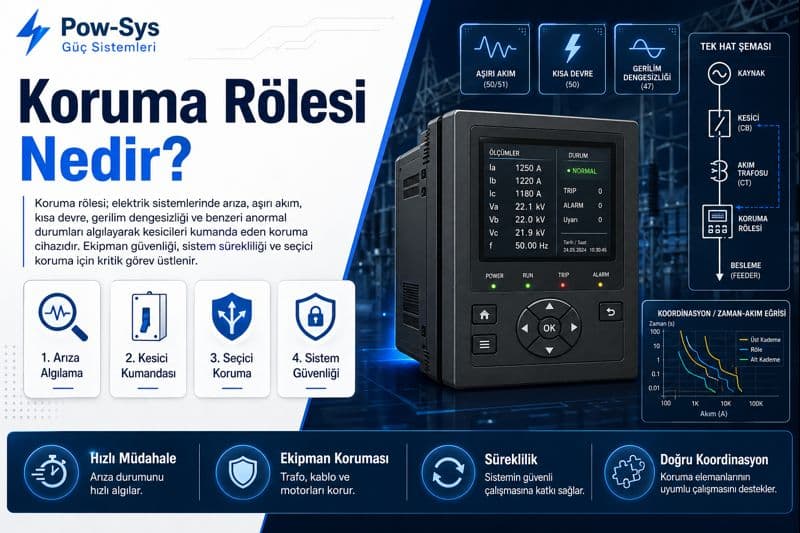
Protection relay is a protection device that detects faults or abnormal operating conditions in the electrical system and gives commands to the relevant breaker or trip chain. Briefly, the answer to the question of what a protection relay is; It is an intelligent monitoring and tripping element that detects when a problem occurs in the electrical installation and makes decisions to protect the system. The main task of this device is not only to see the fault; is to limit the impact of the fault before it grows.
Security and continuity are at the center of the question of what a protection relay does. When a malfunction occurs in an electrical facility, the aim is not to leave the entire system without energy, but to disable only the faulty part. A well-functioning protection relay detects the fault quickly and acts selectively, helping healthy parts continue to operate. In this way, equipment is protected and unnecessary interruptions are reduced.
Protection relays do not only function during short circuits. Overcurrent, earth leakage, overvoltage, undervoltage, frequency deviation, reverse power, differential current, imbalance and many other abnormal situations can also be monitored by relays. Therefore, when it comes to protection relays, not a single type of device should be considered, but a wide protection family that undertakes different protection functions.
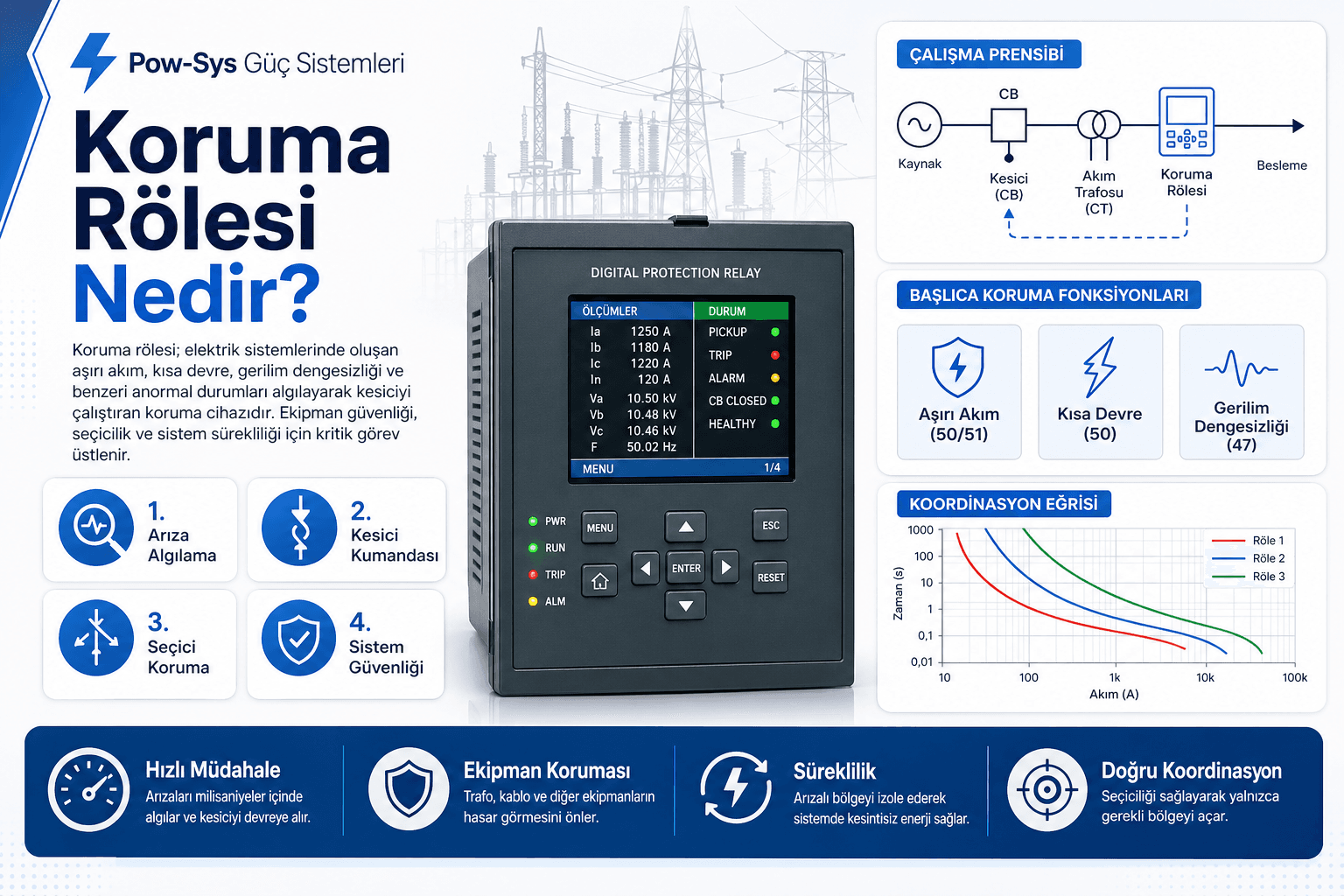
To explain the question of how a protection relay works simply, the device constantly monitors the current and voltage information coming from the system. This information is often transmitted to the relay via current transformers and voltage transformers. The relay evaluates these quantities according to its own settings. If the measured values exceed the specified protection limits, it gives an alarm according to the relevant time logic or sends an opening command to the breaker. In other words, the operation of the relay; It is based on the logic of measurement, comparison and decision-making.
A protection relay and a breaker are not the same thing. Relay is the device that detects the fault and makes a decision. The breaker is the switching equipment that implements this command. In practice, these two elements are often mentioned together; but their duties are different. The success of a protection system is possible if the relay makes the right decision and the breaker implements this decision safely.
Protection relay types vary greatly depending on the application. One of the most common types is the overcurrent relay. This relay works to protect the circuit if a certain current level is exceeded. Ground fault relay is used to detect phase-ground faults more precisely. While voltage relays monitor low or high voltage conditions, frequency relays monitor deviations in system frequency. These basic types form the backbone of many facilities.
In more advanced protection applications, more special solutions such as differential relay, distance relay, directional overcurrent relay, motor protection relay, transformer protection relay and generator protection relay are used. Differential protection provides protection by comparing the input and output currents of a piece of equipment. The distance relay can evaluate the fault distance via impedance, especially in transmission lines. Motor and transformer relays contain protection functions that take into account the specific behavior of the relevant equipment.
Correct operation of the protection relay does not depend solely on device quality. CT and VT ratios, connection type, relay settings, short circuit level, system grounding structure and up-down protection coordination must be established correctly. An incorrectly adjusted relay either treats normal operation as a malfunction or cannot detect the actual malfunction in time. Therefore, the adjustment and commissioning process is as important as the relay selection.
Selectivity is a very important concept in protection engineering. Selectivity means that when a fault occurs, the smallest possible part of the network remains de-energized. In addition, the concepts of sensitivity, reliability and security also define relay behavior. Sensitivity refers to being able to detect the fault, reliability refers to opening in case of real failure, and safety refers to not opening in the wrong situation. A good protection relay application should be balanced between these four topics.
Modern protection relays don't just protect; It also offers measurement, recording and communication functions. Many digital relays can display current, voltage, power and frequency values; may keep incident records; can record oscillography; It can communicate with infrastructures such as SCADA or IEC 61850. Therefore, today's protection relay is not only a tripping device, but also a system monitoring and analysis tool.
The type of facility is of great importance when choosing a protection relay. The relay to be used at a motor output and a transformer differential relay do not have the same structure. Likewise, the relay to be selected for a MV distribution feeder and a transmission line distance relay do not meet the same expectations. Therefore, when selecting a relay, the equipment to be protected, fault type, system structure and operating expectation should be evaluated together.
In industrial facilities, protection relays are often used in MV cubicles, transformer feeders, motor feeds, generator panels and main distribution points. Thanks to these relays, overcurrent, ground fault, voltage abnormality or internal equipment faults can be isolated in a limited area. Thus, process safety and equipment life are maintained. Choosing the right protection relay is of great importance, especially in facilities where production loss is expensive.
Protection relays require periodic testing and maintenance. Because even if the device itself appears to be intact, its actual protection function may be impaired due to a change in setting, incorrect connection, CT problem or auxiliary trip chain failure. For this reason, in systems with protection relays, secondary injection, trip chain test, input-output verification and record reviews should be performed at regular intervals. A good protection system is not just installed but verified.
In summary, protection relay; It is a basic protection device that detects faults and abnormal conditions in the electrical system, gives the opening command to the relevant breaker and ensures facility safety. It can be used in many different forms such as overcurrent, earth fault, differential, distance, voltage, frequency, motor and transformer protection. A correctly selected, correctly adjusted and regularly tested protection relay system; It both protects equipment and strengthens business continuity. If relay selection, relay adjustment calculations, protection coordination and MV/HV field safety will be evaluated together in your facility. LV/MV/HV project design and consultancy with HV/MV testing, maintenance and repair studies can support this process technically.
Frequently Asked Questions
What is a protection relay?
Protection relay is a protection device that detects faults and abnormal operating conditions in the electrical system and gives commands to the relevant breaker or trip chain.
What does a protection relay do?
It helps to selectively disable the faulty section, protect equipment, reduce the risk of fire and damage, and keep healthy sections energized.
How does the protection relay work?
It monitors the current and voltage information coming through CT and VT, compares them with the setting values, and if a fault condition occurs, it generates a trip command according to the determined time logic.
Are a protection relay and a breaker the same thing?
No. Relay is the device that detects the fault and makes a decision. The breaker is the equipment that physically opens the circuit by applying this command.
What are the most common types of protection relays?
Overcurrent, earth fault, voltage, frequency, differential, distance, motor and transformer protection relays are among the most common types.:contentReference[oaicite:1]{index=1}
What does selectivity mean in protection relay?
Selectivity means that only the smallest necessary part of the network is disabled when a fault occurs. This prevents unnecessary large area interruptions.:contentReference[oaicite:2]{index=2}
Why are precision and reliability important in a protection relay?
Sensitivity refers to being able to detect the fault, reliability refers to opening in case of real failure, and safety refers to not opening in the wrong situation. Good protection is built on this balance.:contentReference[oaicite:3]{index=3}
Do modern protection relays only trip?
No. Many digital relays also offer additional functions such as measurement, event recording, oscillography, communications and automation.:contentReference[oaicite:4]{index=4}
What to consider when choosing a protection relay?
The type of equipment to be protected, fault type, short circuit level, CT/VT structure, protection coordination, communication need and operational safety should be evaluated together.
Do protection relays require maintenance and testing?
Yes. Settings, input-outputs, trip chain and measurement circuits need to be tested regularly. Even if the device seems solid, the protection function may be broken on the secondary side.