
Summary Highlights
- What short-circuit analysis is: a study that calculates short-circuit currents that may occur during a fault in electrical installations
- What short-circuit analysis does: checks equipment withstand, verifies protection selection and provides safe operation
- How short-circuit analysis is performed: calculating fault current by considering source, transformer, cable, busbar and motor contributions
- Main quantities examined: three-phase, phase-to-phase and phase-to-earth faults; symmetrical, asymmetrical and peak short-circuit values
- Application area of short-circuit analysis: suitability assessment of circuit breakers, busbars, cables, transformers, relay settings and switchgear
Article Details
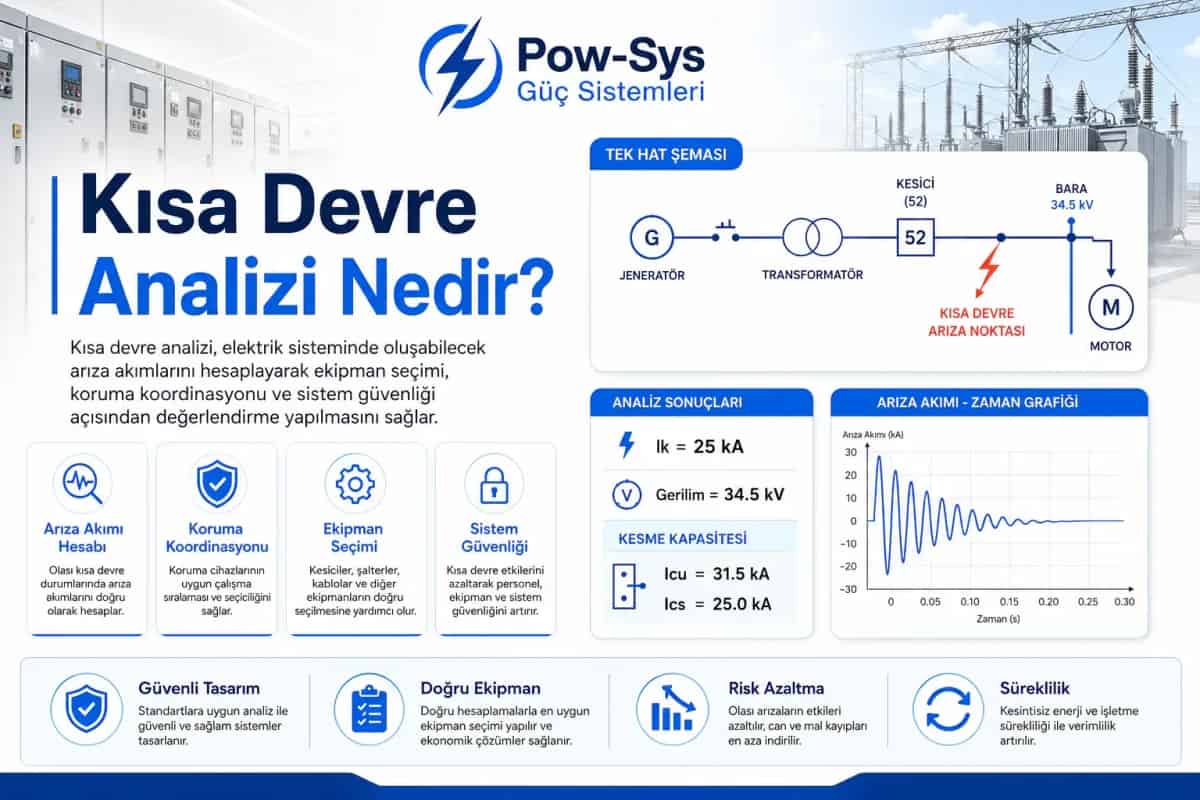
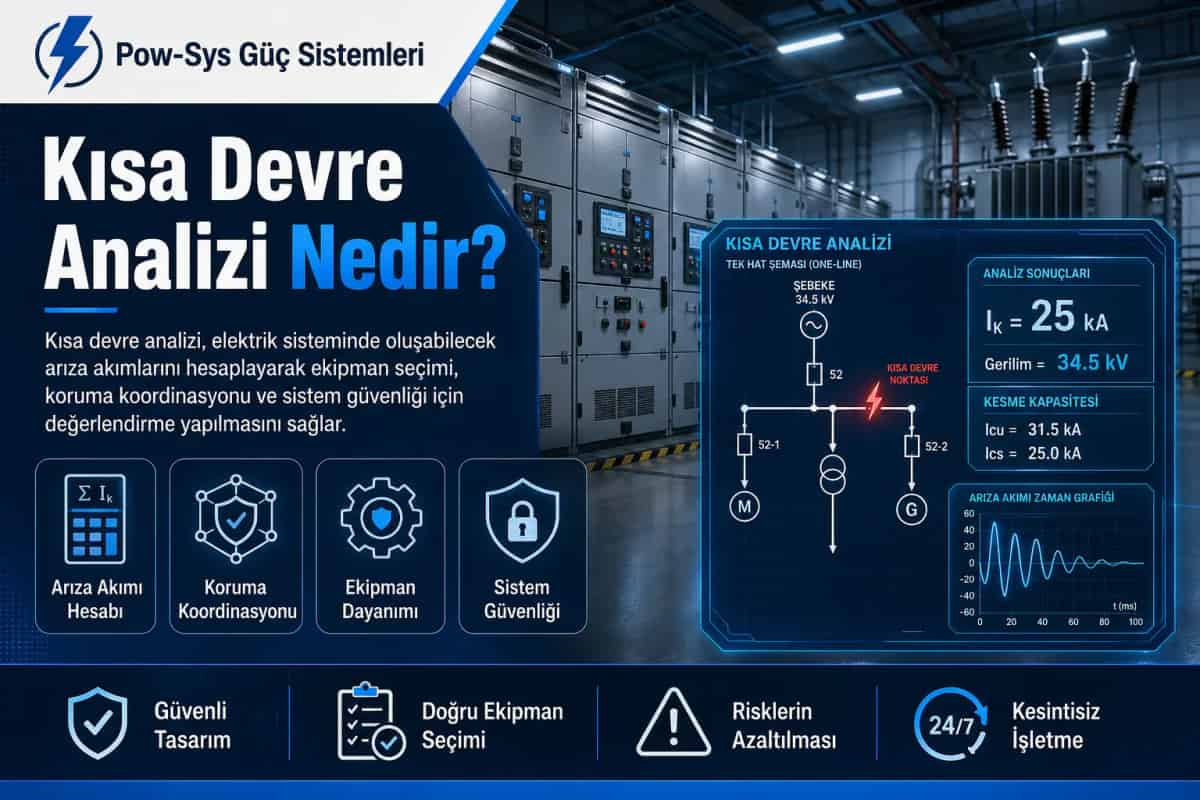
Short-circuit analysis is the calculation of the short-circuit current that may occur at a specific point when a fault occurs in an electrical installation. In short, the answer to the question of what short-circuit analysis is: it is an engineering study that calculates possible fault currents in advance and evaluates whether equipment can withstand this stress. This analysis is not only a numerical calculation; it is a critical system review that forms the basis of facility safety, equipment selection and the protection approach.
Safety is at the center of the question of what short-circuit analysis does. When a short circuit occurs in a system, current may rise far above normal operating values. This creates serious thermal and dynamic stresses on circuit breakers, busbars, cables, transformers, current transformers and switchgear. If this equipment has not been selected according to the fault current that may occur, the fault is not limited to a power outage; it may lead to equipment rupture, fire, arc risk and personnel danger.
For this reason, short-circuit analysis is performed not only for theoretical calculation but also for correct equipment selection. The short-circuit breaking capacity of a circuit breaker, the short-time withstand current of a busbar, the thermal withstand of a cable or the mechanical strength of an MV cubicle can be evaluated correctly only if the expected fault current is known. Equipment selection made without knowing the short-circuit current may become one of the riskiest weaknesses of the design.
To explain simply how short-circuit analysis is performed, the source side of the system is first identified. Utility supply, transformer impedance, generator contribution, cable and busbar impedance, motor contributions and the entire electrical path up to the fault point are considered. Then, short-circuit current is calculated for specific fault types through equivalent impedance. In other words, the analysis reveals how much current all sources in the system can feed into the fault point.
The most widely known case in short-circuit analysis is the three-phase short-circuit calculation. A three-phase bolted fault is often accepted as the most severe fault scenario that produces the highest current. Therefore, it is one of the first values checked in terms of equipment withstand and circuit breaker selection. However, short-circuit analysis is not limited only to three-phase faults. Phase-to-phase, phase-to-earth and, in some applications, double phase-to-earth faults are also evaluated separately. Because each fault type may create a different effect on the system.
When short-circuit current is mentioned, speaking of a single number is often not enough. When the fault first occurs, an asymmetrical current may appear in the system due to DC offset, and the peak value of this current is different from the symmetrical RMS value seen later. Therefore, for some equipment, not only the symmetrical short-circuit value but also the asymmetrical or peak current effect is important. Especially in medium-voltage and high-stress applications, this distinction creates a serious engineering difference.
The X/R ratio is one of the important parameters of short-circuit analysis. Because the asymmetrical behavior and peak value of the fault current are directly related to the system's resistance-reactance relationship. In systems with a high X/R ratio, the initial DC-offset current may last longer and the mechanical impact on equipment may be higher. Therefore, not only the question of how many kA occurred but also the waveform behavior of that current is important.
Transformer impedance is one of the main determining factors in short-circuit calculation. As the percentage impedance of a transformer increases, the maximum short-circuit current that may occur on the secondary side is limited to a certain extent. Therefore, the short-circuit behavior of two transformers with the same power rating may differ according to their impedance value. In short-circuit analysis, the transformer power rating and the impedance percentage are both used as critical data.
Motor contribution may also be at a non-negligible level in some systems. Especially in industrial facilities with large motors, motors may contribute to the system for a short time during a fault and increase the fault current level. Therefore, considering only the utility and transformer side may not always be sufficient. In large industrial facilities, analysis performed without considering motor contribution may remain incomplete.
Short-circuit analysis is directly related to protection coordination. Maximum and minimum fault currents that may occur in the system must be known when setting relays and circuit breakers. Otherwise, the protection device may not detect the fault fast enough or nuisance trips may occur. Therefore, short-circuit analysis is like the preliminary step of relay coordination. It is difficult to make the correct protection selection without knowing the fault current.
Short-circuit analysis also plays a critical role in facility expansion or revision works. Adding a new transformer to the existing system, connecting a generator, increasing motor power or using parallel supply may increase the existing fault level. This may cause circuit breakers or MV cubicles that were previously considered suitable to become inadequate. Therefore, when the system changes, the short-circuit analysis should also be updated.
A short-circuit analysis is not performed only in a single panel; it is generally performed for different points of the system. The main distribution point, transformer secondary, sub-panels, motor control centers, medium-voltage switchgear and critical load points can be examined separately. Because fault current changes throughout the system depending on the distance to the fault point and the impedance in between. It may be higher at points close to the source and lower downstream.
Short-circuit analysis and the short-circuit withstand label are not the same thing. The analysis calculates the real fault level that may occur in the system. The equipment label states how much current the device can withstand or interrupt. The correct engineering approach is to ensure that the calculated fault current does not exceed the equipment's withstand or breaking capacity. In other words, the analysis and equipment data gain meaning together.
In summary, short-circuit analysis is a fundamental engineering study that verifies system safety, equipment selection and the protection structure by calculating possible fault currents in an electrical installation. Three-phase, phase-to-phase and phase-to-earth faults; symmetrical and asymmetrical currents; variables such as transformer impedance, cable-busbar impedance and motor contribution are the main parts of this study. A correctly performed short-circuit analysis is necessary not only to complete the project but to make the facility genuinely safe. If short-circuit analysis, relay coordination, equipment suitability and MV/HV field safety will be evaluated together in your facility, LV/MV/HV project design and consultancy and HV/MV testing, maintenance and repair works can technically support this process.
Related Blog Posts
Related Services
Frequently Asked Questions
What is short-circuit analysis?
Short-circuit analysis is an engineering study that calculates, in advance, the short-circuit currents that may occur at a specific point of an electrical installation when a fault occurs, and evaluates whether the equipment can withstand this stress. It is more than a numerical exercise: it is a critical system review that forms the basis of facility safety, equipment selection and the overall protection approach. The study considers the utility supply, transformer impedance, generator contribution, cable and busbar impedance and motor contributions along the entire electrical path up to the fault point, then calculates the fault current for specific fault types through equivalent impedance. In this way, it reveals how much current all sources in the system can feed into a fault, which is the starting point for checking circuit breakers, busbars, cables and switchgear.
Why is short-circuit analysis necessary?
Short-circuit analysis is necessary because equipment can only be selected and protection can only be set correctly when the expected fault current is known. When a short circuit occurs, current may rise far above normal operating values, creating serious thermal and dynamic stresses on circuit breakers, busbars, cables, transformers, current transformers and switchgear. If this equipment has not been selected according to the fault current that may actually occur, the event is not limited to a power outage; it may lead to equipment rupture, fire, arc risk and danger to personnel. The analysis makes it possible to check a breaker's short-circuit breaking capacity, a busbar's short-time withstand current, a cable's thermal withstand and the mechanical strength of an MV cubicle against realistic values, so the facility becomes genuinely safe rather than only complete on paper.
What does short-circuit analysis do?
Short-circuit analysis determines the possible fault current levels at different points of the system and turns them into practical engineering decisions. With these values, it checks whether existing or planned equipment can withstand the calculated stress, reveals components that are insufficient, supports the correct selection of circuit breakers, busbars, cables, transformers and switchgear, and helps size system components. It also provides the basis for protection: maximum and minimum fault currents must be known when setting relays and circuit breakers, otherwise a protection device may not detect a fault fast enough or nuisance trips may occur. Because fault current changes throughout the installation depending on the distance to the fault point and the impedance in between, the analysis is generally performed for the main distribution point, transformer secondary, sub-panels, motor control centers, medium-voltage switchgear and critical load points.
Which fault types are examined in short-circuit analysis?
Three-phase, phase-to-phase and phase-to-earth faults are the fault types generally examined in short-circuit analysis, and in some applications double phase-to-earth faults are also evaluated separately. The three-phase bolted fault is the most widely known case, because it is often accepted as the most severe scenario that produces the highest current, and it is therefore one of the first values checked for equipment withstand and circuit breaker selection. However, the analysis is not limited to three-phase faults: each fault type may create a different effect on the system, which is why phase-to-phase and phase-to-earth cases are calculated as well. Alongside the fault type, the character of the current matters too, since symmetrical, asymmetrical and peak short-circuit values are examined as the main quantities of the study.
Why is a three-phase short circuit considered important?
A three-phase short circuit is considered important because a three-phase bolted fault is often accepted as the most severe fault scenario that produces the highest short-circuit current in the system. Since equipment must be able to withstand the worst realistic stress, this value is one of the first figures checked in terms of equipment withstand and circuit breaker selection: the breaking capacity of a circuit breaker, the short-time withstand of a busbar and the strength of switchgear are all compared against it. At the same time, short-circuit analysis does not stop at this single case. Phase-to-phase, phase-to-earth and, in some applications, double phase-to-earth faults are evaluated separately, because each fault type may create a different effect on the system and on the protection devices that must clear it.
What is the difference between symmetrical and asymmetrical short-circuit current?
Symmetrical short-circuit current refers to the balanced, RMS-based component of the fault current, while asymmetrical current also includes the DC-offset effect that appears at the first moment of the fault. When a fault first occurs, this DC offset can push the peak value of the current well above the symmetrical RMS value seen later, which is why a single number is often not enough to describe a short circuit. The distinction matters mainly for mechanical stress: for some equipment, not only the symmetrical value but also the asymmetrical or peak current effect must be checked, especially in medium-voltage and high-stress applications. The X/R ratio of the system is closely related to this behavior, because in systems with a high X/R ratio the initial DC-offset current may last longer and the mechanical impact on equipment may be higher.
Does transformer impedance affect short-circuit current?
Yes, transformer impedance directly affects the short-circuit current and is one of the main determining factors in the calculation. As the percentage impedance of a transformer increases, the maximum short-circuit current that may occur on the secondary side is limited to a certain extent. This is why two transformers with the same power rating can show different short-circuit behavior: the unit with lower impedance lets a higher fault current through, while the unit with higher impedance restricts it more. For this reason, short-circuit analysis uses both the transformer power rating and the impedance percentage as critical input data. Knowing these values correctly is essential for checking whether downstream circuit breakers, busbars, cables and switchgear can withstand the fault level that the transformer can actually deliver to the installation.
Is motor contribution included in short-circuit calculation?
Yes, motor contribution is included in the short-circuit calculation when it is relevant, and in systems with large motors it may be at a level that cannot be neglected. During a fault, motors may feed current back into the system for a short time and increase the fault level seen at the fault point. This is especially true in industrial facilities with large motors, where considering only the utility and transformer side may not be sufficient and an analysis performed without motor contribution may remain incomplete. In some practical approaches, a contribution of several times the total motor current is accepted. Because the goal of the study is to reveal how much current all sources in the system can feed into the fault point, every significant contribution, including motors, belongs in the calculation.
What is the relationship between short-circuit analysis and the equipment label?
Short-circuit analysis and the short-circuit withstand label answer two different questions that only gain meaning together. The analysis calculates the real fault level that may occur at a given point in the system, based on the utility supply, transformer impedance, cables, busbars and motor contributions. The equipment label, on the other hand, states how much current the device can withstand or interrupt, such as a breaker's breaking capacity or a busbar's short-time withstand current. The correct engineering approach is to ensure that the calculated fault current does not exceed the equipment's withstand or breaking capacity. If equipment is selected without knowing the real short-circuit current, the label alone proves nothing about safety, and this mismatch may become one of the riskiest weaknesses of the design.
When should short-circuit analysis be updated?
Short-circuit analysis should be updated whenever the system changes in a way that can alter the fault level. Adding a new transformer to the existing installation, connecting a generator, increasing motor power or using parallel supply may all raise the fault current above the values used in the original study. When that happens, circuit breakers or MV cubicles that were previously considered suitable may become inadequate, even though nothing about them has physically changed. Facility expansion and revision works are therefore the typical triggers for a fresh calculation. The practical rule is simple: the analysis reflects a specific system configuration, so when the configuration changes, the short-circuit analysis should change with it, and equipment suitability and protection settings should be re-checked against the new fault levels.