
Summary Highlights
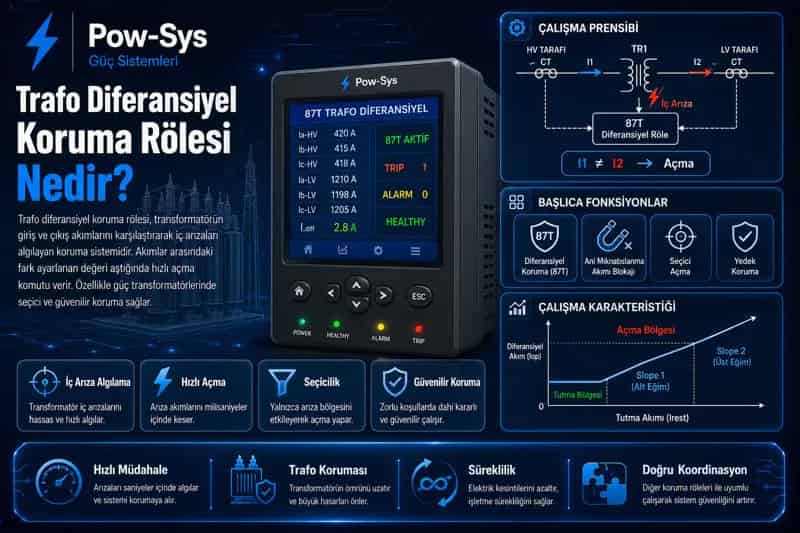
- What a transformer differential protection relay is: the main protection relay that operates by comparing currents entering and leaving the transformer's protection zone
- What a transformer differential protection relay does: detects internal faults quickly and selectively and ensures that the transformer is safely disconnected
- How a transformer differential protection relay works: compares currents from CTs with vector group and ratio compensation and evaluates differential current
- Main operating subjects: percentage differential characteristic, high-set differential, inrush blocking, CT saturation tolerance and OLTC effect
- Application areas and complementary protections: operation with additional protection functions such as REF for power transformers, auto-transformers and multi-winding transformers
Article Details
A transformer differential protection relay is the main protection relay that detects internal faults by comparing the currents entering and leaving the transformer's protection zone. In short, the answer to the question of what a transformer differential protection relay is: it is a protection device that monitors whether the current on two or more sides of the transformer is balanced and gives a very fast trip command when an internal fault occurs. In ANSI numbering, this protection function is often expressed as 87T.
Selective and fast protection is at the center of the question of what a transformer differential protection relay does. When a winding fault, phase-to-phase short circuit, winding-to-earth fault or some internal insulation problems occur in a transformer, the aim is to disconnect only the faulty transformer. Differential protection does this based on the basic principle that the current entering and leaving the transformer's protection zone should be equal. If this balance is disturbed, the relay may interpret it as an internal fault.
Although the basic logic of transformer differential protection looks similar to Kirchhoff's current law, the work is a little more complex in transformers. Because the currents on the two sides of the transformer may naturally be different in both magnitude and phase angle. The reason for this is structural features such as voltage ratio, vector group, delta-star connection difference and OLTC. Therefore, the differential relay does not directly sum the raw currents; it first applies compensation to make them comparable.
To explain simply how a transformer differential protection relay works, current information is first received from CTs on each side of the transformer. These currents are then normalized inside the relay by considering ratio, phase shift and, if necessary, zero-sequence component correction. If there is normal load or an external fault, these corrected currents largely balance each other and the differential current remains small. If there is an internal fault, the equality between entering and leaving current is disturbed and the differential current seen by the relay increases significantly.
Although the power at the input and output of the transformer is the same or nearly the same in normal operation, the currents are not always the same. For example, the current magnitude on the high-voltage side and low-voltage side differs according to the transformation ratio. Phase angle shift also occurs in connections such as delta-star. For this reason, transformer differential protection requires more engineering than straight line differential protection. For the relay to operate correctly, vector group and ratio compensation must be defined correctly.
The most widely used approach in this protection is the percentage differential, or biased differential, characteristic. Here the relay does not look only at the magnitude of the differential current; it also considers the through current level passing through the transformer. In high external fault currents or situations with CT saturation risk, the relay applies restraint logic to remain more stable. This reduces the possibility of false tripping during an external fault.
More than one slope can be used in the percentage differential characteristic. More sensitive operation is desired in low-current regions, while higher stability is desired at high through-fault currents. Therefore, modern transformers commonly use dual-slope or multi-zone differential characteristics rather than a single-slope characteristic. The aim is to remain sensitive to internal faults while avoiding false tripping during CT saturation or temporary unbalance.
One of the most critical special conditions for a transformer differential protection relay is magnetizing inrush current. When a transformer is first energized, very high inrush current can occur especially at certain switching instants and depending on core remanence. This current is often seen only on one side of the transformer and may appear as an internal fault from the perspective of the differential relay. This is why differential protection needs special logic that can distinguish inrush from a real internal fault.
The best-known method for this distinction is second-harmonic-based blocking or restraint. While the second harmonic component can be significantly high in inrush current, this component is generally low in real internal short circuits. Therefore, if the relay sees high second harmonic in the differential current, it can block the protection or apply restraint. Some modern relays also include advanced logic based on fourth harmonic and waveform in addition to this.
Overexcitation also requires special evaluation in differential protection. Because in this condition, differential-like current may occur due to the magnetic behavior of the transformer. For this reason, some relays provide additional security or generate alarms through the fifth harmonic. Thus, differential protection becomes safer during events such as inrush and overexcitation, which are not faults but produce behavior similar to differential current.
Tap changing in transformers with OLTC is also important for differential protection. Since the OLTC changes the effective transformation ratio of the transformer, a differential function operating with a fixed ratio assumption may see false differential current. Therefore, OLTC compensation or a suitable bias setting is used in modern transformers. Correctly applied OLTC balancing can make differential protection both more sensitive and safer.
A transformer differential protection relay does not undertake all protection alone; it often works together with other functions. Restricted Earth Fault, or REF, can provide more sensitive protection especially for earth faults close to neutral. In addition, additional protection functions such as Buchholz, pressure relay, temperature protection, overcurrent backup and high-set differential complete the overall protection philosophy of the transformer. Differential protection generally stands out among these as the main internal fault protection.
A transformer differential protection relay and an overcurrent relay are not the same thing. An overcurrent relay makes a decision according to the magnitude of the current in the system and generally provides a more general protection logic. A transformer differential relay focuses on the question of whether the current balance inside the transformer has been disturbed. Therefore, it can detect internal faults much more selectively and quickly. Especially in large power transformers, differential protection is considered main protection and overcurrent is considered backup protection.
In summary, a transformer differential protection relay is the main protection relay that detects internal faults quickly and selectively by comparing currents entering and leaving the transformer's protection zone. The percentage differential characteristic, CT and vector group compensation, second harmonic security for inrush, additional logic for overexcitation and, when necessary, structures such as high-set differential form the basis of this protection. A correctly selected, correctly set and correctly tested transformer differential protection system is one of the most critical safety layers of the transformer. In the next step, the tests and maintenance required for transformer differential protection relays can be prepared with the same structure.

Related Blog Posts
Related Services
Frequently Asked Questions
What is a transformer differential protection relay?
A transformer differential protection relay is the main protection relay that detects internal faults by comparing the currents entering and leaving the transformer's protection zone. It is a protection device that monitors whether the current on two or more sides of the transformer is balanced and gives a very fast trip command when an internal fault occurs. In ANSI numbering, this protection function is often expressed as 87T. The basic principle is that the current entering and leaving the protection zone should be equal; if this balance is disturbed, the relay may interpret it as an internal fault. Especially in large power transformers, this differential protection relay is considered the main protection while overcurrent serves as backup. Together with the percentage differential characteristic, CT and vector group compensation and inrush security, it forms one of the most critical safety layers of the transformer.
What does a transformer differential protection relay do?
A transformer differential protection relay detects winding and internal-zone faults inside the transformer quickly and selectively and ensures that the transformer is safely disconnected. Selective and fast protection is at the center of its duty: when a winding fault, phase-to-phase short circuit, winding-to-earth fault or some internal insulation problems occur, the aim is to disconnect only the faulty transformer. The protection is based on the basic principle that the current entering and leaving the transformer's protection zone should be equal, so when this balance is disturbed, the relay may interpret it as an internal fault and trip very quickly. Because it focuses on whether the current balance inside the transformer has been disturbed, it can detect internal faults much more selectively and quickly than a general overcurrent approach, which is why it is treated as the main internal fault protection in large power transformers.
How does a transformer differential protection relay work?
A transformer differential protection relay first receives current information from CTs on each side of the transformer. These currents are then normalized inside the relay by considering ratio, phase shift and, if necessary, zero-sequence component correction. If there is normal load or an external fault, the corrected currents largely balance each other and the differential current remains small. If there is an internal fault, the equality between entering and leaving current is disturbed and the differential current seen by the relay increases significantly, so the relay trips. The relay does not directly sum the raw currents, because the currents on the two sides of a transformer may naturally differ in both magnitude and phase angle due to voltage ratio, vector group, delta-star connection difference and OLTC. Compensation is applied first to make the currents comparable, and the tripping decision is based on the corrected values.
Why is compensation required in transformer differential protection?
Compensation is required because the currents on the two sides of the transformer may naturally be different in both magnitude and phase angle. The reasons are structural features such as voltage ratio, vector group, delta-star connection difference and OLTC. For example, the current magnitude on the high-voltage side and low-voltage side differs according to the transformation ratio, and phase angle shift also occurs in connections such as delta-star. Therefore, the differential relay does not directly sum the raw currents; it first applies compensation to make them comparable, including ratio correction, phase shift correction and, if necessary, zero-sequence component correction. This is also why transformer differential protection requires more engineering than straight line differential protection: for the relay to operate correctly, vector group and ratio compensation must be defined correctly, otherwise false differential current may appear even under normal load.
What does percentage differential protection mean?
Percentage differential, or biased differential, is the most widely used characteristic in transformer differential protection. Here the relay does not look only at the magnitude of the differential current; it also considers the through current level passing through the transformer. In high external fault currents or situations with CT saturation risk, the relay applies restraint logic to remain more stable, which reduces the possibility of false tripping during an external fault. More than one slope can be used in this characteristic: more sensitive operation is desired in low-current regions, while higher stability is desired at high through-fault currents. Therefore, modern transformers commonly use dual-slope or multi-zone differential characteristics rather than a single-slope characteristic. The aim is to remain sensitive to internal faults while avoiding false tripping during CT saturation or temporary unbalance, so sensitivity and stability are achieved together.
Why does inrush current affect the differential relay?
Inrush current affects the differential relay because when a transformer is first energized, very high magnetizing inrush current can occur, especially at certain switching instants and depending on core remanence. This current is often seen only on one side of the transformer, so from the perspective of the differential relay it may appear as an internal fault even though the transformer is healthy. This is why differential protection needs special logic that can distinguish inrush from a real internal fault. The best-known method for this distinction is second-harmonic-based blocking or restraint: the second harmonic component can be significantly high in inrush current, while it is generally low in real internal short circuits. Some modern relays also include advanced logic based on the fourth harmonic and the waveform in addition to this, so the relay stays stable during energization but still trips for genuine internal faults.
What does second harmonic blocking do?
Second harmonic blocking helps prevent incorrect tripping of differential protection by detecting the high second harmonic component in inrush current. The logic relies on a clear difference between two situations: while the second harmonic component can be significantly high in magnetizing inrush current, this component is generally low in real internal short circuits. Therefore, if the relay sees high second harmonic in the differential current, it can block the protection or apply restraint instead of tripping. This allows the relay to remain stable during transformer energization, when inrush current is often seen only on one side and may look like an internal fault, while still operating quickly for genuine internal faults. Some modern relays also include advanced logic based on the fourth harmonic and waveform analysis in addition to second-harmonic-based methods, which further strengthens the distinction between inrush and a real fault.
Why is the fifth harmonic important?
The fifth harmonic is important because overexcitation requires special evaluation in differential protection. Under overexcitation conditions, differential-like current may occur due to the magnetic behavior of the transformer even though there is no real fault. For this reason, some relays provide additional security or generate alarms through the fifth harmonic component. In this way, differential protection becomes safer during events such as inrush and overexcitation, which are not faults but produce behavior similar to differential current. This complements the second-harmonic-based logic used against magnetizing inrush: the second harmonic addresses energization transients, while the fifth harmonic addresses magnetic stress conditions such as overexcitation. Together, these harmonic-based security functions allow the transformer differential protection relay to remain sensitive to real internal faults while avoiding false trips during conditions that only imitate an internal fault.
Does an OLTC transformer affect differential protection?
Yes, an OLTC affects differential protection. Since the on-load tap changer changes the effective transformation ratio of the transformer, a differential function operating with a fixed ratio assumption may see false differential current if correct compensation is not applied. Therefore, OLTC compensation or a suitable bias setting is used in modern transformers, and modern relays consider the OLTC effect in their differential evaluation. Correctly applied OLTC balancing can make differential protection both more sensitive and safer, because the relay can stay responsive to real internal faults without producing false trips caused only by tap position changes. This subject is part of the wider compensation requirement of transformer differential protection, in which ratio, vector group and, if necessary, zero-sequence corrections are applied so that the currents on the different sides of the transformer become properly comparable for the differential decision.
Is a transformer differential protection relay sufficient alone?
A transformer differential protection relay is generally the main internal fault protection, but in many applications it does not undertake all protection alone. Restricted Earth Fault, or REF, can provide more sensitive protection especially for earth faults close to the neutral. In addition, protection functions such as Buchholz, pressure relay, temperature protection, overcurrent backup and high-set differential complete the overall protection philosophy of the transformer. Differential protection generally stands out among these as the main internal fault protection, and especially in large power transformers it is considered main protection while overcurrent is considered backup protection. A correctly selected, correctly set and correctly tested transformer differential protection system, working together with these complementary functions, forms one of the most critical safety layers of the transformer and ensures that internal faults are cleared quickly and selectively.