
Summary Highlights
- What a unit protection relay is: the basic definition of an advanced protection relay that treats a specific generation or power conversion unit as a single protection zone
- What a unit protection relay does: detects faults inside the generator, transformer and related connections quickly and selectively and ensures that the unit is safely disconnected
- How a unit protection relay works: distinguishes internal and external faults through differential current comparison and auxiliary protection functions
- Main protection subjects: generator-transformer differential protection, earth fault, overcurrent, over/undervoltage, frequency, reverse power and auxiliary monitoring functions
- Application areas: generator-transformer blocks, power plants, large motor-generator systems and power facilities requiring critical unit-based protection
Article Details
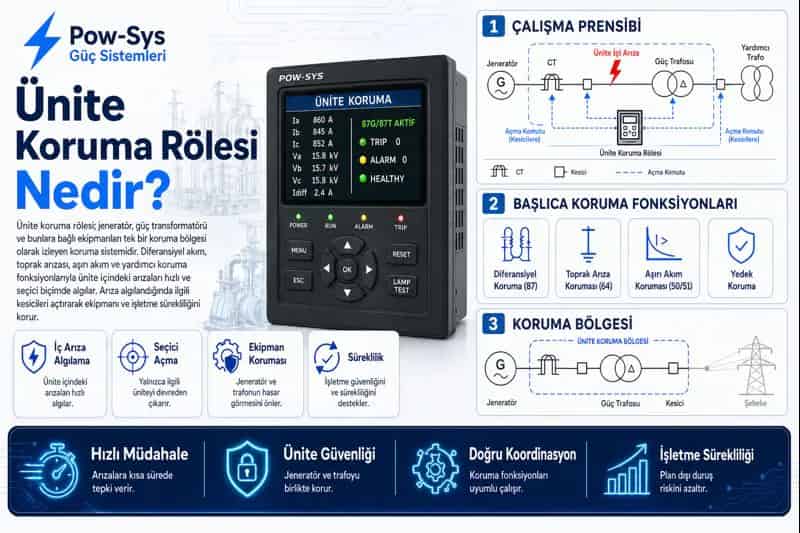
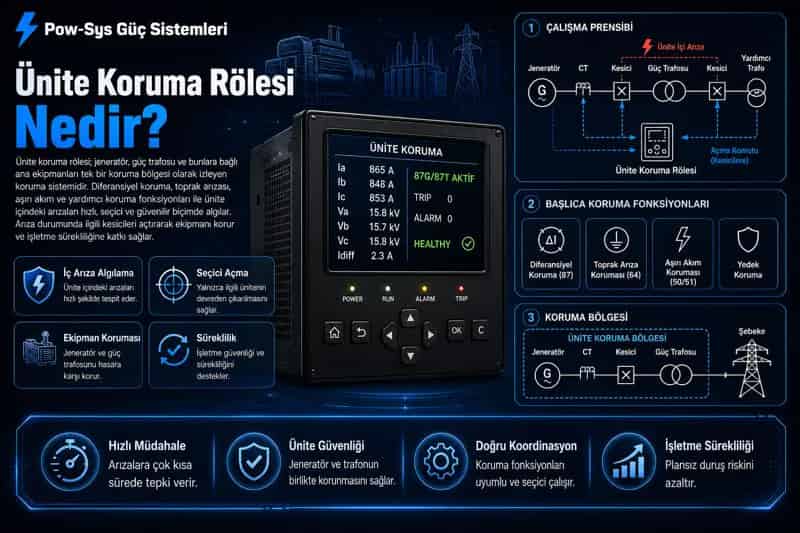
A unit protection relay is an advanced protection relay that selectively detects internal faults of an electrical generation or power conversion unit by evaluating that unit as a single protection zone. In short, the answer to the question of what a unit protection relay is: it is a relay that monitors a generator, power transformer and certain equipment connected to them within a single protection logic and gives a very fast tripping decision during internal faults. In practice, this concept is often mentioned together with generator-transformer unit protection.
Selective main protection is at the center of the question of what a unit protection relay does. A fault occurring in a generation unit or generator-transformer block should cause only the related unit, not the entire facility, to be disconnected. This relay tries to do exactly that. Winding faults, phase-to-earth faults, internal short circuits and some serious abnormal operating conditions remaining within the unit's own internal zone are detected quickly and only the related unit is isolated.
The most important answer to why a unit protection relay is necessary is that these systems contain high-power and high-cost equipment. Internal faults that occur while the generator, power transformer, generator output busbar and related connections operate together can turn into very large damage in a very short time. Therefore, general overcurrent protections are often not sufficient alone. A faster, more selective and unit-specific protection structure is needed.
The basic answer to how a unit protection relay works is protection zone logic. The relay evaluates currents at the input and output points of the equipment group included in the protection scope. If current balance is disturbed due to a fault inside the unit, it interprets this as an internal fault and gives a trip command. If the fault is outside the protection zone, the relay remains stable with correct compensation and setting logic. This approach is especially the foundation of differential protection logic.
The unit protection concept often stands out in the generator-transformer unit structure where the generator and step-up power transformer are protected together. Because these two pieces of equipment are directly connected to each other, and it may sometimes be difficult to selectively separate where the fault started by looking only at general current magnitude. The unit protection relay can make faster and safer decisions by treating this equipment group as a single block.
One of the most important functions in this type of relay is differential protection. Currents coming from the generator side, transformer side and, if necessary, intermediate connection points are compared. Under normal load or external faults, currents are kept balanced with appropriate compensation. If there is a real fault inside the unit zone, differential current increases and the relay operates as the main protection. Therefore, when a unit protection relay is mentioned, differential logic is often the first subject that comes to mind.
However, a unit protection relay does not consist only of differential protection. Depending on the application, overcurrent, earth fault, reverse power, overvoltage, undervoltage, frequency deviation, negative-sequence current, overexcitation, stator-earth fault and some rotor-related monitoring functions may also be included in the same structure. In other words, a unit protection relay is often not a single protection function but an intelligent platform where multiple critical protection functions come together.
On the generator protection side, subjects such as phase unbalance, reverse power and frequency are also important. Because generators must be protected not only against short circuits but also against abnormal operating conditions. On the transformer side, differential protection, overexcitation effects, earth faults and auxiliary protections become important. The unit protection relay combines these two worlds within a single logic and provides a more consistent protection approach.
A unit protection relay and an ordinary feeder protection relay are not the same thing. Feeder protection focuses more on protecting the outgoing circuit and the connected line. Unit protection protects a specific power generation or conversion block, meaning a critical equipment group as a whole. Therefore, the data it uses, setting logic and protection functions may be more comprehensive and more specialized.
These relays are especially important in power generation facilities. If a generator, step-up transformer and connection busbar operate together in a power plant unit, this group must be protected not individually but holistically against faults. Because even if the fault starts at one point, its effect concerns the whole unit. For this reason, the unit protection relay plays a critical role not only for equipment protection but also for generation continuity and facility safety.
For a unit protection relay to operate correctly, CT ratios, polarities, transformer vector group, generator and transformer data, grounding structure and the limits of the equipment included in the protection zone must be defined correctly. Although these relays are powerful, they cannot provide the expected protection performance if the design and settings are incorrect. Measurement chain accuracy is especially important in applications using differential logic.
Modern numerical unit protection relays are not only devices that give a tripping decision. Many models offer additional functions such as event records, oscillography, fault analysis, communication, station automation and remote monitoring. In this way, they generate strong data for both protection and maintenance analysis. Especially in critical power facilities, these records are very valuable for post-fault evaluation and operational improvement.
When selecting a unit protection relay, the structure of the equipment group to be protected must be considered. Generator rating, transformer rating, connection structure, grounding system, internal protection expectation, auxiliary protection functions and communication need should be evaluated together. The same relay structure may not be suitable for every generator or every transformer. Therefore, selection should start not only from the catalog but from the system architecture.
In summary, a unit protection relay is an advanced protection relay that detects internal faults quickly and selectively by treating the generator, power transformer and related connection equipment as a single protection zone. Differential protection logic is at the center of this structure; however, overcurrent, earth fault, voltage, frequency, reverse power and other auxiliary functions are often present together in the same system. A correctly selected, correctly set and correctly tested unit protection relay is one of the most critical safety layers in generation and power conversion facilities. In the next stage, the tests and maintenance required for unit protection relays can be prepared with the same structure.
Related Blog Posts
Related Services
Frequently Asked Questions
What is a unit protection relay?
A unit protection relay is an advanced protection relay that selectively detects internal faults of an electrical generation or power conversion unit by evaluating that unit as a single protection zone. It monitors a generator, power transformer and certain equipment connected to them within a single protection logic and gives a very fast tripping decision during internal faults. In practice, this concept is often mentioned together with generator-transformer unit protection, because the generator and the step-up transformer are directly connected and can be treated as a single block for faster and safer decisions. Differential protection logic is at the center of this structure; however, functions such as overcurrent, earth fault, voltage, frequency and reverse power are often present together in the same system. A correctly selected, correctly set and correctly tested unit protection relay is one of the most critical safety layers in generation facilities.
What does a unit protection relay do?
A unit protection relay detects faults inside the unit quickly and safely, ensures that only the related unit is disconnected and helps prevent the fault from spreading to the entire facility. Selective main protection is at the center of its duty: a fault occurring in a generation unit or generator-transformer block should cause only the related unit, not the whole facility, to be disconnected. Winding faults, phase-to-earth faults, internal short circuits and some serious abnormal operating conditions remaining within the unit's own internal zone are detected quickly and only the related unit is isolated. In this way, high-power and high-cost equipment is protected while healthy sections continue operating. For this reason, the unit protection relay plays a critical role not only for equipment protection but also for generation continuity and overall facility safety.
How does a unit protection relay work?
The basic answer to how a unit protection relay works is protection zone logic. The relay evaluates currents at the input and output points of the equipment group included in the protection scope. If the current balance is disturbed due to a fault inside the unit, the relay interprets this as an internal fault and gives a trip command. If the fault is outside the protection zone, the relay remains stable with correct compensation and setting logic. This approach is the foundation of differential protection: currents coming from the generator side, the transformer side and, if necessary, intermediate connection points are compared; under normal load or external faults they are kept balanced with appropriate compensation, while during a real internal fault the differential current increases and the relay operates as the main protection. The tripping decision is produced together with the auxiliary protection functions included in the same structure.
Where is a unit protection relay most commonly used?
A unit protection relay is used especially in generator-transformer blocks, power generation facilities, large power conversion units and critical systems where equipment is protected together. If a generator, step-up transformer and connection busbar operate together in a power plant unit, this group must be protected not individually but holistically, because even if the fault starts at one point, its effect concerns the whole unit. The concept stands out particularly in the generator-transformer unit structure, where the generator and step-up power transformer are directly connected to each other and it may sometimes be difficult to selectively separate where the fault started by looking only at general current magnitude. By treating this equipment group as a single block, the unit protection relay can make faster and safer decisions. Large motor-generator systems and power facilities requiring critical unit-based protection are also typical application areas.
Are unit protection and differential protection the same thing?
Not exactly. Differential protection can be one of the main components of unit protection, but unit protection often includes other protection functions in addition to it. The differential logic compares currents entering and leaving the protection zone and is often the first subject that comes to mind when a unit protection relay is mentioned, because it distinguishes internal faults as the main protection. However, depending on the application, a unit protection relay may also include overcurrent, earth fault, reverse power, overvoltage, undervoltage, frequency deviation, negative-sequence current, overexcitation, stator-earth fault and some rotor-related monitoring functions within the same structure. In other words, a unit protection relay is often not a single protection function but an intelligent platform where multiple critical protection functions come together. Differential protection sits at the center of this platform, but it is not the whole of it.
Which additional functions can a unit protection relay include?
Depending on the application, a unit protection relay may include overcurrent, earth fault, reverse power, overvoltage, undervoltage, frequency deviation, negative-sequence current, overexcitation, stator-earth fault and some rotor-related monitoring functions in the same structure. On the generator protection side, subjects such as phase unbalance, reverse power and frequency are especially important, because generators must be protected not only against short circuits but also against abnormal operating conditions. On the transformer side, differential protection, overexcitation effects, earth faults and auxiliary protections become important. The unit protection relay combines these two worlds within a single logic and provides a more consistent protection approach. Modern numerical models also offer additional functions such as event records, oscillography, fault analysis, communication, station automation and remote monitoring, generating strong data for both protection and maintenance analysis in critical power facilities.
Why is this relay considered critical?
A unit protection relay is considered critical because the equipment group it protects consists of high-power and high-cost systems. Internal faults that occur while the generator, power transformer, generator output busbar and related connections operate together can turn into very large damage in a very short time. Therefore, general overcurrent protections are often not sufficient alone, and a faster, more selective and unit-specific protection structure is needed. Clearing an internal fault very quickly is very important for both equipment safety and operational continuity. Because even if the fault starts at one point, its effect concerns the whole unit, this group must be protected holistically rather than individually. A correctly selected, correctly set and correctly tested unit protection relay is therefore one of the most critical safety layers in generation and power conversion facilities, supporting both facility safety and generation continuity.
What is the difference between a unit protection relay and a feeder protection relay?
A feeder protection relay and a unit protection relay are not the same thing. Feeder protection focuses more on protecting the outgoing circuit and the connected line. Unit protection protects a specific power generation or conversion block, meaning a critical equipment group such as a generator and power transformer as a whole. Therefore, the data it uses, its setting logic and its protection functions may be more comprehensive and more specialized. A unit protection relay can combine differential logic, which compares the currents entering and leaving the protection zone, with auxiliary functions such as overcurrent, earth fault, voltage, frequency and reverse power on a single platform, while feeder protection undertakes a narrower duty focused on the outgoing circuit. Which structure is suitable is determined according to the equipment group to be protected, the connection structure and the protection expectation of the facility.
Why are CT and ratio data important in a unit protection relay?
CT and ratio data are important in a unit protection relay because differential comparison cannot operate reliably without a correct measuring chain. An incorrect CT ratio or polarity may create false differential current even when there is no real fault. For the relay to operate correctly, CT ratios, polarities, the transformer vector group, generator and transformer data, the grounding structure and the limits of the equipment included in the protection zone must be defined correctly. Although these relays are powerful, they cannot provide the expected protection performance if the design and settings are incorrect. Measurement chain accuracy is especially important in applications using differential logic, because the relay sees the currents entering and leaving the protection zone through this chain. In unit protection projects, building the CT-VT structure and zone boundaries correctly is therefore as important as selecting the relay itself.
Is a unit protection relay sufficient alone?
A unit protection relay often forms the main protection structure, but depending on the application it works together with other backup or complementary protection functions. It treats the generator, power transformer and related connection equipment as a single protection zone and detects internal faults quickly and selectively, with differential protection logic at the center of the structure. At the same time, overcurrent, earth fault, voltage, frequency, reverse power and other auxiliary functions are often present together in the same system and complete the protection philosophy. When selecting a unit protection relay, generator rating, transformer rating, connection structure, grounding system, internal protection expectation, auxiliary protection functions and communication need should be evaluated together, because the same relay structure may not be suitable for every generator or every transformer. Selection should therefore start not only from the catalog but from the system architecture.