
Summary Highlights
- What a VLF test is: a test method that evaluates cable insulation condition with high voltage applied at a very low frequency
- What a VLF test does: reveals weak points in cable insulation and supports commissioning and maintenance decisions
- How a VLF test is performed: applying low-frequency AC test voltage to the cable to be tested for a defined duration and at a defined level
- Application areas: medium-voltage cables, cable terminations, cable joint areas and field acceptance-maintenance tests
- Prominent aspects of VLF testing: field applicability, low power requirement, practical use on long cables and insulation assessment advantage
Article Details
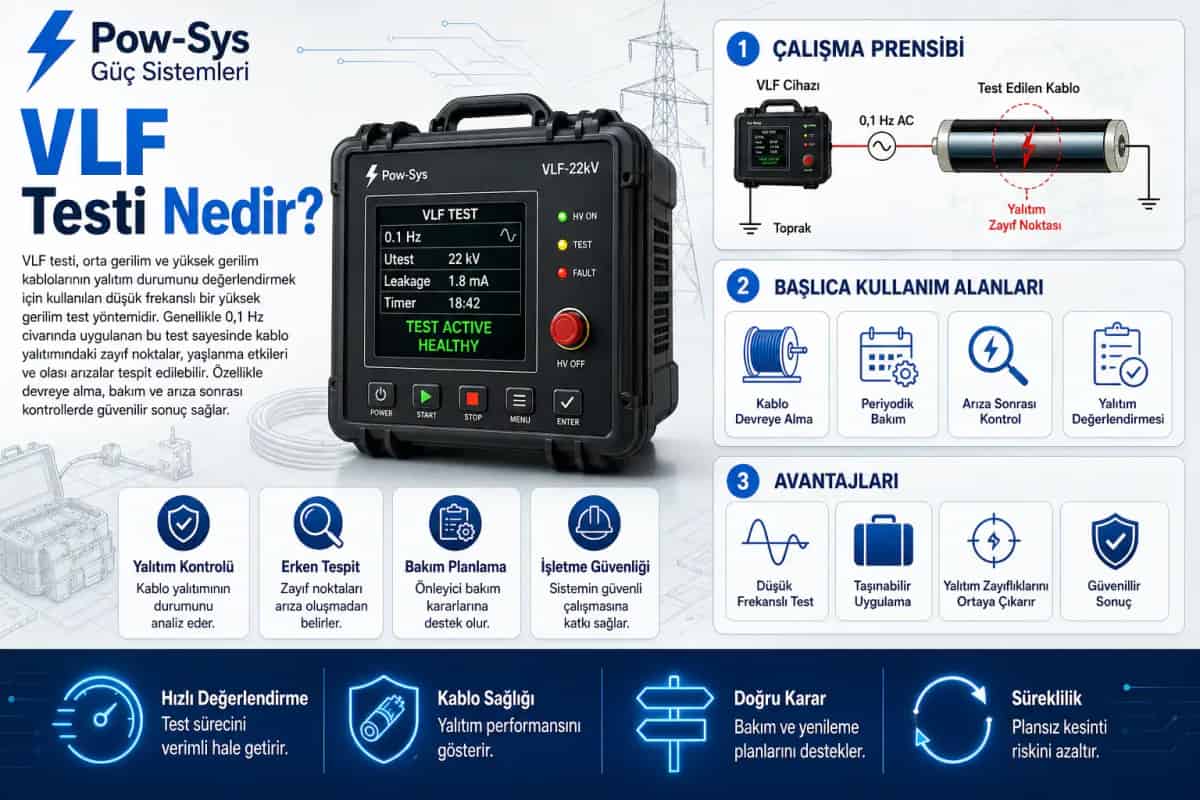
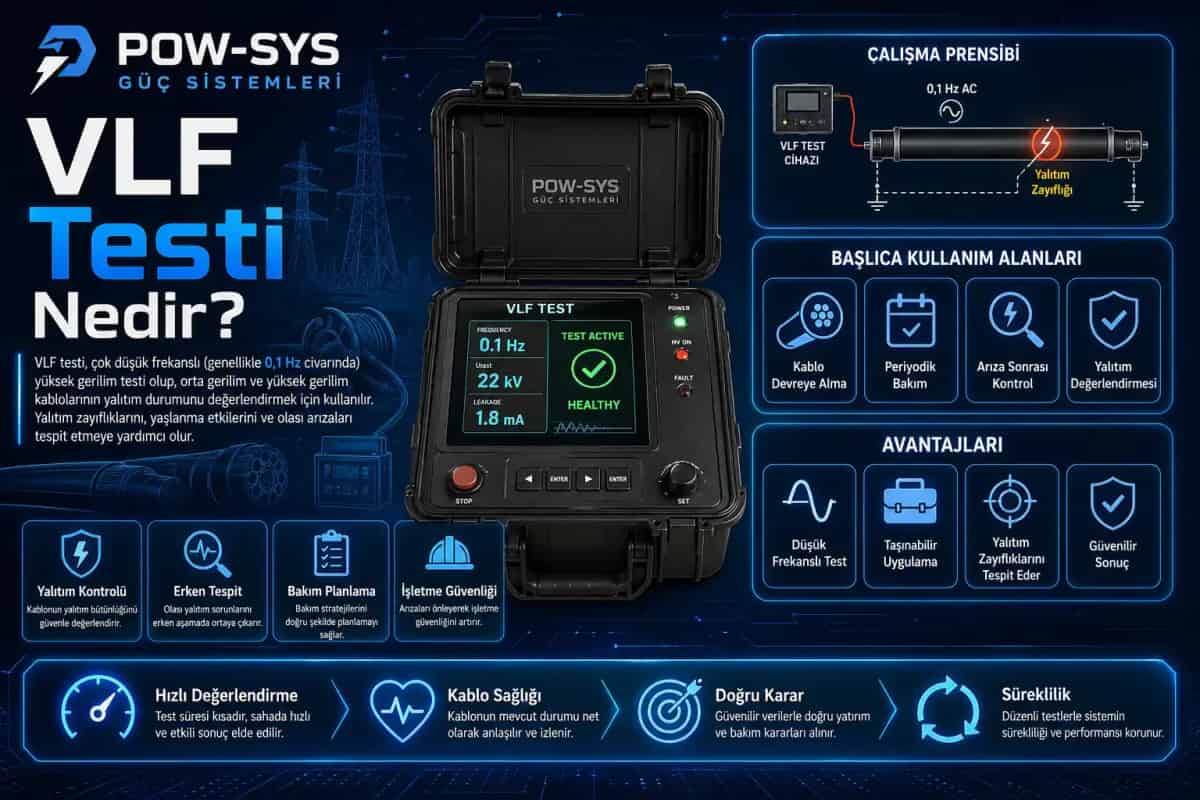
A VLF test means Very Low Frequency high-voltage test. In short, the answer to the question of what a VLF test is: it is an AC test method applied at a frequency much lower than grid frequency, especially to evaluate the insulation condition of cable systems. This method is used mostly in medium-voltage cable systems and has an important place in maintenance and commissioning works because it can be applied in the field with portable test equipment.
The evaluation of cable insulation is at the center of the question of what a VLF test does. A cable looking healthy from the outside does not mean that its insulation structure is completely healthy. Over time, manufacturing defects, installation errors, water treeing, aging, cable joint weaknesses or termination problems may occur. The VLF test helps see how these weak points behave under a defined electrical stress and provides a technical opinion on whether the cable system is suitable for operation.
The main reason VLF testing emerged is the capacitive structure of cables. Very large and heavy test sources are required to perform a conventional 50 Hz or 60 Hz AC test on long cables. This approach is often not practical under field conditions. Since the VLF method operates at a much lower frequency, it significantly reduces the power required to test the same cable. Thus, field test equipment becomes more portable, more applicable and more practical.
To explain simply how a VLF test is performed, the cable system to be tested is de-energized, safely isolated and a suitable test setup is established. Then very low frequency AC voltage is applied to the cable at a defined level. This voltage is held for a defined period and the cable's response to this stress is evaluated. The purpose of the test is to see whether the cable behaves safely under an electrical stress higher than normal operating voltage and to reveal weak points.
The most frequently used frequency value in VLF testing is around 0.1 Hz in many applications. This frequency is very low compared with conventional grid frequency, but it still allows cable insulation to be evaluated under AC-character voltage. In some systems, work can also be performed at lower frequencies depending on the length and capacitance of the cable. The aim here is to preserve field applicability while also providing the test voltage at the desired level.
A VLF test and a DC hipot test are not the same thing. In a DC test, direct current voltage is applied to the cable. In a VLF test, alternating voltage is applied, even if at a very low frequency. This difference is important especially in modern polymer-insulated cables. Because an AC-character test can create an electric field distribution closer to the cable's operating condition. Therefore, in medium-voltage cable tests, the VLF approach stands out in many field applications as a more suitable evaluation method compared with DC.
A VLF test and a conventional 50 Hz AC hipot test are also not the same thing. Although both are AC-based, one is applied at power frequency and the other at very low frequency. A power-frequency test may theoretically look more direct, but it is often not practical for the field in long cable systems. The important advantage of VLF testing appears here: it becomes possible to perform a field test with lower power requirement by using a more portable system.
VLF testing is used mostly in medium-voltage cable systems. Especially XLPE and similar insulated cables can be tested with the VLF method in acceptance tests before commissioning, post-repair verifications, maintenance works and, in some cases, condition assessment programs. Cable terminations, cable joint areas and the cable body are the main areas covered by this test approach. Therefore, VLF testing concerns not only the cable itself but the entire cable system.
Acceptance test logic and maintenance test logic should not be confused with each other. In a newly installed cable, VLF testing is often performed to verify the suitability of installation and accessories. In an older cable in operation, the same test may be part of a maintenance or condition assessment approach. Therefore, test voltage, duration and acceptance criteria are not considered the same in every case. The purpose of the application directly affects the test plan.
VLF testing is not a method that answers every question alone. In some applications, it produces much more meaningful results when used together with additional diagnostic methods such as tan delta or partial discharge. While a test performed only with withstand logic shows whether the cable can withstand a certain voltage, additional diagnostic methods can help understand in more detail why the cable has weakened or in which region the weakness may be located. Therefore, the place of VLF testing is often within a broader cable assessment process.
One important advantage of VLF testing is field applicability. Because the equipment is more portable, testing the cable line on site becomes easier. It also offers a much more practical approach compared with conventional AC test sources on long cable lines. For this reason, VLF test equipment is widely used in distribution networks, industrial facilities, power generation facilities and systems with underground cable infrastructure.
However, a VLF test is not a process to be applied randomly in every situation. Test level, duration, waveform and equipment suitability should be determined according to cable type, voltage level, age and application purpose. Unnecessarily high stress or incorrect method selection may cause unwanted results especially in old cables or cables that are already in a weak condition. Therefore, the test plan should be established according to the actual condition of the cable, not according to the availability of the device.
The waveform used in VLF testing is also important. In some systems a sinusoidal form can be used, while in some systems different waveforms can be used. This preference may change according to the purpose of the application. In the cable testing world, waveform is important not only as a device preference but also in terms of the purpose and interpretation method of the test. Therefore, the character of the equipment used should not be ignored in result evaluation.
VLF testing and fault location are not the same thing. VLF is primarily a test method used for withstand and condition assessment. Different fault location methods are required to directly find the fault location. Still, in some systems, VLF equipment may be part of a broader field diagnostic infrastructure together with sheath testing or other auxiliary functions. It is important to make this distinction correctly.
In summary, a VLF test is an AC high-voltage test method applied at very low frequency to evaluate the insulation condition of especially medium-voltage cables and their connected accessories. Thanks to field applicability on long cables, low power requirement and practical use advantage, it has an important place in commissioning, acceptance and maintenance works. When planned correctly, it provides valuable information about cable health; when applied incorrectly, it may cause misleading results or unnecessary stress. In the next step, the testing and maintenance approach required in VLF testing or how VLF testing is used on which equipment can be prepared with the same structure.
Related Blog Posts
- What Is a DC Hipot Test? What Does It Do, How Is It Performed and Why Is It Used?
- What Is a DC Insulation (Megger) Test? What Does It Do, How Is It Performed and Why Is It Used?
- What Is an AC Insulation Test Performed with Tan Delta and Capacitance Measurement? What Does It Do, How Is It Performed and Why Is It Used?
- What Is a Surge Arrester? How It Works and Its Types
Related Services
Frequently Asked Questions
What is a VLF test?
A VLF test, meaning Very Low Frequency test, is an AC high-voltage test method applied at a frequency much lower than grid frequency, used especially to evaluate the insulation condition of medium-voltage cable systems. Although the frequency is very low, the voltage still has an alternating character, which distinguishes it from DC test methods. The approach is used mostly on medium-voltage cables and their accessories, including cable terminations and joint areas, so it concerns the entire cable system rather than the cable body alone. Because it can be applied in the field with portable test equipment, the VLF test has an important place in commissioning, acceptance and maintenance works, where it shows whether a cable behaves safely under an electrical stress higher than its normal operating voltage.
What does a VLF test do?
A VLF test reveals weak points in cable insulation and provides a technical opinion on whether the cable system is suitable for operation. A cable that looks healthy from the outside may still hide problems: manufacturing defects, installation errors, water treeing, aging, cable joint weaknesses or termination faults can develop over time. By applying a defined electrical stress higher than normal operating voltage, the test shows how these weak points behave before they cause trouble in service. The results support acceptance tests before commissioning, verifications after repair, maintenance works and condition assessment programs. In a newly installed cable, the test typically verifies the suitability of the installation and accessories, while in an older cable in operation it becomes part of a maintenance or condition assessment approach.
How is a VLF test performed?
A VLF test is performed by applying a very low frequency AC voltage to a cable system that has first been de-energized and safely isolated. After a suitable test setup is established, the test voltage is raised to a defined level and held for a defined period, and the cable's response to this stress is evaluated. The purpose is to see whether the cable behaves safely under an electrical stress higher than normal operating voltage and to reveal weak points in the insulation, terminations and joints. The test level, duration, waveform and equipment suitability are not fixed: they should be determined according to the cable type, voltage level, age and purpose of the application, since acceptance testing of a new cable and maintenance testing of an aged cable follow different plans.
Why is VLF testing preferred for medium-voltage cables?
VLF testing is preferred for medium-voltage cables mainly because of the capacitive structure of long cable runs. Performing a conventional 50 Hz or 60 Hz AC test on a long cable requires very large and heavy test sources, which is often not practical under field conditions. Because the VLF method operates at a much lower frequency, the power required to test the same cable drops significantly, so the equipment becomes more portable, more applicable and more practical on site. At the same time, the test voltage keeps its AC character, which in modern polymer-insulated cables creates an electric field distribution closer to the cable's operating condition than a DC test would. This combination of field practicality and AC-character stress is why VLF stands out in many medium-voltage applications.
What is the most frequently used frequency in VLF testing?
The most frequently used frequency in VLF testing is around 0.1 Hz in many applications. This value is very low compared with conventional grid frequency, yet it still allows the cable insulation to be evaluated under voltage with an AC character. Depending on the length and capacitance of the cable, some systems can also work at even lower frequencies; the aim is to preserve field applicability while still providing the test voltage at the desired level. The frequency choice is connected to the core advantage of the method: operating far below power frequency dramatically reduces the power the test source must supply for a capacitive cable load, which keeps the equipment portable. Alongside frequency, the waveform used by the equipment also matters for how the results are interpreted.
Are VLF testing and DC hipot testing the same thing?
No, a VLF test and a DC hipot test are not the same thing. In a DC test, direct current voltage is applied to the cable, while in a VLF test alternating voltage is applied, even though its frequency is very low. This difference is especially important for modern polymer-insulated cables, because an AC-character test can create an electric field distribution closer to the cable's actual operating condition. For this reason, in medium-voltage cable testing the VLF approach stands out in many field applications as a more suitable evaluation method compared with DC. The two methods share the same general goal of stressing insulation to reveal weaknesses, but the character of the applied voltage, and therefore how representative the stress is for the cable, differs fundamentally.
Are VLF testing and 50 Hz AC testing the same?
No, VLF testing and 50 Hz AC testing are not the same, even though both are AC-based methods. The difference is the frequency at which the voltage is applied: one works at power frequency, the other at very low frequency. A power-frequency test may theoretically look like the more direct approach, since it matches the grid, but on long cable systems it is often not practical in the field, because the capacitive load demands very large and heavy test sources. This is exactly where the advantage of VLF appears: by working at very low frequency, it makes a field test possible with a much lower power requirement and a more portable system, while still stressing the insulation with alternating voltage rather than DC.
Which equipment is VLF testing used on?
VLF testing is used most widely on medium-voltage cable systems, and it covers the whole cable system rather than only the cable body: cable terminations and cable joint areas are also within its scope. XLPE and similar polymer-insulated cables in particular can be tested with the VLF method in acceptance tests before commissioning, post-repair verifications, maintenance works and, in some cases, condition assessment programs. Because the equipment is portable and the power requirement is low, VLF test sets are widely used in distribution networks, industrial facilities, power generation facilities and systems with underground cable infrastructure. In some setups, the same equipment can also be part of a broader field diagnostic infrastructure together with sheath testing or other auxiliary functions.
Is VLF testing sufficient alone?
Not always. VLF testing performed with withstand logic shows whether a cable can survive a certain voltage, but it does not explain everything on its own. In some applications, it produces much more meaningful results when combined with additional diagnostic methods such as tan delta or partial discharge measurement, which can help understand why the cable has weakened or in which region the weakness may be located. For this reason, the place of VLF testing is often within a broader cable assessment process rather than as a standalone verdict. Planning also matters: the test level, duration and waveform must match the cable's type, age and condition, because unnecessarily high stress or an incorrect method may cause unwanted results, especially in old or already weakened cables.
Does VLF testing find the fault location?
No, VLF testing does not find the fault location. VLF is primarily a test method used for insulation withstand and condition assessment: it shows whether the cable system can safely handle a defined electrical stress and helps reveal that a weakness exists. Locating exactly where a fault sits on the cable route requires different, dedicated fault location methods. The two activities should not be confused, even though they both belong to cable diagnostics. That said, in some systems VLF equipment may form part of a broader field diagnostic infrastructure together with sheath testing or other auxiliary functions, so the same field visit can combine several techniques. The correct engineering approach is to use VLF for withstand and condition assessment and separate methods for pinpointing fault positions.