
Last updated: September 9, 2026
Reviewed by Hüseyin ÇOKAL, Electrical and Electronics Engineer. Updated: September 9, 2026.
What changed: Service scope, report outputs, official sources, pre-proposal information and technical transparency notes were reviewed for the current period.
Short-Circuit Analysis, Relay Coordination and Selectivity Summary
- Maximum-minimum short-circuit current calculations and equipment withstand/breaking capacity verification in HV/MV systems: you learn whether your equipment can actually clear a fault
- Relay selectivity (protection coordination) studies with time-current curves, tripping sequence and setting optimization: a small fault no longer de-energizes the whole facility
- Technical suitability assessment of circuit breakers, fuses, MCCB/ACB devices, protection relays and contactors according to fault level: replacement decisions rest on calculation, not guesswork
- Analysis and reporting for new facilities, capacity increases, transformer replacement, generator/SPP integration and revision projects: system changes stop silently invalidating your protection settings
- Modelling with ETAP/similar software, field data verification, relay setting list preparation and commissioning support: the study ends as working protection in the field, not just a report
Technically reviewed by
Short-Circuit Analysis, Relay Coordination and Selectivity Scope
What are short-circuit analysis and relay selectivity
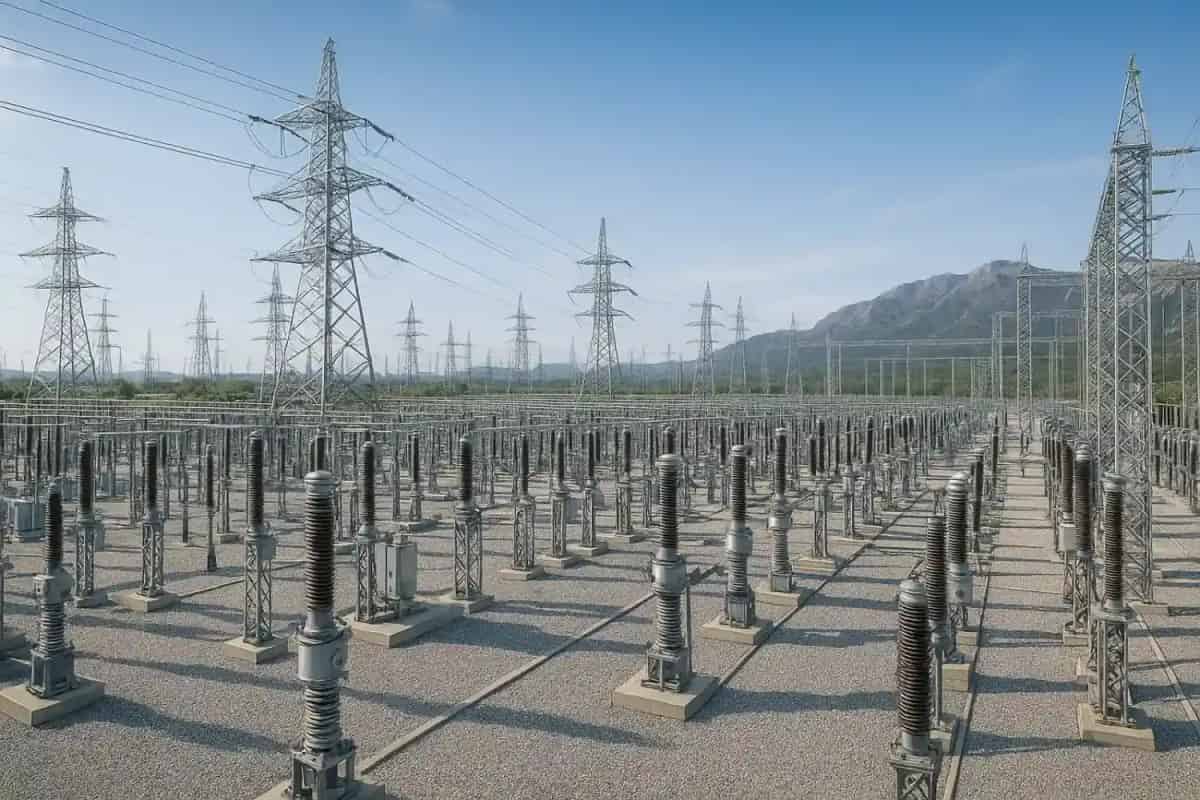
Short-circuit analysis and relay selectivity studies are among the fundamental engineering studies for safe operation, equipment protection and energy continuity in electrical installations. Especially in industrial facilities, production lines, hospitals, data centers, shopping centers, hotels and large commercial buildings, it is difficult to ensure healthy operational safety without technically verifying which protection device will trip in which order during a fault.
How is short-circuit analysis performed
What is short-circuit analysis Short-circuit analysis is the process of calculating expected fault currents in fault scenarios such as three-phase short circuit, phase-to-ground, phase-to-phase and two-phase-to-ground faults that may occur in an electrical system. These calculations are made by taking transformer rating and impedance, grid short-circuit power, cable lengths and cross-sections, motor contributions, generator/SPP contributions and system topology into account.
Relay selectivity and protection coordination
What is relay selectivity study Relay selectivity (protection coordination) study is the setting and coordination work that ensures the protection device closest to the fault trips first in the event of a fault, while upstream protection devices operate only when necessary. The aim is to isolate only the faulty zone without de-energizing the entire facility.
Why are these studies critical
Why are these studies important If the short-circuit level is calculated incorrectly, the selected circuit breaker or protection device may be insufficient during a fault. If selectivity is not performed correctly, the main circuit breaker may trip because of a small fault and the entire facility may be de-energized. This can lead to production loss, equipment damage, occupational safety risks and unplanned downtime costs.
Data collection and field verification
Within the scope of the service, first the single-line diagram, transformer data, MV/LV panel data, cable lists, protection device types, existing relay brand-model information and existing setting values, if available, are collected. Field data are compared with project documents; if there is missing or outdated information, it is revised for model accuracy.
Software modelling and operating scenarios
During the modelling stage, grid supply, transformers, generators, motor loads, cables, busbars and protection devices are represented in the software environment. Operating scenarios such as normal operation, generator supply, ring opening/closing condition and parallel transformer operation are evaluated separately, and fault currents are calculated for each scenario.
Breaker rating and equipment withstand verification
The outputs of short-circuit analysis are not limited to giving a fault-current value. The breaking capacity, thermal-dynamic withstand adequacy, busbar/cable stresses and suitability of the measuring ranges of protection devices are also checked. In this way, it becomes clear whether the equipment selection is sufficient from an engineering perspective.
TCC curves and relay setting optimization
In relay selectivity studies, protection relays, fuses, MCCB/ACB electronic trip units and, when necessary, motor protection devices are evaluated together. Tripping thresholds and delays are coordinated on time-current curves (TCC); overcurrent, short-circuit, earth fault and directional protection functions are optimized according to the application.
Special protection approach for critical loads
When carrying out a selectivity study, not only theoretical coordination but also operational priorities are taken into account. For example, continuity is prioritized on feeders supplying critical loads, while special protection approaches may be required for fire pumps, process safety loads, UPS supply paths or critical production lines. Therefore, the study is not a standard setting-copying task; it is an engineering optimization according to the facility's operating scenarios.
New facilities, capacity increases and revision projects
In new facility installations, short-circuit and selectivity studies are critical for correct equipment selection. In revision projects, after transformer capacity increase, panel replacement, new machine addition, generator integration or SPP connection, it must be checked whether the existing protection levels have been disrupted. Existing settings may become insufficient or overly sensitive after a system change.
Reporting and investment priorities
At the reporting stage, the assumptions and acceptances used, system model, short-circuit calculation results, equipment suitability assessment, coordination curves, relay setting recommendations and revision items to be implemented are presented clearly. If requested, the 'existing condition' and 'recommended condition' can be provided comparatively so that investment priorities can be determined.
Field implementation, testing and commissioning
Field implementation and commissioning support are also important parts of this service. To ensure that relay settings do not remain only in the report, coordination is provided with field teams, relay parameter entries are checked, a primary/secondary test plan is created if necessary, and the expected tripping behavior of protection functions is verified. In this way, the analysis study turns into a protection system that works in practice.
Selectivity in LV main distribution and MCC panels
Short-circuit analysis and relay selectivity studies make a major difference not only in MV systems but also in LV main distribution panels, MCC panels and critical sub-distribution systems. Especially in transformer-fed facilities with high short-circuit power, LV-side protection coordination can be vital to prevent fault propagation and preserve business continuity.
Pow-Sys service approach
As Pow-Sys Power Systems, we provide this service through a systematic process consisting of field data collection, single-line verification, software modelling, short-circuit calculations, protection coordination, relay setting optimization, reporting and field implementation support. According to the need, we can carry out the service in an integrated manner with relay tests, power quality measurements, harmonic analyses, thermal inspections and periodic maintenance works.
Proposal and study scope
If you would like to receive detailed information about short-circuit analysis and relay selectivity studies, request a technical assessment for your existing facility or ask for a proposal for your new project, you can contact us. When your single-line diagram and basic equipment list are shared, the scope is clarified from this information, and before signing you see in writing what is included and what is planned as a separate service.
Reporting, Inspection and Proposal Preparation
Sample Inspection Table
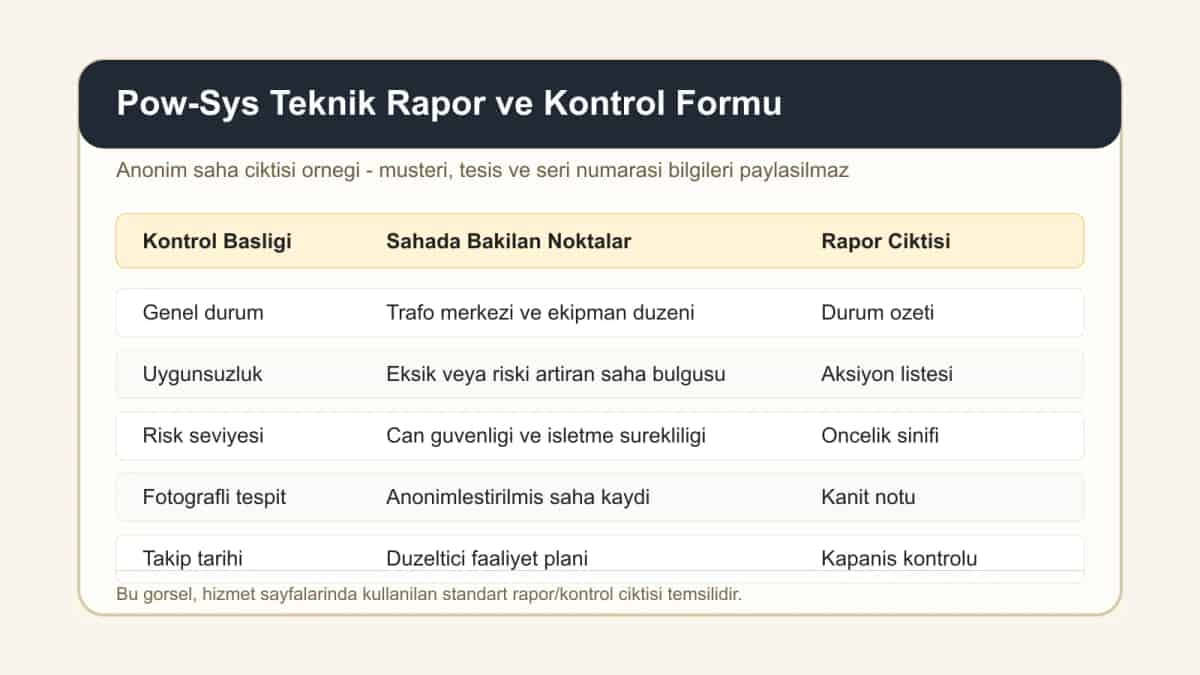
This table summarizes which headings are evaluated on site and which outputs may appear in the report.
| Inspected area | Checked criterion | Report output |
|---|---|---|
| Site and equipment condition | Existing equipment structure, access conditions, visible risks and operating conditions | Site inspection note and prioritized findings list |
| Document and project conformity | Single-line diagram, current project, labeling, reports and conformity with site implementation | Document conformity assessment and missing record list |
| Safety and operational risk | Life safety, equipment safety, energy continuity and maintenance access risk headings | Risk classification and corrective action recommendations |
| Measurement, test or inspection need | Measurement, test, visual inspection and technical review items required by the service scope | Measurement/test plan or inspection scope note |
| Reporting and follow-up | Nonconformity priority, follow-up date, responsibility allocation and next steps | Photo-supported report, action list and follow-up recommendation |
Coordination Study and Separate Field Work
Short-circuit calculations, protection coordination and the setting study specified in the proposal belong to this service. Additional field tests and equipment changes are evaluated separately.
| Work item | Relationship to the service | Scope decision |
|---|---|---|
| Short-circuit and protection coordination study | Fault-current calculations, time-current curves and the setting list follow the agreed system model. | The engineering study and proposed settings are delivered within the study scope. |
| Relay field testing and setting implementation | Injection tests and implementation may require test equipment and outage planning. | Field testing and implementation are performed only when included in the agreed proposal. |
| Equipment replacement or additional system changes | Findings may require new protection devices, wiring or further modelling. | Materials, implementation and additional study scope are agreed separately. |

Official Regulatory Sources
- EMO certificate verification portal
Claim supported on this page: EMO registration, SMM and certificate verification transparency.
- TEDAŞ official website
Claim supported on this page: Distribution infrastructure, project/acceptance processes and technical specification context.
- TEİAŞ official website
Claim supported on this page: Transmission system, connection and high-voltage infrastructure context.
- Electrical High Current Installations Regulation
Claim supported on this page: Installation, operation, maintenance and safety of high-current electrical installations.
Frequently Asked Questions
What is short-circuit analysis and what is it used for?
Short-circuit analysis is an engineering study that calculates expected fault currents during faults that may occur in an electrical system. With this study, the adequacy of circuit breakers, fuses, busbars, cables and other equipment against the fault level is checked; the risk of incorrect equipment selection and damage during a fault is reduced.
What is relay coordination (selectivity) and why is it necessary?
Relay coordination — also called selectivity or protection coordination — is the setting and coordination work that ensures the protection device closest to the fault trips first, while upstream devices operate only when necessary. A selectivity study aims to de-energize only the faulty zone during a fault. If correct coordination is not made, upstream protection devices far from the fault may trip and the entire facility may be shut down. This creates unnecessary energy interruption, production loss and operational risk.
In which facilities should short-circuit and selectivity studies be carried out?
This study is recommended for transformer substations, industrial facilities, factories, hospitals, shopping centers, hotels, data centers, large commercial buildings and all MV/LV electrical systems containing critical loads. In addition, after transformer capacity increase, panel revision, generator/SPP integration or new machine addition, the study should be updated.
What information is required for this study?
Generally, single-line diagram, transformer rating and impedance data, grid short-circuit data if available, panel and circuit breaker brand-model information, cable lengths/cross-sections, relay types, existing relay settings and operating scenarios are required. Missing data or inconsistencies can be completed by field verification.
Is it mandatory to use ETAP?
ETAP is a common and powerful analysis platform; however, short-circuit and selectivity studies can also be carried out with different engineering software. What matters is that the methods used are correct, the model represents the field, and the output is converted into an applicable technical report and setting list.
What outputs are delivered at the end of the study?
Depending on the scope, short-circuit calculation results (maximum/minimum fault currents), equipment suitability assessment, time-current curves (TCC), selectivity/coordination comments, relay setting recommendation lists, revision recommendations and an engineering report are delivered. Field implementation and testing support can also be provided if requested.
Can selectivity be achieved without changing existing relay settings?
In some facilities, existing settings may be sufficient; however, in many cases optimization is required due to system changes, different equipment characteristics or incorrect historical settings. As a result of the study, whether existing settings should be retained, revised or equipment replacement should be recommended is determined according to technical data.
Are short-circuit analysis and arc flash analysis the same thing?
No. Short-circuit analysis and selectivity study evaluate fault-current levels and protection coordination. Arc flash analysis focuses on determining possible arc energy levels, approach distances and PPE requirements. However, short-circuit and protection data are important inputs for arc flash studies.
When should the study be updated?
Short-circuit and selectivity studies should be reviewed again when a transformer is replaced or its rating is increased, a new panel or feeder is added, generator/SPP integration is performed, a large motor is added, protection equipment is changed or significant changes are made in the operating topology. Otherwise, existing settings may not be suitable for the new system.
Can relay selectivity study be carried out together with field tests?
Yes. The healthiest approach is to carry out analysis, setting recommendation, field parameter implementation and relay test/verification steps together. In this way, it is checked that the protection behavior recommended in the report actually occurs in the field, and commissioning is completed safely.
Can short-circuit analysis be performed if the single-line diagram is not up to date?
Yes, but field verification is required first. Transformer, panel, circuit breaker, fuse, relay, cable and load data are checked on site; building a reliable model without updating the single-line diagram according to the actual installation is not the correct approach.
Is selectivity study also required for LV main distribution panels?
Yes. Especially in transformer-fed facilities, LV main distribution panels, MCC panels and critical sub-distribution feeders may have high short-circuit levels. If MCCBs, ACBs, fuses and protection relays are not coordinated correctly, a small fault may de-energize a wider area.
In which situations is a short-circuit analysis required?
A short-circuit analysis is required whenever equipment must be verified against the fault levels it may face. Typical situations include new facility installations, where circuit breakers, fuses, busbars and cables must be selected with adequate breaking and withstand capacity; system changes such as transformer replacement or capacity increase, new panels or feeders, generator or solar plant integration and large motor additions, which can alter fault currents significantly; and project or authority approval processes, where short-circuit calculations often form part of the technical file. It is also the necessary starting point for relay selectivity work, because coordination settings are derived from calculated fault currents. If the existing study is outdated or the single-line diagram no longer matches the field, the analysis should be renewed with verified data.