
Summary Highlights
- Importance of distance protection relay maintenance: preserving line protection reliability, selectivity and fast tripping performance
- Basic maintenance steps: visual inspection, setting verification, secondary injection, zone and direction tests, trip circuit check
- Main checks to be performed: CT/VT chain, fuse fail logic, binary inputs/outputs, breaker trip circuit and event records
- Advanced tests: impedance characteristic verification on the Z-plane, end-to-end tests in teleprotection schemes, time synchronization and communication checks
- Recording and trend tracking: comparison of trip times, zone reach results, alarm history, oscillography records and maintenance reports
Article Details
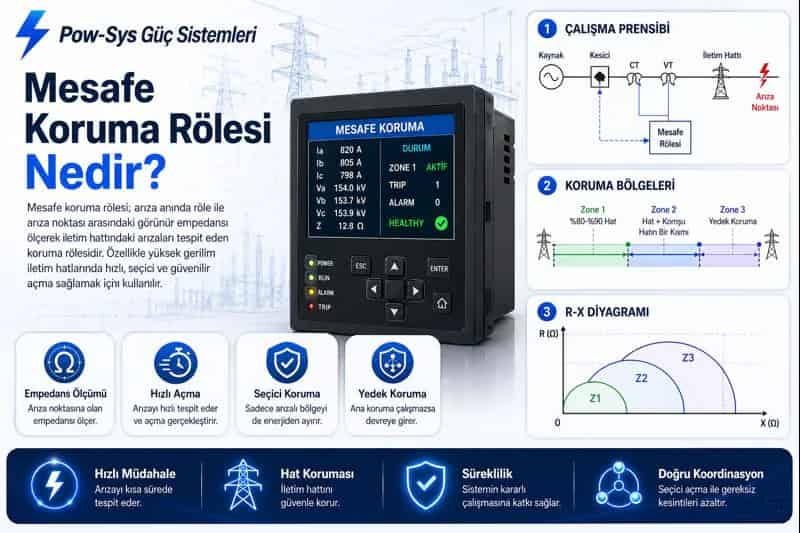
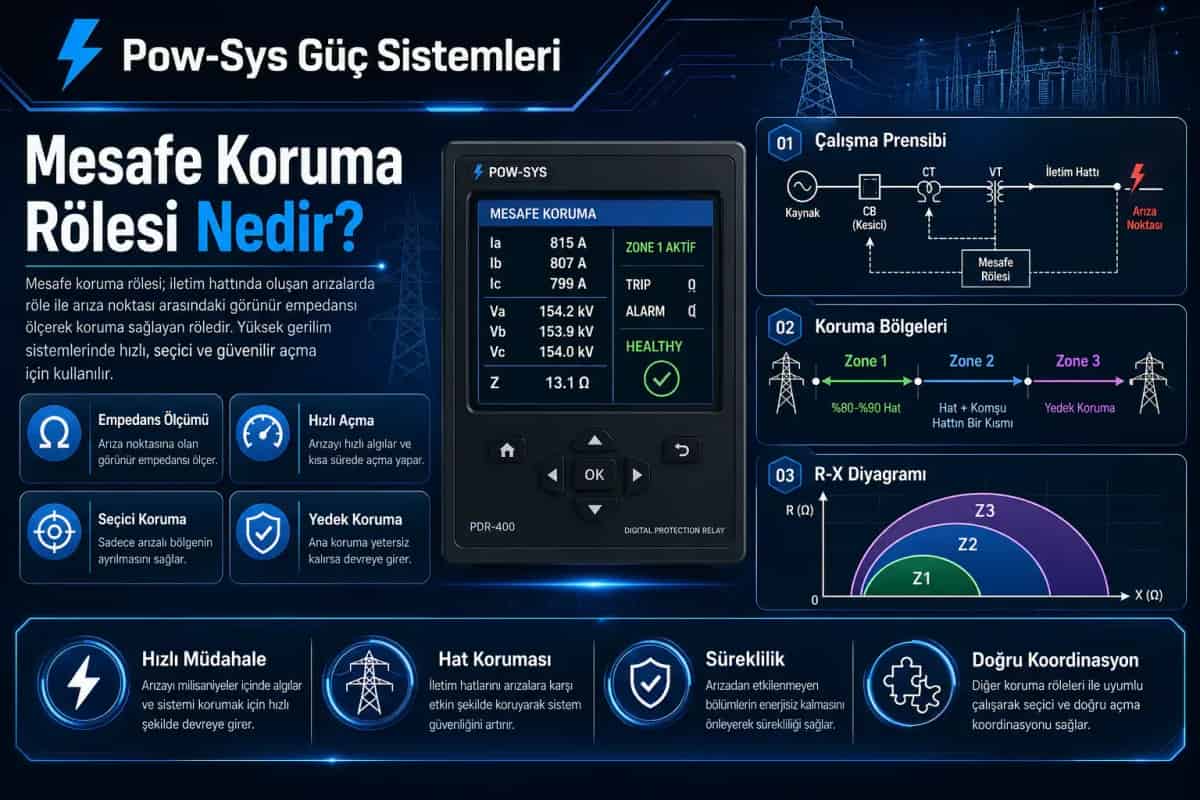
This article focuses on the tests and maintenance of distance protection relays, not on the definition of the relay itself. Because distance protection relays evaluate faults on transmission and distribution lines through apparent impedance, their tests and maintenance also focus on verifying this impedance behavior. Therefore, the tests and maintenance required for distance protection relays are not performed only to see whether the relay is energized. The main purpose is to ensure that the relay sees the fault in the correct zone, interprets it in the correct direction, issues a trip in the correct time and operates reliably together with the connected circuit breaker. A small setting or circuit error in a distance relay can cause either unnecessary tripping or delayed clearing of a real fault.
The first step of maintenance is always safety. Before working on the relay, the related protection system should be placed in a safe test condition, the required test switch or test block arrangement should be used correctly and CT/VT circuits should be handled according to manufacturer procedure. Especially in systems using test blocks, it is very important that trip and alarm circuits are blocked, the CT secondary is short-circuited and the VT secondary is isolated in a controlled way when the test plug is inserted. Incorrect test preparation can create a much greater field risk than a relay fault.
Visual inspection is the basis of maintenance. The relay front panel, display, LED indicators, alarm records, covers, terminal connections, auxiliary supply terminals and communication ports should be visually inspected. If there are self-supervision alarms, internal relay failure warnings, time synchronization loss or VT fuse fail type warnings on the relay, these should become maintenance priorities. Even if the protection relay appears to operate, alarm history can reveal internal problems early.
One of the first technical maintenance headings in distance protection relays is setting verification. The setting file loaded in the relay should be compared with the approved protection coordination file. Zone 1, Zone 2 and Zone 3 reach values, mho or quadrilateral characteristic selection, directional element settings, earth distance functions, teleprotection logic and output assignments should be compatible with the expected project. A small setting change made in the field can alter the entire behavior of the distance relay.
Secondary injection is one of the basic methods in periodic maintenance tests. In this test, controlled current and voltage signals are applied to the relay to verify whether the protection function operates correctly. For a distance relay, this is not merely a pickup test; it is also checked whether the apparent impedance enters the relay characteristic area correctly, which zone operates and whether the trip time complies with the expected value. In distance protection, the test logic is based more on verifying impedance behavior than current magnitude alone.
Zone tests are the heart of distance relay maintenance. It should be verified that the relay operates fast or without delay within the Zone 1 reach, gives delayed tripping for Zone 2 and behaves correctly as a backup zone for Zone 3. In-zone tests alone are not sufficient; out-of-zone points should also be applied to see that the relay does not overreach. If the relay interprets a Zone 1 fault as Zone 2, this is a serious indication of a setting or connection problem.
The direction determination test is also very important. A distance relay should not only detect the fault, but also correctly distinguish whether it is in the forward or reverse direction. Therefore, forward and reverse fault scenarios should be applied during maintenance, and it should be verified that the relay provides protection only in the correct direction. Especially in parallel-fed, ring-type or pilot-protected systems, reliability of the directional element is the basis of protection performance.
Verification of the impedance characteristic on the Z-plane is an important part of the modern distance test approach. In relays using mho or quadrilateral characteristics, test points are selected inside, on the boundary and outside the characteristic to check boundary behavior. Thus, not only a single trip test but whether the protection area is really formed as expected can be seen. This approach is especially valuable after setting changes or during new commissioning.
The CT and VT chain should be examined separately in distance relay maintenance. If CT polarity, VT polarity, phase sequence, secondary ratios and ratio definitions inside the relay are not compatible, the distance calculation will be wrong. Voltage loss, a blown fuse or VT circuit discontinuity can also lead the relay to make an incorrect zone decision. Therefore, during maintenance, not only the relay but the entire measurement chain seen by the relay should be verified.
Trip circuit and binary input-output tests should not be neglected. It is not sufficient for the relay to make the correct zone decision; this decision must reach the circuit breaker through the correct binary output. The trip coil circuit, lockout logic, signals related to auto-reclosing, breaker failure chain and, when required, single-pole/triple-pole trip outputs should be verified one by one. Even if the protection relay is healthy, the real protection function does not occur if the trip chain is faulty.
In distance relays with teleprotection or pilot protection, end-to-end tests should also be performed. In schemes using POTT, PUTT, DCB, permissive or blocking logic, local relay testing alone is not sufficient. Both ends should be tested together to verify that the signals sent and received for Zone 1 and overreaching zone faults are correct and that fast trip and blocking logic operate as expected. In such schemes, the communication channel as well as the relay logic is part of the test.
Event records and oscillography review are important parts of maintenance. During maintenance, it should be examined from which zone the relay tripped in the past, what the fault locator result was, how the directionality decision was formed and through which signals possible incorrect trips occurred. Modern distance relays do not only provide protection; they also produce powerful records for analyzing the moment of fault. These records make the maintenance plan smarter.
Communication and time synchronization are also within the maintenance scope. If IEC 61850, SCADA, teleprotection channel, IRIG-B, SNTP or other time/communication infrastructure used does not operate correctly, event record timing may deteriorate, pilot protection logic may weaken or the central monitoring system may see incorrect data. Accurate timestamping is critical especially in faults where records from both ends need to be compared.
At the end of maintenance, all results should be recorded. Which zone points were tested, trip times, direction test result, binary output verifications, CT/VT check findings, pilot protection test scenarios and event record reviews should be archived regularly. Because distance relay problems usually do not appear suddenly; they grow as setting deviation, measurement chain problems or communication instability. If trend tracking is performed, weak points can be seen before a real fault occurs. In summary, the tests and maintenance required for distance protection relays should be performed by carrying out safe test preparation, setting verification, secondary injection, zone and direction tests, CT/VT and trip circuit checks, end-to-end pilot protection verification when required and record analysis together. If distance protection relays, line protection, relay coordination and MV/HV field safety in your facility will be evaluated together, LV/MV/HV project design and consultancy and HV/MV testing, maintenance and repair work can technically support this process.
Related Blog Posts
Related Services
Frequently Asked Questions
Why is maintenance required on distance protection relays?
Maintenance is required because distance protection relays evaluate faults on transmission and distribution lines through apparent impedance, using zone and direction logic. Maintenance is not performed only to see whether the relay is energized; the main purpose is to ensure that the relay sees the fault in the correct zone, interprets it in the correct direction, issues a trip in the correct time and operates reliably together with the connected circuit breaker. A small error in the settings, the measurement chain or the trip circuit can cause either unnecessary tripping or delayed clearing of a real fault. Because a distance relay depends on so many linked elements, from the CT/VT chain to the trip coil, a weakness in any of them undermines protection even when the relay itself is healthy. Regular maintenance verifies zone behavior, directional reliability and the trip chain together, so that line protection stays selective and fast.
Which tests are performed on distance protection relays?
Setting verification, secondary injection, Zone 1, Zone 2 and Zone 3 tests, the direction determination test, the CT/VT circuit check, the trip circuit test and end-to-end tests when pilot protection exists can be performed. Setting verification compares the relay's loaded setting file with the approved coordination file, checking zone reach values, mho or quadrilateral characteristic selection, directional settings and output assignments. Secondary injection applies controlled current and voltage to confirm the protection function operates, and zone tests check correct reach and that the relay does not overreach. The direction test confirms forward and reverse discrimination, while impedance characteristic verification on the Z-plane checks boundary behavior. The CT and VT chain, trip circuit and binary inputs and outputs are verified, and event records are reviewed. In teleprotection schemes, end-to-end tests are added. The scope depends on the relay, the scheme and whether settings have recently changed.
Why is secondary injection used in periodic maintenance tests?
Secondary injection is used because it allows the relay's measurement and decision chain to be verified safely, and it is one of the basic methods in periodic maintenance tests. In this test, controlled current and voltage signals are applied to the relay to check whether the protection function operates correctly. For a distance relay, secondary injection is not merely a pickup test; it also checks whether the apparent impedance enters the relay characteristic area correctly, which zone operates and whether the trip time complies with the expected value. This matters because, in distance protection, the test logic is based more on verifying impedance behavior than on current magnitude alone. By injecting known signals, the maintenance team can confirm that the relay interprets the fault as intended without waiting for a real fault on the line. For this reason secondary injection sits at the center of periodic distance relay testing, alongside setting verification and zone tests.
Why are zone tests so important?
Zone tests are so important because the most basic duty of a distance relay is to identify a fault in the correct zone, and zone tests are the heart of distance relay maintenance. It should be verified that the relay operates fast or without delay within the Zone 1 reach, gives delayed tripping for Zone 2 and behaves correctly as a backup zone for Zone 3. In-zone tests alone are not sufficient; out-of-zone points should also be applied to see that the relay does not overreach. If the relay interprets a Zone 1 fault as Zone 2, this is a serious indication of a setting or connection problem, and both the speed and the selectivity of the protection deteriorate. Because a distance relay is meant to clear close-in faults quickly while backing up more distant ones with delay, confirming the reach of each zone in both directions is what proves the protection area is really formed as the coordination intended.
Why is the direction determination test performed?
The direction determination test is performed because a distance relay must not only detect a fault, but also correctly distinguish whether it is in the forward or reverse direction. For this reason forward and reverse fault scenarios should be applied during maintenance, and it should be verified that the relay provides protection only in the correct direction. Especially in parallel-fed, ring-type or pilot-protected systems, the reliability of the directional element is the basis of protection performance, because a wrong direction decision can trip a healthy line or fail to trip a faulted one. If the directional element behaves incorrectly, the whole zone logic loses meaning, since the relay could reach in the wrong direction. Confirming forward and reverse discrimination therefore protects both security and selectivity, and it is treated as a main verification alongside the zone tests. In interconnected networks, a dependable directional decision is what keeps distance protection coordinated with the surrounding system.
What does characteristic testing on the Z-plane verify?
Characteristic testing on the Z-plane verifies that the relay's mho or quadrilateral characteristic operates as expected inside, on the boundary and outside the characteristic. In relays using these characteristics, test points are selected inside, on the boundary and outside the protection area to check boundary behavior, so that not just a single trip test but whether the protection area is really formed as designed can be seen. Thus, not only tripping but the actual impedance reach is tested, which is a more complete picture than a single pickup check. This approach is especially valuable after setting changes or during new commissioning, when the shape of the characteristic needs to be confirmed against the intended coordination. Because a distance relay decides on the basis of apparent impedance, verifying its behavior across the Z-plane shows that the boundary between operate and no-operate regions matches the settings.
Why are CT and VT circuits checked separately?
CT and VT circuits are checked separately because a distance relay calculates apparent impedance through this measurement chain, so an error in it corrupts every zone and direction decision. If the CT polarity, VT polarity, phase sequence, secondary ratios and the ratio definitions inside the relay are not compatible, the distance calculation will be wrong. Voltage loss, a blown fuse or a VT circuit discontinuity can also lead the relay to make an incorrect zone decision, which is why fuse fail logic matters. For this reason, during maintenance, not only the relay but the entire measurement chain the relay sees should be verified. Because the relay cannot know the true impedance if the signals reaching it are wrong, CT/VT polarity, ratio or phase errors can disturb the whole distance protection behavior while the relay itself appears healthy. Confirming the measurement chain is therefore a basic step before trusting any zone, direction or characteristic result.
Is a local test sufficient in pilot protection schemes?
No, a local test is not sufficient in pilot protection schemes. In distance relays with teleprotection or pilot protection, end-to-end tests should also be performed, because in schemes using POTT, PUTT, DCB, permissive or blocking logic, testing the local relay alone does not prove the scheme works. Both ends should be tested together to verify that the signals sent and received for Zone 1 and overreaching zone faults are correct, and that the fast trip and blocking logic operate as expected. In such schemes, the communication channel as well as the relay logic is part of the test, since a healthy relay at each end still fails to deliver the intended fast, coordinated tripping if the channel carrying the permissive or blocking signals is faulty. For this reason end-to-end testing verifies both relays and the communication channel together, so that the pilot scheme behaves correctly for the fault scenarios it was designed to handle.
Why are event records examined in distance relay maintenance?
Event records are examined because oscillography and event records show from which zone, according to which direction decision and in what time the relay operated. During maintenance it should be reviewed from which zone the relay tripped in the past, what the fault locator result was, how the directionality decision was formed and through which signals any possible incorrect trips occurred. Modern distance relays do not only provide protection; they also produce powerful records for analyzing the moment of fault, and these records make the maintenance plan smarter. They are very valuable for analyzing incorrect trips or setting errors, because they reveal how the relay actually behaved during real disturbances rather than only how it responds to injected test signals. Accurate timestamping strengthens this, especially where records from both ends of a line need to be compared. By studying past events, maintenance can catch a developing setting or measurement problem before it causes a wrong operation on a real fault.
Why is record keeping important in distance protection relay maintenance?
Record keeping is important because distance relay problems usually do not appear suddenly; they grow as setting deviation, measurement chain problems or communication instability. At the end of maintenance, which zone points were tested, the trip times, the direction test result, the binary output verifications, the CT/VT check findings, the pilot protection test scenarios and the event record reviews should all be archived regularly. When this data is kept, zone reach deviations, trip time changes, directional instability and communication problems can be compared from one visit to the next. With regular records and trend tracking, weak points can be noticed before a real fault occurs, rather than being discovered only when the relay misoperates. Because a distance relay sits in a coordinated protection scheme, keeping a clear history of its test results also makes it easier to confirm that a setting change or measurement fix has not disturbed the wider coordination with neighboring lines.