
Summary Highlights
- Importance of metal-clad maintenance: operating safety, reduction of fault risk and preservation of system continuity
- Basic maintenance steps: visual inspection, compartment cleaning, connection tightness, mechanical movement and shutter/interlock verification
- Main checks to be performed: withdrawable circuit breaker, busbar compartment, cable compartment, instrument transformers, grounding and auxiliary equipment
- Electrical verifications: contact resistance, insulation checks, secondary circuit tests and auxiliary contact verifications
- Recording and trend tracking: comparison of thermal observations, mechanical behavior, test results and maintenance history
Article Details
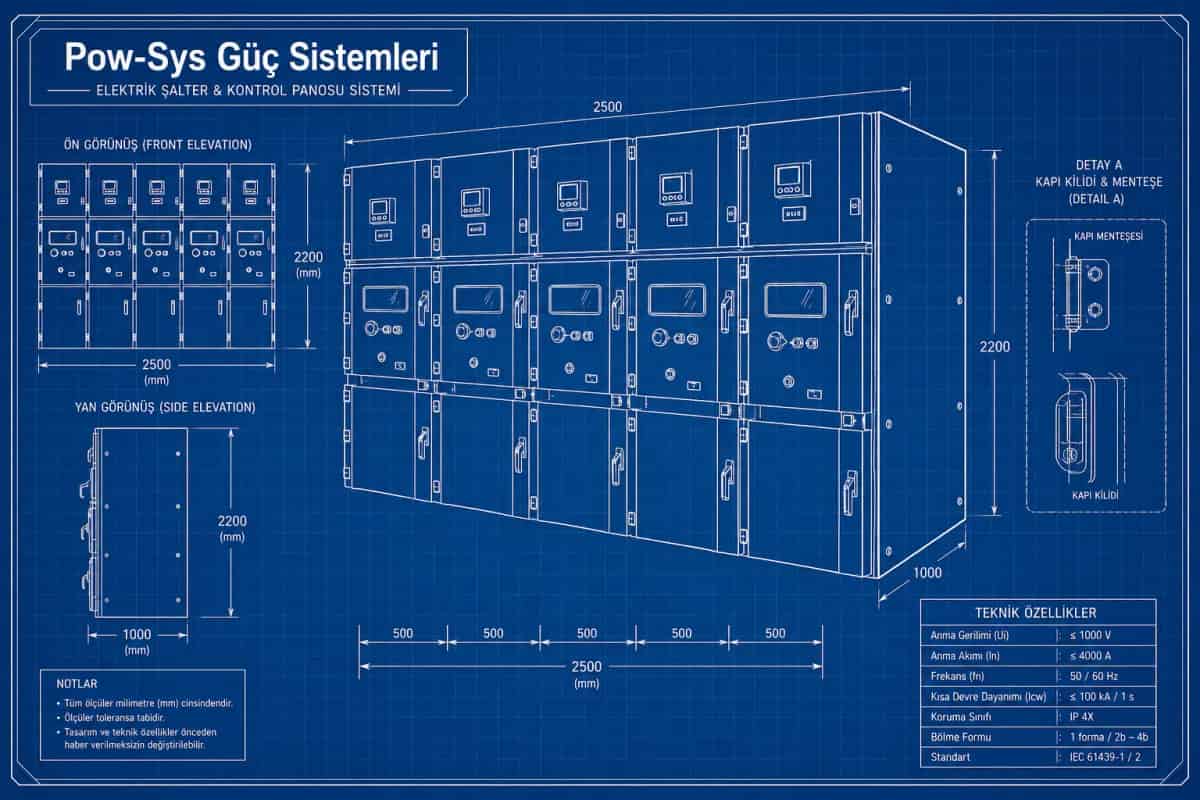
Metal-clad systems are structures with strong safety and compartmentalization logic in medium-voltage switchgear installations. Therefore, the tests and maintenance required for metal-clad switchgear are not performed only to see whether the equipment carries energy. The main purpose is to ensure long-term safe operation of the separate compartment structure, withdrawable circuit breaker logic, shutter and interlock arrangement, busbar connections and secondary systems. Because a small mechanical defect or connection weakness in metal-clad panels can directly affect both operating safety and energy continuity over time.
The first step of maintenance is always safety. Before working on a metal-clad cubicle, the related section should be taken out of service with the correct switching sequence, absence of voltage should be verified, grounding operations should be completed and, if necessary, the withdrawable circuit breaker should be moved to the disconnected position. Especially in systems with drawout circuit breakers, not leaving the equipment in an intermediate position, ensuring safe operation of the shutter area and preserving the door interlock logic are very important. Therefore, maintenance is not only a test operation but also correct isolation discipline.
Visual inspection is the basis of maintenance. Front covers, cubicle body, paint surface, signs of rust or corrosion, cabinet alignment, labels, warning signs and mechanical locking elements should be visually inspected. Although the separate compartment structure provides a safety advantage in metal-clad systems, dust, moisture, looseness or mechanical deterioration may develop in these compartments over time. Therefore, external appearance should be evaluated not only cosmetically, but also in terms of functional safety.
Compartment cleaning is a critical step in metal-clad maintenance. The busbar compartment, circuit breaker compartment, cable compartment and low-voltage/auxiliary circuit compartments should be cleaned properly. Dust, metal particles, insect residues, moisture traces or foreign object accumulation can negatively affect both insulation safety and mechanical movement. Especially in panels that have remained in operation for a long time, if cleaning is neglected, shutter movement, auxiliary contact behavior and surface insulation can weaken over time.
The withdrawable circuit breaker is one of the most sensitive parts of the metal-clad structure. It should be checked whether the circuit breaker moves properly between service, test and disconnected positions, whether there is stiffness or play in the racking mechanism and whether the circuit breaker seats fully into the cubicle. In addition, primary contact arms, tulip contact structures and moving main connection surfaces should be reviewed for wear, contamination and loss of pressure. In metal-clad maintenance, opening and closing the circuit breaker alone is not enough; mechanically compatible operation with the cubicle must also be verified.
The shutter mechanism requires separate attention. In metal-clad systems, primary contact openings are often protected by metal shutters, and these shutters open and close according to the position of the withdrawable circuit breaker. During maintenance, it should be verified that shutters move freely, evenly and safely; that there is no deterioration in spring or locking elements; and that they correctly close openings when the circuit breaker is withdrawn. A cubicle with a faulty shutter system loses one of the most important safety advantages of the metal-clad logic.
The interlock arrangement is the safety heart of the metal-clad system. Door interlocks, the relationship between the earthing switch and circuit breaker, test position locks, shutter access logic, key locks and electromechanical permission chains, if present, should be tested one by one. A door that can be opened in the wrong sequence, a circuit breaker that moves at an unsuitable time or a faulty earthing switch mechanism creates serious field risk. Therefore, interlock testing is not an auxiliary part of maintenance; it is a main part.
Busbar compartment and cable compartment checks are also very important in metal-clad maintenance. Busbar connections should be inspected for looseness, darkening and heating marks; insulators for cracks; the cable compartment for moisture; terminations for deterioration; and the screen-grounding arrangement for problems. Cable terminations, CT/VT areas and terminal connections are among the areas that require the most attention in terms of fault risk in a metal-clad panel. The separate compartment structure makes these areas more controlled, but it does not eliminate the need for maintenance.
Instrument transformers and auxiliary primary elements should also be checked. CT and VT installations, secondary connections, grounding points, fuse structures and insulation surfaces should be reviewed. In metal-clad systems, the low-voltage instrument compartment is usually separated from the high-voltage compartments; this is an advantage, but it does not remove the need for regular testing of secondary circuits. If relays are to operate correctly, this measurement chain must first be healthy.
Contact resistance measurement is one of the valuable electrical tests in metal-clad maintenance. Especially on withdrawable circuit breaker main contacts, primary fixed contact points and busbar transitions, micro-ohm level measurements can reveal whether there is an abnormal resistance increase in the conducting path. A clear difference between phases indicates loose connection, contamination, loss of contact pressure or the need for detailed mechanical inspection. This test is not sufficient alone, but it is a very strong early warning tool.
Insulation checks are also important. Insulation assessment should be performed with suitable test procedures on busbar-earth, phase-phase, secondary circuits and auxiliary wiring when required. Especially in metal-clad cubicles that have remained out of service for a long time, been exposed to moisture or undergone field intervention, the insulation resistance approach can provide important data for the maintenance plan. However, results should always be interpreted together with previous measurements and environmental conditions.
Secondary circuit and auxiliary equipment tests should not be neglected in metal-clad maintenance. Protection relays, auxiliary contacts, circuit breaker trip-close circuits, motorized racking mechanism control if present, indicators, alarm circuits and cable ends should be verified one by one. Because many faults in metal-clad panels originate not from the primary side but from the low-voltage control chain. Even if the cubicle appears healthy, safe operation is not possible if the secondary logic has deteriorated.
Thermal camera inspection is very efficient. When busbar joints, primary connections, circuit breaker contact areas, CT/VT terminal areas, cable terminations and auxiliary panel connections are thermally inspected, looseness or increased contact resistance can be detected early. Since metal-clad structures have compartment separation, thermal observations should be planned and comparison between similar cubicles should be taken as the basis. A clear temperature difference between phases is often a sign requiring detailed maintenance.
At the end of maintenance, all findings should be recorded. Movement behavior of the withdrawable circuit breaker, shutter and interlock tests, contact resistance measurements, insulation results, secondary circuit tests, thermal images and observed mechanical defects should be archived regularly. Because problems in metal-clad systems usually do not appear suddenly; they develop over time. If trend tracking is performed, weakening mechanisms, heating connections and recurring cubicle problems can be noticed before faults occur. In summary, the tests and maintenance required for metal-clad switchgear consist of visual inspection, compartment cleaning, withdrawable circuit breaker and shutter/interlock verification, busbar and cable compartment checks, contact resistance and insulation tests, secondary circuit verifications and thermal inspections carried out together. If metal-clad cubicles, withdrawable circuit breakers, relay systems and MV panel safety in your facility will be evaluated together, HV/MV testing, maintenance and repair and LV/MV/HV project design and consultancy services can support the technical decision process.
Related Blog Posts
Related Services
Frequently Asked Questions
Why is maintenance required on metal-clad switchgear?
Maintenance is required because metal-clad systems are structures with strong safety and compartmentalization logic in medium-voltage switchgear installations. Maintenance is not performed only to see whether the equipment carries energy; the main purpose is to ensure long-term safe operation of the separate compartment structure, the withdrawable circuit breaker logic, the shutter and interlock arrangement, busbar connections and secondary systems. A small mechanical defect or connection weakness in a metal-clad panel can directly affect both operating safety and energy continuity over time, and deterioration on the mechanical, electrical or secondary side can undermine the very compartment logic the design relies on. Because these panels combine primary equipment, a moving withdrawable breaker and a low-voltage control chain, weaknesses can appear in several places at once. Regular maintenance detects these defects early, so that the safety advantages of the metal-clad structure and operating continuity are preserved.
Which checks are performed on metal-clad switchgear?
Visual inspection, compartment cleaning, the withdrawable circuit breaker movement test, shutter and interlock verification, busbar and cable compartment checks, contact resistance, insulation checks, secondary circuit tests and thermal inspection can be performed. Visual inspection covers the body, paint, rust, cabinet alignment, labels and locking elements, while compartment cleaning removes dust, metal particles and moisture from the busbar, breaker, cable and low-voltage compartments. The withdrawable circuit breaker is checked for proper movement between service, test and disconnected positions, and the shutter and interlock arrangement is verified for safe operation. Busbar and cable compartments are inspected for looseness, insulator cracks, moisture and termination deterioration. Contact resistance and insulation tests assess the conducting path and insulation, secondary circuits and auxiliary contacts are verified, and thermal inspection reveals heating connections. The scope is chosen according to the panel and its history, so not every check applies in every visit.
Why is the withdrawable circuit breaker checked separately?
The withdrawable circuit breaker is checked separately because it is one of the most sensitive parts of the metal-clad structure. During maintenance it should be verified that the breaker moves properly between service, test and disconnected positions, that there is no stiffness or play in the racking mechanism, and that the breaker seats fully into the cubicle. In addition, the primary contact arms, tulip contact structures and moving main connection surfaces should be reviewed for wear, contamination and loss of contact pressure. In metal-clad maintenance, simply opening and closing the breaker is not enough; its mechanically compatible operation with the cubicle must also be verified. Because the withdrawable breaker carries the main current and moves between positions, a defect in its racking, seating or contacts can affect both operating safety and the conducting path. For this reason it is treated as a distinct and priority item within metal-clad maintenance rather than a routine open-close check.
Why is the shutter mechanism important?
The shutter mechanism is important because, in metal-clad systems, the primary contact openings are often protected by metal shutters that open and close according to the position of the withdrawable circuit breaker. This protects the primary openings and contributes to access safety when the breaker is withdrawn. During maintenance it should be verified that the shutters move freely, evenly and safely, that there is no deterioration in the spring or locking elements, and that they correctly close the openings when the breaker is withdrawn. A cubicle with a faulty shutter system loses one of the most important safety advantages of the metal-clad logic, because the openings that carry primary voltage may no longer be reliably covered. For this reason the shutter mechanism requires separate attention in maintenance, and its correct, position-dependent operation is one of the key checks that keeps the compartment structure safe for personnel working on the panel.
Why is the interlock test a main part of maintenance?
The interlock test is a main part of maintenance because the interlock arrangement is the safety heart of the metal-clad system. Interlocks prevent parts such as doors, circuit breakers and earthing switches from operating in the wrong sequence. During maintenance, door interlocks, the relationship between the earthing switch and the circuit breaker, test position locks, shutter access logic, key locks and any electromechanical permission chains should be tested one by one. A door that can be opened in the wrong sequence, a circuit breaker that moves at an unsuitable time or a faulty earthing switch mechanism creates serious field risk for anyone working on the panel. Because these logics directly protect personnel and prevent dangerous switching, interlock testing is not an auxiliary part of maintenance but a main part. Verifying every interlock ensures that the compartment structure and switching discipline the metal-clad design depends on continue to work safely.
What does contact resistance measurement show in a metal-clad system?
Contact resistance measurement shows whether there is an abnormal resistance increase in the conducting path of a metal-clad system. It is one of the valuable electrical tests in metal-clad maintenance, applied especially to the withdrawable circuit breaker main contacts, primary fixed contact points and busbar transitions at micro-ohm level. A clear difference between phases indicates a loose connection, contamination, loss of contact pressure or the need for detailed mechanical inspection at that point. Because the withdrawable breaker relies on moving contact surfaces that can wear or lose pressure over time, this measurement is well suited to revealing developing problems in the main current path. The test is not sufficient on its own, but it is a very strong early warning tool and is interpreted together with visual inspection and thermal findings. Catching an abnormal contact resistance early helps prevent a weakening contact from turning into heating and a fault.
What is checked in the busbar and cable compartments?
In the busbar and cable compartments, loose connections, darkening, heating marks, insulator cracks, cable termination deterioration, moisture and the grounding arrangement are checked. Busbar connections are inspected for looseness, darkening and heating marks; insulators for cracks; the cable compartment for moisture; terminations for deterioration; and the screen-grounding arrangement for problems. Cable terminations, CT and VT areas and terminal connections are among the areas that require the most attention in terms of fault risk in a metal-clad panel. The separate compartment structure makes these areas more controlled and provides a safety advantage, but it does not eliminate the need for maintenance. Because these compartments carry the primary current and connect the cables to the panel, a loose joint, cracked insulator or moisture problem here can develop into a fault over time. Checking them together, and combining the results with contact resistance and thermal findings, lets weak points be caught early.
Why are secondary circuits tested separately?
Secondary circuits are tested separately because many faults in metal-clad panels originate not from the primary side but from the low-voltage control chain. Even if the cubicle appears healthy as primary equipment, safe operation is not possible if the secondary logic has deteriorated. During maintenance, protection relays, auxiliary contacts, circuit breaker trip-close circuits, the motorized racking mechanism control if present, indicators, alarm circuits and cable ends should be verified one by one. In metal-clad systems the low-voltage instrument compartment is usually separated from the high-voltage compartments, which is an advantage, but it does not remove the need for regular testing of the secondary circuits. If the relays are to operate correctly, this measurement and control chain must first be healthy. Because the secondary side carries protection, control and indication functions, a fault here can prevent correct tripping or signalling, so it is treated as a distinct part of metal-clad maintenance.
What does a thermal camera do in metal-clad maintenance?
A thermal camera helps detect abnormal heating early across the connection points of a metal-clad panel. When busbar joints, primary connections, circuit breaker contact areas, CT and VT terminal areas, cable terminations and auxiliary panel connections are thermally inspected, looseness or increased contact resistance can be found before it causes a fault. Because metal-clad structures have compartment separation, thermal observations should be planned, and comparison between similar cubicles should be taken as the basis rather than a single absolute value. A clear temperature difference between phases is often a sign requiring detailed maintenance at that point. Thermal inspection is very efficient because it is non-intrusive and can reveal heating connections that visual inspection alone would miss. Its findings are recorded and compared with previous images and with similar cubicles, so that developing hot spots on busbars, contacts and terminations can be tracked and addressed before they fail.
Why is record keeping important in metal-clad maintenance?
Record keeping is important because problems in metal-clad systems usually do not appear suddenly; they develop over time. At the end of maintenance, the movement behavior of the withdrawable circuit breaker, the shutter and interlock tests, contact resistance measurements, insulation results, secondary circuit tests, thermal images and any observed mechanical defects should be archived regularly. When this data is kept, mechanical behavior, contact resistance and thermal differences can be compared from one maintenance visit to the next. If trend tracking is performed, weakening mechanisms, heating connections and recurring cubicle problems can be noticed before faults occur. In this way, records turn individual observations into a clear picture of how each cubicle is behaving and whether a specific breaker, contact or connection is deteriorating. Because so much of the metal-clad structure depends on mechanical and contact integrity that changes slowly, keeping records lets maintenance catch deterioration trends before they turn into faults.