

Summary Highlights
- Preparation of an installation plan suitable for the field for oil type and dry type power transformers
- Transformer lowering, placement, mechanical fixing and MV/LV connection controls
- Grounding connections, cable terminations, busbar connections and auxiliary circuit checks
- Commissioning preparation with insulation resistance, turning ratio, winding resistance and function tests
- One-stop management of the substation project design, installation, testing, reporting and commissioning process
Service Details
Transformer installation service is the process of safely lowering a power transformer to the field, placing it at the appropriate point, making mechanical and electrical connections, testing it and making it ready for commissioning. Transformer installation is not just about putting the transformer in place; Transport route, crane operation, ground suitability, cable entries, MV/LV connections, grounding system and protection equipment should be evaluated together.
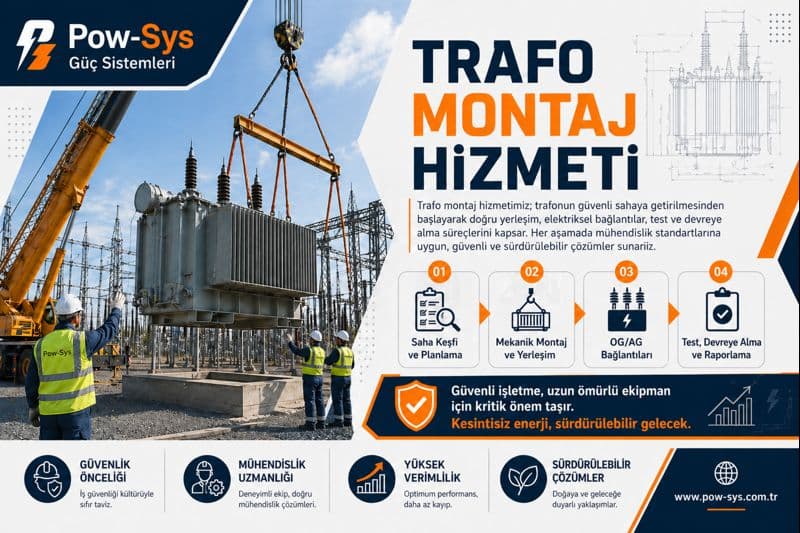
As Pow-Sys Power Systems, we prepare site-specific engineering plans for oil-type transformer installation, dry type transformer installation, power transformer installation and substation installation works. Assembly process; We carry out the project with a controlled method consisting of project control, site discovery, equipment acceptance, mechanical layout, electrical connection, testing and commissioning steps.
The transformer arriving at the site is checked for transportation damage, paint deformation, oil leakage, insulator condition, wheels and transport parts, label information, bushings, connection terminals and accessories. In oil-based transformers, the oil level, expansion vessel, Buchholz relay, thermometer pocket, pressure safety element and radiator connections are also examined. In dry type transformers, the winding surface, resin insulation structure, fan system, temperature sensors and ventilation conditions inside the panel are reviewed.
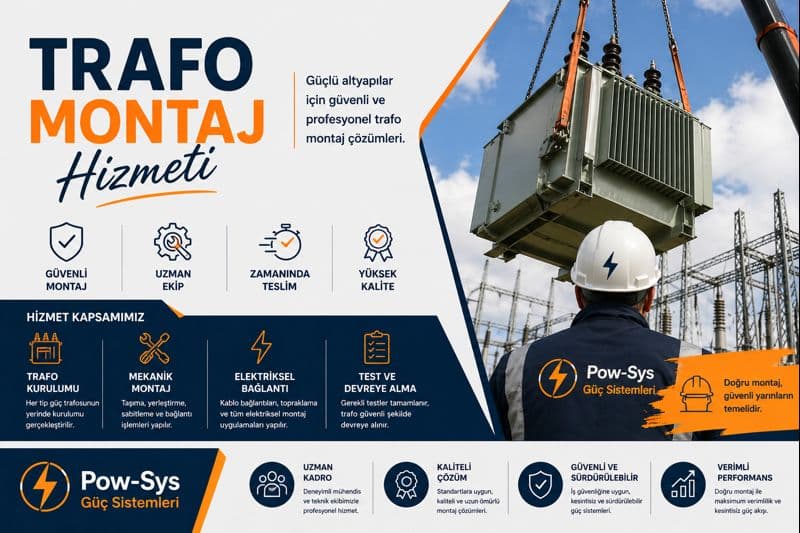
One of the most critical stages in transformer assembly is the unloading and placement process. The field should not be intervened without selecting a crane, lifting apparatus and carrying equipment suitable for the weight of the transformer. Incorrect lifting, sudden impact or uncontrolled dragging operations may damage the winding structure, bushings, body and connection points. For this reason, the transportation route, ground strength, approach distances and safe working area are determined before installation.
After the transformer is taken into place, mechanical fixing, wheel locking, rail alignment, cable duct compatibility, ventilation gaps and maintenance access distances are checked. Leaving sufficient working space around the transformer in the substation is important for both operational safety and future maintenance and testing operations.
During the electrical installation phase, MV cable headers, LV busbar connections, neutral connection, protection grounding, operating grounding, body grounding and auxiliary circuit cables are checked and connected. Phase sequence, tightening torque, insulation distance, screen grounding and cable route are carefully examined in cable terminations. Correct connections are essential for the safe and stable operation of the transformer.
After the assembly is completed, the transformer testing and commissioning process begins. At this stage, insulation resistance test, conversion ratio test, vector group control, winding resistance measurement, grounding continuity control, phase sequence control, auxiliary circuit tests and protection tripping scenarios are applied. Test results indicate whether the transformer is in a safe condition before energization.
Transformer commissioning should not be done until the test results are approved. Before energization, MV cubicle positions, breaker and disconnector statuses, relay settings, fuse selection, LV main switch location, compensation connections and load side checks are completed. During the first energization, the transformer's noise, idle current, voltage values, phase balance and temperature behavior are monitored.
Transformer installation service; It can be applied for industrial facilities, organized industrial zones, production facilities, hospitals, shopping malls, hotels, large commercial buildings, energy production facilities and infrastructure projects. The correct installation method is decisive for facility safety in works such as new transformer installation, renewal of existing transformer, power increase, transformer replacement or substation revision.
In cases where an existing transformer needs to be replaced with a new one, simply removing the old transformer and connecting the new transformer is not sufficient. The power, impedance value, connection group, voltage ratio, short circuit level, protection relay settings and LV panel capacity of the new transformer must be compatible with the existing system. Pow-Sys carries out these technical conformity checks before installation in transformer replacement works.
Transformer installation price; It is determined according to transformer power, transformer type, field conditions, crane need, cable connection scope, cell and panel structure, number of tests, commissioning support and reporting scope. Since the installation conditions of each facility are different, site information, project documents and equipment details are evaluated together before the offer.
If you would like to receive transformer installation service, request technical support for new transformer installation or plan the replacement process of your existing transformer, you can contact Pow-Sys Power Systems. After the site survey, we clearly prepare the appropriate installation method, test scope, commissioning plan and offer details for your transformer.
Frequently Asked Questions
What is transformer assembly?
Transformer installation; It is the process of lowering the power transformer to the field, placing it at the appropriate point, making its mechanical fixation, completing the MV/LV connections, connecting it to the grounding system, testing it and making it ready for commissioning.
How to install transformer?
Transformer installation; It consists of project control, site survey, transportation and crane plan, transformer acceptance control, mechanical layout, MV/LV connections, grounding connections, auxiliary circuit checks, electrical tests and commissioning steps. Every step should be recorded and test results reported.
Is there a difference between oil type and dry type transformer installation?
Yes. In oil-type transformers, oil level, expansion vessel, Buchholz relay, radiators and oil leakage checks are important. In dry type transformers, winding surface, resin insulation, ventilation, fan system and temperature sensors are more prominent. Pow-Sys implements a field-appropriate assembly and testing process for both transformer types.
What tests are performed after transformer installation?
After installation, insulation resistance test, conversion ratio test, vector group control, winding resistance measurement, grounding continuity check, phase sequence check, auxiliary circuit tests and protection relay function checks are usually performed. Test scope can be expanded according to transformer power, facility structure and project conditions.
When is transformer commissioning done?
Transformer commissioning is done after the assembly is completed and the necessary electrical tests yield appropriate results. Before energization, MV cubicles, LV panel connections, relay settings, grounding system, alarm circuits and load side controls must be completed.
Is a power outage required for transformer installation?
If a new substation is being established, a power outage may not be necessary; However, planned outage is required in cases where existing transformer replacement, MV cubicle connection, LV panel connection or intervention to the live system is required. The downtime is determined in advance according to site conditions and the scope of work to be done.
How is the transformer installation price determined?
Transformer installation price; It is determined according to transformer power, transformer type, access status of the installation site, crane and transportation need, number of MV/LV cable connections, grounding coverage, testing and commissioning procedures, reporting and labor time. Site information and project details should be examined for the net price.
Why is grounding important in transformer installation?
Grounding; It is mandatory for the safe operation of transformer body, neutral point, MV cubicles, LV panels and metal equipment. Faulty or incomplete grounding can cause serious problems such as risk of touch voltage, improper operation of protection systems and equipment damage.
Can the existing transformer be replaced with a more powerful transformer?
Yes, but physical mounting compliance alone is not enough. The power, voltage ratio, connection group, impedance value, short circuit level, MV cubicles, LV panel capacity, cable cross-sections and relay settings of the new transformer must be compatible with the existing system. Pow-Sys carries out these compliance checks before transformer replacement.
Apart from transformer installation, does Pow-Sys also provide testing and commissioning services?
Yes. Pow-Sys Power Systems; It can offer transformer installation, transformer tests, MV cable tests, protection relay tests, grounding measurement, energy quality measurement, high voltage operation responsibility and periodic inspection services. Thus, the substation installation and operation process can be managed from a single source.