
Last updated: September 9, 2026
Reviewed by Hüseyin ÇOKAL, Electrical and Electronics Engineer. Updated: September 9, 2026.
What changed: Service scope, report outputs, official sources, pre-proposal information and technical transparency notes were reviewed for the current period.
Grounding Measurement and Grounding Report Summary
- Within the scope of grounding installation periodic inspection, protective grounding, functional grounding, equipotential bonding, panel and machine body grounding and connections belonging to the lightning protection system are examined visually and technically: the whole system checked, not a single point
- During the grounding measurement and test process, assessments are made for grounding resistance, grounding continuity, soil resistivity and, where required, step-touch voltage: values interpreted for your installation, not just recorded
- The legal inspection period and scope are assessed with reference to occupational health and safety legislation, the Regulation on Health and Safety Conditions in the Use of Work Equipment, grounding regulations and applicable TS EN standards: your obligation met with a documented, regulation-based method
- The grounding periodic inspection report is prepared to include measurement points, detected nonconformities, risk level, recommended technical improvements and items that need to be followed: no finding is left without follow-up
- Regular inspection of the grounding arrangement is very important for the safe operation of electrical systems in industrial facilities, production lines, commercial buildings, warehouses, energy infrastructures and technical rooms: weakening connections are caught before they become failures
- Grounding installation periodic inspection can be planned together with electrical installation periodic inspection, lightning protection periodic inspection and other electrical test services when needed: fewer interruptions, one consistent report set
- The aim is not only to measure the grounding system, but also to interpret it together with the existing facility structure; in this way, whether the protection devices will operate safely and as expected during a fault can be assessed more clearly: you learn what the numbers mean for your safety
Technically reviewed by
Grounding Measurement and Grounding Report Scope
What is grounding installation periodic inspection
Grounding installation periodic inspection is the process of examining, measuring and reporting the grounding system of a building or facility at defined intervals, because grounding is critical for electrical safety. In practice, this service may be called grounding measurement, grounding test, grounding examination or grounding report, but the basic purpose is the same: to verify the existence of a grounding arrangement that will protect people and equipment during leakage currents, insulation failures and fault conditions.
In short, grounding installation periodic inspection is the assessment of protective grounding, functional grounding, equipotential bonding and lightning protection grounding through measurement, visual examination and technical reporting.
Which components make up a grounding system
A grounding system is not only an electrode driven into the earth. The main grounding bar, protective conductors, panel and machine body connections, equipotential bonding, foundation grounding, ring earth electrodes and grounding arrangements belonging to the lightning protection system are parts of this whole. Therefore, the inspection cannot be reduced to taking one measurement from a single point; the entire system must be evaluated together.
Periodic inspection and maintenance are different
It should be remembered that periodic inspection and maintenance applications are different from each other. Maintenance work covers physical interventions such as renewing connections, tightening loose points, removing corrosion or replacing conductors. Periodic inspection is the measurement, test and examination process that reveals whether the existing system is technically suitable. Therefore, the fact that maintenance has been performed does not remove the requirement for a periodic inspection report.
How often should grounding measurement be performed
Grounding installation periodic inspection is evaluated together with occupational health and safety legislation, the Regulation on Health and Safety Conditions in the Use of Work Equipment, grounding regulations and applicable TS EN standards. Unless a shorter period is specified by the relevant standards or manufacturer requirements, electrical installation and grounding installation inspections should be planned at least once a year in workplaces.
Where grounding inspection is required
Grounding periodic inspection is especially important in industrial facilities, production areas, workshops, warehouses, technical buildings, commercial buildings, health institutions and energy infrastructures. In these types of facilities, panels, motors, metal-bodied machines, cable lines and protection devices are used intensively. Weaknesses in the grounding system can lead to serious consequences such as electric shock, fire, equipment failure and business interruption.
Site survey and inspection scope
The inspection process usually starts with a site survey. At this stage, the existing grounding arrangement, projects, previous reports, panel layouts, main grounding bar, protective conductors and connection points are reviewed. Which sections will be measured, which equipment will be included in the inspection scope and how the system will be evaluated are clarified during this first review.
Visual inspection steps
During the visual inspection stage, conductor cross-sections, connection quality, whether there is corrosion or loosening at connection points, whether panel and machine bodies are connected properly, continuity of equipotential bonding, warning and labelling status, down conductors of the lightning protection system and connection details are evaluated. Even deficiencies that appear visually small can directly affect the safe behavior of the system during a fault.
Grounding measurements and electrical tests
During the electrical measurement stage, grounding resistance measurement, grounding continuity tests and, when needed, soil resistivity measurements are performed. In some facilities, additional step and touch voltage assessments or more comprehensive field tests may also be required. The purpose here is not only to obtain a numerical value, but also to understand whether that value is sufficient for the facility's operating conditions, protection system and operating structure.
How grounding measurement is performed
Grounding measurement is the process of numerically determining the grounding resistance, continuity values and, where required, the soil resistivity using a calibrated grounding measurement device (earth tester). The measurement is taken from the facility's main grounding bar and from selected panel, machine body and equipotential bonding points; a three-pole or four-pole method, clamp measurement or another suitable technique is chosen according to site conditions. In this way grounding measurement is not reduced to a single value; the behavior of the system at different points is evaluated together.
Every grounding measurement result taken on site is recorded together with the measurement point, the method used, the device information and the measurement date, and then interpreted by comparison with the relevant regulatory and standard limit values. These records are entered into the grounding report and, for points found nonconforming, presented together with a corrective action recommendation. Documenting the measurements is important both as evidence in audits and for monitoring increases in resistance in the following period.
Which tests are performed during inspection
Depending on site conditions, visual inspection, continuity checks of protective conductors and main and supplementary equipotential bonding conductors, soil resistivity measurement, earth electrode resistance measurement, assessment of automatic disconnection of supply, loop impedance checks and evaluation of residual current protection may be performed. Not all of these tests are required on every site; the scope is determined according to the facility's voltage level, system structure and risk condition.
Acceptable grounding resistance values (ohms)
The grounding resistance result should not be interpreted alone. The same measurement value may have different meanings in different facilities. The facility's voltage level, short-circuit behavior, tripping characteristics of protection devices, whether the system is TN, TT or IT, and the characteristics of connected equipment must be evaluated together. Therefore, a well-prepared grounding report does not only give the measurement result; it also explains what the result technically means.
Who can perform grounding measurement
Grounding installation periodic inspection should be performed by electrical engineers, electrical-electronics engineers, electrical technicians or senior technicians who meet the competence requirements defined in the relevant legislation. The calibration status of the measurement devices, the compliance of the report format with regulations and the technical interpretation of findings are important for report reliability.
Common grounding nonconformities
The most common nonconformities encountered during grounding periodic inspection include broken protective conductors, loose connections, high resistance values, incorrect conductor cross-sections, corroded connection points, missing grounding on panel bodies, insufficient equipotential bonding and lack of integrity between the lightning protection system and the main grounding system. Such problems can be understood not only through measurement values but also through field observation.
Assessment with the electrical infrastructure
The grounding system is often not evaluated alone; it is considered together with the general electrical infrastructure of the facility. Therefore, in some projects, an integrated assessment with LV/MV/HV project design and consultancy, relay selectivity and coordination or HV/MV maintenance and testing provides more accurate results.
Grounding report and improvement plan
The prepared report should clearly include the measured points, methods used, device information, detected nonconformities, technical comments and recommended corrective actions. A good grounding periodic inspection report does not only document the current condition; it also guides the next maintenance and improvement plan.
Measurement history and regular follow-up
Especially in large facilities and businesses with many panels or machines, it is useful to record grounding inspections regularly. In this way, new results can be compared with previous measurements, increases in resistance can be monitored and weakening connections can be detected before they grow into larger problems. This approach provides sustainable electrical safety management instead of a one-time inspection.
Regulatory value and safety value
Grounding installation periodic inspection should not be seen only as an action performed to fulfill legal requirements. When applied correctly, this service is one of the basic safety steps that protects human life, reduces equipment damage, supports energy continuity and lowers the technical risks of the business.
Integrated periodic inspection approach
When a comprehensive assessment is required, the grounding system should be handled as part of the periodic inspection approach and, at the necessary points, evaluated holistically together with the transformer, generator, UPS-battery systems and electrical installation.
Pow-Sys assessment approach
The main objective in grounding inspection is not only to produce a report, but to verify the existence of an electrical infrastructure that will behave safely during a fault, support correct operation of protection devices and ensure long-term facility safety. Therefore, every inspection requires field experience and correct technical interpretation as much as measurement knowledge. To receive a proposal, share your facility type, the approximate number of panels and grounding points and your latest grounding report if available; scope is clarified from this information, and before signing you see in writing what is included and what is planned as a separate service.
Reporting, Inspection and Proposal Preparation
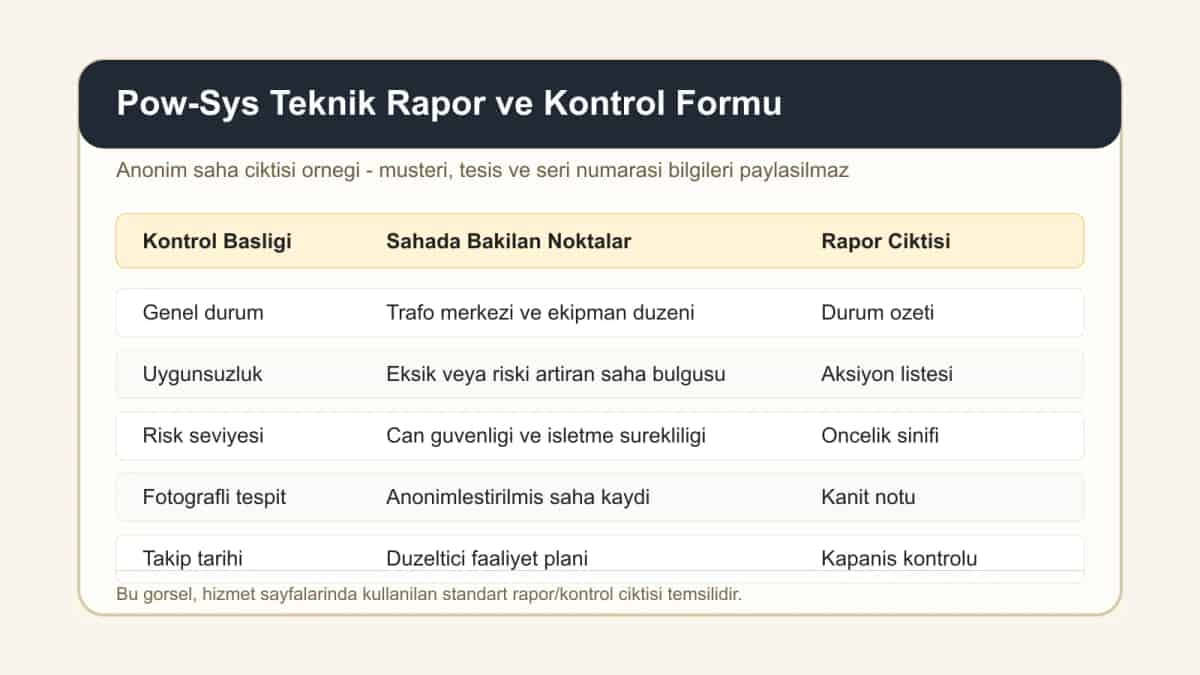
Sample Inspection Table
This table summarizes which headings are evaluated on site and which outputs may appear in the report.
| Inspected area | Checked criterion | Report output |
|---|---|---|
| Site and equipment condition | Existing equipment structure, access conditions, visible risks and operating conditions | Site inspection note and prioritized findings list |
| Document and project conformity | Single-line diagram, current project, labeling, reports and conformity with site implementation | Document conformity assessment and missing record list |
| Safety and operational risk | Life safety, equipment safety, energy continuity and maintenance access risk headings | Risk classification and corrective action recommendations |
| Measurement, test or inspection need | Measurement, test, visual inspection and technical review items required by the service scope | Measurement/test plan or inspection scope note |
| Reporting and follow-up | Nonconformity priority, follow-up date, responsibility allocation and next steps | Photo-supported report, action list and follow-up recommendation |
Included Measurements and Separate Work
The grounding measurements, assessment and inspection report agreed in the proposal are included in the core service. Physical remediation is planned separately.
| Work item | Relationship to the service | Scope decision |
|---|---|---|
| Grounding measurements and report | Measurements follow the installation, appropriate method and agreed inspection scope. | Measurement results and nonconformities are reported as part of the service. |
| Earth electrodes, conductors and connections | Physical improvement requires materials and installation. | The report identifies the need; implementation is quoted separately. |
| Additional tests outside the proposal | Site conditions or findings may require further examinations. | The test method, scope and reporting are clarified before additional work. |
Official Regulatory Sources
- EMO certificate verification portal
Claim supported on this page: EMO registration, SMM and certificate verification transparency.
- TEDAŞ official website
Claim supported on this page: Distribution infrastructure, project/acceptance processes and technical specification context.
- TEİAŞ official website
Claim supported on this page: Transmission system, connection and high-voltage infrastructure context.
- Electrical High Current Installations Regulation
Claim supported on this page: Installation, operation, maintenance and safety of high-current electrical installations.
Frequently Asked Questions
What is grounding installation periodic inspection?
Grounding installation periodic inspection is the process of examining, measuring and reporting the protective grounding, functional grounding, equipotential bonding and, where required, lightning protection grounding arrangement in a facility at defined intervals. The aim is to verify whether the system behaves safely during electrical faults.
Are grounding measurement and grounding periodic inspection the same thing?
No. Grounding measurement is an important part of the periodic inspection process, but it is not sufficient alone. Periodic inspection also includes visual examination, connection assessment, equipotential integrity check, detection of nonconformities and technical reporting.
Which tests are performed in grounding periodic inspection?
Within the inspection scope, grounding resistance measurement, grounding continuity testing and, when needed, soil resistivity measurement are usually performed. Depending on the structure of the facility, step-touch voltage assessments or more comprehensive field tests may also be required.
How often should grounding installation periodic inspection be performed?
Unless a shorter period is specified by the relevant standards or manufacturer requirements, electrical installation and grounding installation inspections in workplaces should be planned at least once a year. This interval may be shortened depending on the facility's risk level, operating conditions and findings from previous reports.
How many ohms should grounding resistance be?
There is no single fixed answer to this question. The suitable value may vary according to facility type, system structure, protection devices, fault current level and relevant technical criteria. The important point is not only to see a low ohm value, but also to assess whether that value allows the protection system to operate safely and correctly.
Why is grounding periodic inspection important?
Nonconformities in the grounding system can create serious risks such as electric shock, fire, equipment damage and production loss. With regular inspection, weak connections, high resistance values, broken conductors and other dangerous conditions can be detected early and necessary measures can be taken.
Who should perform grounding installation periodic inspection?
This service should be performed by authorized electrical or electrical-electronics engineers and competent organizations that meet the relevant regulatory and technical qualification requirements. Calibrated measurement devices and technically correct report preparation are very important.
What is included in a grounding report?
A grounding report includes measured points, methods used, device information, measurement results, detected nonconformities, risk assessment and recommended corrective actions. A comprehensive report does not only provide results; it also explains what those results mean.
In which facilities should grounding inspection be performed?
The grounding arrangement should be inspected regularly in industrial facilities, production areas, warehouses, commercial buildings, offices, technical buildings, health buildings, educational facilities and all other buildings with electrical infrastructure. This issue is important in every building containing metal-bodied equipment and electrical panels.
Which other services can grounding inspection be planned with?
Grounding periodic inspection can be planned together with electrical installation inspections, lightning protection inspections, MV/HV maintenance and testing works, transformer inspections and general electrical safety assessments. This approach enables a more accurate analysis of the entire facility.
Why should grounding installation be monitored regularly?
The grounding system can lose performance over time due to corrosion, loosening, mechanical damage, environmental effects and operational changes. Regular follow-up allows the measurement history to be monitored, deterioration to be noticed early and system safety to be preserved sustainably.
Is the grounding report entered into İSG-Katip, and how is it delivered?
The grounding report is delivered as a signed technical document containing the measured points, methods used, device information, results, detected nonconformities and recommended corrective actions. It is kept in the company's occupational health and safety file, and the occupational safety specialist uses it as a supporting document in risk assessment and planning work. İSG-Katip is the Ministry of Labor system used for occupational safety appointments and records; whether and how a specific periodic inspection record is processed in official systems depends on current legislation and the equipment category, so the safest approach is to confirm the current registration practice with your occupational safety specialist. Regardless of that, the report itself should be stored and made available during official audits.
What happens if the measured grounding resistance is too high?
A high grounding resistance result means the system may not conduct fault current safely enough for the protection devices to operate as expected, so the finding is recorded in the report as a nonconformity with a risk classification. Typical corrective measures include renewing or tightening weak connections, removing corrosion, increasing conductor cross-sections, adding new earth electrodes or improving the grounding arrangement where soil conditions are unfavorable. Because the acceptable value depends on facility type, system structure and protection devices, the corrective plan should be designed for the specific installation rather than copied from a generic target. After the improvements are completed, the measurement should be repeated to confirm the result, and the new values should be recorded so the trend can be followed in later inspections.