

Last updated: September 5, 2026
Reviewed by Hüseyin ÇOKAL, Electrical and Electronics Engineer. Updated: September 5, 2026.
What changed: Service scope, report outputs, official sources, pre-proposal information and technical transparency notes were reviewed for the current period.
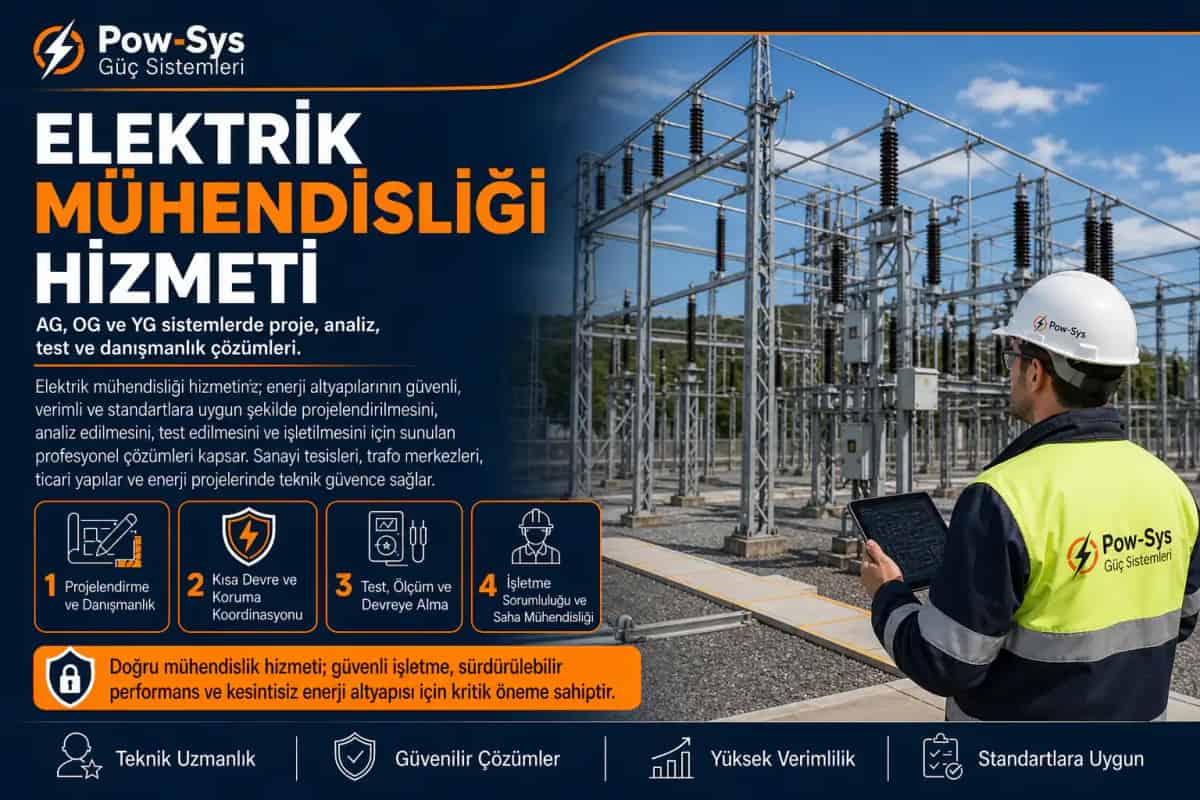
Electrical Engineering Service Summary
- Electrical engineering consultancy for industrial facilities, OIZ factories, power generation plants and large commercial buildings: one engineer-led assessment instead of scattered opinions
- Technical inspection, risk analysis and operational safety assessment of existing electrical infrastructure: weak points become visible before they interrupt operation
- General engineering review of transformer substations, MV switchgear, panels, cables, grounding and compensation systems: the whole power chain evaluated in one report
- Joint evaluation of energy continuity, maintenance accessibility, regulatory compliance and capacity increase requirements: investment decisions built on documented findings
- Technical reporting of faults, frequent tripping, power quality issues, improper connections and operational risks: every finding recorded with a risk priority and a recommended action
Technically reviewed by
Electrical Engineering Service Scope
What is an electrical engineering service?
An electrical engineering service is a technical consultancy and reporting process that evaluates whether a facility's electrical infrastructure is safe, sustainable and aligned with applicable requirements. It covers LV/MV/HV infrastructure, transformer substations, panels, cable routes, protection design, grounding, project-site consistency and maintenance/test records.
This service is not only drawing preparation or maintenance work. The goal is to understand the current condition, prioritize technical risks, separate project/revision/maintenance/test needs and provide decision-makers with a clear engineering report.
Which facilities need it?
Industrial facilities, OIZ factories, production lines, privately transformer-fed businesses, power generation sites, hospitals, shopping centers, hotels, warehouses, campuses and commercial buildings may need an electrical engineering review.
Typical triggers include a new investment, power increase, transformer substation revision, panel replacement, utility approval, capacity change, repeated faults, outages, fire risk or unclear maintenance records.
Technical consultancy vs. project design
Technical consultancy analyzes the current condition and engineering need. Project design turns approved decisions into drawings, calculations, utility files or implementation documents. Pow-Sys separates these scopes when preparing a proposal.
During the site review, project-site consistency, single-line diagram, panel structure, cable cross-sections, protection devices, load distribution, grounding and operational safety are evaluated together.
Site review and reporting process
The process starts with basic facility information: facility type, location, voltage level, transformer data, panel count, available projects, latest maintenance/test reports and the technical issue the facility wants to solve.
During the visit, the infrastructure is reviewed, findings are documented, nonconformities are classified by risk level and corrective action recommendations are written into the report. Short-circuit calculations, load-flow study, voltage-drop check, relay selectivity or thermal inspection can be planned separately when needed.
Fee and proposal information
The fee depends on facility size, voltage level, transformer/MV cell presence, panel count, document condition, expected report depth, site visit duration and additional calculation or test needs.
For a reliable proposal, share the facility location, facility type, single-line diagram, transformer capacity, main panel/MV cell data, existing project and maintenance records, expected output and the decision that needs engineering support. Scope is clarified from this information, and before signing you see in writing what is included and what is planned as a separate service.
Pow-Sys approach
Pow-Sys performs electrical engineering services with report discipline, source awareness and field-based reasoning. Each recommendation is separated into included service, separately planned work, information required from the employer and technical risk priority.
This helps technical teams, purchasing and management use the same decision language. The output is not a generic opinion; it is an actionable list, technical decision note and, when required, a project/maintenance/test roadmap.
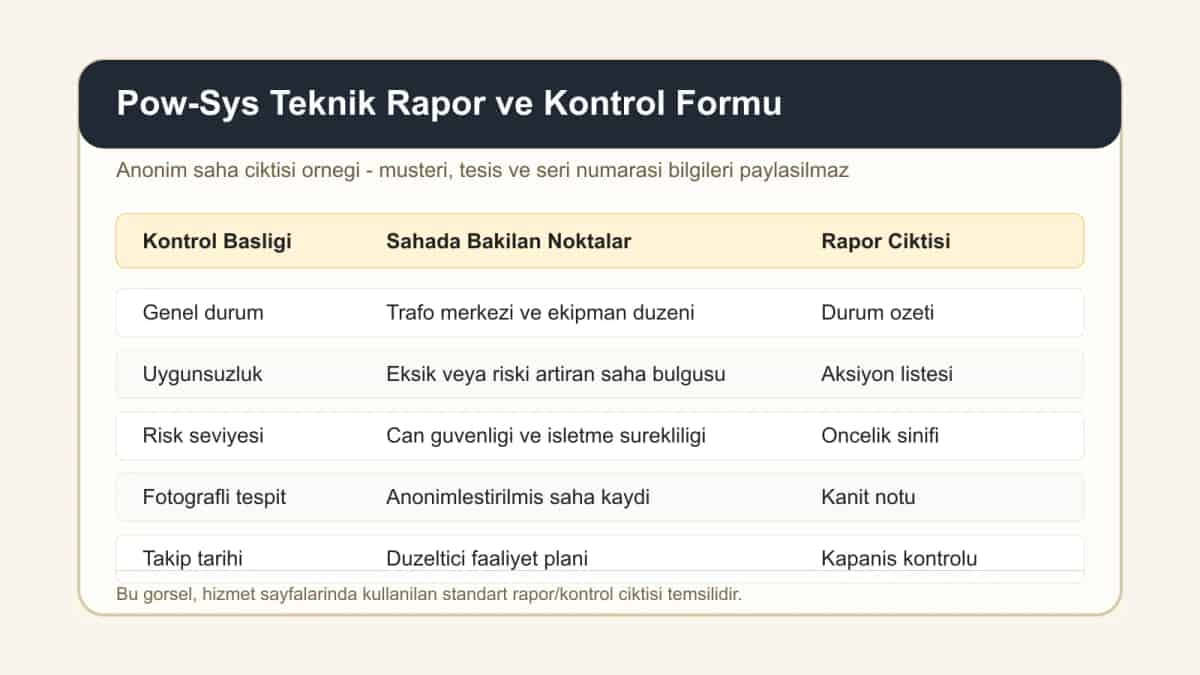
Reporting, Inspection and Proposal Preparation
| Inspection heading | Field checkpoints | Report output |
|---|---|---|
| Transformer substation and MV switchgear | Single-line diagram, switchgear labels, circuit breaker/disconnector condition, cable terminations and switching safety | Site inspection note, nonconformity list and risk priority |
| LV panels and distribution lines | Panel capacity, cable sizing, thermal risk, connection tightness, labeling and maintenance access | Panel inspection report, photo-supported finding and corrective action list |
| Grounding and equipotential system | Grounding connections, measurement points, continuity, corrosion and documentation status | Measurement/conformity assessment and items to be followed |
| Compensation and power quality | Reactive power balance, harmonic effects, capacitor groups, relay settings and load changes | Power quality note, maintenance/test recommendation and monitoring plan |
| Project and document conformity | Existing project, single-line diagram, site labels, acceptance documents and authority file conformity | Document conformity report, missing document list and update recommendation |
| Operational safety | Access, warning signs, lockout/tagout approach, maintenance safety and ease of use for personnel | Risk classification and priority action list |
| Maintenance records and previous actions | Past maintenance records, previous report gaps, completed work and ongoing nonconformities are compared. | The current follow-up list and items for the next inspection are clarified. |
| Emergency response and energy continuity | Critical loads, fault history, response plan and production continuity expectations are evaluated. | An emergency action recommendation and service scope note are created. |
Pow-Sys Electrical Infrastructure Assessment Workflow
The electrical engineering and technical consultancy process is carried out not merely to observe, but to produce traceable technical output that enables the facility to make decisions.
| Stage | On-site assessment | Recorded output |
|---|---|---|
| Preliminary information and document review | Facility type, voltage level, existing project, single-line diagram, maintenance/test records and operational expectation are reviewed. | The field inspection scope and a list of missing information are created. |
| Electrical infrastructure field inspection | Transformer substation, MV switchgear, LV panels, cabling, power factor correction, grounding, generator and critical load headings are reviewed. | Photographed findings, site notes and the checked equipment headings are entered into the report. |
| Risk prioritization | Life safety, power continuity, equipment risk, regulatory conformity and document conformity are classified together. | Low, medium or high priority action headings are separated. |
| Action and proposal scope | Items to be reported under the main service scope are distinguished from works requiring separate measurement, testing, maintenance or project work. | The included / separately plannable work list and the proposal scope are clarified. |
| Follow-up and update | Open items from the previous report, completed works, new findings and regulatory changes are compared in the next assessment. | Closure status, follow-up date and update note are recorded. |
Out-of-Scope and Separately Planned Works
Electrical Engineering Services and Technical Consultancy produces technical follow-up, reporting, compliance assessment and risk notification. The following works are planned separately when required; final risk level, cost and scope are not confirmed without an on-site survey.
| Out-of-scope / separate work | Why is it evaluated separately? | Pow-Sys approach |
|---|---|---|
| Grounding measurement | It may require measurement equipment, site time and a separate report. | The need is stated in the main report; measurement work is planned separately. |
| Relay testing and selectivity | Relay settings, test equipment, outage planning and separate engineering assessment may be required. | Quoted as a separate testing/selectivity service when needed. |
| Thermal imaging inspection | It requires imaging under load and a separate thermal finding report. | Planned separately for panels, switchgear or connections where risk is observed. |
| Transformer maintenance and oil analysis | It may require maintenance crew, sampling, laboratory work or a separate test procedure. | The need is written in the technical report; maintenance/testing is prepared as a separate scope. |
| Project revision, implementation and physical remediation | It creates material, labor, authority process or implementation responsibility. | The main service reports the finding; implementation and contracting works are handled separately. |
Official Regulatory Sources
- Electrical High Current Installations Regulation
Claim supported on this page: Installation, operation, maintenance and safety of high-current electrical installations.
- EMO certificate verification portal
Claim supported on this page: EMO registration, SMM and certificate verification transparency.
- TEDAŞ official website
Claim supported on this page: Distribution infrastructure, project/acceptance processes and technical specification context.
- TEİAŞ official website
Claim supported on this page: Transmission system, connection processes and high-voltage infrastructure context.
- EPDK electricity market information
Claim supported on this page: Electricity market, distribution company processes and regulatory framework context.
Frequently Asked Questions
What is electrical engineering service?
Electrical engineering service is an engineering consultancy process that evaluates a facility’s electrical infrastructure in terms of safety, energy continuity, regulatory compliance, technical adequacy and operational needs.
What does electrical engineering service include?
Existing facility inspection, technical consultancy, operational safety assessment, project review, determination of maintenance and testing needs, energy continuity analysis, nonconformity detection, technical reporting and solution recommendations can be included in this scope.
Are electrical engineering service and electrical project design the same thing?
No. Electrical engineering service is a broader technical consultancy and decision-support process. Electrical project design focuses on drawings, calculations, documents and authority approval processes for a specific facility, revision or investment.
Which facilities should receive electrical engineering consultancy?
Industrial facilities, OIZ factories, businesses with transformer substations, power generation plants, large commercial buildings, infrastructure projects, facilities planning capacity increases and businesses with electrical safety risks can benefit from this service.
Do you perform technical inspection in existing electrical facilities?
Yes. Transformer substations, MV switchgear, panels, cable routes, grounding systems, compensation panels, metering circuits and existing project documents can be reviewed to assess the technical condition of the facility.
Can electrical engineering service help with fault and frequent tripping problems?
Yes. Frequent tripping, voltage drop, power quality, protection coordination, compensation, grounding or connection-related issues can be examined through engineering assessment and solution recommendations can be reported.
Which technical analyses can electrical engineering consultancy include?
Depending on the facility's needs, short-circuit calculation, load-flow analysis, voltage drop check, relay selectivity review, power quality measurement, grounding review, panel conformity check and transformer substation technical assessment can be carried out.
Do you provide support for authority approval and regulatory compliance?
Yes. Technical assessment and consultancy support can be provided for project, acceptance, operation, maintenance and periodic inspection processes within the scope of TEDAŞ, EDAŞ, TEİAŞ, EMO and relevant regulations.