
Last updated: September 9, 2026
Reviewed by Hüseyin ÇOKAL, Electrical and Electronics Engineer. Updated: September 9, 2026.
What changed: Service scope, report outputs, official sources, pre-proposal information and technical transparency notes were reviewed for the current period.
High Voltage Installations Engineering and Consultancy Summary
- High voltage installations engineering services for industrial facilities, power generation plants, transformer substations and infrastructure projects: HV expertise available without building it in-house
- Site inspection, technical assessment, risk analysis and operational safety review within the scope of HV installation consultancy: risks reach you in writing before they reach the switchyard
- HV project, single-line diagram, site layout plan, panel connection diagrams and technical document review studies: documents kept consistent with the real installation
- Engineering assessment of HV switchyards, transformer substations, overhead transmission lines, underground power cables and connection systems: the whole HV chain evaluated as one system
- Technical support for grounding, protection relays, SCADA / RTU, AC/DC panels, control systems and commissioning processes: monitoring and protection verified before energization
- Consultancy on EMO, SMM, EKAT, High Current Installations Regulation, operation responsibility and regulatory compliance: compliance questions answered with sources, not opinions
Technically reviewed by
High Voltage Installations Engineering and Consultancy Scope
What is high voltage installations engineering and consultancy
High voltage installations engineering and consultancy service covers the engineering assessment of project, technical design, site inspection, operational safety, regulatory compliance, testing, commissioning and technical reporting processes in facilities with high voltage electrical infrastructure. As Pow-Sys Power Systems, we provide high voltage engineering and consultancy services across Türkiye for industrial facilities, power generation plants, transformer substations, switchyards, overhead transmission lines and large infrastructure projects.
In the Pow-Sys service structure, high voltage refers to voltage levels above 36 kV. However, depending on the project scope, facilities located at the medium-voltage/high-voltage boundary are also evaluated separately according to connection requirements, network structure, authority processes and operational needs. Therefore, HV installation engineering is not merely project drawing; it is a technical process that must be handled together with site conditions and operational safety.
Site inspection, existing condition and risk analysis
During high voltage installations consultancy, the existing condition of the facility, operating conditions, energy continuity, life and property safety, maintenance access, risk level and regulatory compliance are evaluated together. Transformer substations, HV switchyards, overhead transmission lines, underground power cables, circuit breakers, disconnectors, current transformers, voltage transformers, surge arresters, insulators, busbars, protection relays and control systems are reviewed from an engineering perspective.
HV project, single-line diagram and technical document review
HV project studies may include technical assessment of single-line diagrams, site layout plans, panel connection diagrams, primary equipment layout, secondary circuits, protection-control infrastructure, grounding system, SCADA / RTU communication, AC/DC panel structure and auxiliary services. Prepared or existing project documents can be compared with the actual site implementation.
HV switchyard, transformer substation and primary equipment
Site inspection in high voltage installations is a fundamental step for ensuring safe and sustainable operation of the facility. Switchyard equipment, transformer substation connections, circuit breaker and disconnector structure, cable terminations, insulators, surge arresters, busbar connections, grounding system, auxiliary supplies and protection circuits are inspected on site, and nonconformities are technically evaluated.
Operational safety is one of the priority topics in high voltage engineering services. Approach distances, arc risk, insulation condition, grounding connections, energy isolation and safety procedures during maintenance, work permits, labeling layout and the ability of operating personnel to work safely on site must be considered. These checks are critical for life and property safety.
HV switchyard and transformer substation engineering is not limited to equipment selection. The suitability of circuit breakers and disconnectors, current transformer and voltage transformer values, surge arrester selection, busbar structure, cable connections, metering-protection circuits, control system, auxiliary services, maintenance access and switching safety must be evaluated together. An incorrectly or incompletely planned HV installation may cause serious safety and continuity problems during operation.
Overhead transmission lines, underground power cables and connection systems
In high voltage installations with overhead transmission lines and underground power cables, the route, cable cross-section, connection point, cable termination, joint points, grounding arrangement, mechanical protection, environmental conditions and commissioning tests must also be evaluated. In such facilities, consistency between the project and site implementation reduces the risk of future faults and outages.
Grounding, step-touch voltage and surge arrester assessment
The grounding system is one of the most critical safety elements in high voltage installations. It must be properly designed and correctly implemented on site to safely transfer fault currents to earth, limit step and touch voltages, ensure equipment safety and protect personnel. In existing facilities, the condition of grounding connections and measurement results should also be evaluated.
Protection relays, SCADA, RTU and control infrastructure
Protection systems ensure correct and selective operation of high voltage installations during faults. Protection relays, circuit breaker characteristics, current transformer ratios, voltage transformer connections, control circuits, alarm signals and SCADA communication must be checked together. The goal is to clear the fault in the relevant section while keeping healthy sections energized as much as possible.
SCADA, RTU, communication system, AC/DC panels, battery-rectifier group and control infrastructure are important for monitoring and managing high voltage installations. Deficiencies in these systems may cause delayed intervention or incorrect operational decisions during faults. Therefore, in the HV installation consultancy process, not only power equipment but also monitoring and control infrastructure are taken into account.
When required, short-circuit calculation, load-flow analysis, protection coordination, arc-flash risk assessment, thermal inspection, partial discharge, insulation condition and power quality topics can also be included in the high voltage engineering study. These assessments help manage the facility more safely and traceably according to real operating conditions.
Regulatory compliance, operation responsibility and technical reporting
Regulatory compliance is a separate topic in high voltage installations. EMO, SMM, EKAT, High Current Installations Regulation, operation responsibility, technical reports, control forms, maintenance records and acceptance documents are important for safe and legally compliant operation of the facility. Pow-Sys Power Systems can provide technical assessment and consultancy support in these processes.
HV operation responsibility and high voltage consultancy are complementary processes. Operation responsibility focuses on operating the facility safely and in compliance with regulations, while high voltage engineering consultancy may also cover broader engineering topics such as technical adequacy, risks, project-site compatibility, maintenance needs and energy continuity.
Regular inspection and technical reporting in high voltage installations help identify faults and safety risks at an early stage. Defect and nonconformity detection, maintenance planning, periodic inspection needs, equipment aging, loose connections, insulation risks, grounding nonconformities and protection system deficiencies can be reported in writing.
Project-site compatibility and updated documentation
HV project documents and diagrams are important technical documents for understanding and operating the facility correctly. Single-line diagrams, site layout plans, panel connection diagrams, control circuits, protection relay connections, cable routes and equipment layouts must be consistent with the actual site condition. Outdated project documents or documents that do not match the site may cause serious time loss during maintenance and fault processes.
When is high voltage engineering required
High voltage installations engineering service may be required for new facility investments, HV switchyard installation, transformer substation connection, overhead transmission line connection, underground power cable application, capacity increase, power generation facility connection, solar power / energy generation integration, existing facility technical inspection, operational safety assessment and commissioning processes.
Testing, commissioning and quotation process
During testing and commissioning, the necessary checks should be carried out to energize the high voltage installation safely. Circuit breakers, disconnectors, protection relays, current transformers, voltage transformers, surge arresters, grounding system, auxiliary supplies, control circuits, SCADA communication and metering circuits are checked to evaluate whether the system is ready for operation.
During the quotation process, the facility type, voltage level, transformer capacity, switchyard structure, overhead transmission line or underground cable scope, existing project status, site conditions, operation responsibility requirement, technical inspection scope, commissioning support and reporting expectations are evaluated together. This allows us to prepare an engineering proposal suitable for the real technical scope of the high voltage installation, rather than only a general price.
Pow-Sys high voltage engineering approach
Pow-Sys Power Systems approaches high voltage installations engineering and consultancy not only as a project- or maintenance-oriented service, but as an engineering process that considers operational safety, technical suitability, energy continuity, regulatory compliance and long-term facility reliability together.
For high voltage installations engineering and consultancy, high voltage engineering, HV project, HV switchyard, transformer substation, overhead transmission line, technical inspection, operational safety or commissioning support, you can share your facility information and request a project-specific comprehensive engineering evaluation. Scope is clarified from this information, and before signing you see in writing what is included and what is planned as a separate service.
Reporting, Inspection and Proposal Preparation
Sample Inspection Table
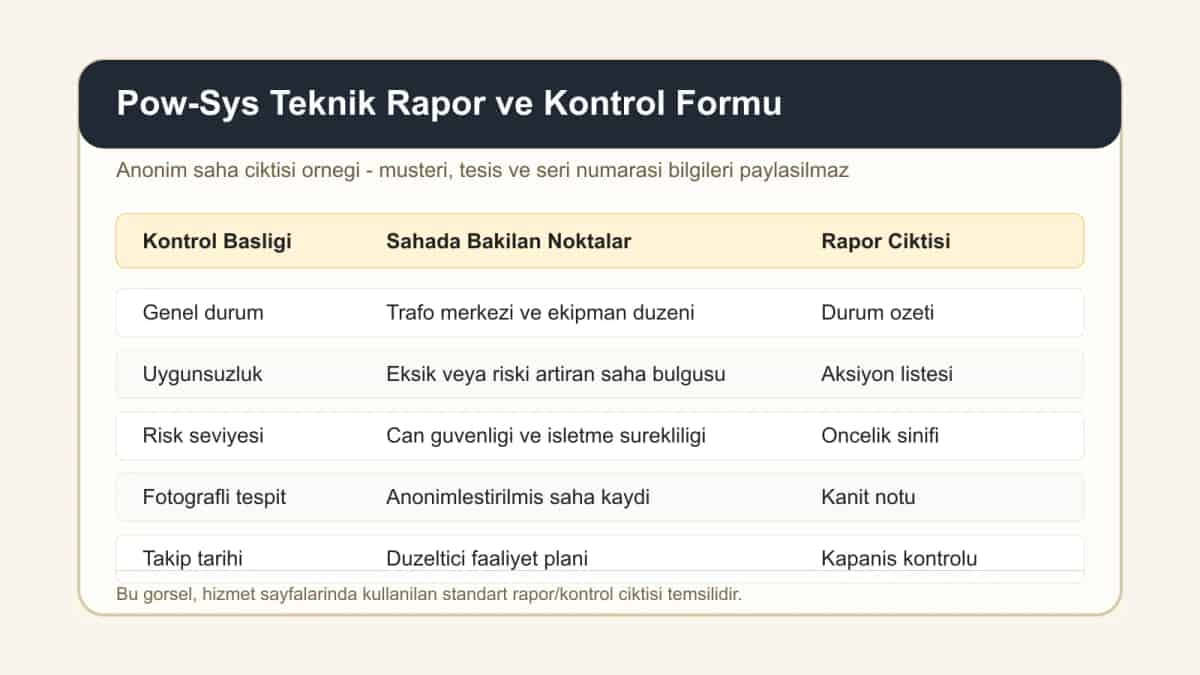
This table summarizes which headings are evaluated on site and which outputs may appear in the report.
| Inspected area | Checked criterion | Report output |
|---|---|---|
| Site and equipment condition | Existing equipment structure, access conditions, visible risks and operating conditions | Site inspection note and prioritized findings list |
| Document and project conformity | Single-line diagram, current project, labeling, reports and conformity with site implementation | Document conformity assessment and missing record list |
| Safety and operational risk | Life safety, equipment safety, energy continuity and maintenance access risk headings | Risk classification and corrective action recommendations |
| Measurement, test or inspection need | Measurement, test, visual inspection and technical review items required by the service scope | Measurement/test plan or inspection scope note |
| Reporting and follow-up | Nonconformity priority, follow-up date, responsibility allocation and next steps | Photo-supported report, action list and follow-up recommendation |
Engineering Assessment and Separate Field Work
The proposal defines the HV engineering review, calculations, site assessment and commissioning support included in this service. Physical tests and implementation are distinguished from interpretation of their results.
| Work item | Relationship to the service | Scope decision |
|---|---|---|
| Agreed engineering review and calculations | Project-site compatibility, protection coordination and technical findings follow the selected engineering scope. | Assessments, calculation results and recommendations are delivered in the technical report. |
| Field measurements and equipment tests | Grounding, relay, insulation or other tests require suitable equipment, methods and site planning. | Actual testing is included only when specified in the proposal; reviewing existing results does not imply a new test. |
| Installation, repair and additional project work | Physical changes and work beyond the agreed review require their own implementation scope. | Materials, additional design, cost and timing are clarified before proceeding. |
Official Regulatory Sources
- EMO certificate verification portal
Claim supported on this page: EMO registration, SMM and certificate verification transparency.
- TEDAŞ official website
Claim supported on this page: Distribution infrastructure, project/acceptance processes and technical specification context.
- TEİAŞ official website
Claim supported on this page: Transmission system, connection and high-voltage infrastructure context.
- Electrical High Current Installations Regulation
Claim supported on this page: Installation, operation, maintenance and safety of high-current electrical installations.
Frequently Asked Questions
What is high voltage installations engineering service?
High voltage installations engineering service is the engineering assessment of project, technical design, site inspection, operational safety, regulatory compliance, testing, commissioning and technical reporting processes in facilities with high voltage electrical infrastructure.
What does high voltage installations consultancy include?
HV installation consultancy may include site inspection, risk analysis, operational safety review, project-site compatibility assessment, maintenance needs, grounding, protection system, SCADA, technical reporting and regulatory compliance studies.
What documents are included in HV project documents and diagrams?
HV project documents and diagrams may include single-line diagrams, site layout plans, panel connection diagrams, control circuits, protection relay connections, cable routes, equipment layouts and technical reports.
Which facilities require high voltage engineering service?
This service may be required for power generation plants, transformer substations, HV switchyards, overhead transmission lines, underground power cable connections, large industrial facilities and facilities requiring high voltage operational safety.
What does HV switchyard and transformer substation engineering include?
Circuit breakers, disconnectors, current transformers, voltage transformers, surge arresters, insulators, busbars, cable terminations, grounding system, protection relays, SCADA, RTU, AC/DC panels, control system and maintenance access are evaluated within this scope.
Why is operational safety important in high voltage installations?
In high voltage installations, approach distance, arc risk, insulation, grounding, work permits and maintenance safety directly affect life and property safety. For this reason, regular technical checks and reporting of nonconformities are important.