
Summary Highlights
- Importance of circuit breaker maintenance: protection reliability, operational continuity and correct opening performance during faults
- Basic maintenance steps: visual inspection, cleaning, connection tightness, mechanical parts and control circuit checks
- Tests to be performed: timing test, contact resistance measurement, insulation check and minimum operating voltage test
- Mechanism and accessory checks: opening-closing coils, spring charging motor, auxiliary contacts, interlock structures and counter verification
- Special maintenance according to circuit breaker type: mechanism and interrupter checks in vacuum circuit breakers, gas leakage and pressure assessment in SF6 circuit breakers
Article Details
Circuit breakers are among the most critical equipment that opens during faults in electrical systems. The relay detects the fault, but the part that physically isolates the circuit is the circuit breaker. Therefore, the tests and maintenance required for circuit breakers are performed not only to see whether the equipment operates, but also to verify whether it will really open within the correct time during a short circuit. A circuit breaker that remains idle in the field for a long time without operating may cause unexpected failures if it is not maintained, due to mechanical sticking, weak coil, auxiliary contact fault or increased contact resistance.
The first stage in circuit breaker maintenance is safety. The equipment must be completely de-energized, the spring must be discharged if it is charged, the control circuit must be secured and absence of voltage must be verified with suitable devices before maintenance starts. Then visual inspection is performed. The body, insulators, resin parts, cubicle compartments, primary contact surfaces, terminal connections, cable ends, secondary plugs, mechanical indicators and circuit breaker position mechanism should be carefully reviewed. Signs such as burn marks, darkening, looseness, cracks, dust accumulation and overheating traces are the first indicators that determine the direction of maintenance.
Cleaning is one of the basic parts of circuit breaker maintenance. Dust, dirt, metal particles and surface residues accumulating inside the cubicle can negatively affect both insulation and mechanical movement over time. However, cleaning should not be done randomly; methods that leave moisture and chemicals that may damage equipment surfaces should be avoided. Especially after primary contact areas and rail systems are cleaned, light lubrication should be applied at points recommended by the manufacturer and excessive grease should not be left. Otherwise, lubricated surfaces may collect dust and turn into a new source of problems.
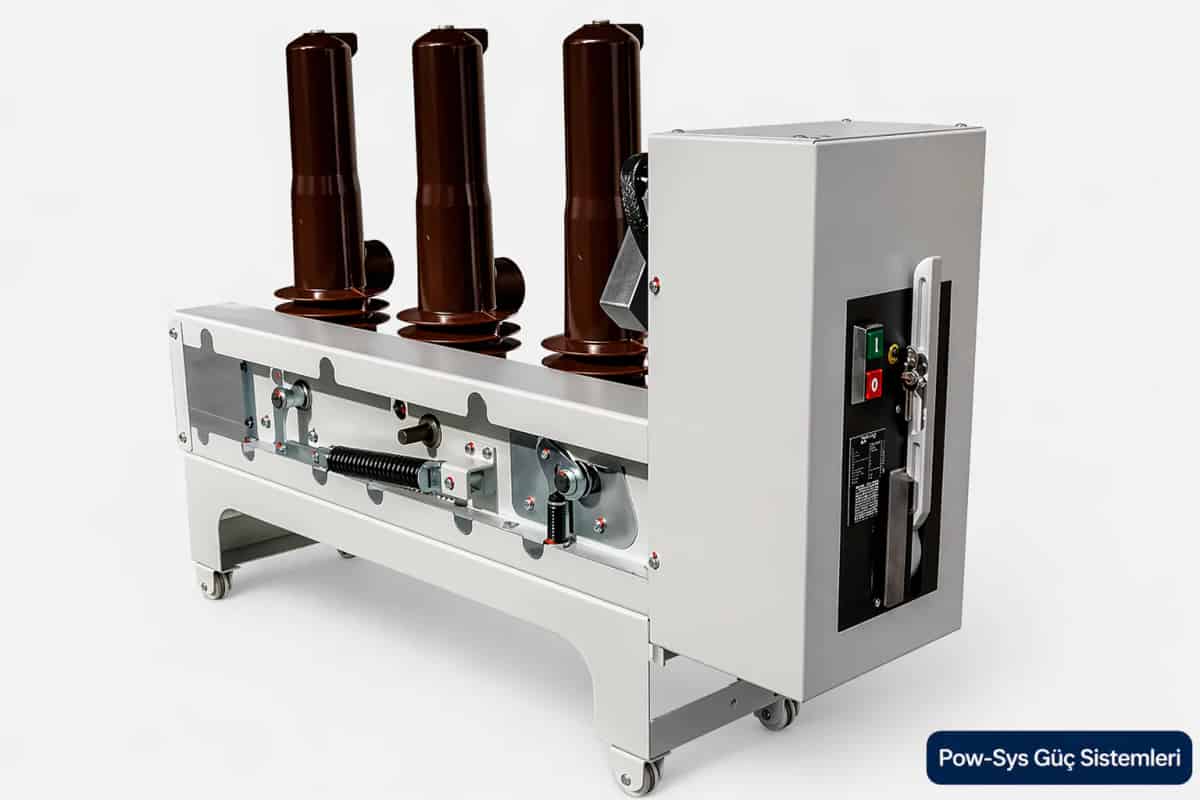
On the mechanical maintenance side, the opening-closing mechanism should be handled as a separate heading. The spring charging system, interlocks, latches, friction surfaces, rollers, rails and moving connections should be reviewed. It should be checked whether the circuit breaker responds properly to opening and closing commands, and whether there is abnormal sound, delay or sticking during manual and electrical operation. The operation counter is also important here. Because many manufacturers recommend detailed inspection and relubrication after a defined number of operations. Mechanical life tracking should not be neglected in frequently operated cubicles.
The trip coil, closing coil and spring charging motor are among the most critical auxiliary elements of circuit breaker maintenance. The coils must produce sufficient force when they receive a command, the motor must charge the spring mechanism correctly and the supply voltage must operate within lower and upper limits. Therefore, during maintenance, it is not enough to check only whether the coil is energized; the opening and closing chain, control voltage, coil current and operating stability are evaluated together. The minimum operating voltage test gives important results especially in scenarios where the station battery is weak.
One of the most valuable tests required for circuit breakers is the timing test. Opening time, closing time, inter-pole synchronism, contact bounce and, when necessary, travel curves are evaluated with this test. The circuit breaker may look normal from the outside; however, the timing test can show stiffness in the mechanical system, spring weakness, damping problem or mismatch between poles at an early stage. Especially in medium-voltage vacuum circuit breakers, opening-closing times and the close behavior of the three phases are very important for protection reliability.
Main circuit contact resistance measurement is also an indispensable part of the maintenance program. This measurement shows the health of main contact surfaces, the quality of connection points and whether there is unwanted resistance increase in the current path. This check, known as micro-ohm or contact resistance testing, is very effective in detecting problems such as loose primary contacts, contamination, wear or deterioration of the contact surface. A clear difference between phases or an incompatible increase compared with previous records indicates that the circuit breaker should be taken under detailed inspection.
Insulation tests are also necessary to understand not only the open-close operation of the circuit breaker but also its dielectric health. Measurements made on primary-to-earth, phase-to-phase and other insulation paths considered necessary provide important information about contamination, moisture effect, surface deterioration or insulation weakening. Insulation checks become even more important especially after cubicle maintenance, after removal-installation works and on equipment that has remained out of service for a long time. The insulation value becomes more meaningful when interpreted together with historical measurements rather than alone.
Auxiliary contacts, interlock structures and position signals must also be tested. Because in many fields, the problem occurs not in the main contacts but in mechanical locks that prevent opening permission, auxiliary contacts that give incorrect status information or poor contact in secondary plugs. If positions such as test position, service position and isolated position exist, all of them should be verified in sequence. The cubicle door, earthing switch, racking mechanism and electrical interlocks are also a natural part of the maintenance chain.
On the primary circuit side, busbar connections, primary fixed contacts, primary tulip or finger contact structures in withdrawable circuit breakers and connection torques should be checked. Slight dulling on the surface does not always mean a problem; however, findings such as clear darkening, marked contact, overheating color or weak spring force are serious warnings. Especially in circuit breakers inserted into and withdrawn from cubicles, cleanliness and lubrication of primary contact surfaces directly affect circuit resistance and reliable operation.
The maintenance approach also changes according to circuit breaker type. In vacuum circuit breakers, the main focus is often to evaluate the mechanism, contact resistance, opening-closing timing and, when necessary, the condition of the vacuum interrupter through indirect tests. In SF6 circuit breakers, gas pressure, gas density, leakage control and related alarm-lockout logic also become part of maintenance in addition to these. In other words, the same checklist should not be used for every circuit breaker; a maintenance scenario suitable for the technology of the equipment should be selected.
Functional verification after major maintenance, revision or cubicle renewal has separate importance. Electrical opening-closing trials in test position, auxiliary contact feedbacks, relay command chain, remote control scenario and, if necessary, primary injection or holistic circuit verification should be performed. Because a fault occurring after maintenance is often seen not inside the equipment but in reconnected control cables, secondary plugs or interlock settings.
At the final stage, all results must be recorded. Opening and closing times, differences between poles, contact resistance values, insulation results, coil tests, minimum voltage behavior, lubrication performed and replaced parts should be archived regularly. Thus, in the next maintenance, not only the instantaneous condition but also trend analysis can be performed. In summary, the tests and maintenance required for circuit breakers consist of visual inspection, cleaning, mechanism check, coil and motor tests, timing analysis, contact resistance measurement, insulation checks, interlock verification and special inspections according to type carried out together. If circuit breakers, relays and cubicle equipment in your MV/HV installation need to be evaluated together, it is possible to proceed in an integrated way with HV/MV testing, maintenance and repair, LV/MV/HV project design and consultancy on the project side and HV operation responsibility services in operation processes.
Related Blog Posts
- What Is a Circuit Breaker? What Does It Do, How Does It Work and What Types Are There?
- What Are Breaker Failure Protection and Busbar Protection Relays? What Do They Do, How Do They Work and Why Are They Used?
- What Tests and Maintenance Are Required for Breaker Failure and Busbar Protection Relays?
- What Is Power Factor Correction and Why Is It Needed?
Related Services
Frequently Asked Questions
Why is maintenance required on circuit breakers?
Maintenance is required because the circuit breaker is the equipment that physically isolates the circuit during a fault: the relay detects the problem, but the breaker must actually open. Testing and maintenance therefore verify not merely whether the equipment operates, but whether it will really open within the correct time during a short circuit. A breaker that remains idle in the field for a long time without operating is particularly at risk, because mechanical sticking, a weak coil, an auxiliary contact fault or increased contact resistance can develop unnoticed and cause unexpected failures at the worst possible moment. Regular maintenance keeps protection reliability and operational continuity intact by catching these conditions early, through visual inspection, mechanical review, coil and motor tests, timing analysis, contact resistance measurement and insulation checks.
Which tests are performed on circuit breakers?
Depending on the application, circuit breaker testing includes the timing test with opening and closing time checks and inter-pole synchronism evaluation, contact resistance measurement on the main circuit, insulation tests, auxiliary contact and coil tests, the minimum operating voltage test and mechanism function verification. The timing test can also cover contact bounce and, when necessary, travel curves. These electrical tests are combined with the maintenance side of the program: visual inspection, controlled cleaning, connection tightness checks, mechanical review of the operating mechanism and verification of interlocks and position signals. The exact scope also depends on the breaker technology, since vacuum breakers focus on mechanism, timing, contact resistance and interrupter condition, while SF6 breakers add gas pressure, gas density and leakage checks to the same core program.
Why is the timing test important?
The timing test is important because it shows how long the circuit breaker actually takes to open and close, which is exactly what protection depends on. It evaluates opening time, closing time, inter-pole synchronism, contact bounce and, when necessary, travel curves. Its diagnostic value lies in what it reveals early: a breaker may look completely normal from the outside while the timing test exposes stiffness in the mechanical system, spring weakness, a damping problem or a mismatch between poles. In medium-voltage vacuum circuit breakers especially, opening and closing times and the close behavior of the three phases are very important for protection reliability. Because these degradations develop gradually, comparing timing results against previous records turns the test into a trend-tracking tool rather than a one-off check.
What does contact resistance measurement show?
Contact resistance measurement shows the health of the main contact surfaces, the quality of connection points and whether unwanted resistance has appeared in the current path. Known as micro-ohm or contact resistance testing, it is very effective in detecting loose primary contacts, contamination, wear or deterioration of the contact surface. Two findings deserve particular attention: a clear difference between phases, and an increase that does not fit previous records; either indicates the circuit breaker should be taken under detailed inspection. The measurement matters especially for withdrawable breakers, where the cleanliness and lubrication of primary tulip or finger contact surfaces directly affect circuit resistance and reliable operation. Read together with historical values, this simple measurement becomes one of the most dependable indicators of the breaker's primary circuit condition.
Why is the minimum operating voltage test performed on a circuit breaker?
The minimum operating voltage test is performed to verify that the circuit breaker can still open and close when the station battery is low or the auxiliary supply is weak. The trip coil, closing coil and spring charging motor are designed to work within lower and upper supply limits, and this test confirms that the opening and closing chain still functions at the unfavorable end of that range. It is very valuable for reliable opening during a fault, because a real fault may coincide with a weakened battery, and a coil that only works at full control voltage is a hidden failure point. During maintenance, the test is evaluated together with control voltage, coil current and operating stability rather than simply checking that the coil energizes.
Which mechanical parts are checked in circuit breaker maintenance?
The mechanical review covers the spring charging system, latches, rollers, rails, friction surfaces, interlock mechanisms, the opening-closing mechanism itself and the operation counter. During maintenance, it is checked whether the breaker responds properly to opening and closing commands in both manual and electrical operation, and whether there is abnormal sound, delay or sticking; any of these findings calls for detailed inspection. The operation counter matters more than it may seem, because many manufacturers recommend detailed inspection and relubrication after a defined number of operations, so mechanical life tracking must not be neglected in frequently operated cubicles. In withdrawable designs, the racking mechanism, the cubicle door, the earthing switch and the electrical interlocks are also treated as a natural part of the same maintenance chain.
Why should auxiliary contacts be tested?
Auxiliary contacts should be tested because many control and interlock chains operate through them, and in many fields the problem occurs not in the main contacts but around them: mechanical locks that wrongly prevent opening permission, auxiliary contacts that give incorrect status information or poor contact in secondary plugs. Even if the main contacts are in perfect condition, an auxiliary contact fault may cause incorrect position signaling, coil burnout or interlock problems that stop the breaker from doing its job. Where test position, service position and isolated position exist, all of them should be verified in sequence. This is also why functional verification after major maintenance focuses on auxiliary contact feedbacks, the relay command chain and reconnected control cables, since faults after maintenance often appear exactly there.
Is maintenance different on vacuum circuit breakers?
Yes, the maintenance approach changes with the circuit breaker type. In vacuum circuit breakers, the main focus is on evaluating the mechanism, contact resistance, opening-closing timing and, when necessary, the condition of the vacuum interrupter through indirect tests. In SF6 circuit breakers, the same core program applies, but gas pressure, gas density, leakage control and the related alarm and lockout logic also become part of maintenance. The practical conclusion is that the same checklist should not be used for every breaker: a maintenance scenario suitable for the technology of the specific equipment should be selected. What stays common across types is the foundation of visual inspection, cleaning, mechanism checks, coil and motor tests, timing analysis, contact resistance measurement, insulation checks and interlock verification.
Should lubrication always be performed in circuit breaker maintenance?
Lubrication should be performed according to the manufacturer's instructions and the maintenance interval, not as an automatic step in every visit. The correct approach is thin lubrication with the correct grease at the points the manufacturer recommends, applied after the primary contact areas and rail systems have been cleaned. Excessive grease must not be left behind, because lubricated surfaces collect dust and can turn into a new source of problems rather than a solution. The operation counter also plays a role here, since many manufacturers tie detailed inspection and relubrication to a defined number of operations. In short, lubrication is a genuine part of circuit breaker maintenance, but its value depends entirely on using the right product, the right amount and the right locations at the right time.
What should be verified after circuit breaker maintenance?
After maintenance, the breaker's manual and electrical opening-closing functions, auxiliary contact feedbacks, interlock structures, position signals and secondary connections must all be verified, and, if necessary, the relay-to-breaker command chain should be confirmed with primary injection or a holistic circuit verification. Electrical opening-closing trials in the test position and the remote control scenario belong to this stage as well. The reason for this discipline is field experience: a fault occurring after maintenance is often found not inside the equipment but in reconnected control cables, secondary plugs or interlock settings. Finally, all results should be recorded, including opening and closing times, differences between poles, contact resistance values, insulation results, coil tests, minimum voltage behavior, lubrication performed and replaced parts, so the next maintenance can perform trend analysis.