
Last updated: September 5, 2026
Reviewed by Hüseyin ÇOKAL, Electrical and Electronics Engineer. Updated: September 5, 2026.
What changed: Service scope, reporting outputs and proposal preparation were updated. The limits of the sample documents were clarified.
Bursa High Voltage Operation Responsibility Summary
- Authorized HV operation supervisor for MV/HV facilities above 1 kV in Bursa: your regulatory obligation handled by a single authorized engineer
- Regular technical follow-up for transformer substations, MV switchgear, grounding, switching and maintenance: risks reach you in writing before they grow
- Contract, reporting and field inspection plan aligned with EMO requirements and regulations: a facility prepared for audits and utility processes
- From OIZ factories to hospitals, hotels and shopping malls: scope defined per facility for every privately transformer-fed operation
- Deficiency detection, priority-ranked action list and contract-based emergency support: no finding is left without follow-up
Technically reviewed by
Bursa HV Operation Supervisor Service Scope
What is Bursa high voltage operation responsibility?
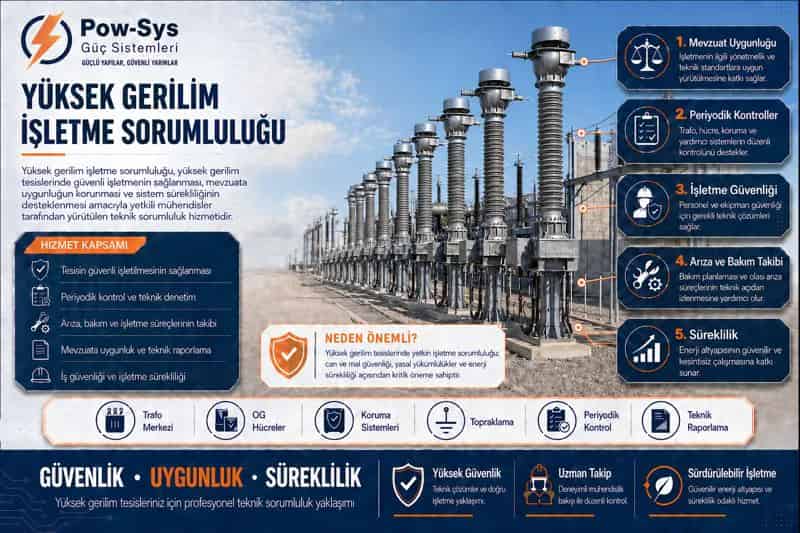
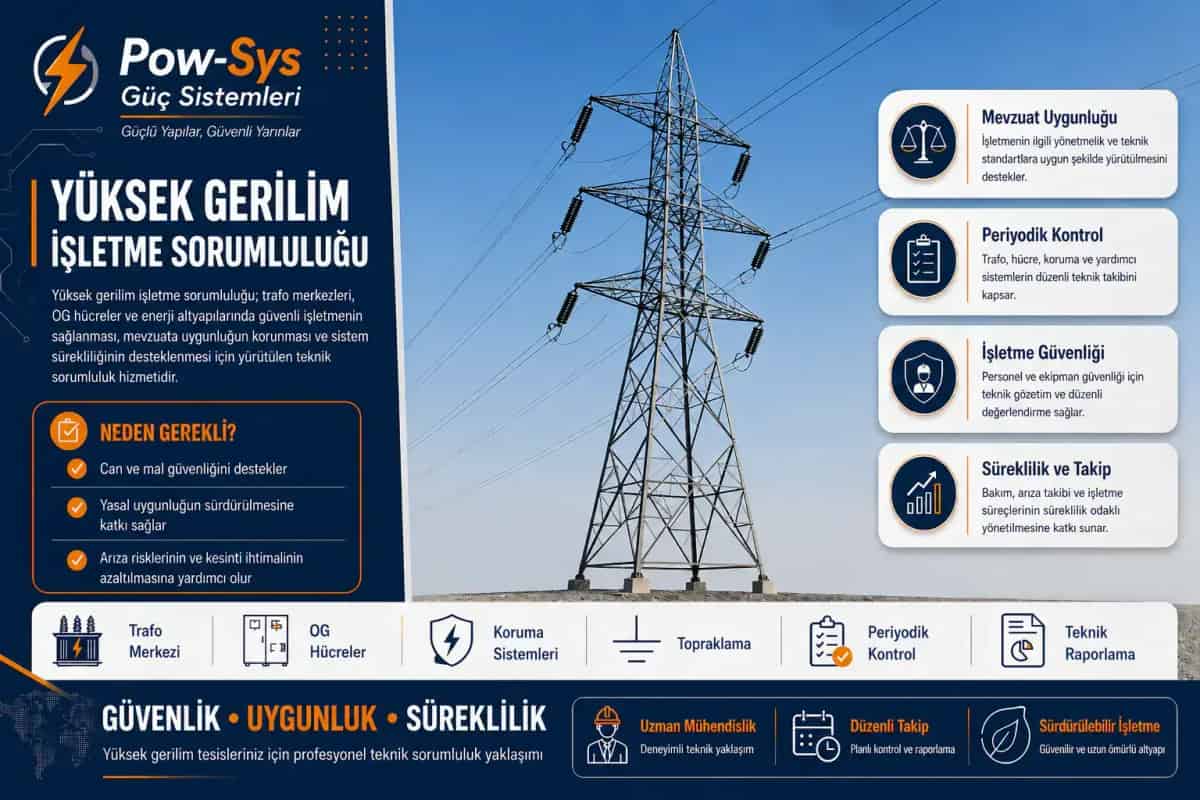
Bursa high voltage operation responsibility is the authorized engineering follow-up service for MV/HV installations above 1 kV in Bursa and surrounding industrial areas. It combines contract scope, field inspection, reporting and open action tracking for privately transformer-fed facilities.
Pow-Sys evaluates the YGTIS scope for industrial and commercial facilities according to their transformer and switchgear configuration. Site visits, reporting and follow-up responsibilities are agreed in the service contract.
Who is this service for?
Facilities in Nilufer, Osmangazi, Kestel, Gursu, Inegol, Gemlik, Mudanya, Karacabey and Bursa OIZ zones should consider this service if they have a private transformer, MV cell or transformer substation.
The need is evaluated by voltage level, MV cell count, switching arrangement, current contract, maintenance records, single-line diagram and safety equipment condition, not only by transformer size.
What is checked during the Bursa site review?
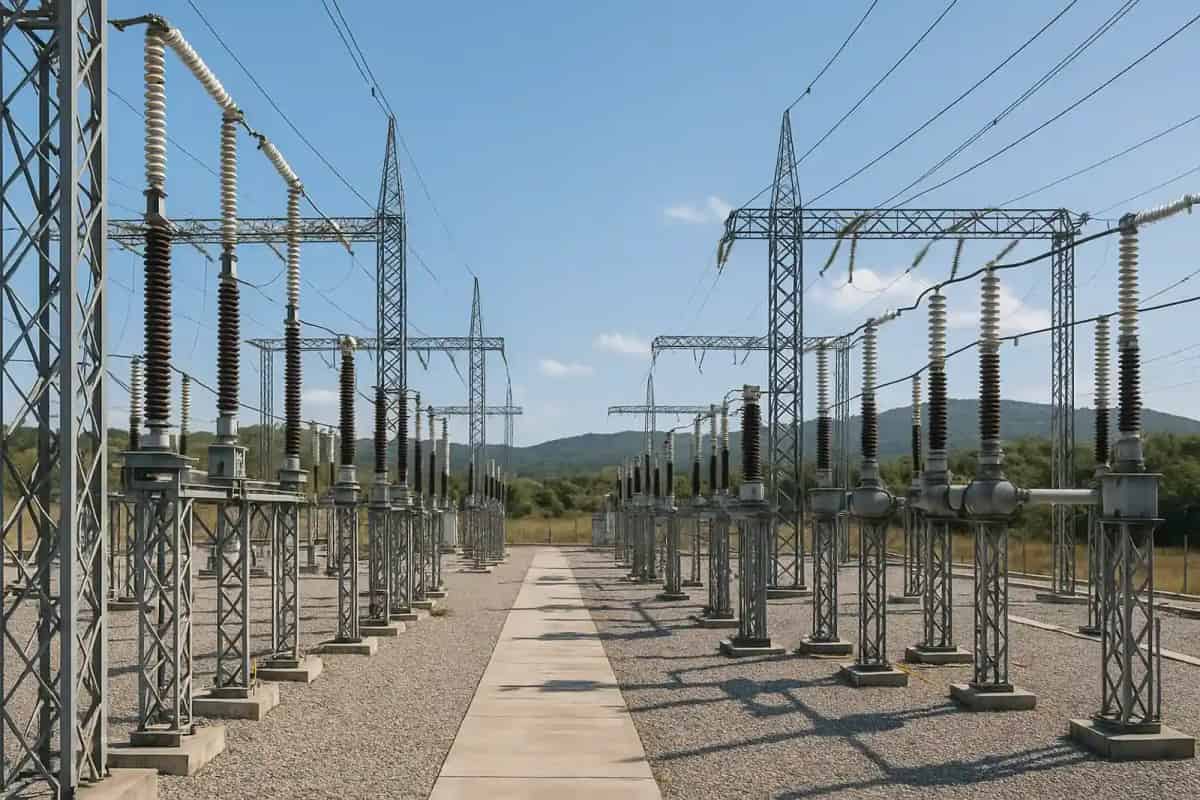
The field review covers transformer substation condition, MV cells, breaker/disconnector status, single-line diagram, switching instructions, grounding records, compensation system if separately contracted, maintenance/test history, safety equipment and open actions.
Pow-Sys does not treat this as a simple yes/no checklist. Findings are reported with risk priority, separate maintenance/test/measurement needs, responsible party and follow-up date.
Contract, report and proposal process
A Bursa HV operation responsibility proposal considers transformer kVA, transformer type, MV cell count, location, current contract, latest maintenance and measurement dates, single-line diagram and expected visit period.
When an SMM undertakes operation responsibility, the HV installation is inspected at least once a month, with more frequent visits when needed. Under Article 7(l) of the EMO Operation Responsibility Regulation, a report is prepared when required and at intervals no longer than four months. Inspection and reporting intervals are separate; risks, deficiencies and additional maintenance or testing are tracked in writing.
Are maintenance and measurement works separate?
HV operation responsibility does not replace transformer maintenance, relay testing, thermal camera inspection, grounding measurement or fault repair. These works are marked in the report as separately planned services when required.
Proposal comparison should consider the authorized engineer, report format, visit frequency, included/excluded works, regulatory source awareness and action tracking, not only the price.
Output of working with Pow-Sys
The facility receives a current inspection form, field finding report, open action list, technical notes aligned with official sources and a clearer proposal scope.
For a Bursa facility proposal, share transformer capacity, MV cell count, single-line diagram, current contract status and latest maintenance/measurement dates. Scope and visit frequency are clarified from this information, and before signing you see in writing what is included and what is planned as a separate service.
Reporting, Inspection and Proposal Preparation
| Inspection heading | Field checkpoints | Report output |
|---|---|---|
| Transformer substation general condition | Access, ventilation, cleanliness, room/panel safety and working area suitability are reviewed. | A general condition note, risk priority and maintenance requirement record are created. |
| MV switchgear, circuit breakers and disconnectors | Labeling, mechanical condition, earthing switch position, interlocks and visible nonconformities are checked. | Visual inspection findings and the required action list are prepared. |
| Single-line diagram and switching instruction | The currency of the single-line diagram, its consistency with field equipment and the switching sequence are evaluated. | Revision needs, instruction updates and personnel briefing notes are defined. |
| Grounding connections | Grounding conductors, equipotential bonding, corrosion, continuity and measurement needs are checked. | A measurement plan, nonconformity record or improvement recommendation is created. |
| Transformer monitoring points | Oil level, leakage condition, temperature indication, loading information and ventilation condition are reviewed. | Transformer maintenance, testing or oil analysis needs are added to the report. |
| Protection relays and safety equipment | Relay setting records, warning signs, insulated equipment, PPE and safe working tools are reviewed. | Testing needs, missing equipment and safety actions are added to the follow-up list. |
| Maintenance records and previous actions | Past maintenance records, previous report gaps, completed work and ongoing nonconformities are compared. | The current follow-up list and items for the next visit are clarified. |
| Emergency response and energy continuity | Fault contact points, critical loads, response plan and production continuity expectations are evaluated. | An emergency action recommendation and service scope note are created. |
Pow-Sys HV Operation 5-Step Inspection Workflow
Bursa HV operation responsibility is carried out not as a signature-only contract process, but through risk classification, inspection planning, written action list and follow-up/closure logic.
| Step | On-site assessment | Recorded output |
|---|---|---|
| Preliminary review | Transformer power, MV switchgear count, single-line diagram, switching arrangement, maintenance records and production sensitivity are reviewed. | Initial site notes affecting the HV operation responsibility scope are created. |
| Risk classification | Wrong switching, equipment confusion, missing documentation, grounding/measurement need and energy continuity risk are evaluated together. | Priority risk headings and items requiring urgent follow-up are separated. |
| Inspection and measurement plan | MV switchgear, transformer substation, safety equipment, records and, when required, grounding, thermal imaging or relay testing needs are planned. | Inspection schedule, separate testing need and visit frequency are clarified. |
| Written action list | Nonconformities are separated by responsible party, target date and risk priority. | A written action list that the facility can follow is prepared. |
| Follow-up and closure | Items opened during previous visits, completed works and continuing risks are compared in the next inspection. | Closed/open items and the new follow-up date are added to the report. |
Works Outside the Scope of This Service
HV operation responsibility covers technical follow-up, reporting, regulatory compliance assessment and risk notification processes. The following works are planned separately when required. Risk level, final scope and cost cannot be finalized without an on-site survey.
| Separately planned work | Why is it a separate scope? | Pow-Sys approach |
|---|---|---|
| Grounding measurement | It requires measurement equipment, site time, measurement point access and separate reporting. | It is stated as a need in the HV operation responsibility report; the measurement service is planned separately. |
| Relay testing and selectivity | It may require relay setting files, test equipment, outage planning and separate engineering work. | The protection and selectivity need is written into the report; testing/setting work is quoted separately. |
| Thermal imaging inspection | It requires imaging under load, separate equipment and a photo-supported thermal finding report. | Recommended as a separate work for panels, MV switchgear or connections where risk is observed. |
| Transformer maintenance and oil analysis | It may require maintenance crew, sampling, laboratory work or separate test procedure. | Transformer maintenance/testing need is stated in the HV report; maintenance and oil analysis are handled as separate services. |
| Project revision, implementation and physical remediation | It creates material, labor, authority process or implementation responsibility. | The HV responsible engineer reports the finding; implementation and contracting works are evaluated under a separate scope. |
Official Regulatory Sources
- Electrical High Current Installations Regulation
Claim supported on this page: Supports the operating, maintenance, life-safety and property-safety framework for high-current electrical installations above 1 kV.
- EMO Electrical High Voltage Installations Operation Responsibility Regulation
Claim supported on this page: Supports the scope of HV operation responsibility, duties of the responsible engineer, contract process and operation responsibility conditions.
- EMO YGTIS Regulation Amendment Dated 05.10.2024
Claim supported on this page: Supports the explanations about the YGTIS certificate, employer wording, certificate conditions and current EMO implementation changes.
Frequently Asked Questions
What is high voltage operation responsibility?
High voltage operation responsibility is a technical responsibility service carried out by an authorized electrical engineer to ensure that MV/HV facilities above 1 kV are operated safely, systematically and in compliance with applicable regulations. Transformer substations, MV switchgear, switching operations, maintenance planning, grounding systems, protection schemes and reporting activities are evaluated within this scope.
What does an HV operation supervisor do?
An HV operation supervisor monitors the condition of the transformer substation and MV switchgear, prepares switching instructions, checks safe working conditions during maintenance and repair activities, provides necessary information to operating personnel, ensures that tests and inspections are recorded and reports identified deficiencies to the business in writing.
Is high voltage operation responsibility mandatory?
For transformer substations supplied at MV/HV voltage levels and falling within the scope of facilities above 1 kV, working with an authorized HV operation supervisor in accordance with relevant regulations is required. This requirement is important for safe operation of the facility, organization of maintenance processes and reduction of possible fault or occupational accident risks.
Are transformer operation supervisor and HV operation supervisor the same?
In practice, these two terms are often used for the same service. In businesses with privately owned transformers, the transformer substation is considered within the scope of MV/HV facilities above 1 kV, and operation responsibility is carried out by an authorized electrical engineer. However, the service is not limited to the transformer only; MV switchgear, switching processes, protection systems, grounding, maintenance planning and reporting are also part of this responsibility.
Is HV operation responsibility required for factories in OIZs?
Factories located in OIZs and supplied from their own transformer substations at MV/HV voltage levels are evaluated within the scope of operation responsibility. In these facilities, the transformer substation, MV switchgear, switching arrangement, grounding system and maintenance processes must be followed up by an authorized engineer.
Which inspections are carried out within the scope of HV operation responsibility?
Within the scope of the service, the general condition of MV switchgear, circuit breakers and disconnectors, earthing switches, transformer oil level, leakage condition, temperature indicators, ventilation, grounding connections, single-line diagram, switching instructions, warning signs, occupational safety equipment and maintenance records are inspected. Depending on the facility’s needs, grounding measurements, thermal camera inspections, relay tests and power quality measurements may also be planned separately.
How does the HV operation responsibility service process work?
The process starts with a site survey and current condition assessment. Transformer power, number of MV/LV switchgear cells, facility structure, single-line diagram, maintenance status and operating conditions are evaluated. Then the contract scope, visit frequency, reporting structure and planned inspections are clarified. During periodic visits, deficiencies are reported and an action list is provided to the business.
How is the HV operation responsibility fee determined?
The fee for HV operation responsibility is determined according to transformer power, number of transformers, number of MV/LV switchgear cells, facility size, location, visit frequency, scope of tests to be performed, emergency support and reporting details. Pow-Sys Power Systems prepares a transparent offer for your facility in Bursa by taking into account the current minimum fee tariff and the service scope.
What are the risks of not having an HV operation supervisor?
Businesses that do not work with an HV operation supervisor may face administrative sanction risks in terms of relevant regulations and distribution company processes. In addition, in the event of an electrical fault, fire, equipment damage or occupational accident, the legal and technical responsibility of the business may increase. Therefore, operation responsibility is not only an official procedure but also an important requirement for facility safety.
Which areas in Bursa do you provide HV operation responsibility services for?
As Pow-Sys Power Systems, we provide services for industrial facilities, factories and privately owned transformer facilities based in Bursa. We can carry out site survey, contract, inspection and reporting processes for facilities in the Bursa, Demirtaş, Nilüfer, Kayapa, Hasanağa and Kestel organized industrial zones, as well as Gürsu, Osmangazi, Nilüfer, İnegöl, Gemlik, Mudanya and Karacabey.
Who can obtain an HV operation responsibility certificate?
The HV operation responsibility certificate, currently referred to as the YGTİS certificate, is an authorization certificate issued for relevant engineering disciplines that meet the training, membership and competence requirements determined by the Chamber of Electrical Engineers. Engineers holding this certificate can provide operation responsibility services for high voltage facilities within the scope of relevant regulations. Businesses should work with engineers who have current and valid competence.
Does the HV operation responsibility certificate have a validity period?
The validity, renewal and training conditions of the HV operation responsibility certificate are evaluated according to the current regulations of the Chamber of Electrical Engineers. From the business perspective, the important point is that the engineer providing the service meets current requirements and carries out the operation responsibility duty in compliance with regulations.
Are transformer maintenance and HV operation responsibility the same service?
No. Transformer maintenance covers maintenance, testing and inspection procedures for the transformer and related equipment. HV operation responsibility covers a wider area, including safe operation of the facility, switching processes, follow-up of the maintenance plan, regulatory compliance, reporting and technical guidance to the employer and facility management. When necessary, these two services can be planned together.
What should be considered when requesting an HV operation responsibility offer?
When requesting an offer, not only the monthly fee but also the service scope, visit frequency, reporting structure, inspections to be carried out, emergency support, number of transformers and switchgear cells, field responsibilities and regulatory compliance should be evaluated together. Pow-Sys Power Systems clearly states which inspections will be performed and what the service scope includes in its offer file.
Is a site survey required for HV operation responsibility?
Yes. A site survey is useful for preparing the correct offer and defining the correct service scope. During the survey, transformer power, number of switchgear cells, general condition of the facility, access conditions, maintenance history, available documents, single-line diagram and safety equipment are evaluated. This allows an inspection and reporting plan suitable for the actual needs of the business to be prepared.
How many days does it take to prepare an HV operation responsibility proposal?
Proposal timing depends on how ready the facility information is. When transformer power, number of MV switchgear units, facility location, current single-line diagram and expected visit frequency are shared, the preliminary scope can be prepared faster. For facilities requiring an on-site survey, the final proposal is clarified after field review and authorized engineer assessment.
Can a price be given without an on-site survey?
An approximate scope can be discussed based on preliminary information; however, final price and risk level are not confirmed without on-site survey, current document review, transformer substation structure, number of MV switchgear units, maintenance history and contract scope assessment. This approach is necessary to define both customer expectations and technical responsibility boundaries correctly.
Are grounding measurement and transformer maintenance included in this service?
Grounding measurement, relay testing, thermal imaging, transformer maintenance and oil analysis may be stated as needs in the HV operation responsibility report; however, they are usually planned as separate testing, measurement or maintenance services. The main service covers technical follow-up, reporting, nonconformity notification and the operation responsibility process.
How does the HV operation responsibility process work in Bursa OIZs?
The process in Bursa organized industrial zones follows the same core steps as elsewhere: site survey, contract scoping, periodic inspection visits, written reporting and open action tracking. For OIZ factories fed from their own transformer substations, the survey reviews transformer capacity, MV cell count, the single-line diagram, switching arrangement, maintenance records and safety equipment condition. Pow-Sys serves facilities in the Bursa, Demirtaş, Nilüfer, Kayapa, Hasanağa and Kestel organized industrial zones as well as surrounding districts, and the visit plan is aligned with the facility's production schedule. Findings are reported with risk priority, responsible party and follow-up date, and separately planned works such as maintenance, testing or measurement are clearly marked so the OIZ business can manage its technical file and proposal comparisons transparently.