
Last updated: September 5, 2026
Reviewed by Hüseyin ÇOKAL, Electrical and Electronics Engineer. Updated: September 5, 2026.
What changed: Service scope, report outputs, official sources, pre-proposal information and technical transparency notes were reviewed for the current period.
Bursa Fire Detection Periodic Inspection Summary
- Periodic inspection of addressable and conventional fire detection and alarm systems in Bursa in line with legislation and the TS EN 54-14 approach: your system verified against the standard it was built to
- Fire alarm panel, smoke detector, heat detector, flame detector, beam detector, manual call point, sounder, strobe, loop and zone checks: silent failures found before they delay a real evacuation
- Reporting according to the Regulation on Fire Protection of Buildings, the Regulation on Health and Safety Conditions in the Use of Work Equipment and relevant standards: a report that stands up in fire brigade, ministry and insurance audits
- Site-specific inspection plans for facilities in Nilufer, DOSAB, NOSAB, Hasanaga, Kayapa, Kestel, Gursu and Inegol organized industrial zones: tests scheduled around production, sounder trials coordinated in advance
- Authorized persons meeting EKİPNET registration requirements, calibrated test devices, nonconformity list and engineer-approved periodic inspection report: no finding is left without a documented corrective action
- Integrated planning of fire detection inspection with electrical installation, grounding, generator, battery and other periodic inspections: related risks assessed together in one inspection calendar
Technically reviewed by
Bursa Fire Detection Periodic Inspection Scope
What is fire detection periodic inspection in Bursa
Fire detection and alarm system periodic inspection is the process of checking and reporting the panel, detectors, manual call points, sounders, strobes, power supply, loop/zone lines and fire scenarios at defined intervals according to legislation, relevant standards and manufacturer instructions. The aim is to verify that the system can perform early detection, correct warning, safe evacuation and required automation outputs reliably during an actual fire.
In industrial facilities, OIZ factories, shopping centers, hospitals, hotels, schools, warehouses, public buildings and large commercial properties in Bursa, a fire detection system should not be considered safe merely because it is installed. Detector contamination, disabled points, weak batteries, incorrect scenarios, insufficient sounder audibility or faulty loop wiring may cause delayed detection and evacuation delay in a real fire.
Legal basis and standards
Fire detection system periodic inspection is evaluated by considering Law No. 6331 on Occupational Health and Safety, the Regulation on Health and Safety Conditions in the Use of Work Equipment, the Regulation on Fire Protection of Buildings and the relevant TS EN 54 standard family. The Regulation on Fire Protection of Buildings defines periodic inspection, testing and maintenance of fire detection and warning systems according to the relevant standards as an important responsibility of the building owner, manager or authorized building representative.
The TS EN 54-14 approach provides a technical framework for the planning, design, installation, commissioning, use, maintenance and inspection processes of fire detection and alarm systems. Work equipment legislation is also important because periodic inspection must be carried out by authorized persons, documented and kept available for official audits.
How is the inspection interval determined
Annual comprehensive periodic inspection is taken as the baseline for fire detection and alarm systems; if manufacturer instructions, the relevant standard, facility risk analysis or insurance/OIZ/authority requirements define a shorter interval, that interval should be followed. Interim function checks can be planned for chemical, textile, plastic, paper, logistics warehouse, intensive production, hospital and data center facilities where fire risk or evacuation sensitivity is high.
Monthly visual checks, panel fault indications, power-supply status and disabled points can be followed by the business. Quarterly or six-monthly interim checks may test selected detectors, call points, sounders, strobes and scenario functions. The annual periodic inspection is completed with wider sampling, loop/zone checks, battery and power-supply assessment, integration tests and official reporting.
Which equipment is inspected
The inspection covers the fire alarm panel, repeater panel, communication modules, main and backup power supplies, batteries, smoke detectors, heat detectors, flame detectors, beam detectors, manual fire call points, sounders, strobes, audible-visual warning devices, loop lines, zones, cable routes and field connections.
The system may be addressable or conventional. In addressable systems, each detector and call point is checked to verify that it appears on the panel with the correct address. In conventional systems, zone-based alarm, fault and cable continuity are assessed. In both system types, the main objective is to detect fire at the earliest possible stage and reliably report the correct area.
Site preparation and document review
Before starting on site, the fire detection project, as-built drawings, panel brand and model information, loop/zone lists, detector and call point quantities, previous periodic inspection reports, maintenance records, fault records and fire scenario matrix are reviewed. These documents help determine which points are critical, which integrations must be prioritized and which areas have higher risk during field testing.
The test plan is prepared by considering the facility's production order, shift hours, evacuation plan, enclosed-area density, dust/humidity/temperature conditions and critical equipment. Sounder tests, elevator recall, smoke extraction, door holders and gas extinguishing integrations are performed in a controlled manner in coordination with facility representatives.
Panel, power supply and battery checks
Normal, alarm, fault, disabled, test and bypass states are reviewed on the fire alarm panel. Main power supply, backup power supply, battery voltages, charging circuit, panel event logs, loop/zone conditions, communication modules and repeater panels are checked. Points that continuously produce faults, are disabled or cannot be clearly matched with the field are listed separately in the report.
Battery and backup power condition is critical for continuity of the fire detection system. During a mains power failure, the panel, detectors and warning devices are expected to operate for the required duration. Therefore, battery voltage, connection condition, charging circuit and ageing signs are checked; where needed, a more detailed battery periodic inspection can be planned separately.
Detector, call point and warning device tests
Smoke detectors are tested with suitable test aerosols, heat detectors with a controlled heat source, and flame and beam detectors according to manufacturer instructions. During testing, whether the detector generates an alarm, whether it appears on the panel with the correct address or zone, response delay, contamination level and false alarm risk are assessed.
For manual fire call points, mechanical operation, accessibility, glass or reset element condition and correct alarm creation on the panel are checked. For sounders and strobes, activation, audibility, visibility, regional alarm logic and compatibility with the fire scenario are assessed. Missing, weak or incorrectly operating warning devices are reported as priority nonconformities for evacuation safety.
Scenario and integration tests
In many facilities, the fire detection system does not only generate an alarm; it interacts with elevator recall, smoke extraction, pressurization, door holders, turnstiles, gas extinguishing, sprinkler alarm, fire pump room signal, emergency announcement and building automation systems. Therefore, periodic inspection verifies whether fire scenarios produce the expected results not only on the panel but also on connected systems.
Scenario tests are planned by considering the production and usage conditions of the facility. The aim is to use controlled tests close to real fire behavior to verify that the alarm indicates the correct area, required warnings are generated, related equipment moves to the expected position and unnecessary activation or missing triggering risks are eliminated.
Cable, loop and insulation checks
Cable continuity, loop integrity, short circuit, open circuit, earth leakage, line resistance and insulation condition directly affect fire detection system reliability. Cable-related fault risk may increase especially in production areas, humid areas, cable trays, field transitions and areas that have undergone renovation.
During loop and zone checks, panel fault records, field connections and cable routes are evaluated together. Where required, insulation resistance, continuity and earth leakage checks are performed to verify the electrical integrity of the detection line. Identified cable, connection or field-device issues are clearly included in the report.
Fire detection periodic inspection report
At the end of the inspection, a fire detection system periodic inspection form, test results, inspected equipment list, panel and field observations, measurement results, fire scenario assessment, nonconformity list and corrective action recommendations are prepared. The report is written clearly enough to be used in Ministry of Labor, fire brigade, OIZ administration, insurance audits and occupational health and safety files.
Each nonconformity is classified according to its severity. Detector contamination, faulty call point, non-operating sounder, weak battery, missing scenario, disabled zone, incorrect addressing, insufficient audibility or integration failure are documented with practical corrective action recommendations. If necessary, the need for retesting after correction is also stated.
Authorized persons and EKİPNET registration
Periodic inspections of fire detection and alarm systems should be carried out by persons authorized to perform periodic inspections under the relevant legislation and meeting EKİPNET registration requirements. In practice, authorized persons from relevant technical disciplines such as electrical, electrical-electronics, electronics and communications should use calibrated test devices and appropriate inspection methods when preparing the report.
When selecting a service provider, not only price but also the competence of the person performing the inspection, EKİPNET registration status, calibration of test devices, conformity of the report format with regulations, experience in fire detection systems and scenario/integration knowledge should be evaluated together. This approach makes the report understandable and defensible during audits.
Service scope for facilities in Bursa
We plan Bursa fire detection periodic inspection services for industrial facilities, organized industrial zones, shopping centers, hospitals, hotels, schools, logistics warehouses, cold storage facilities, public buildings and campus structures in Bursa, especially in Nilufer, Osmangazi, Yildirim, Gursu, Kestel, Inegol, Gemlik, Mudanya, Karacabey and Mustafakemalpasa.
In industrially dense areas such as Nilufer OSB, DOSAB, NOSAB, Hasanaga, Kayapa, Demirtas, Kestel, Gursu and Inegol OSB, fire detection system periodic inspection is especially important for production continuity, occupational safety, insurance processes and official audits. The inspection plan is prepared according to each facility's risk profile and operating order.
How is pricing determined
Fire detection system periodic inspection price is determined according to panel brand and model, number of loops and zones, number of detectors, call points, sounders and strobes, number of buildings, number of floors, field access, integration scope, whether the test will be performed outside production hours and reporting detail.
To prepare a clear proposal, panel information, device list, number of loops/zones, facility layout plan, existing maintenance records and, if available, previous fire detection periodic inspection report are reviewed. After a site survey or preliminary information assessment, an understandable proposal is prepared according to the actual size of the system. Scope is clarified from this information, and before signing you see in writing what is included and what is planned as a separate service.
Integrated periodic inspection plan
Fire detection periodic inspection produces more efficient results when planned together with the facility's other electrical and safety inspections. Handling electrical installation, grounding, lightning protection, generator, battery, transformer and fire detection checks within the same periodic inspection calendar organizes the audit file and allows mutually related risks to be seen as a whole.
As Pow-Sys Power Systems, we evaluate fire detection and warning systems in Bursa not only by device, but also together with electrical supply, evacuation scenario, fire safety, maintenance history and operational continuity. This turns the report from a mere formality into a technical document that contributes to the facility's real safety plan.
Reporting, Inspection and Proposal Preparation
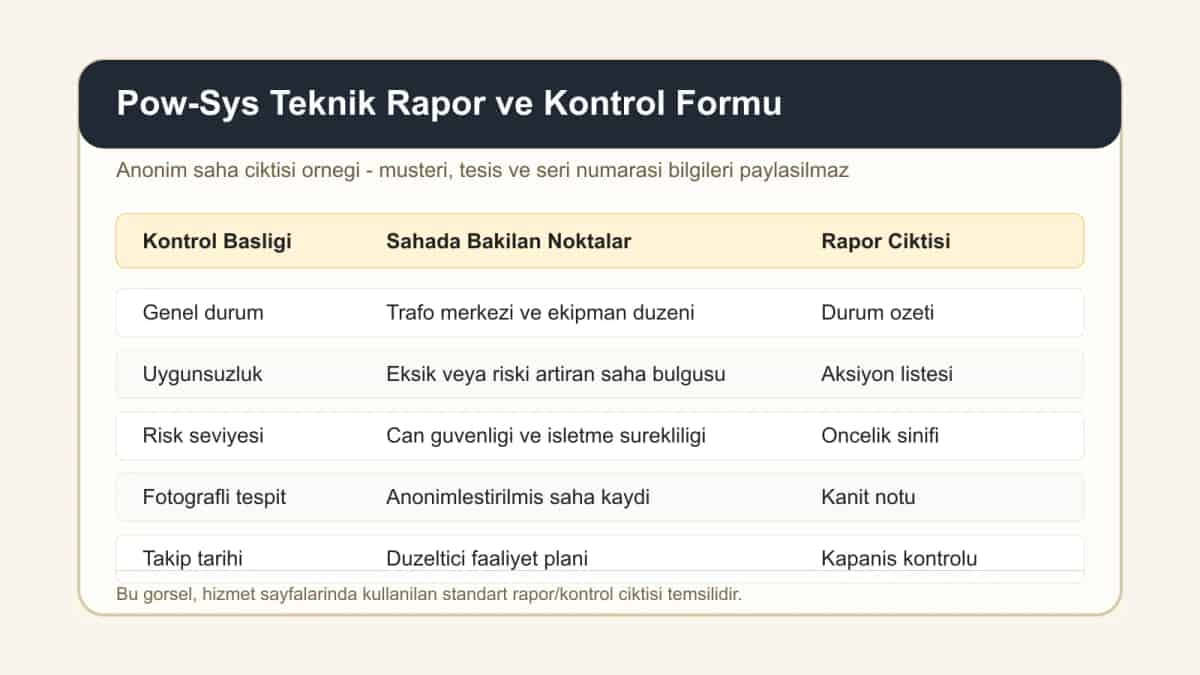
Sample Inspection Table
This table summarizes which headings are evaluated on site and which outputs may appear in the report.
| Inspected area | Checked criterion | Report output |
|---|---|---|
| Site and equipment condition | Existing equipment structure, access conditions, visible risks and operating conditions | Site inspection note and prioritized findings list |
| Document and project conformity | Single-line diagram, current project, labeling, reports and conformity with site implementation | Document conformity assessment and missing record list |
| Safety and operational risk | Life safety, equipment safety, energy continuity and maintenance access risk headings | Risk classification and corrective action recommendations |
| Measurement, test or inspection need | Measurement, test, visual inspection and technical review items required by the service scope | Measurement/test plan or inspection scope note |
| Reporting and follow-up | Nonconformity priority, follow-up date, responsibility allocation and next steps | Photo-supported report, action list and follow-up recommendation |
Out-of-Scope and Separately Planned Works
Bursa Fire Detection Periodic Inspection produces technical follow-up, reporting, compliance assessment and risk notification. The following works are planned separately when required; final risk level, cost and scope are not confirmed without an on-site survey.
| Out-of-scope / separate work | Why is it evaluated separately? | Pow-Sys approach |
|---|---|---|
| Grounding measurement | It may require measurement equipment, site time and a separate report. | The need is stated in the main report; measurement work is planned separately. |
| Relay testing and selectivity | Relay settings, test equipment, outage planning and separate engineering assessment may be required. | Quoted as a separate testing/selectivity service when needed. |
| Thermal imaging inspection | It requires imaging under load and a separate thermal finding report. | Planned separately for panels, switchgear or connections where risk is observed. |
| Transformer maintenance and oil analysis | It may require maintenance crew, sampling, laboratory work or a separate test procedure. | The need is written in the technical report; maintenance/testing is prepared as a separate scope. |
| Project revision, implementation and physical remediation | It creates material, labor, authority process or implementation responsibility. | The main service reports the finding; implementation and contracting works are handled separately. |

Official Regulatory Sources
- EMO certificate verification portal
Claim supported on this page: EMO registration, SMM and certificate verification transparency.
- TEDAŞ official website
Claim supported on this page: Distribution infrastructure, project/acceptance processes and technical specification context.
- TEİAŞ official website
Claim supported on this page: Transmission system, connection and high-voltage infrastructure context.
- Electrical High Current Installations Regulation
Claim supported on this page: Installation, operation, maintenance and safety of high-current electrical installations.
Frequently Asked Questions
How many times a year should fire detection system periodic inspection be performed?
According to the regulations and TS EN 54-14, if the manufacturer does not recommend a shorter period, the maximum interval is one year. In other words, periodic inspection and maintenance for fire detection and alarm systems must be performed at least once a year. More frequent checks are recommended in hazardous-class businesses and high-risk facilities.
Who performs fire detection system periodic inspection?
Periodic inspection of fire detection and alarm systems must be performed by persons authorized to carry out periodic inspections under the Regulation on Health and Safety Conditions in the Use of Work Equipment and meeting EKİPNET registration requirements. This includes engineers, technicians, senior technicians and technical teachers who meet the relevant requirements. When receiving inspection service, it is important to work with persons or organizations experienced in fire detection and alarm systems, using calibrated test devices and preparing reports in accordance with the legislation.
Does the system become completely disabled during inspection?
No. Periodic inspection and function tests are performed as far as possible without interrupting the operation of the system. During some tests, short-term sounder and warning activations may be given in a controlled way; this is planned in coordination with the business and carried out by considering critical production processes.
Is the periodic inspection report valid in official audits?
A fire detection system periodic inspection report prepared by an authorized person or authorized inspection body using calibrated test devices and considering the TS EN 54-14 approach, the Regulation on Fire Protection of Buildings and the Regulation on Health and Safety Conditions in the Use of Work Equipment is a strong technical supporting document in Ministry of Labor, organized industrial zone administration, fire brigade and insurance audits.
What is the risk of not having the inspection performed?
In systems that are not inspected regularly, detector contamination, incorrect installation, disabled zones or non-operating sounders may go unnoticed. This may cause delayed detection, evacuation delay and serious loss of life and property in a real fire. In addition, administrative sanctions, work stoppage decisions and problems in insurance claim processes may occur during official audits.
How are prices calculated?
Pricing is project-based according to panel type, number of loops and zones, number of detectors-call points-sounders, facility size, integration complexity such as smoke extraction, elevator and gas extinguishing, and location. Small systems require lower budgets, while complex fire safety systems such as organized industrial zone facilities require higher budgets. For a clear proposal, it is sufficient to contact us with your system information.
Is a fire detection system mandatory?
According to paragraph 3 of Article 75 of the Regulation on Fire Protection of Buildings, automatic fire detection devices must be installed in buildings whose building height or total enclosed area exceeds the values in Annex 7. Therefore, a fire detection system is legally mandatory in buildings exceeding certain height and enclosed area limits. Whether your business falls within this scope should be evaluated according to building usage class, building height and total enclosed area. In addition, in workplaces under Law No. 6331 and high fire-risk facilities, installing a fire detection system is strongly recommended even below the regulation thresholds.
According to which regulations is fire detection periodic inspection performed?
Fire detection and alarm system periodic inspection is evaluated within the framework of Law No. 6331 on Occupational Health and Safety, the Regulation on Health and Safety Conditions in the Use of Work Equipment, the Regulation on Fire Protection of Buildings and the TS EN 54 standard family — particularly the TS EN 54-14 approach for planning, installation, commissioning, use, maintenance and inspection. The Regulation on Fire Protection of Buildings assigns the periodic testing and maintenance of fire detection and warning systems to the building owner, manager or authorized representative as an important responsibility, while the work equipment legislation requires the inspection to be performed by authorized persons and documented for official audits. In practice, an annual comprehensive inspection is the baseline unless a stricter interval applies to your facility.