

Last updated: September 9, 2026
Reviewed by Hüseyin ÇOKAL, Electrical and Electronics Engineer. Updated: September 9, 2026.
What changed: Service scope, report outputs, official sources, pre-proposal information and technical transparency notes were reviewed for the current period.
Bursa Grounding Measurement and Report Summary
- Bursa grounding installation periodic inspection covers visual examination of protective grounding, functional grounding, lightning protection grounding and equipotential bonding, grounding resistance measurement, grounding continuity testing and, where required, grounding performance tests: the whole grounding system verified in one visit
- Electrical grounding measurement and grounding testing are carried out according to the Regulation on Grounding in Electrical Installations and the relevant TS EN standards, considering grounding resistance, soil resistivity by the Wenner method, grounding continuity, step-touch voltage and whether the fault current flows safely to earth according to the TN/TT/IT system structure: results you can defend in audits
- Within the scope of Bursa grounding periodic inspection, panel and machine body grounding, switchyards and transformer substations, lightning protection grounding, electrical installation grounding bars and equipotential bars are evaluated as a whole; protective grounding periodic inspection and functional grounding periodic inspection are handled in the same report set, and deficiencies that may be considered major nonconformities are highlighted: critical risks reach you in writing before they grow
- The grounding measurement report, grounding conformity report and grounding installation periodic inspection report are prepared with resistance values for measurement points, comparison of grounding resistance measurement results with limit values, risk levels of nonconformities, required corrective-preventive actions and a regulation-compliant periodic inspection form structure: no measurement point is left without an interpretation
- In Bursa organized industrial zones and industrial areas such as Nilufer OSB, DOSAB, Hasanaga, Kayapa, Kestel, Gursu and Inegol OSB, grounding periodic inspections are planned at least once a year according to the regulation provisions, grounding measurement intervals are followed and reporting is prepared in a structure suitable for EKİPNET / OHS-KATIP documentation: your inspection calendar is tracked so deadlines are not missed
- By planning grounding periodic inspection, electrical installation periodic inspection, lightning protection tests, thermal camera measurements and MV/HV operation-transformer maintenance tests together, we offer an integrated, regulation-compliant and cost-effective solution for periodic inspections of electrical installations and grounding installations: fewer site visits, one consistent report set
Technically reviewed by
Bursa Grounding Measurement and Report Scope
What is grounding installation periodic inspection
Grounding installation periodic inspection is the process of measuring and examining the protective grounding, functional grounding, lightning protection grounding and equipotential bonding of a facility at defined intervals. In businesses in Bursa, this process is often referred to as grounding periodic inspection, grounding installation periodic examination, grounding measurement, grounding test or grounding report. Their common purpose is to verify the effectiveness and continuity of the grounding system in a way that reduces electric shock, arc-flash and fire risks.
Difference between periodic inspection and maintenance
It should be remembered that periodic inspection and periodic maintenance are different concepts. Grounding installation periodic inspection is an official periodic examination that documents the compliance of grounding through independent measurements, tests and visual checks. Periodic maintenance covers interventions such as tightening connections, cleaning corrosion and renewing conductors, and it does not replace a grounding installation periodic inspection report. What is requested during inspections by a labor inspector, insurance company or certification body is a periodic inspection report prepared by an authorized engineer or an accredited Type A inspection body.
Legal basis and inspection interval
The legal basis of grounding periodic inspection is Law No. 6331 on Occupational Health and Safety and the Regulation on Health and Safety Conditions in the Use of Work Equipment, published under this law on 25.04.2013 with number 28628. In the field, this text may be referred to as the work equipment periodic inspection regulation, electrical grounding periodic inspection regulation, grounding periodic inspection interval or simply the grounding regulation. In addition, the Regulation on Grounding in Electrical Installations, EMO grounding rules and the relevant TS EN standards define grounding resistance limit values, measurement methods, soil resistivity measurement and report format.
Scope of grounding installation
Grounding installation covers the main grounding bar, foundation grounding, ring earth electrodes, local earth electrodes, electrical installation grounding bars, panel and machine body grounding, lightning protection grounding and equipotential bonding. In factories in Bursa, production facilities in organized industrial zones, logistics warehouses, shopping centers, hospitals, hotels and office buildings, all metal bodies of electrical machinery and equipment must be connected to suitable protective grounding. Grounding periodic inspections verify whether this entire system operates continuously, with low impedance and safely.
Site survey, visual inspection and measurement process
In the field, grounding periodic inspection is generally carried out in three steps: preparation and site survey, visual examination and electrical measurements. During the site survey stage, the grounding installation diagram is created; which panel, which machine and which lightning protection system are connected to which earth electrode or main grounding bar is determined. Previously prepared grounding measurement reports, electrical installation conformity reports, projects and soil resistivity reports, if any, are reviewed; measurement points, test methods to be used and grounding periodic inspection form details are clarified.
Visual inspection and major nonconformity checks
During the visual examination stage, conductor cross-sections, terminal connections, corrosion and mechanical damage, cable and busbar routes, the arrangement of the main grounding bar and equipotential bars, down conductors and connection points of the lightning protection system, panel body grounding connections, labels and warning signs are checked. In protective grounding periodic inspection, the grounding continuity of machine bodies and panels, coordination with residual current devices (RCDs), and suitability of thermal-magnetic protection devices are evaluated. Corrosion, loose connections, broken conductors, incorrect cross-section selection or non-standard connections are specified in the report as major nonconformities.
Grounding measurement and test methods
During the electrical measurement and test stage, grounding resistance measurement methods such as the three-point method, 62% rule and clamp-meter measurement, grounding continuity tests, step and touch voltage assessments, soil resistivity measurement by the Wenner method and, where required, SELVAZ grounding performance tests in switchyards are applied. In this way, not only the magnitude of grounding resistance but also whether the system can safely conduct the fault current that may pass through it during a fault is analyzed.
Evaluation of measurement results
Grounding measurement results are evaluated by taking the Regulation on Grounding in Electrical Installations, the relevant standards such as TS EN 62305 and TS EN 60364-4-41, and distribution company / EDAS practices into account. Permitted limit values and safety criteria may vary for different facility types such as residential buildings, commercial buildings, industrial facilities, explosive atmospheres and hospitals. Therefore, a grounding measurement report does not only answer the question of how many ohms were measured; it also answers whether this value is safe under the existing conditions and whether the protection devices will open within the required time.
How often should grounding measurement be performed
The grounding periodic inspection interval is one of the most frequently asked topics in businesses. The Regulation on Health and Safety Conditions in the Use of Work Equipment generally defines the maximum inspection period for electrical installations and grounding installations as one year. Therefore, the practical answer to how often grounding measurements should be performed is once a year unless applicable standards specify otherwise for most businesses in Bursa. In humid, corrosive, chemically exposed, extremely dusty, high mechanical vibration or explosive atmosphere (Ex zone) facilities, this interval should be shortened further; risk analysis, manufacturer recommendations and functional grounding periodic inspection results should be evaluated together.
Who can perform grounding periodic inspection
Who performs grounding periodic inspection According to the regulation, electrical grounding measurements and grounding installation periodic inspection must be carried out by electrical / electrical-electronics engineers with the required qualifications or accredited Type A inspection bodies. Measurements must be made with calibrated instruments, the method used must be stated in the report, measurement dates and device calibration information must be included, and the results must be delivered as a signed and sealed periodic inspection report.
Service scope in Bursa OIZ and industrial zones
As Pow-Sys Power Systems, we provide Bursa grounding periodic inspection and Bursa grounding measurement services throughout Bursa, especially in Nilufer OSB, Demirtas OSB (DOSAB), Hasanaga, Kayapa, Kestel, Gursu, Inegol and surrounding organized industrial zones. For businesses looking for Bursa grounding measurement, Bursa grounding report, Bursa electrical and grounding measurements or Bursa grounding installation periodic inspection, we first create an inventory of the existing grounding system, then plan measurement intervals and the next periodic inspection date together.
Reporting and classification of nonconformities
During grounding periodic examination, ring earth electrodes, column and panel grounding, machine body grounding, functional and protective grounding, and the lightning protection system are traced end-to-end starting from the main grounding bar. Values for each measurement point are recorded and clearly shown in the grounding measurement report. For resistance values that are critically high, technical solutions such as adding new electrodes, increasing conductor cross-section, renewing connection points or preparing additional grounding projects in areas with high soil resistivity are recommended.
EKİPNET and OHS-KATIP processes
For mandatory grounding inspections, the employer and authorized inspector must approve an İSG-KATİP contract at least one day before the visit. EKİPNET records the authorized person. Keep the signed inspection report in the facility records; it does not replace the contract.
How are Bursa grounding measurement prices determined
Bursa grounding periodic inspection prices are determined according to the size of your facility, the number of grounding points and measurements, the number of lightning protection systems, whether there is a switchyard or transformer substation, additional tests to be performed such as soil resistivity measurement, SELVAZ test or thermal camera scan, requested report language, delivery time and location. After preliminary survey or project review, we provide clear pricing and, if you wish, alternative proposal scenarios for different scopes.
Integrated periodic inspection plan
When needed, we plan grounding installation periodic inspection together with electrical installation periodic inspection, lightning protection tests and MV/HV maintenance-test works. In this way, both the electrical installation and grounding system are inspected in the same period, and the relationship between them can be read in a single report set. For detailed information, you can also review our Bursa electrical installation periodic inspection, Bursa HV/MV maintenance and testing and Bursa transformer maintenance, testing and oil analysis pages.
Annual follow-up and measurement history
We configure our Bursa grounding installation periodic inspection service, whenever possible, as an annual contracted structure rather than a one-time service. In this way, your grounding measurement history is kept, point-based trends can be monitored and the improvement steps that must be completed before the next periodic inspection date can be managed more systematically. This model turns the safety of your grounding system, periodic inspections of your electrical and grounding installations, and your occupational health and safety management into a sustainable whole. To receive a proposal, share your facility location, the number of panels and grounding points and any previous grounding reports; scope is clarified from this information, and before signing you see in writing what is included and what is planned as a separate service.
Reporting, Inspection and Proposal Preparation
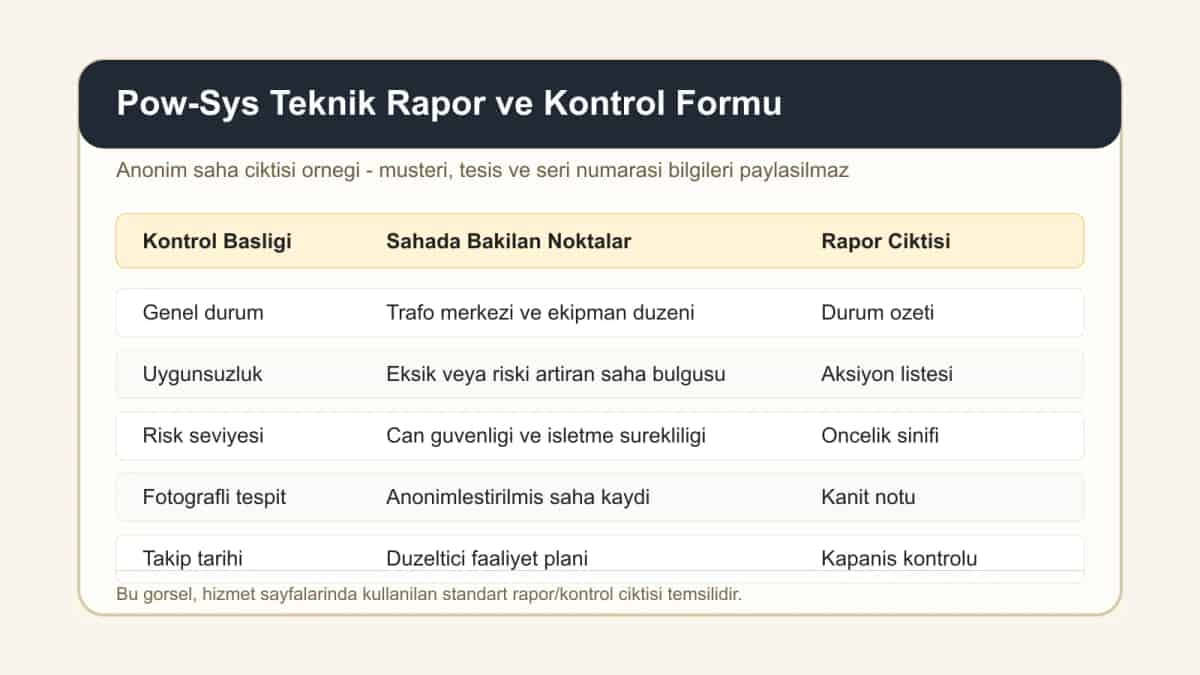
Sample Inspection Table
This table summarizes which headings are evaluated on site and which outputs may appear in the report.
| Inspected area | Checked criterion | Report output |
|---|---|---|
| Site and equipment condition | Existing equipment structure, access conditions, visible risks and operating conditions | Site inspection note and prioritized findings list |
| Document and project conformity | Single-line diagram, current project, labeling, reports and conformity with site implementation | Document conformity assessment and missing record list |
| Safety and operational risk | Life safety, equipment safety, energy continuity and maintenance access risk headings | Risk classification and corrective action recommendations |
| Measurement, test or inspection need | Measurement, test, visual inspection and technical review items required by the service scope | Measurement/test plan or inspection scope note |
| Reporting and follow-up | Nonconformity priority, follow-up date, responsibility allocation and next steps | Photo-supported report, action list and follow-up recommendation |
Included Measurements and Separately Planned Work
The grounding measurements, assessment and inspection report agreed in the proposal are included in the core service. Physical remediation of detected defects is planned separately from the inspection.
| Work item | Relationship to inspection | Scope decision |
|---|---|---|
| Grounding measurements and inspection report | Performed according to the methods explained on this page and the agreed proposal. | Measurements and findings within the core inspection scope are reported. |
| Conductor, connection or earth electrode improvement | Physical remediation of a detected defect may require materials and installation. | The inspection identifies the need; implementation is quoted separately. |
| Additional examinations outside the agreed scope | Determined by site conditions, existing design and risk assessment. | Test method, outage and additional reporting requirements are clarified before the proposal. |
Official Regulatory Sources
- EMO certificate verification portal
Claim supported on this page: EMO registration, SMM and certificate verification transparency.
- TEDAŞ official website
Claim supported on this page: Distribution infrastructure, project/acceptance processes and technical specification context.
- TEİAŞ official website
Claim supported on this page: Transmission system, connection and high-voltage infrastructure context.
- Electrical High Current Installations Regulation
Claim supported on this page: Installation, operation, maintenance and safety of high-current electrical installations.
Frequently Asked Questions
What is grounding installation periodic inspection? What does grounding periodic examination cover?
Grounding installation periodic inspection is the technical examination of a facility's protective grounding, functional grounding, lightning protection grounding and equipotential bonding at defined intervals. Grounding periodic examination includes grounding resistance measurement, grounding continuity tests, soil resistivity measurement, step-touch voltage assessments, SELVAZ switchyard grounding performance tests when required, and visual checks. The aim is to document that you have a grounding system compliant with regulations and standards at a level that minimizes electric shock and fire risks.
What is the grounding periodic inspection interval? How often should grounding measurements be performed?
The grounding periodic inspection interval is generally defined as one year for electrical installations and grounding installations in the Regulation on Health and Safety Conditions in the Use of Work Equipment. Therefore, grounding measurements and grounding installation periodic inspection in workplaces are accepted as a legal obligation once a year unless applicable standards specify otherwise. In humid, chemically exposed, explosive-atmosphere or heavy-industrial operating conditions, shorter intervals should be preferred by considering risk analysis, manufacturer instructions and functional grounding periodic inspection results.
What is grounding measurement? How is grounding resistance measured?
Grounding measurement is the measurement of the resistance encountered by an electrical current flowing to earth through an earth electrode, in other words grounding resistance. Measurements are generally performed with an earth tester using the three-point method and the 62% rule; in some cases, clamp-meter grounding measurement without disconnecting the circuit and grounding continuity testing can also be performed. In measurement, a test current is applied to the earth electrode and the resulting voltage drop is measured; grounding resistance is calculated according to Ohm's law. The measured value is compared with the limits specified in the Regulation on Grounding in Electrical Installations and the relevant standards.
How many ohms should the grounding measurement value be?
There is no single fixed limit value for grounding resistance; the permitted maximum value may vary according to facility type, voltage level, grounding arrangement, whether the system is TN/TT/IT, the magnitude of the fault current and the characteristics of protection devices such as fuses, circuit breakers and residual current devices. While 1-2 ohms may be targeted in some facilities, higher values may be acceptable in other cases according to regulations, project specifications and distribution company criteria. The important point is to obtain a grounding resistance that allows a sufficient fault current to flow during a fault so that protection devices open within a safe time.
Who performs grounding periodic inspection? Who is authorized?
Grounding installation periodic inspection and grounding measurements must be performed by electrical / electrical-electronics engineers with the qualifications specified in the Regulation on Health and Safety Conditions in the Use of Work Equipment or by accredited Type A inspection bodies. Persons and organizations performing grounding measurements must know the Regulation on Grounding in Electrical Installations, the relevant TS EN standards and correct measurement methods, use currently calibrated test devices and convert the results into a signed grounding measurement report and grounding conformity report accepted in official inspections.
Which measurements and tests are performed during grounding periodic inspection?
Within the scope of grounding periodic inspection, grounding resistance measurements such as the three-point method and clamp-meter measurement, grounding continuity tests, soil resistivity measurement by the Wenner method, step and touch voltage assessments, checks of panel and machine body grounding, and tests of electrical installation grounding bars and equipotential bonding are performed. In facilities with a transformer substation or switchyard, SELVAZ switchyard grounding performance tests can also be applied when required.
What are a grounding measurement report and a grounding conformity report?
A grounding measurement report is the technical report that includes the results of grounding measurements, descriptions of measurement points, the device and method used, the measurement date and evaluation results. A grounding conformity report is the document showing whether the grounding installation complies with the relevant regulations and standards; it is often evaluated together with the electrical installation conformity report. In practice, these reports may also be called a grounding periodic inspection report, grounding installation periodic examination report, Bursa grounding report or simply a grounding report.
What is the relationship between EKİPNET, OHS-KATIP and grounding periodic inspections?
For mandatory grounding inspections, the employer and authorized inspector must approve an İSG-KATİP contract at least one day before the visit. EKİPNET records the authorized person. Keep the signed inspection report in the facility records; it does not replace the contract.
How are grounding periodic inspection prices determined in Bursa?
The Bursa grounding periodic inspection price is determined according to the size of the facility, number of grounding points to be measured, whether there is a lightning protection system and transformer substation, requested additional tests such as soil resistivity measurement, SELVAZ test or thermal camera scan, report language, delivery time and the location of the facility. After site survey or project review, we provide clear pricing and alternative proposal packages for different scopes such as only grounding measurement and report, electrical installation plus grounding, or HV maintenance plus transformer plus grounding.
Can I receive electrical installation and grounding periodic inspections together in Bursa?
Yes. As Pow-Sys Power Systems, we can plan electrical installation periodic inspection, grounding installation periodic inspection, lightning protection tests and MV/HV maintenance-test services in Bursa in an integrated manner. In this way, both your internal installation and grounding system are inspected at the same site in one visit, and your reports are collected under one structure compatible with EKİPNET and OHS-KATIP processes. This approach provides important advantages for businesses in terms of both cost and planning, and allows you to manage your Bursa periodic inspection needs from a single point.
In which areas of Bursa do you provide grounding measurement services?
Pow-Sys provides grounding measurement and grounding periodic inspection services throughout Bursa, with a focus on the industrial regions where demand is most intensive: Nilufer OSB, Demirtas OSB (DOSAB), Hasanaga, Kayapa, Kestel, Gursu, Inegol and the surrounding organized industrial zones. Factories, production facilities in OIZs, logistics warehouses, shopping centers, hospitals, hotels and office buildings in these areas are typical service locations. For each facility, an inventory of the existing grounding system is created first, then measurement intervals and the next periodic inspection date are planned together with the business. Where practical, the grounding work is scheduled in the same visit as electrical installation and lightning protection inspections so that reporting stays consistent and total site time is reduced.