

Last updated: September 9, 2026
Reviewed by Hüseyin ÇOKAL, Electrical and Electronics Engineer. Updated: September 9, 2026.
What changed: Service scope, report outputs, official sources, pre-proposal information and technical transparency notes were reviewed for the current period.
Bursa Electrical Installation Periodic Inspection Summary
- Bursa electrical installation periodic inspection covers visual examination, measurement and function testing of main and sub-panels, cable routes, socket and lighting circuits, protective conductors, residual current devices and equipotential bonding: the whole internal installation verified in one process
- Electrical installation conformity inspection evaluates newly installed or revised installations according to the Electrical Internal Installations Regulation, TS EN/HD 60364 series standards and the Regulation on Health and Safety Conditions in the Use of Work Equipment: new installations documented as safe before they carry load
- Continuity testing, insulation resistance testing, loop impedance, prospective short-circuit current, residual current device trip testing, voltage checks and thermal imaging where required are among the core applications: protection behavior proven by measurement, not assumption
- The electrical installation periodic inspection report is prepared audit-ready with measurement results, photographic findings, nonconformity classes, risk levels and recommended corrective actions: no finding is left without follow-up
- For organized industrial zones, factories, warehouses, shopping centers, schools, hotels, plazas and service buildings in Bursa, the inspection program is planned without interrupting production: tests scheduled around your shifts, not over them
- Reports prepared by EKİPNET-registered electrical/electronics engineers authorized to perform periodic inspections are arranged in line with the Ministry report format and OHS-KATIP processes: documents that hold up in official audits
- We can plan electrical installation inspection together with grounding, lightning protection, generator, UPS/battery, transformer and other electrical periodic inspections to provide single-source electrical safety management: one visit, one calendar, one report set
Technically reviewed by
Bursa Electrical Installation Periodic Inspection Scope
What is electrical installation periodic inspection in Bursa
Electrical installation periodic inspection is the process of electrically measuring and examining low-voltage power panels, lines, conduit and cable routes, concealed installation, socket and lighting circuits, protective grounding and equipotential installation inside buildings and facilities at defined intervals. In businesses in Bursa, this process is often called electrical installation periodic inspection, internal installation periodic examination, Bursa electrical installation periodic inspection or simply electrical periodic inspection.
Periodic inspection and maintenance are different
Periodic inspection and periodic maintenance should not be confused. Periodic examination is an official inspection that reveals whether the electrical installation is safe through independent measurements, tests and visual checks. Periodic maintenance covers repair, tightening, cleaning and material replacement works and does not replace an electrical installation periodic inspection report or technical examination report.
Legal basis and technical standards
The legal basis for electrical installation periodic inspections is the Regulation on Health and Safety Conditions in the Use of Work Equipment dated 25.04.2013 and numbered 28628. In the field, this text is often called the work equipment periodic inspection regulation, electrical installation periodic inspection regulation or electrical periodic inspection regulation. In addition, the Electrical Internal Installations Regulation, TS EN/HD 60364 series standards and manufacturer instructions define test methods, measurement criteria and report format to be applied during electrical installation conformity inspection.
Which installations and equipment are inspected
Electrical installation covers the entire low-voltage network between the main supply point and final user points. The main distribution panel, sub-panels, cable and busbar systems, cable trays and conduit installation, concealed and surface-mounted lines, lighting and socket circuits, motor supply circuits, protective conductors (PE, PEN), residual current devices, switches and sockets, junction boxes and equipotential bars are components of the electrical installation. Low-voltage power installations in factories, production facilities, logistics warehouses, schools and educational institutions, shopping centers, hotels, offices and service buildings in Bursa are subject to electrical installation periodic inspection obligation.
How the inspection interval is determined
One of the most frequently asked questions is how often electrical installations should be inspected and whether electrical installation periodic inspection is mandatory. According to the legislation, periodic inspections of electrical installations must be carried out once a year unless applicable standards specify otherwise. In risky, humid, dusty, chemically exposed or explosive atmosphere facilities, the interval should be determined more frequently together with the risk assessment of your occupational safety specialist and manufacturer recommendations. In this way, legal obligations are fulfilled and electric shock and fire risks are reduced.
Authorized persons and EKİPNET registration
Electrical installation periodic inspections must be carried out by electrical / electrical-electronics engineers who meet the conditions specified in the regulation or by accredited Type A inspection bodies. Persons performing the inspection are expected to know the Electrical Internal Installations Regulation, relevant TS EN standards and the Mandatory Periodic Inspection Report Format and Criteria for Electrical Group Work Equipment published by the Ministry of Labor and Social Security, add calibration certificates of the test devices used to the report and deliver the results as a periodic inspection report that can be submitted in official audits.
Visual examination and site review
Electrical installation periodic inspection is generally carried out in two main steps in the field: first visual examination, then electrical measurements and tests. During visual examination, busbar and cable cross-sections in main and sub-panels, thermal current carrying capacities, tightness of terminals and connection points, panel internal arrangement, concealed and surface-mounted conduit and cable routes, cable trays, junction box connections, labels and warning signs, selection of residual current and other protection devices, panel covers and locking arrangements are examined.
Electrical measurements and function tests
During the electrical measurement and test stage, continuity tests of lines and protective conductors, insulation (megger) measurements, loop impedance and prospective short-circuit current measurements, tripping time and tripping current tests of residual current devices, phase-neutral and phase-earth voltage levels and load distribution checks are performed. When required, hot-spot scanning is carried out with a thermal camera on panel and cable connections to detect heating caused by loose connections or overload.
Grounding and equipotential bonding
Because protective grounding and equipotential installation are integral parts of the electrical installation, grounding resistance, soil resistivity and continuity of equipotential bonding are also measured within electrical installation periodic inspection. In this way, electric shock and fire risks caused by leakage current, insulation faults or potential differences between metal masses are minimized. For more detailed information on grounding installation periodic inspection and soil resistivity measurements, you can review our Bursa grounding installation periodic inspection page.
Conformity report and periodic inspection report
An electrical installation conformity report is the report showing whether a newly installed or extensively revised electrical installation has been installed in accordance with the project, regulations and relevant standards. An electrical installation periodic inspection report is the report prepared as a result of re-examining the existing internal installation at defined intervals and includes the results of measurements and tests. In practice, these documents may also be called technical electrical examination report or electrical technical report.
Report format and audit readiness
At the reporting stage, the Ministry's electrical installation periodic inspection report format and criteria are taken as the basis. Measurement results, observations and photographs are arranged in an electrical installation inspection form structure so that they can be easily followed during audits. The signed report remains in the facility records. EKİPNET identifies the registered inspector; it is not a substitute for the required İSG-KATİP contract.
Site planning and document review
During the periodic examination process, the inventory of your installation is created during the initial site survey; all lines from the main distribution panel to final circuits are classified and checklists are created. Which tests will be performed on which panel, measurement points and devices to be used, such as insulation tester, loop impedance / short-circuit current tester, grounding meter and thermal camera, are clarified at this stage. Previously prepared conformity or periodic inspection reports are also included in the plan when available.
Classification of nonconformities
After periodic examination, detected nonconformities are classified by risk level as critical, important and improvable. For critical-risk findings, restriction or shutdown of equipment use may be recommended; for other findings, corrective actions to be completed within certain periods are described. In this way, you can clearly see which points in your electrical installation need improvement and within what time, and you can check completion during follow-up inspections.
EKİPNET and OHS-KATIP relationship
Before a mandatory electrical installation inspection, the employer and authorized inspector must approve an İSG-KATİP contract at least one day in advance. EKİPNET is the authorized-person registration module. The signed inspection report remains part of the facility records; documentation alone does not replace authorization and contract requirements.
Your occupational safety specialist appointed through OHS-KATIP uses electrical installation reports while preparing risk assessments, annual work plans and emergency plans. Therefore, internal installation reports are among the basic documents of your occupational health and safety processes. A systematic audit working in line with the Ministry's work equipment periodic inspection list and report formats for electrical-group equipment provides important advantages in both audits and insurance processes.
Service scope in Bursa
As Pow-Sys Power Systems, we mainly carry out our Bursa electrical installation periodic inspection service in industrial areas such as Nilufer OSB, Demirtas OSB (DOSAB), Hasanaga, Kayapa, Kestel, Gursu and Inegol OSB; however, we also serve factories, warehouses, schools, shopping centers, plazas and service buildings in Bursa center and surrounding provinces. For businesses looking for Bursa electrical installation periodic inspection companies, Bursa electrical technical examination or Bursa electrical installation conformity report, we analyze your current condition and plan together which panels and lines are subject to inspection and your next inspection date.
How pricing is determined
Bursa electrical installation periodic inspection prices are determined according to the size of your facility, number of main and sub-panels to be inspected, number of circuits and lines, scope of measurements and tests, number of reports to be issued and facility location. After preliminary survey, clear pricing and alternative scenarios for different scopes are provided when necessary. You can optimize total cost by planning the electrical installation inspection together with grounding, lightning protection, generator, UPS/battery and other electrical periodic inspections. To receive a proposal, share the number of main and sub-panels, the approximate circuit count and your facility location; scope is clarified from this information, and before signing you see in writing what is included and what is planned as a separate service.
Annual follow-up and integrated inspection plan
We configure our Bursa electrical installation periodic inspection service, whenever possible, as an annual contracted structure rather than a one-time service. In this way, your electrical measurement history is kept, trends can be monitored by panels and lines, and improvement steps that must be completed before the next inspection date can be managed more systematically. When necessary, we also handle the project design or revision needs of your internal installation together with our LV/MV/HV project design and consultancy team.
Official legislation and technical resources
For official legislation and technical criteria related to electrical installation periodic inspection, the Regulation on Health and Safety Conditions in the Use of Work Equipment published in the Official Gazette dated 25.04.2013 and numbered 28628, the Electrical Internal Installations Regulation, the Ministry's work equipment periodic inspection documents such as Mandatory Periodic Inspection Report Format and Criteria for Electrical Group Work Equipment and ZPKK02 electrical installation visual inspection and function test criteria, and electrical safety and periodic inspection guides of EMO and TMMOB can be reviewed.
Reporting, Inspection and Proposal Preparation
Sample Inspection Table
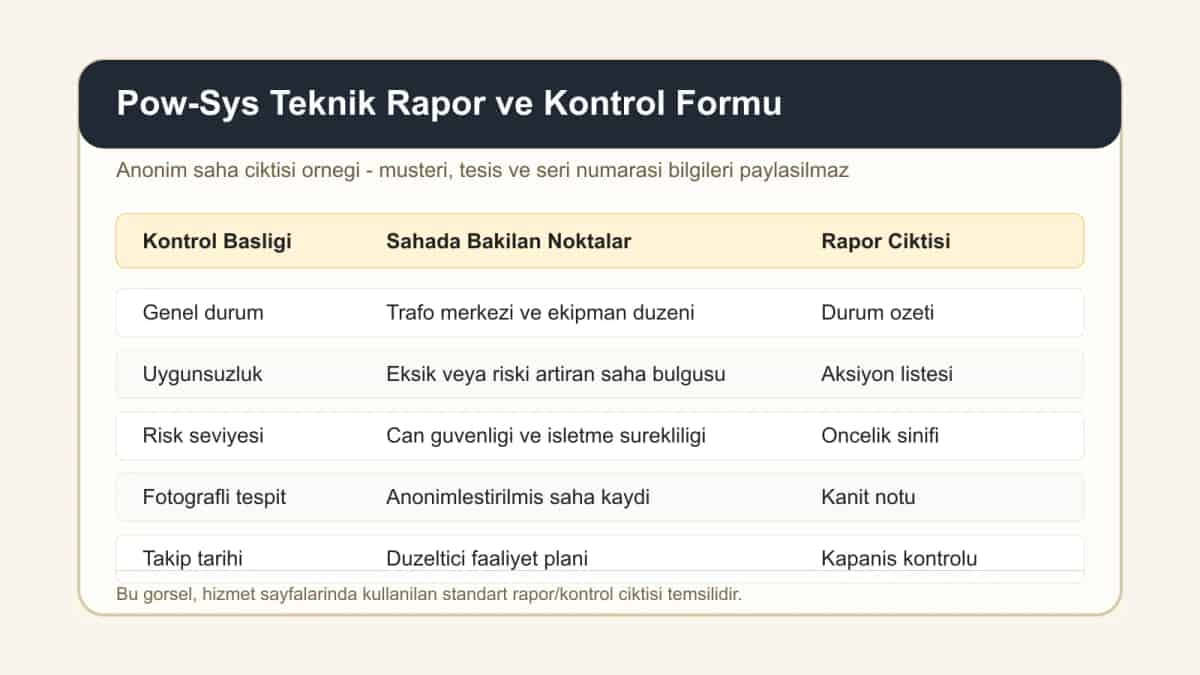
This table summarizes which headings are evaluated on site and which outputs may appear in the report.
| Inspected area | Checked criterion | Report output |
|---|---|---|
| Site and equipment condition | Existing equipment structure, access conditions, visible risks and operating conditions | Site inspection note and prioritized findings list |
| Document and project conformity | Single-line diagram, current project, labeling, reports and conformity with site implementation | Document conformity assessment and missing record list |
| Safety and operational risk | Life safety, equipment safety, energy continuity and maintenance access risk headings | Risk classification and corrective action recommendations |
| Measurement, test or inspection need | Measurement, test, visual inspection and technical review items required by the service scope | Measurement/test plan or inspection scope note |
| Reporting and follow-up | Nonconformity priority, follow-up date, responsibility allocation and next steps | Photo-supported report, action list and follow-up recommendation |
Installation Inspection Scope and Separate Work
The installation checks, measurements and report specified in the inspection proposal belong to this service. Additional systems and physical corrections are evaluated separately.
| Work item | Relationship to the service | Scope decision |
|---|---|---|
| Agreed installation inspection and measurements | Visual inspection, continuity, insulation, protective-device and grounding checks follow the applicable criteria and agreed scope. | Required measurements and nonconformities are recorded in the inspection report. |
| Additional equipment or specialist tests | Systems and examinations outside the agreed inspection inventory may require a separate visit or method. | Additional test scope and reporting are clarified before work begins. |
| Repair, replacement and installation revision | Physical correction requires materials, labour and safe implementation planning. | The inspection identifies the need; corrective work is quoted separately. |
Official Regulatory Sources
- EMO certificate verification portal
Claim supported on this page: EMO registration, SMM and certificate verification transparency.
- TEDAŞ official website
Claim supported on this page: Distribution infrastructure, project/acceptance processes and technical specification context.
- TEİAŞ official website
Claim supported on this page: Transmission system, connection and high-voltage infrastructure context.
- Electrical High Current Installations Regulation
Claim supported on this page: Installation, operation, maintenance and safety of high-current electrical installations.
Frequently Asked Questions
What is electrical installation periodic inspection? What is the difference from periodic examination?
Electrical installation periodic inspection is the technical examination at defined intervals of main and sub-panels, conduit and cable routes, lighting and socket circuits, protective grounding and equipotential installation inside buildings and facilities. Periodic examination is an official inspection that reveals whether the installation is safe through independent measurements, tests and visual checks. Maintenance covers repair, tightening, cleaning and material replacement and does not replace the periodic inspection report.
What is the electrical installation periodic inspection regulation?
The legal basis of the regulation commonly called the electrical installation periodic inspection regulation in the field is the Regulation on Health and Safety Conditions in the Use of Work Equipment dated 25.04.2013 and numbered 28628. This regulation defines inspection intervals, who can perform inspections and the minimum content of reports. The Electrical Internal Installations Regulation, TS EN/HD 60364 series standards and manufacturer instructions determine test methods and measurement criteria.
For which installations and equipment is inspection mandatory?
Electrical installation periodic inspection covers the main distribution panel, sub-panels, cable and busbar systems, concealed and surface-mounted conduit routes, cable trays, lighting and socket circuits, motor supply circuits, protective conductors, residual current devices, equipotential bars and their connections. Other electrical-group work equipment such as transformers, MV switchgear, generators, UPS and batteries also have periodic examination obligations, but this page focuses on electrical installation and conformity inspections.
Why are electrical installation inspections vital?
Problems such as loose connections, overheated cables and busbars, incorrectly selected protection devices, damaged insulation or insufficient grounding can seriously increase the risk of electric shock, arc flash and fire. Periodic inspections detect these risks early and allow corrective actions to be planned.
How often should electrical installations be inspected?
According to the Regulation on Health and Safety Conditions in the Use of Work Equipment, electrical installations must be inspected once a year unless applicable standards specify otherwise. In practice, most businesses in Bursa perform this inspection once a year. In humid, dusty, chemically exposed or explosive atmosphere facilities, the interval should be considered more frequently with the risk assessment and manufacturer recommendations.
Is an electrical installation conformity report mandatory and how long is it valid?
An electrical installation conformity report shows that a newly installed or extensively revised electrical installation has been installed according to the project, regulations and standards, and it is effectively required in new facility and permit processes. Its practical validity is until the next periodic inspection period; since electrical installations must be inspected at least once a year, safety must be documented with regular reports.