
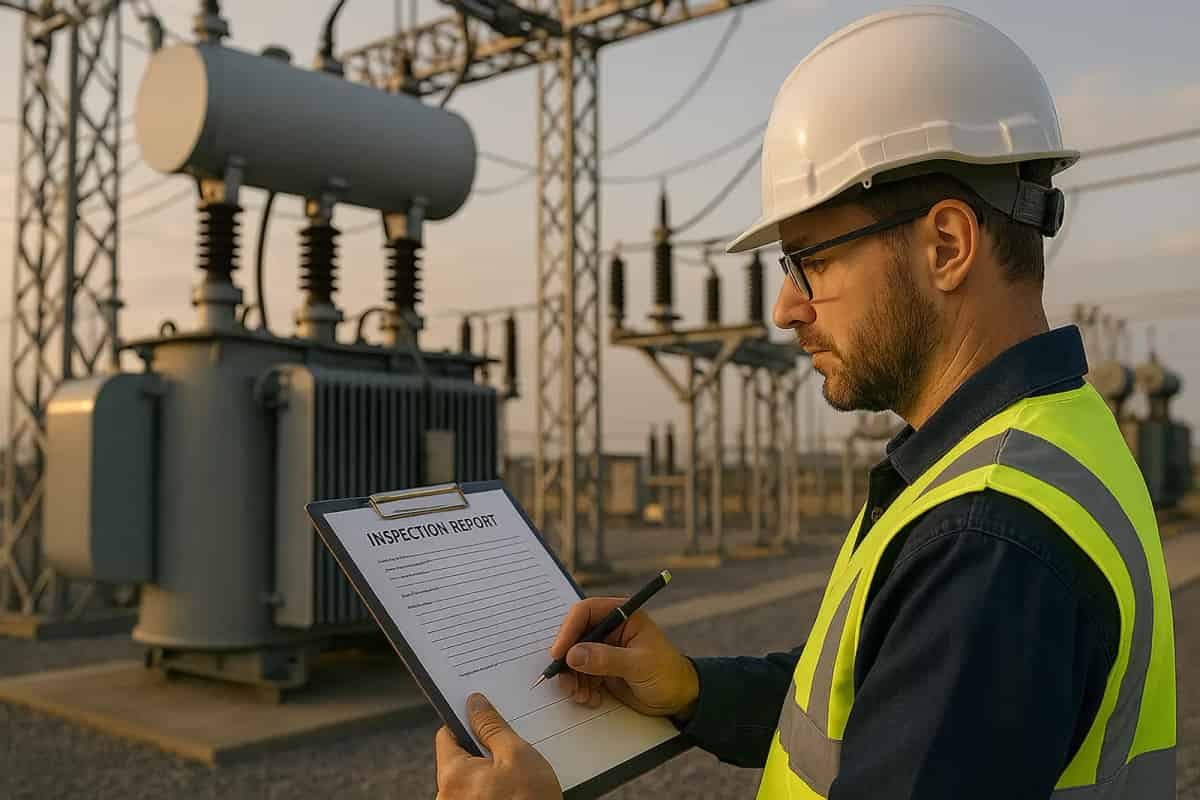
Last updated: September 9, 2026
Reviewed by Hüseyin ÇOKAL, Electrical and Electronics Engineer. Updated: September 9, 2026.
What changed: Service scope, report outputs, official sources, pre-proposal information and technical transparency notes were reviewed for the current period.
Bursa Transformer Periodic Inspection and Testing Summary
- Bursa transformer periodic inspection covers visual examination, electrical testing, transformer oil checks for oil-immersed units and diagnostic measurements where required for MV/LV power and distribution transformers, transformer rooms, MV switchgear, grounding installations and cable-busbar connections: the whole substation assessed as one safety scope
- Transformer periodic inspection is a mandatory periodic examination activity that must be performed once a year unless applicable standards specify otherwise for electrical installations, grounding systems, lightning protection systems, batteries, transformers and similar electrical equipment under the Regulation on Health and Safety Conditions in the Use of Work Equipment: your legal obligation met with the correct engineer-signed document
- In HV transformer periodic inspection, tests such as TTR, winding resistance, insulation resistance, grounding continuity, thermal imaging, oil dielectric strength and, where required, dissolved gas analysis (DGA) are planned according to site conditions: hidden internal faults surface in a test, not in a breakdown
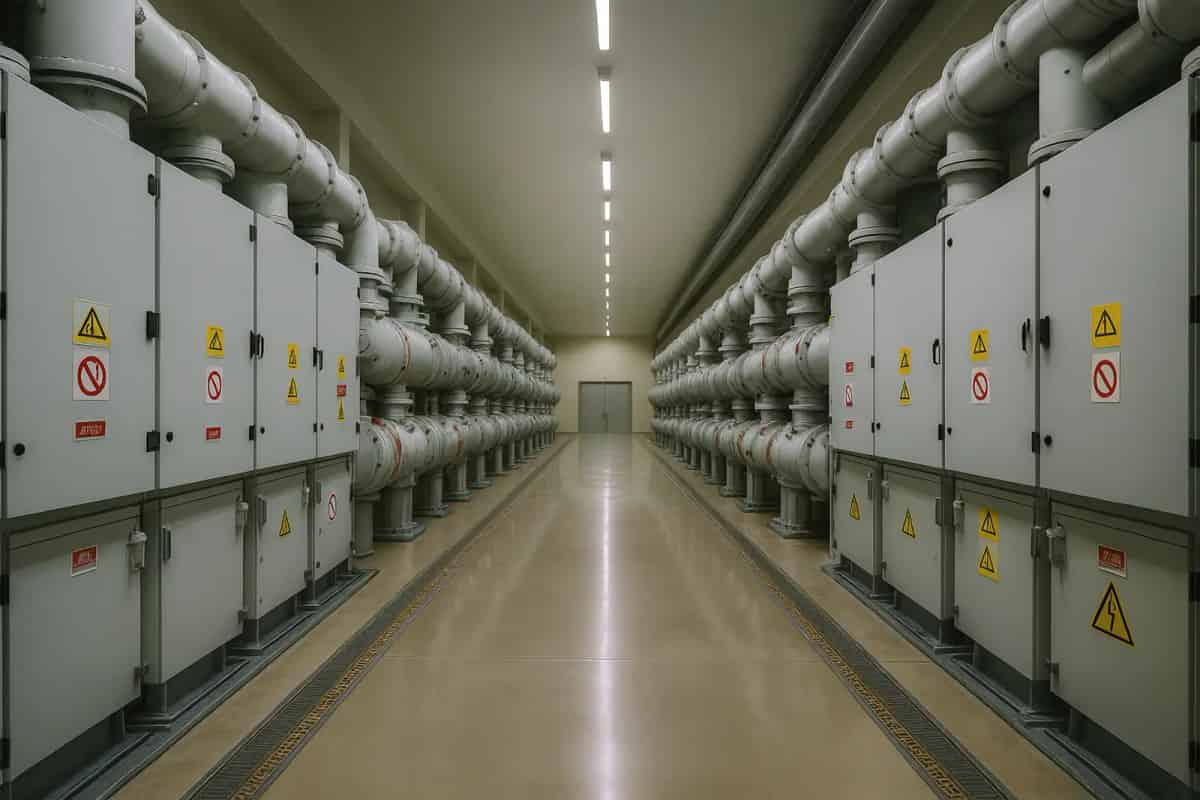
- Transformer room inspection evaluates ventilation, fire safety, oil collection arrangements, escape routes, locked doors, warning signs, barriers, MV switchgear, cable ducts and equipotential bonding as a single safety scope: life-safety gaps reach you in writing with priorities
- We provide transformer examination and reporting services for Nilufer OSB, NOSAB, DOSAB, Kestel, Gursu, Inegol, Hasanaga, Kayapa, Demirtas, TOSAB, Bursa Free Zone, factories, shopping centers, hospitals, hotels, business centers, logistics warehouses and public facilities in Bursa: the inspection program aligned with your outage tolerance
- We plan transformer periodic inspections together with electrical installation, grounding, lightning protection, generator, UPS and battery periodic inspections to provide a traceable electrical inspection package compatible with EKİPNET records and OHS-KATIP processes: one period, one supplier, one consistent audit file
Technically reviewed by
Bursa Transformer Periodic Inspection and Testing Scope
What is transformer periodic inspection in Bursa
Transformer periodic inspection is the process of examining and testing a facility's MV/LV power and distribution transformers, transformer room or transformer substation, transformer grounding installation and related MV/LV equipment at defined intervals according to the relevant legislation and standards. In practice, this service is referred to by different names such as transformer periodic inspection, transformer periodic examination, transformer room periodic inspection, transformer grounding installation periodic inspection, high-voltage transformer periodic inspection, transformer periodic tests or transformer periodic inspection report. The common purpose of all these terms is to verify that the transformer operates safely, continuously and in compliance with regulations.
Transformer inspection and maintenance are different
Periodic inspection and periodic examination refer to the inspections, experiments and tests performed at defined intervals to determine whether work equipment endangers occupational health and safety. Transformer periodic inspection should not be confused with classic transformer maintenance services. Periodic maintenance covers operating and service activities mostly based on manufacturer recommendations, such as oil and filter replacement, connection tightening, cleaning and tap changer maintenance. Periodic inspection and examination, often mentioned under the heading of transformer periodic maintenance and inspection, is an independent test and examination activity required by the Regulation on Health and Safety Conditions in the Use of Work Equipment, and an official transformer periodic inspection report is issued at the end. Maintenance alone does not replace this report.
Legal basis and inspection interval
According to the relevant regulations, electrical installations, grounding systems, lightning protection systems, batteries, transformers and similar electrical equipment must be periodically inspected at least once a year. Therefore, unless a shorter period is defined in the standards or manufacturer instructions, the transformer periodic inspection interval is accepted as a maximum of one year. Regular transformer checks and measurements by authorized electrical/electronics engineers aim to reduce damage, fire and electric shock risks that may arise from lack of supervision and uncontrolled operation. In high-risk facilities where the probability of failure or fire is critical, such as hospitals, data centers and energy-intensive industrial facilities, the inspection interval should be shortened with interim checks.
Which transformers and substations are inspected
Our Bursa transformer periodic inspection service covers MV/LV power transformers, distribution transformers, oil-immersed and dry-type transformers, indoor and outdoor transformer substations, compact transformer substations and MV switchgear. Within this scope, transformer tank and protection equipment, tap changer, MV/LV busbar and cable connections, transformer grounding and equipotential system, transformer room architecture and ventilation are evaluated as a whole; high-voltage transformer periodic inspection tests are planned according to the site.
Site preparation and document review
Before arriving on site, transformer single-line and detailed projects, nameplate data, previous transformer inspection reports, commissioning tests, maintenance contracts, fault records and high-voltage operation responsibility contracts are reviewed. By considering the facility's power structure, redundant transformer-generator scenarios, short outage tolerances and operating conditions, a site-specific inspection plan is prepared for transformer periodic inspection.
Visual and mechanical examination
During visual and mechanical examination, the transformer tank, conservator and expansion tank, radiators, cooling fans, bushings, connection clamps, tap changer mechanism, oil level and possible oil leaks, and corrosion conditions are checked. The wall and floor structure of the transformer room, locked doors, barriers, physical condition of MV switchgear, cable ducts, lighting, emergency exits and warning signs are also reviewed; deficiencies affecting life safety are noted with priority according to visual inspection criteria.
Electrical tests and diagnostic measurements
During electrical testing, the correctness of primary-secondary winding ratios is checked with the TTR test, winding integrity and connection quality are evaluated with winding DC resistance tests, and insulation levels between windings and between winding-earth are determined by insulation resistance measurements. In transformers where required, possible hidden faults are detected early through transformer oil dielectric strength tests, dissolved gas analysis (DGA), partial discharge checks, infrared thermal imaging, high-voltage withstand tests and no-load or load-loss tests under suitable conditions.
Transformer grounding installation checks
In transformer grounding installation periodic inspection, transformer body grounding, MV switchgear grounding, neutral point grounding, protective conductors and equipotential bars are checked. Grounding continuity measurements and, when required, soil resistivity measurements are performed to ensure that touch and step voltages remain within limit values. The application is carried out according to methods specified in the relevant TS EN grounding and power transformer standards and criteria in the Regulation on Health and Safety Conditions in the Use of Work Equipment; results are included in the transformer grounding installation periodic inspection report.
Transformer room and fire safety
Within transformer room periodic inspection, natural and/or mechanical ventilation capacity, temperature values, oil pit and oil collection arrangements, fire resistance of cabling and cable penetrations, presence of fire detection and extinguishing systems, emergency lighting and emergency stop buttons, distances between MV switchgear and transformer and barriers are examined. Thus, electrical risks and fire / explosion risks are evaluated holistically.
Transformer periodic inspection report
The transformer periodic inspection report consists of inspection date, transformer substation and facility information, transformer brand/model and rating, brand/model and calibration information of test devices used, visual and mechanical examination results, measured electrical values such as TTR, insulation resistance, winding resistance and grounding values, additional tests performed, detected nonconformities and their severity levels, and conclusion-recommendations. The report is prepared in accordance with the mandatory periodic inspection report format and criteria published by the Ministry of Labor and Social Security for electrical-group work equipment and is signed by the relevant engineer so that it can be used in official audits.
Classification of nonconformities and follow-up plan
Nonconformities detected during inspection are evaluated in terms of life safety, fire risk, energy continuity, regulatory compliance and maintenance needs. Findings that create critical risk are reported with priority, corrective action recommendations are written clearly, and a practical action list is created so the business can follow maintenance, repair or renewal decisions.
Authorized personnel and EKİPNET registration
Transformer periodic inspection requires an authorized person with the relevant qualifications and an EKİPNET registration. For mandatory inspections, the employer and authorized inspector must approve an İSG-KATİP contract at least one day beforehand. Keep the signed inspection report with the facility records; a registration number alone does not replace qualification and contract requirements.
Choosing a qualified inspection provider
When choosing among transformer periodic inspection companies in Bursa, you should consider not only price, but also the authorized inspector's EKİPNET registration status, the report format's conformity with the criteria specified in the regulation for electrical-group work equipment, calibration certificates of the test devices used, referenced organized industrial zones and facilities, and the ability to provide transformer maintenance, testing and high-voltage operation responsibility services together when necessary.
Service scope in Bursa
We plan Bursa transformer periodic inspection works for production facilities, energy-intensive factories, shopping centers, hospitals, hotels, business centers, logistics warehouses and public facilities, especially in Nilufer OSB, NOSAB, DOSAB, Kestel, Gursu, Inegol, Hasanaga, Kayapa, Demirtas, TOSAB and Bursa Free Zone. The inspection program is prepared according to the facility's production schedule and tolerance for energy interruption.
How pricing is determined
Bursa transformer periodic inspection pricing is determined according to the number of transformers, transformer rating, oil-immersed or dry-type design, number of MV switchgear cubicles, number of transformer rooms, facility location, requested test scope, need for oil analysis and thermal imaging, reporting language and site working conditions. After the single-line diagram, transformer nameplate data and previous inspection reports are reviewed, comprehensive or narrower proposal options can be prepared. Scope is clarified from this information, and before signing you see in writing what is included and what is planned as a separate service.
Integrated transformer inspection plan in Bursa
We can plan Bursa transformer periodic inspection services in an integrated manner with regular transformer maintenance, high-voltage operation responsibility, transformer maintenance and operation contracts, MV/LV panel maintenance and your other electrical periodic inspections. In this way, production outage times are reduced and all critical equipment such as transformers, generators, electrical installations, grounding and lightning protection installations can be inspected in the same period.
Related electrical periodic inspections
You can plan transformer periodic inspection together with your other electrical periodic inspections when needed. For detailed information, you can also review our Bursa electrical installation periodic inspection, Bursa grounding installation periodic inspection, Bursa lightning protection periodic inspection, Bursa generator periodic inspection, Bursa battery periodic inspection and, for detailed maintenance-test content, our Bursa transformer maintenance and testing services pages.
Reporting, Inspection and Proposal Preparation
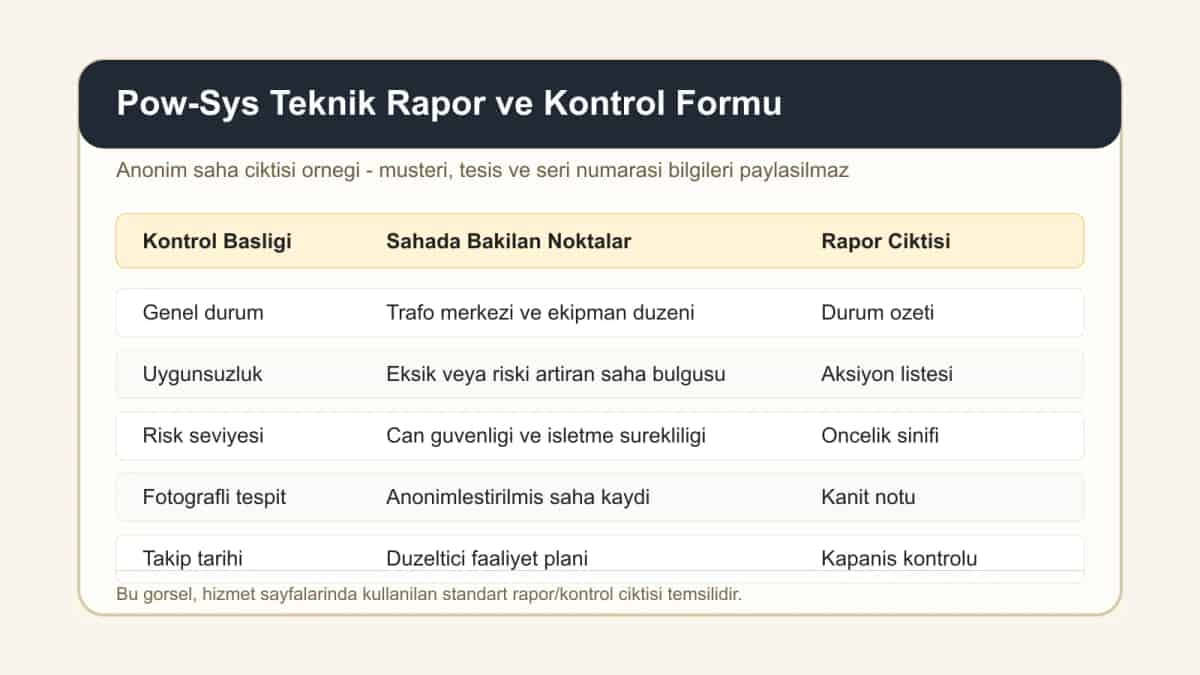
Sample Inspection Table
This table summarizes which headings are evaluated on site and which outputs may appear in the report.
| Inspected area | Checked criterion | Report output |
|---|---|---|
| Site and equipment condition | Existing equipment structure, access conditions, visible risks and operating conditions | Site inspection note and prioritized findings list |
| Document and project conformity | Single-line diagram, current project, labeling, reports and conformity with site implementation | Document conformity assessment and missing record list |
| Safety and operational risk | Life safety, equipment safety, energy continuity and maintenance access risk headings | Risk classification and corrective action recommendations |
| Measurement, test or inspection need | Measurement, test, visual inspection and technical review items required by the service scope | Measurement/test plan or inspection scope note |
| Reporting and follow-up | Nonconformity priority, follow-up date, responsibility allocation and next steps | Photo-supported report, action list and follow-up recommendation |
Transformer Inspection Scope and Separate Work
The transformer inspection, required measurements and reporting identified in the proposal belong to this service. Maintenance and repairs remain separate from the statutory inspection.
| Work item | Relationship to the service | Scope decision |
|---|---|---|
| Agreed transformer inspection and measurements | Transformer, room and grounding checks follow the inspection criteria and selected test plan. | Required measurements and findings are recorded in the periodic-inspection report. |
| Additional diagnostic or laboratory tests | Further examinations may be indicated by transformer condition and inspection findings. | Tests beyond the agreed inspection scope and their reporting are clarified separately. |
| Maintenance, oil treatment and replacement | Corrective work may require materials, specialist maintenance and outage planning. | Maintenance and repairs are quoted separately and do not replace the inspection report. |
Official Regulatory Sources
- EMO certificate verification portal
Claim supported on this page: EMO registration, SMM and certificate verification transparency.
- TEDAŞ official website
Claim supported on this page: Distribution infrastructure, project/acceptance processes and technical specification context.
- TEİAŞ official website
Claim supported on this page: Transmission system, connection and high-voltage infrastructure context.
- Electrical High Current Installations Regulation
Claim supported on this page: Installation, operation, maintenance and safety of high-current electrical installations.
Frequently Asked Questions
What is transformer periodic inspection and why is it performed?
Transformer periodic inspection is the visual, mechanical and electrical testing of power and distribution transformers, transformer room and transformer grounding installation at defined intervals according to the relevant legislation and TS EN standards. The aim is to verify that the transformer, which ensures energy continuity, operates safely and in compliance with regulations, and to reduce risks such as failure, fire and electric shock.
What is the transformer periodic inspection interval?
According to the Regulation on Health and Safety Conditions in the Use of Work Equipment, electrical installations, grounding installations, lightning protection installations and electrical installations such as accumulators and transformers must be inspected at least once a year. If the relevant TS EN standards define a shorter period, that period is taken as the basis. Therefore, under normal conditions, the maximum transformer periodic inspection interval is one year.
Is transformer periodic inspection mandatory?
Yes. Transformer periodic inspection is mandatory under Law No. 6331 on Occupational Health and Safety and the Regulation on Health and Safety Conditions in the Use of Work Equipment. Transformers are included among electrical-group work equipment subject to periodic inspection and must be inspected once a year unless applicable standards specify otherwise according to the principles specified in the mandatory report format and criteria published by the Ministry of Labor and Social Security.
Who can perform transformer periodic inspection?
Transformer periodic inspection must be performed by persons authorized to perform periodic inspections of work equipment, generally electrical or electrical-electronics engineers registered in the EKİPNET system, or by accredited inspection bodies. The EKİPNET registration number and required professional qualifications of the engineer signing the report are important for acceptance in official audits.
Which tests and measurements are performed?
Depending on the facility, visual and mechanical examination of transformer tank, radiators, bushings, tap changer and connections; TTR test, winding DC resistance tests, insulation resistance measurements, grounding continuity and earth resistance measurements, transformer oil dielectric strength and DGA tests when required, thermal camera checks, high-voltage withstand tests and no-load / short-circuit loss tests may be performed.
What does the transformer periodic inspection report include, and is it valid in official audits?
The report includes facility and transformer information, inspection date, test device and calibration information, visual and mechanical checks, measured electrical values such as TTR, insulation resistance and grounding values, additional tests, detected nonconformities and severity levels, and conclusion-recommendations. When signed by an authorized engineer and prepared in accordance with legislation, it is accepted as a supporting document in official audits.
What is the difference between transformer periodic inspection and maintenance?
Transformer maintenance covers service activities such as oil, filter and gasket replacements, connection tightening, cleaning and tap changer maintenance based on manufacturer recommendations. Transformer periodic inspection is an independent examination, testing and reporting activity that must be performed at least once a year under the regulations. Maintenance helps prevent faults and extend service life, but it does not replace the periodic inspection report.
Is there a difference between dry-type and oil-immersed transformers?
The basic principles are similar: both require visual examination, electrical tests, grounding and transformer room safety assessment. In oil-immersed transformers, oil dielectric strength, oil level, oil leakage and DGA are critical; in dry-type transformers, dust on windings, blockage of air ducts and temperature rises become more prominent.
How are Bursa transformer periodic inspection prices determined?
The price is determined according to the number of transformers, rating and type of each transformer, number of transformer rooms, number of MV switchgear cubicles, facility location, requested test scope such as basic measurements only or inclusion of oil/gas analysis and thermal camera tests, and report language. Different proposal scenarios can be created after site survey or project review.
What should I consider when choosing a transformer inspection company in Bursa?
You should check whether the authorized inspector is registered in EKİPNET, whether the report format complies with the criteria published by the Ministry for electrical-group work equipment, calibration certificates of test devices, whether EMO-member electrical / electrical-electronics engineers are involved and the referenced organized industrial zones, factories and facilities.
How can I use transformer reports in EKİPNET and OHS-KATIP processes?
EKİPNET records the authorized inspector, while İSG-KATİP is used for the required inspection contract. For mandatory inspections, both parties must approve that contract at least one day beforehand. Keep the signed transformer inspection report with the facility records; your occupational safety specialist can use its findings in risk assessment and corrective-action planning.