
Last updated: September 9, 2026
Reviewed by Hüseyin ÇOKAL, Electrical and Electronics Engineer. Updated: September 9, 2026.
What changed: Service scope, report outputs, official sources, pre-proposal information and technical transparency notes were reviewed for the current period.
Bursa Transformer Maintenance and Testing Summary
- Transformer maintenance, periodic maintenance, routine tests, measurements, maintenance forms and detailed condition assessment reports for power and distribution transformers in Bursa: transformer health tracked on record, not on memory
- Field transformer tests such as TTR (turns ratio) test, winding DC resistance, insulation (megger) test, short-circuit impedance, load and no-load losses, power factor / tan-delta, magnetic balance and vector group checks: winding and insulation problems caught while they are still repairable
- Transformer oil testing and oil analysis according to IEC/ASTM standards, including DGA, dielectric strength, moisture, acidity, color and furanic compounds, with a technical roadmap for oil treatment, oil regeneration and mobile oil processing solutions: internal faults surface in the lab before they surface as a breakdown
- Transformer acceptance tests, testing and commissioning procedures (FAT/SAT), current / voltage transformer tests, protection relay secondary / primary tests and MV switchgear function checks after factory tests for new or renewed transformers: reference values recorded so future ageing can be measured
- Transformer fault maintenance and repair, transformer repair in Bursa, on-site mobile repair service, hermetic distribution transformer and dry-type transformer repair-maintenance, bushing and gasket replacement, oil leak elimination, cooling system and OLTC maintenance: most faults resolved on site, downtime kept short
- Integrated solutions for MV transformer maintenance-repair, transformer service and HV/MV tests, including transformer measurements, grounding and touch voltage tests, thermal camera infrared checks and Bursa HV/MV testing, maintenance and repair services: the transformer and its MV environment tested as one system
- As a Bursa transformer maintenance company and service provider, we offer contracted transformer maintenance, periodic maintenance and project-based maintenance-repair solutions in Bursa center, Nilufer OSB, DOSAB, Hasanaga, Kayapa, Kestel, Gursu, Inegol OSB and similar regions: maintenance dates managed for you under contract
Technically reviewed by
Bursa Transformer Maintenance and Testing Scope
What is transformer maintenance and testing service in Bursa
We provide transformer maintenance, transformer tests, transformer oil analysis, fault maintenance-repair and transformer testing-commissioning services for industrial facilities, factories in organized industrial zones, power generation-distribution facilities and large buildings using power and distribution transformers in Bursa. As a Bursa transformer maintenance company and transformer service provider, our aim is to ensure safe and efficient transformer operation, reduce unplanned outages and detect faults before they occur through a predictive maintenance approach.
How it differs from transformer operation responsibility
While transformer operation responsibility service covers regulation-compliant operation, record follow-up and signing responsibility, the Bursa transformer maintenance, testing and repair services described on this page cover periodic maintenance, electrical tests, transformer oil testing and analysis, transformer measurements, fault maintenance and MV transformer maintenance-repair works directly related to the transformer itself. The two services complement each other but their scopes and responsibility areas are different.
Why transformer maintenance is necessary
Transformer maintenance is required to keep the ageing insulation system, loosening connection points and transformer oil losing its properties under control against heating-cooling cycles, short circuits, impulse voltages, mechanical stresses and environmental effects. If regular maintenance and routine tests are not performed, serious risks such as internal faults, dielectric breakdown of oil, busbar and terminal burns, circuit breaker trips and even fire may occur. Therefore, electrical transformer maintenance is an inseparable part of periodic inspection obligations under Law No. 6331 and the Regulation on Health and Safety Conditions in the Use of Work Equipment.
Site survey and existing condition assessment
We begin with a site survey and existing condition assessment. Transformer type (oil-immersed or dry-type), rating, voltage level, brand, age, connected MV switchgear arrangement, protection-measurement relays, cable supplies and previous transformer maintenance and test reports are reviewed. When required, factory routine tests and previous acceptance tests are also reviewed, the scope of electrical tests to be applied in the field is clarified and a maintenance program suitable for outage windows is prepared.
Electrical transformer tests
Our routine transformer test package includes the main electrical tests answering the question of which transformer tests are performed: TTR (turns ratio) test, winding DC resistance measurement, insulation (megger) test, and where required, power factor / tan-delta, short-circuit impedance, load and no-load loss measurements, magnetic balance and vector group checks. With these tests, winding faults, contact problems, connection errors, insulation weaknesses, unbalanced loading and installation-related errors are detected at an early stage.
Dry-type and oil-immersed transformer checks
There are some differences between routine tests applied to dry-type transformers and oil-immersed transformers. In dry-type transformers, partial discharge, surface contamination, temperature rise and air-channel cleanliness come to the fore; in oil-immersed transformers, additional parameters such as oil dielectric strength, moisture in oil and cellulose insulation condition are checked. Within this framework, power transformer tests and distribution transformer tests are planned separately; special steps are defined when dry-type transformer repair-maintenance or hermetic distribution transformer maintenance is required.
Integration with MV switchgear, relay and cable tests
Transformer electrical tests should be considered together with the protection system and cables on the MV side. Therefore, when necessary, MV switchgear tests, circuit breaker and disconnector checks, protection relay secondary / primary tests, cable insulation tests, grounding resistance and touch voltage measurements are planned as a single package for the transformer substation. HV transformer tests and commissioning steps before energization are carried out in an integrated manner with our HV/MV testing, maintenance and repair service.
Transformer oil testing and DGA analysis
In oil-immersed transformers, transformer oil testing and oil analysis are among the most critical predictive maintenance tools that provide information about internal health. Oil samples are taken according to IEC/ASTM standards and parameters such as dissolved gas analysis (DGA), breakdown voltage (BDV), moisture, acidity (TAN), color, sludge tendency and, when required, furanic compounds are examined. Thus, arcing, partial discharge, overheating, cellulose aging and insulation damage that is difficult to reverse can be detected at an early stage even when the transformer appears normal from outside.
Oil treatment, regeneration and mobile oil processing
According to transformer oil test and oil analysis results, actions such as oil treatment, oil regeneration, complete oil replacement, elimination of oil leaks or reassessment of the loading profile are recommended. With mobile oil treatment devices, oil processing can be carried out on site; in this way, the electrical and chemical properties of transformer oil can be improved without removing the transformer from the field. When oil analysis trends are followed over years, the maintenance interval can be optimized with numerical data.
Mechanical and visual checks
During mechanical and visual checks, the transformer tank, expansion tank, radiators, connection bolts, terminals, MV/LV busbars, cable terminations and joints, bushings, tap changer and cooling fans/pumps are examined in detail. Points with abnormal temperature rise observed during infrared scans with a thermal camera may indicate loose connection, overload, unbalanced phase current or internal fault. The practical answer to how a faulty transformer is detected is the combined evaluation of these measurements, tests and observations; when required, tightening, cleaning, oxide removal, improvement of insulation distances and part replacement are performed on site.
Transformer fault repair and on-site service
Transformer fault maintenance-repair works cover many items such as elimination of oil leaks, gasket and bushing replacements, tap changer maintenance and setting, renewal of cooling fans/pumps, revision of circuit breakers and disconnectors in MV switchgear, and cleaning of transformer cabinets and panels. In cases with heavy winding damage or comprehensive oil processing needs, transformer repair, winding renewal, oil treatment / oil regeneration and workshop tests are organized together with partner workshops; field and laboratory results are evaluated together.
Acceptance tests and commissioning
In new transformer substation investments or capacity increase projects, we work together with our LV/MV/HV project design and consultancy team for transformer selection, MV switchgear and cable projects, protection relay coordination, factory tests, field acceptance tests, testing and commissioning steps and energization scenarios. Electrical tests performed during first commissioning create reference values for future periodic maintenance, measurements and tests and allow the aging curve of the equipment to be monitored numerically.
Maintenance planning and production outage management
When planning transformer maintenance, production outages, maintenance windows, shift order, number of transformers and criticality of the facility are evaluated together. Some checks are performed while energized, such as online measurements and thermal scans, while comprehensive electrical tests are performed after the transformer is safely de-energized. Thus, occupational safety rules are followed and transformer maintenance intervals become compatible with production plans of facilities in Bursa. Contracted maintenance, periodic programs and emergency response services can be configured together when needed.
Transformer maintenance and test report
All measurement and test results are delivered as a technical transformer maintenance and test report together with the devices used, reference / limit values, photographs and thermal images when required. The report clearly states tests performed, detected nonconformities, recommended corrective-preventive actions and parameters to be followed. These reports and the transformer maintenance / test forms used can serve as technical references in your electrical installation periodic inspection and other examination files. A maintenance-test report does not replace the separate statutory periodic inspection report.
How the transformer maintenance interval is determined
The transformer maintenance interval is determined according to transformer rating, loading profile, environmental conditions, facility criticality, previous faults and test results. The general approach is to perform comprehensive transformer maintenance and routine tests at least once a year for power and distribution transformers, and to monitor the condition with intermediate oil analyses and control measurements when required. If desired, this continuity can be managed by integrating it with transformer operation responsibility and HV operation responsibility contracts.
How Bursa transformer maintenance prices are determined
The service fee is determined project-specifically according to the number and rating of transformers, whether they are oil-immersed or dry-type, requested test scope such as routine tests, acceptance tests, oil tests, MV switchgear and cable tests, time to be spent on site, special test equipment to be used and facility location. In Bursa and nearby regions, especially Nilufer OSB, DOSAB, Hasanaga, Kayapa, Kestel, Gursu and Inegol OSB, we perform site surveys and provide clear, understandable and comparable proposal options for transformer maintenance-repair, transformer repair in Bursa and testing-commissioning. Scope is clarified from this information, and before signing you see in writing what is included and what is planned as a separate service.
Reporting, Inspection and Proposal Preparation
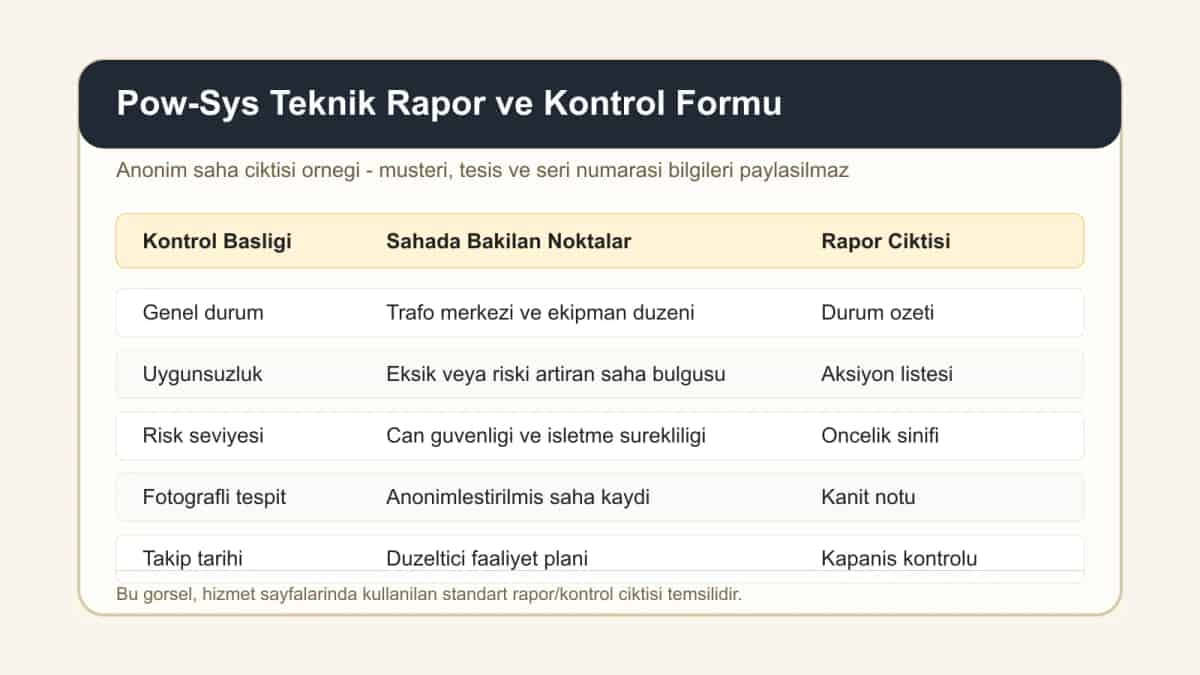
Sample Inspection Table
This table summarizes which headings are evaluated on site and which outputs may appear in the report.
| Inspected area | Checked criterion | Report output |
|---|---|---|
| Site and equipment condition | Existing equipment structure, access conditions, visible risks and operating conditions | Site inspection note and prioritized findings list |
| Document and project conformity | Single-line diagram, current project, labeling, reports and conformity with site implementation | Document conformity assessment and missing record list |
| Safety and operational risk | Life safety, equipment safety, energy continuity and maintenance access risk headings | Risk classification and corrective action recommendations |
| Measurement, test or inspection need | Measurement, test, visual inspection and technical review items required by the service scope | Measurement/test plan or inspection scope note |
| Reporting and follow-up | Nonconformity priority, follow-up date, responsibility allocation and next steps | Photo-supported report, action list and follow-up recommendation |
Maintenance-Test Scope and Separate Inspection Work
Transformer maintenance, electrical tests and oil analysis specified in the proposal belong to this service. Statutory periodic inspection and repairs outside the agreed scope are evaluated separately.
| Work item | Relationship to the service | Scope decision |
|---|---|---|
| Transformer maintenance, testing and oil analysis | Performed according to transformer type, condition and the agreed test plan. | Measured values, analysis and maintenance findings are recorded in the technical maintenance-test report. |
| Statutory periodic inspection | Requires its own authorization, contract and inspection criteria. | Where required, a separate inspection scope and report are prepared. |
| Additional replacement or installation work | Findings may require materials, labour and outage planning. | Additional work and cost are clarified before implementation. |
Official Regulatory Sources
- EMO certificate verification portal
Claim supported on this page: EMO registration, SMM and certificate verification transparency.
- TEDAŞ official website
Claim supported on this page: Distribution infrastructure, project/acceptance processes and technical specification context.
- TEİAŞ official website
Claim supported on this page: Transmission system, connection and high-voltage infrastructure context.
- Electrical High Current Installations Regulation
Claim supported on this page: Installation, operation, maintenance and safety of high-current electrical installations.
Frequently Asked Questions
How often should transformer maintenance be performed? Is it mandatory?
Maintenance intervals depend on manufacturer instructions, loading, environmental conditions and previous findings. There is no single maintenance interval suitable for every transformer. Statutory periodic inspection is a separate obligation with its own authorization, scope and reporting requirements; maintenance does not replace it.
Who can perform transformer maintenance?
Transformer maintenance should be performed by electrical / electrical-electronics engineers experienced in high voltage and trained technical teams who know the relevant standards and regulations and can work with suitable test devices. For MV transformers, working under the supervision of EMO-registered authorized engineers is important for both safety and official reporting.
Which transformer tests are performed?
The main electrical transformer tests we apply in the field are TTR (turns ratio), winding DC resistance, insulation (megger), power factor / tan-delta when required, short-circuit impedance, load and no-load loss measurements, vector group and magnetic balance checks, and partial discharge monitoring. Depending on the project, MV switchgear tests, protection relay tests, cable insulation tests, grounding resistance-touch voltage measurements and commissioning steps can also be included.
Why are transformer oil testing and DGA so important?
Transformer oil is a critical component that provides both insulation and cooling. Oil tests and DGA performed according to IEC/ASTM standards examine dielectric strength, moisture, acidity and gases formed in oil, revealing internal faults such as arcing, partial discharge, overheating and cellulose aging at an early stage. It should be repeated periodically especially in aged transformers, facilities with changing loading profiles or previous oil results approaching limits.
How can a faulty transformer be detected?
Fault indications include abnormal noise, smell or vibration, sudden changes in oil level, oil leakage, bushing cracks, abnormal temperature rise seen on thermal camera, frequent trips of protection relays and decreases in insulation / BDV values. When such signs are observed, the transformer should not be forced to remain energized; a specialist service capable of tests, oil analysis and visual checks should be called.
Can we receive on-site transformer repair service in Bursa?
Yes. We provide on-site fault maintenance-repair and mobile transformer repair service for organized industrial zones and industrial facilities in Bursa. Oil leaks, gasket and bushing problems, loose connections, hot spots, cooling system faults and protection relay setting problems can often be resolved on site with mobile equipment. For more comprehensive damage, workshop repair, oil treatment and additional testing are organized with partner workshops.
What is a transformer maintenance contract?
A transformer maintenance contract is a written agreement in which annual or multi-year maintenance, routine tests, oil tests and required MV switchgear-cable checks are planned in advance for the power and distribution transformers in your facility. Contracted maintenance prevents forgotten inspection dates, meets legal requirements regularly, reduces fault risks and makes budget planning more predictable.
Which acceptance tests and commissioning procedures are applied for a new transformer?
Before energizing a new or renewed transformer, visual and mechanical checks, insulation tests, TTR, winding resistance measurements, load / no-load loss tests, short-circuit impedance measurement, partial discharge checks and, where required, high-voltage withstand tests are performed. In parallel, MV switchgear tests, protection relay tests, grounding and touch voltage measurements are completed. These steps form the field acceptance and commissioning procedure.
What are the differences between dry-type and oil-immersed transformer maintenance?
The overall goal is the same, but the critical checkpoints differ. In oil-immersed transformers, maintenance and testing concentrate on the condition of the oil: dielectric strength, moisture, acidity and dissolved gas analysis, plus oil level, leak elimination, gasket and bushing condition and the cooling circuit. In dry-type transformers there is no oil to analyze, so partial discharge behavior, surface contamination, dust on windings, cleanliness of air channels and temperature rise become the priority items. Test packages are therefore planned separately for each design, and special steps are defined when dry-type transformer repair-maintenance or hermetic distribution transformer maintenance is required. In both cases, TTR, winding resistance and insulation tests remain part of the routine electrical test scope.