

Last updated: September 9, 2026
Reviewed by Hüseyin ÇOKAL, Electrical and Electronics Engineer. Updated: September 9, 2026.
What changed: Service scope, report outputs, official sources, pre-proposal information and technical transparency notes were reviewed for the current period.
Electrical Installation Conformity Report and Periodic Inspection Summary
- Electrical installation periodic inspection covers technical examination of main distribution panels, sub-panels, cable routes, socket and lighting circuits, motor supply lines, protective conductors, residual current devices and equipotential bonding: the whole low-voltage chain checked, not just the panel door
- Within internal installation examination, visual inspection, measurement, function testing and technical assessment are carried out together; the aim is not only to find faults but also to reveal whether the system can be operated safely: you learn how the system behaves in a fault, not just today
- Insulation testing, continuity testing, loop impedance measurement, residual current device trip testing, voltage checks, load assessment and thermal inspection where required are among the core applications: protection devices proven to trip, not assumed to
- Electrical installation conformity report, periodic inspection report, examination report and nonconformity list are prepared together with measurement results, technical findings, risk classes and corrective action recommendations: no finding is left without a documented next step
- A regular inspection approach is important for sustainable electrical safety in factories, warehouses, commercial buildings, offices, hospitals, schools, hotels, shopping centers and production facilities: risks are caught early, before they become outages or fires
- Deficiencies detected during the periodic inspection process are classified as critical, important and improvement-required items and reported in a way that guides the business: you know what to fix first and why
- This page only covers electrical installation inspections; transformer, lightning protection, generator, UPS-battery and other electrical-group equipment inspections can be handled under separate headings: you see exactly what this scope includes before you commit
Technically reviewed by
Electrical Installation Conformity Report and Periodic Inspection Scope
What is electrical installation periodic inspection
Electrical installation periodic inspection is the technical review process that reveals whether the low-voltage distribution system inside a building or facility operates safely, suitably and sustainably. Within this scope, the electrical infrastructure from the main distribution panel to final user circuits is checked, measured and reported at defined intervals. This service is one of the important headings of the general periodic inspection approach focused on electrical infrastructure.
In practice, this service may be called electrical installation periodic inspection, internal installation periodic examination, electrical installation conformity check or electrical installation examination. Although the name may change, the main purpose is the same: to identify electrical risks in advance and contribute to safe operation of the facility.
Legal basis and technical standards
The legal framework for electrical installation periodic inspection is evaluated together with the Regulation on Health and Safety Conditions in the Use of Work Equipment, the Electrical Internal Installations Regulation, the TS EN/HD 60364 series standards and the mandatory periodic inspection report format and criteria published for electrical-group work equipment. This framework requires the inspection to be performed not only by visual review, but also through examination, testing, measurement, function testing and reporting steps.
Which installations and equipment are inspected
Electrical installation consists of main distribution panels, sub-panels, cable and busbar lines, cable trays, conduit installation, junction boxes, socket and lighting circuits, motor supply lines, protective conductors, residual current protection devices and equipotential bonding. Therefore, the inspection process is not limited to opening a panel door and looking visually; the entire system must be evaluated technically.
Periodic inspection and maintenance are different
Periodic inspection and maintenance are not the same thing. Maintenance covers applications such as cleaning, tightening, part replacement or repair. Periodic inspection is an independent technical audit that reveals the conformity status of the existing system through measurement, testing and examination. In other words, performing maintenance does not replace a periodic inspection report.
Why it matters for electrical safety
Electrical installation inspections are critical for occupational safety, fire prevention, equipment protection and production continuity. Connections loosening over time, worn insulation, faulty protection devices, unbalanced loads or insufficient grounding can lead to serious consequences for both life safety and business operation when unnoticed.
The most common risks include overheated panel connections, weak selectivity in the protection structure, faulty or non-functional residual current devices, broken protective conductors, unsuitable cable penetrations and inadequate equipotential bonding. Regular electrical installation inspections allow these problems to be detected before they grow.
Visual inspection and structural review
The periodic examination process is usually carried out in two main stages. In the first stage, visual and structural review is performed. Panel internal layout, labelling, cable cross-sections, placement of protection equipment, connection quality, cable routes, junction boxes, exposed conductor risks and access safety are evaluated.
Function tests and electrical measurements
In the second stage, electrical tests and measurements are applied. Insulation resistance measurements, protective conductor continuity tests, loop impedance checks, residual current device tripping tests, phase-neutral and phase-earth voltage checks, load distribution reviews and thermal observation at necessary points may be included in this stage.
Grounding and equipotential system
Protective grounding and the equipotential system are integral parts of the electrical installation. Therefore, when electrical installation periodic inspection is performed, grounding continuity and the function of protection devices must also be evaluated. It is not enough for a circuit to be energized; that circuit must behave safely during a fault. In buildings where lightning protection integrity is important, it is healthier to evaluate the system together with lightning protection periodic inspection.
Conformity report and periodic inspection report
Conformity assessment has separate importance in newly installed or significantly revised installations. An electrical installation conformity report is prepared to document whether the system has been installed according to the project, technical rules and safe-use conditions. A periodic inspection report is prepared after the existing system is reassessed at defined intervals. In comprehensive revision or new installation processes, proceeding with LV/MV/HV project design and consultancy support is beneficial.
Reporting and nonconformity classification
At the reporting stage, not only measurement results but also what these results mean should be presented clearly. Therefore, a well-prepared electrical installation periodic inspection report should clearly include detected nonconformities, risk levels, recommended corrective actions and points requiring follow-up.
For businesses, these reports are not only technical records. They are also among the main documents referred to in occupational health and safety processes, internal audits, insurance reviews and official inspections. Regular and accurate reporting makes electrical safety management traceable.
How the inspection interval is determined
Electrical installation periodic inspection frequency should be evaluated according to facility usage, environmental conditions, load structure, equipment density and risk level. Especially in humid, dusty, chemically exposed, continuously operating or heavily loaded facilities, a more careful inspection plan is required.
Authorized persons and EKİPNET records
Electrical installation periodic inspections should be carried out by persons who meet the qualifications specified in the legislation and are authorized to perform periodic inspections. The inspection team must understand electrical internal installations, low-voltage distribution, protection arrangements, measurement techniques and report formats. EKİPNET and OHS-KATIP processes should be evaluated together with current legislation, equipment type and the company's occupational safety documentation.
Which buildings need regular inspection
In all buildings where electrical infrastructure is used intensively, such as production facilities, warehouses, commercial buildings, educational institutions, healthcare buildings and multi-storey business centers, regular inspection of the installation is extremely important for reducing faults, lowering fire risk and preserving facility safety. In these buildings, the installation often operates together with transformers, generators and UPS-battery systems, so the electrical infrastructure should be evaluated holistically.
Report format and audit readiness
The periodic inspection report should clearly include the inspections performed, measuring instruments used, measurement results, limit values, photographic findings, nonconformity classes and recommended corrective actions. The purpose of the report is not only to complete a file, but to create a traceable technical record for the occupational safety specialist, business management, maintenance team, insurance reviews and official audits.
Sustainable inspection model
Electrical installation periodic inspection should not be seen as a one-time formality. The correct approach is a sustainable inspection model in which measurement results are compared with previous reports, deficiencies are followed and improvements are planned systematically. In this way, electrical installation safety becomes one of the continuously managed technical topics of the business.
Integrated electrical periodic inspection plan
On site, electrical installation inspection is often connected with grounding installation, lightning protection, generator, UPS-battery, transformer and fire detection systems. Planning electrical installation periodic inspection in the same schedule as other electrical periodic inspections reduces site interruptions, unifies the report set and makes the company's electrical safety management easier to read.
Why expert assessment is required
The main objective in electrical installation inspections is not only regulatory compliance, but also protection of human life, equipment and business continuity. Therefore, every examination must be carried out by specialists who truly understand the site, can read risks and can interpret technical outputs correctly. To receive a proposal, share your facility type, the number of main and sub-panels and, if available, your previous inspection report; scope is clarified from this information, and before signing you see in writing what is included and what is planned as a separate service.
Reporting, Inspection and Proposal Preparation
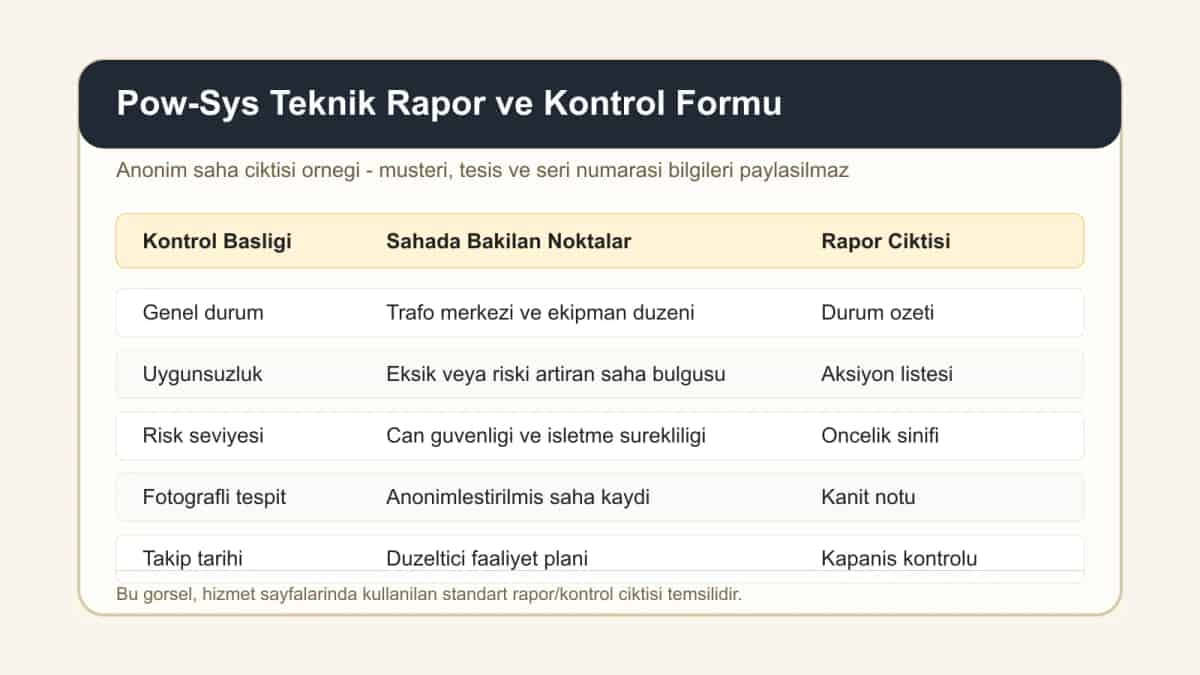
Sample Inspection Table
This table summarizes which headings are evaluated on site and which outputs may appear in the report.
| Inspected area | Checked criterion | Report output |
|---|---|---|
| Site and equipment condition | Existing equipment structure, access conditions, visible risks and operating conditions | Site inspection note and prioritized findings list |
| Document and project conformity | Single-line diagram, current project, labeling, reports and conformity with site implementation | Document conformity assessment and missing record list |
| Safety and operational risk | Life safety, equipment safety, energy continuity and maintenance access risk headings | Risk classification and corrective action recommendations |
| Measurement, test or inspection need | Measurement, test, visual inspection and technical review items required by the service scope | Measurement/test plan or inspection scope note |
| Reporting and follow-up | Nonconformity priority, follow-up date, responsibility allocation and next steps | Photo-supported report, action list and follow-up recommendation |
Installation Inspection Scope and Separate Work
The installation checks, measurements and report specified in the inspection proposal belong to this service. Additional systems and physical corrections are evaluated separately.
| Work item | Relationship to the service | Scope decision |
|---|---|---|
| Agreed installation inspection and measurements | Visual inspection, continuity, insulation, protective-device and grounding checks follow the applicable criteria and agreed scope. | Required measurements and nonconformities are recorded in the inspection report. |
| Additional equipment or specialist tests | Systems and examinations outside the agreed inspection inventory may require a separate visit or method. | Additional test scope and reporting are clarified before work begins. |
| Repair, replacement and installation revision | Physical correction requires materials, labour and safe implementation planning. | The inspection identifies the need; corrective work is quoted separately. |
Official Regulatory Sources
- EMO certificate verification portal
Claim supported on this page: EMO registration, SMM and certificate verification transparency.
- TEDAŞ official website
Claim supported on this page: Distribution infrastructure, project/acceptance processes and technical specification context.
- TEİAŞ official website
Claim supported on this page: Transmission system, connection and high-voltage infrastructure context.
- Electrical High Current Installations Regulation
Claim supported on this page: Installation, operation, maintenance and safety of high-current electrical installations.
Frequently Asked Questions
What is electrical installation periodic inspection?
Electrical installation periodic inspection is the examination, measurement and technical assessment at defined intervals of main and sub-panels, cable lines, socket and lighting circuits, protective conductors, equipotential bonding and protection devices in a facility.
What is the difference between periodic inspection and maintenance?
Maintenance covers applications such as repair, cleaning, tightening and part replacement. Periodic inspection is a technical assessment that reveals the current safety and conformity status of the system through independent measurement, testing and examination.
Which sections are examined in electrical installation periodic inspection?
The main distribution panel, sub-panels, cable and conduit routes, socket and lighting circuits, motor supply lines, protective conductors, equipotential system and residual current protection devices can be evaluated within the inspection scope.
Which tests are performed?
Depending on the scope, insulation resistance measurement, continuity test, loop impedance measurement, residual current device function test, voltage checks, load assessment and thermal inspection in required areas may be performed.
Are the electrical installation conformity report and periodic inspection report the same?
No. A conformity report mainly shows whether a newly installed or revised installation has been installed correctly from a technical perspective. A periodic inspection report contains the examination and test results of the existing installation at defined intervals.
Why is electrical installation periodic inspection important?
Regular inspections allow leakage current, insufficient protection, loose connections, overheating, insulation weakness and grounding problems to be detected early. This reduces electric shock, fire and unplanned outage risks.
What is included in the periodic inspection report?
The report includes inspections performed, measurement results, detected nonconformities, risk assessment and recommended corrective actions. The aim is not only to provide results but also to provide technical guidance for the improvement process.
For which buildings are electrical installation inspections required?
Regular inspection of internal electrical installations is important in industrial facilities, factories, warehouses, commercial buildings, offices, hospitals, schools and all buildings where electrical infrastructure is actively used.
Who can issue an electrical installation conformity report?
An electrical installation conformity report should be issued by persons who meet the qualification requirements defined in the relevant legislation and are authorized to perform this type of inspection — in practice, electrical or electrical-electronics engineers and competent inspection organizations. The person issuing the report must understand electrical internal installations, low-voltage distribution, protection arrangements and measurement techniques, use calibrated instruments and prepare the report in a format that is accepted in official processes. Because the report documents that a newly installed or significantly revised installation matches the project, technical rules and safe-use conditions, businesses should confirm the issuer's authorization and ask how measurement results and findings will be presented before commissioning the work. A properly issued report also remains a reference for later periodic inspections.
What are visual inspection and function tests in an electrical installation check?
Visual inspection is the first stage of the check: panel internal layout, labelling, cable cross-sections, placement of protection equipment, connection quality, cable routes, junction boxes, exposed conductor risks and access safety are reviewed without measurement. Function tests and electrical measurements form the second stage: insulation resistance measurements, protective conductor continuity tests, loop impedance checks, residual current device tripping tests, phase-neutral and phase-earth voltage checks, load distribution reviews and thermal observation at critical points. The two stages complement each other, because some risks — such as an incorrectly selected protection device or a poor connection — are visible before any measurement, while others can only be revealed through testing. Both sets of findings are combined in the report with risk levels and corrective actions.