
Last updated: September 9, 2026
Reviewed by Hüseyin ÇOKAL, Electrical and Electronics Engineer. Updated: September 9, 2026.
What changed: Service scope, report outputs, official sources, pre-proposal information and technical transparency notes were reviewed for the current period.
Electrical Installations Project Design and Consultancy Summary
- Electrical installations design and consultancy services for industrial facilities, OIZ factories, power generation plants and large commercial buildings: the whole project handled with one engineering language
- Site survey, existing condition analysis, project design and implementation control for LV, MV and HV electrical installations: drawings that match the real site, not just the archive
- Single-line diagram, transformer substation design, MV switchgear arrangement, cable route and panel layout studies: layout decisions made before they become field problems
- Short-circuit calculation, load flow analysis, voltage drop, cable sizing and busbar dimensioning studies: equipment selected on calculation, not assumption
- Relay selectivity, protection coordination, grounding, compensation and power quality evaluations: faults cleared at the right point instead of shutting down the facility
- Project file, revision, authority approval, acceptance, high-current-installation regulatory context and commissioning support for official authority processes: approval steps followed so the investment is not delayed
Technically reviewed by
Electrical Installations Project Design and Consultancy Scope
What is electrical installations design and consultancy
Electrical installations design and consultancy service includes determining the energy needs of a facility, designing the electrical infrastructure correctly, carrying out technical calculations, following official authority processes and engineering control of implementation and commissioning stages. As Pow-Sys Power Systems, we provide electrical installations design and consultancy services across Türkiye for industrial facilities, factories in organized industrial zones, power generation plants, transformer substations, large commercial buildings and infrastructure projects.
Proper design of electrical installations does not only mean preparing drawings. The installed power, demand power, load characteristics, production continuity, maintenance needs, capacity increase plans, voltage level and official authority requirements of the facility must be evaluated together. For this reason, in the electrical design and consultancy process, we handle technical calculations, site conditions and operational needs as a whole. You can see how this works in practice on this page: sample calculation and report formats explain the expected deliverables.
Site survey and existing condition analysis
Before starting project studies, a site survey and existing condition analysis are carried out. Transformer substations, MV switchgear, low-voltage panels, cable routes, generator systems, compensation panels, grounding installation, metering circuits and existing project documents, if available, are reviewed. This preliminary assessment is the basic step for correctly determining the existing capacity of the facility and the need for a new investment or revision.
LV/MV/HV design and technical calculations
The design process for LV, MV and HV electrical installations must be planned according to the operating conditions of the facility. In low-voltage systems, panel, cable, lighting, socket outlet, machine feeder, compensation and grounding details come to the forefront, while in medium-voltage and high-voltage installations, transformer substations, MV switchgear, circuit breakers, disconnectors, protection relays, metering systems, cable terminations, busbar connections and switching safety become more critical.
Within the scope of electrical installations design, single-line diagrams, load lists, cable sizing calculations, voltage drop calculations, short-circuit calculations, load flow analyses, panel and transformer layout plans, MV switchgear arrangements, grounding calculations and implementation projects can be prepared. When required, different project documents such as preliminary design, final design, implementation project, revision project and as-built project can also be prepared.
Short-circuit calculation, load flow analysis and voltage drop calculations are among the most important technical steps in the electrical installations design process. These calculations are required for correct selection of transformer capacity, circuit breaker ratings, cable cross-sections, busbar systems, panel capacities and protection equipment. Equipment selected without proper calculations may cause unnecessary trips, voltage problems or safety risks during operation.
Sample technical calculation outputs
In an electrical installations design and consultancy study, each calculation is connected to the real load information and site conditions of the facility. Short-circuit, load flow, voltage drop and relay selectivity outputs are reported in a format that can be used in equipment selection, authority approval files, implementation control and commissioning planning.
Relay selectivity, protection coordination and substation design
Relay selectivity and protection coordination studies ensure that the system responds correctly during faults in electrical installations. The aim is to clear the fault only at the relevant point, prevent unnecessary outages and keep critical loads energized as much as possible. In this scope, short-circuit results, relay curves, circuit breaker characteristics, transformer data and facility operating scenarios are evaluated together.
In facilities with transformer substations, design and consultancy require a more comprehensive engineering approach. Selection of MV switchgear, transformer capacity, cable entries and exits, busbar connections, metering and protection circuits, grounding system, maintenance access, switching areas and safety clearances are reviewed separately. When designing a transformer substation, not only the initial investment cost but also long-term operation and maintenance convenience are considered.
Grounding, compensation and power quality
Grounding, compensation and power quality studies are also important parts of the electrical installations consultancy process. The grounding system plays a critical role in life and facility safety. The compensation system affects reactive power balance and energy costs. Harmonics, voltage fluctuations and power quality problems may create risks for production continuity. Therefore, these topics should be evaluated together during the project or revision process.
Implementation control, authority approval and commissioning
Within the scope of electrical project consultancy, not only design and calculation studies are carried out; whether the implementation process proceeds in accordance with the project is also checked. Cable routes, panel connections, cable cross-sections, MV switchgear layout, transformer connections, labeling, grounding connections, metering circuits and protection equipment are inspected on site. Conditions that do not comply with the project or may create operational risks in the future are reported in writing.
TEDAŞ, relevant distribution company processes, TEİAŞ and EMO processes form an important part of electrical installations design and consultancy services. Project files must be prepared correctly, authority revisions must be followed, application documents must be completed without deficiencies, official acceptance files must be prepared and technical checks must be carried out before acceptance. During authority approval and acceptance, the Electrical High Current Installations Regulation, distribution company practices and connection/acceptance expectations are evaluated together. Incomplete or incorrectly prepared project documents in these official processes may cause time loss and additional costs during the investment process.
Technical specifications, quantity take-off, bill of quantities, estimated cost, equipment selection and implementation control are also important for correctly managing investments in electrical installations. Especially in industrial facilities, cement plants, iron and steel facilities, mining facilities, petrochemical plants, port operations, automotive plants and production-line businesses, the electrical infrastructure directly affects production continuity.
During commissioning, tests, measurements and functional checks are carried out to verify that the system operates in accordance with the project. Transformer, MV switchgear, protection relay, grounding, continuity, metering circuits, compensation and, when necessary, power quality measurements are evaluated. These studies are important for safely putting the facility into operation and creating reference values for future periodic inspection works.
Which facilities need this service
Electrical installations design and consultancy service may be required in many cases such as new facility investments, transformer capacity increases, machinery park expansion, generator integration, solar power plant connection, MV switchgear renewal, panel revision, power quality problems, frequent tripping faults, capacity increase or regulatory compliance needs.
Content review and update process
This content is technically reviewed by Huseyin COKAL for electrical installations design, high-current installations, authority approval and technical reporting topics. When regulations, authority practices or acceptance processes change, the relevant section is re-evaluated; if outdated information is identified, the content is updated and the service scope is clarified again through a site survey.
Quotation process and Pow-Sys approach
During the quotation process, the facility type, installed power, demand power, transformer capacity, number of MV switchgear units, panel structure, machinery list, existing single-line diagram, current project status, site distances, authority approval requirement, implementation control scope and commissioning support are evaluated together. This allows us to prepare a phased and clear engineering proposal that reflects the real technical scope of the project, rather than only a general price.
Pow-Sys Power Systems approaches electrical installations design and consultancy service not only as a drawing preparation process, but as a technical engineering study carried out to make the facility safe, sustainable and suitable for long-term operational needs. Our goal is to improve energy continuity, manage official processes correctly, reduce implementation errors and make your facility’s electrical infrastructure reliable.
For electrical installations design and consultancy, LV/MV/HV project design, transformer substation design, short-circuit analysis, load flow, relay selectivity or authority approval processes, you can share your facility information and request a project-specific comprehensive engineering evaluation. Scope is clarified from this information, and before signing you see in writing what is included and what is planned as a separate service.
Reporting, Inspection and Proposal Preparation
| Technical calculation | Sample parameters | Output |
|---|---|---|
| Short-circuit calculation | Transformer capacity, short-circuit voltage, grid short-circuit power, cable impedance, busbar and circuit breaker ratings are evaluated. | Sample result format: Ik'' = 18.4 kA; equipment withstand suitable/not suitable, circuit breaker and protection suitability note is prepared. |
| Load-flow analysis | Installed power, demand power, simultaneity, critical loads, generator/transformer supply scenarios and voltage levels are reviewed. | Sample result format: transformer loading 72%, critical bus voltage 0.98 pu; capacity limit and revision requirement are reported. |
| Voltage drop calculation | Cable cross-section, line length, load current, power factor, installation method and environmental conditions are calculated together. | Sample result format: ΔV = 2.8%; suitable cable cross-section, voltage drop percentage and site implementation note are created. |
| Relay selectivity | Relay curves, circuit breaker characteristics, short-circuit results, transformer data and operating scenarios are compared. | Sample result format: main breaker/outgoing protection selectivity result is classified as suitable, partial improvement required or testing required. |
| Cable sizing and busbar check | Current-carrying capacity, temperature, installation grouping, short-circuit withstand and mechanical layout conditions are reviewed. | Sample result format: cable ampacity suitable below 80% loading; busbar/cable capacity limit and control items are clarified. |
| Authority approval file | Single-line diagram, load list, project revision, technical calculations, site suitability and acceptance documents are evaluated together. | Sample result format: 5-heading missing document list, project revision note and pre-acceptance follow-up plan are prepared. |
Electrical Design Consultancy Process Table
In the electrical installation design process, the input, calculation/check, delivered output, responsible party and follow-up step are managed together. This table makes visible which information a technical decision is based on and to whom the next action is assigned.
| Input | Technical check | Calculation / analysis | Delivered output / responsible party / follow-up |
|---|---|---|---|
| Single-line diagram and load list | Existing field equipment, panel outputs, MV switchgear layout and new loads are compared. | Installed power, demand power, transformer loading and critical load impact are evaluated. | A revision note, load list interpretation and project-site conformity output are prepared; the technical decision is made by the engineer, and the follow-up items on the customer side are listed separately. |
| Transformer substation and MV switchgear information | Incoming/outgoing cells, metering/protection arrangement, cable routing and maintenance access are checked. | Short-circuit level, breaker withstand, protection coordination and grounding need are analyzed. | The MV switchgear arrangement, transformer substation note and separate test/measurement need are reported; open items are linked to a site visit or project revision follow-up. |
| Utility application and acceptance documents | Distribution company/utility expectations, missing documents and revision items are examined. | Risk items for the utility-approved electrical project, pre-acceptance check and electrical installation acceptance procedures are separated. | An application file checklist, revision follow-up note and responsible document items are prepared; the revision step is tracked after the utility response. |
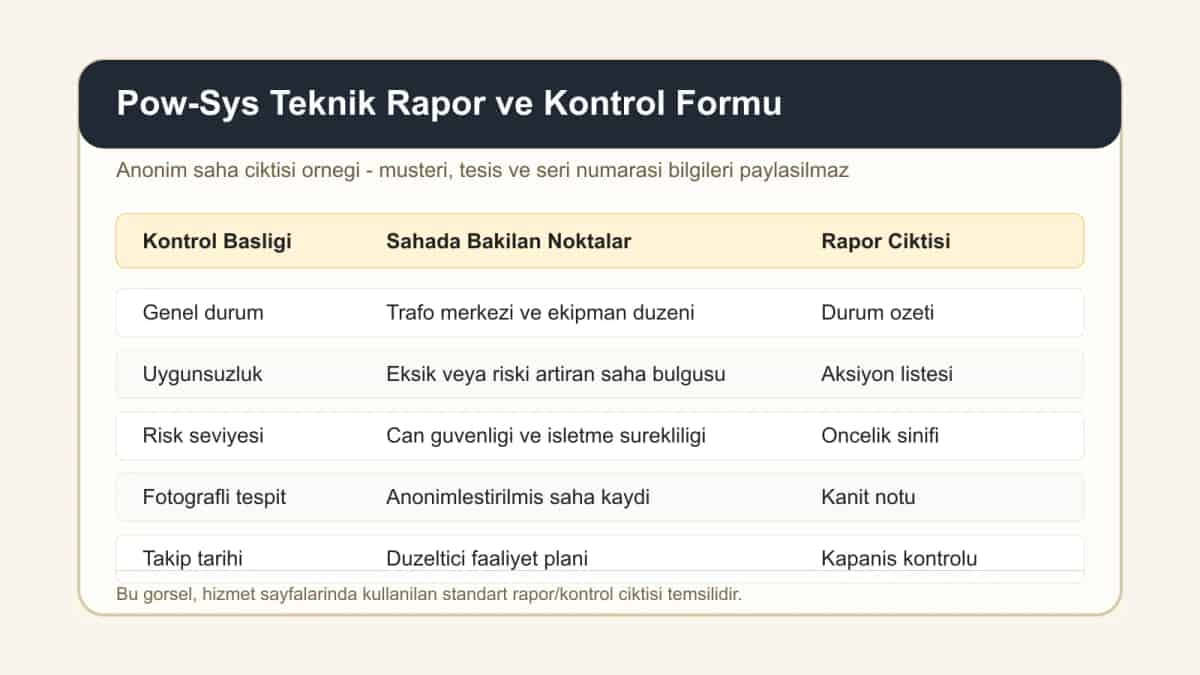
| Field implementation status | Panel connections, cable cross-sections, labeling, grounding and implementation-project conformity are checked on site. | The possibility of nonconformity in terms of voltage drop, cable cross-section, energy continuity and safety is evaluated. | Photographed field findings, risk level, corrective action and follow-up date are added to the report; the closure status is re-evaluated at the next inspection. |
Agreed Project Scope and Additional Work
The design and approval tasks specified in the proposal belong to this service. Additional design scope, field implementation and testing are distinguished before work begins.
| Work item | Relationship to the service | Scope decision |
|---|---|---|
| Electrical project design and approval work | Drawings, calculations, agreed revisions and approval follow-up are defined in the project proposal. | The agreed project files and engineering calculations are delivered. |
| Additional capacity, layout or equipment changes | Changes outside the agreed design may require new calculations or drawings. | Additional scope, cost and timing are agreed before revision. |
| Physical installation and field tests | Construction, materials and commissioning measurements require their own work plan. | These are included only when expressly agreed in the proposal; design alone does not include installation. |
Official Regulatory Sources
- Electrical High Current Installations Regulation
Claim supported on this page: Provides the regulatory basis for project, operation, safety, acceptance and technical suitability assessments in high-current installations.
- TEDAŞ official website
Claim supported on this page: Provides institutional context for distribution infrastructure, project/acceptance practices and technical requirements.
- TEİAŞ official website
Claim supported on this page: Supports the technical process context for transmission system, connection and high-voltage infrastructure topics.
- EPDK electricity market page
Claim supported on this page: Provides official authority context for distribution company processes and electricity market regulations.
- EMO certificate verification portal
Claim supported on this page: Supports transparency for EMO registration, SMM and certificate verification.
Frequently Asked Questions
What is electrical installations design and consultancy?
Electrical installations design and consultancy is the engineering management of determining a facility’s energy needs, designing the electrical infrastructure, carrying out technical calculations, following official authority processes, implementation control and commissioning stages.
Which facilities require electrical installations design service?
It is required for industrial facilities, OIZ factories, power generation plants, businesses with transformer substations, large commercial buildings, infrastructure projects, facilities planning capacity increases and businesses with electrical safety risks.
What project studies are carried out in LV/MV/HV electrical installations?
Single-line diagram, load list, transformer substation design, MV switchgear arrangement, cable route, panel layout, short-circuit calculation, load flow analysis, voltage drop calculation, cable sizing, grounding calculation and relay selectivity studies can be carried out.
Are electrical design and consultancy the same as electrical contracting?
No. Electrical design and consultancy focuses on the engineering side such as design, calculations, technical review, specifications, authority approval, implementation supervision and reporting. Electrical contracting covers on-site installation and assembly works.
Why are short-circuit and load flow analyses performed?
Short-circuit and load flow analyses are performed to select equipment correctly, determine fault currents, check voltage levels, evaluate transformer and cable capacities and ensure safe operation of the system.
Why is relay selectivity important in the design process?
Relay selectivity aims to disconnect only the relevant section during a fault while keeping healthy sections energized. This study is important for energy continuity, equipment safety and operational reliability.
Do you provide support in official authority and EMO processes?
Yes. We provide technical support for project file preparation, technical revisions, application tracking, authority approval processes, official acceptance files, pre-acceptance checks and commissioning stages.
What does transformer substation design service include?
Transformer substation design includes transformer capacity assessment, MV switchgear selection, circuit breaker and disconnector suitability, single-line diagram, cable entries and exits, busbar connections, metering-protection circuits, grounding system and maintenance access planning.