
Last updated: September 5, 2026
Reviewed by Hüseyin ÇOKAL, Electrical and Electronics Engineer. Updated: September 5, 2026.
What changed: Service scope, report outputs, official sources, pre-proposal information and technical transparency notes were reviewed for the current period.
High Voltage Operation Responsibility Summary
- Operation responsibility with an EMO/YGTİS-authorized electrical engineer for MV/HV installations above 1 kV: your regulatory obligation handled by a single authorized engineer
- Clarification of the scope of HV operation responsible engineer, MV operation responsible engineer and transformer operation responsible engineer services: you compare proposals on scope, not just price
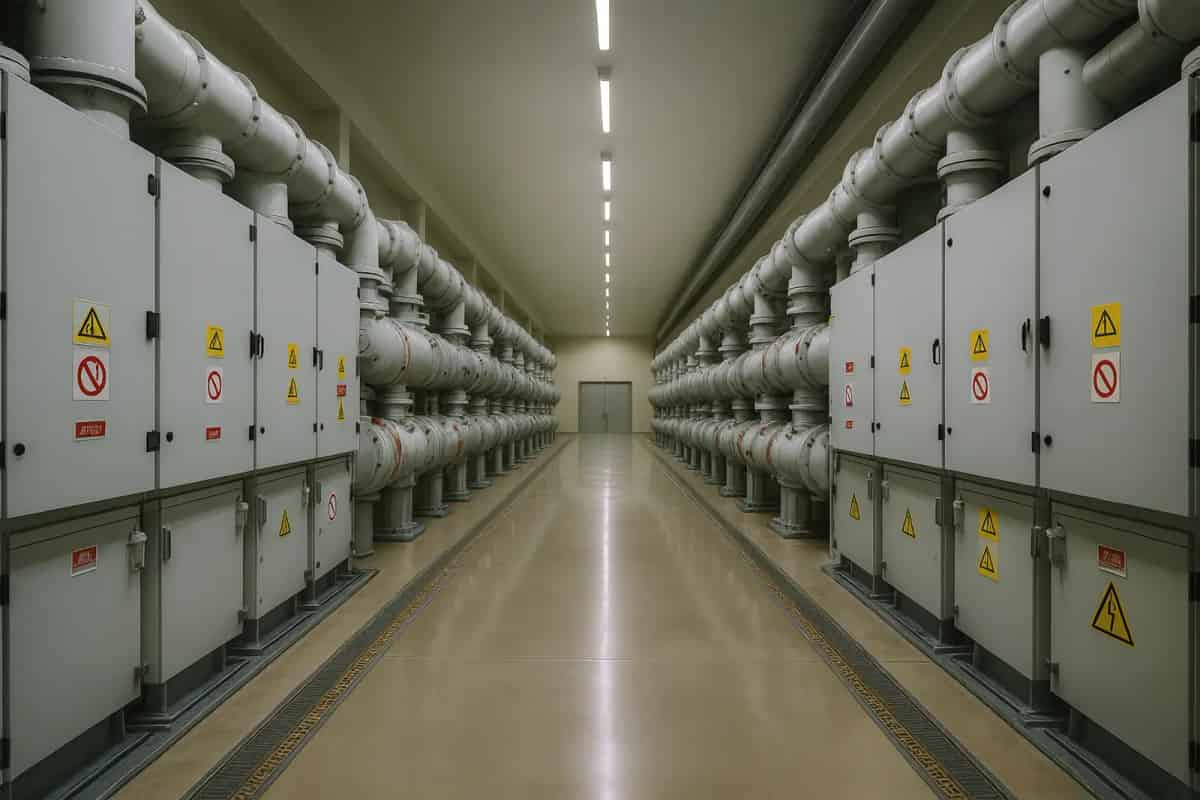
- Technical follow-up for transformer substations, MV switchgear, circuit breakers, disconnectors, protection relays, grounding systems and switching safety: risks reach you in writing before they grow
- Operation responsibility agreement, site survey, inspection plan, deficiency identification, maintenance coordination and regular reporting: no finding is left without follow-up
- Solutions for industrial facilities, factories, Organized Industrial Zone businesses, privately transformer-fed subscribers, hospitals, hotels, shopping malls and large energy infrastructures: scope defined per facility, not copied from a template
Technically reviewed by
High Voltage Operation Responsibility Scope
Under Article 6 of the EMO regulation, operation responsibility is normally undertaken within provincial boundaries. Adjacent-province and multi-province contractor arrangements require separate checks of branch approval, credentials and local engineer conditions. Eligibility for a facility outside Bursa is assessed before accepting responsibility.
What is high voltage operation responsibility?
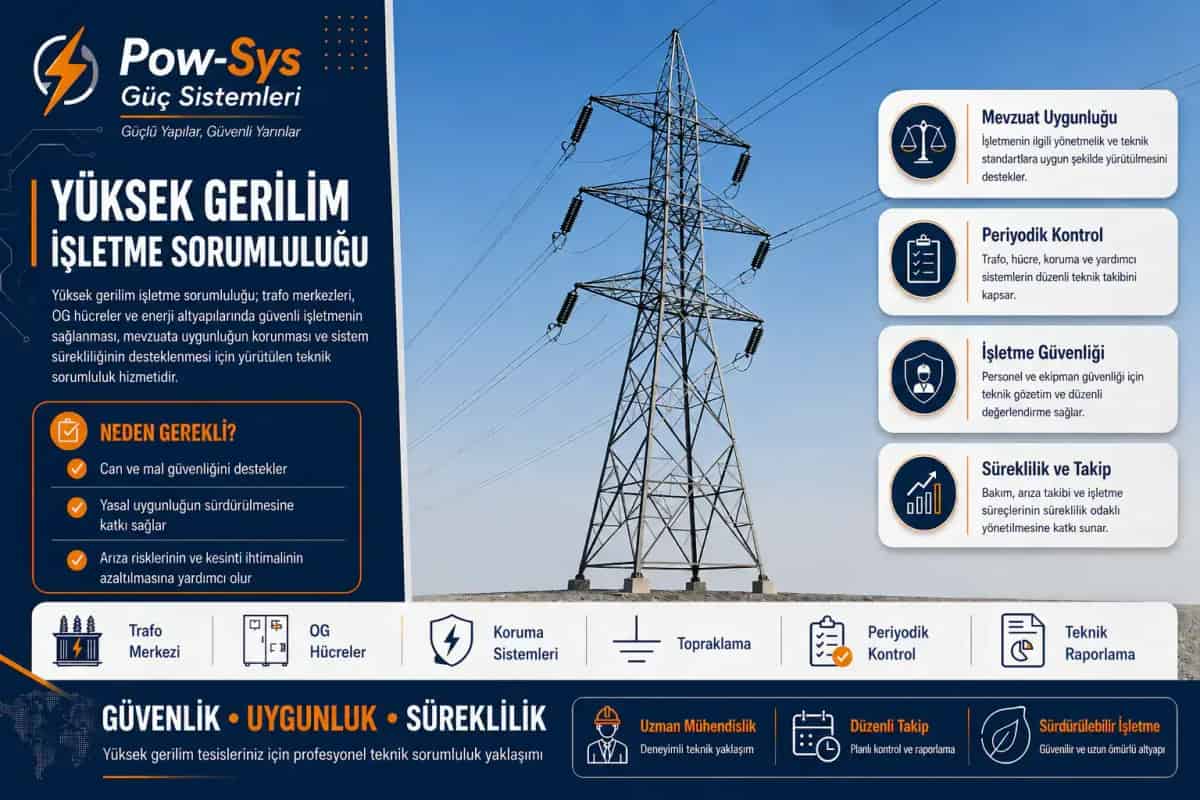
High voltage operation responsibility is the authorized engineering follow-up service for MV/HV installations above 1 kV. It covers the transformer substation, MV switchgear, single-line diagram, switching safety, maintenance records, grounding status and open action tracking under a written service scope.
This service is not only a contract signature. The installation is reviewed periodically, technical risks are documented, separate maintenance/test/measurement needs are identified, and the facility receives a written report it can use for follow-up.
Which facilities need this service?
Facilities with a private transformer, MV cell, transformer substation or electrical installation above 1 kV should be reviewed by an authorized electrical engineer. Typical examples include factories, OIZ facilities, hospitals, shopping centers, hotels, cold storage sites, logistics facilities and production plants where continuity matters.
The scope is not decided only by transformer kVA. Voltage level, connection structure, substation ownership, MV cell count, switching authority, existing contract, maintenance history and utility-side processes are evaluated together.
Authorization, credential and responsibility boundary
The responsible engineer should have the relevant electrical engineering qualification and YGTIS authorization. EMO/MISEM records, SMM scope and credential validity are confirmed at service start according to current regulations and the signed contract scope.
In practice this authorization is often referred to as the high voltage operation responsibility certificate: an EMO-approved YGTIS authorization showing that the electrical engineer is entitled to undertake operation responsibility in MV/HV installations above 1 kV. Its basis is the engineer's EMO membership, SMM registration and the MISEM training and authorization process. The facility owner can confirm this authorization by requesting a current copy of the certificate from the engineer and checking the registration through EMO's online verification channel; recording the verified certificate details in the contract file makes the authorization easier to demonstrate during audits.
Pow-Sys does not provide legal penalty advice on this page. The technical output is a responsibility boundary, inspection form, nonconformity list, risk priority, corrective action recommendation and next follow-up date.
Transformer, MV and maintenance distinction
Transformer operation responsibility, MV operation responsibility and high voltage operation responsibility usually refer to the same service family. Transformer maintenance is different: oil tests, relay tests, thermal camera inspections, grounding measurements and fault repairs are planned separately when needed.
Operation responsibility checks whether those technical works are recorded, whether site safety equipment is available, and whether open actions are tracked. This distinction is critical when comparing proposals.
Service contract, fees and proposal (EMO minimum tariff)
The fee depends on transformer capacity, transformer type, MV cell count, risk profile, visit period, reporting depth, existing records and additional service needs, and the current EMO minimum fee tariff is used as a reference context. A facility-specific technical scope is more reliable than a generic fixed price.
For a clear proposal, share the facility name and location, transformer kVA, transformer type, MV cell count, single-line diagram, current contract status, latest maintenance/measurement dates, operating schedule and technical contact.
Inspection form and report output
The inspection form covers transformer data, MV cell status, single-line diagram, switching instruction, grounding measurement date, compensation system if separately contracted, safety equipment, maintenance records, risk items and recommended actions.
The report includes the inspection date, reviewed equipment, findings, risk level, separately planned maintenance/test/measurement works, responsible party, target date and next follow-up items. This turns the service into an auditable technical management process.
Pow-Sys approach
Pow-Sys delivers high voltage operation responsibility through authorization transparency, field observation, report discipline and source-aware technical explanations. The goal is to strengthen the facility file, reduce switching and documentation risk, identify maintenance/test needs and record technical decisions.
To clarify your facility scope, share transformer capacity, MV cell count, single-line diagram, current contract and latest maintenance/measurement records. Pow-Sys uses that information to define service boundary, visit period and report format, and before signing you see in writing what is included and what is planned as a separate service.
Reporting, Inspection and Proposal Preparation
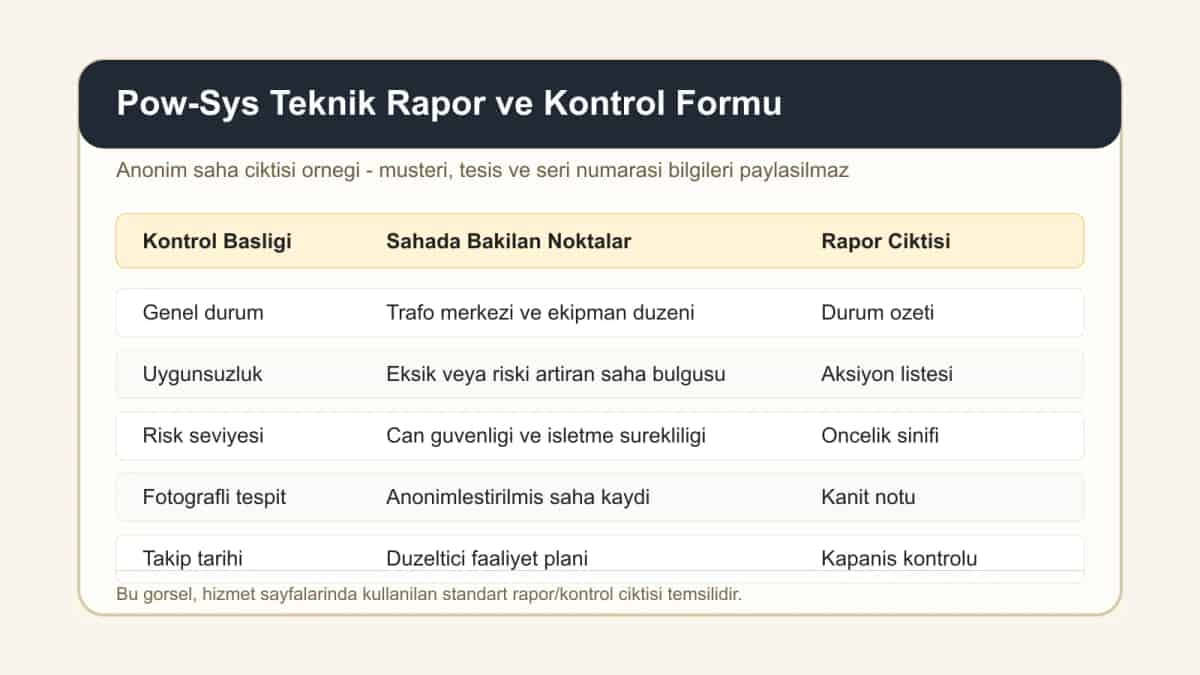
Sample Inspection Table
This table summarizes which headings are evaluated on site and which outputs may appear in the report.
| Inspected area | Checked criterion | Report output |
|---|---|---|
| Site and equipment condition | Existing equipment structure, access conditions, visible risks and operating conditions | Site inspection note and prioritized findings list |
| Document and project conformity | Single-line diagram, current project, labeling, reports and conformity with site implementation | Document conformity assessment and missing record list |
| Safety and operational risk | Life safety, equipment safety, energy continuity and maintenance access risk headings | Risk classification and corrective action recommendations |
| Measurement, test or inspection need | Measurement, test, visual inspection and technical review items required by the service scope | Measurement/test plan or inspection scope note |
| Reporting and follow-up | Nonconformity priority, follow-up date, responsibility allocation and next steps | Photo-supported report, action list and follow-up recommendation |
Out-of-Scope and Separately Planned Works
High Voltage Operation Responsibility produces technical follow-up, reporting, compliance assessment and risk notification. The following works are planned separately when required; final risk level, cost and scope are not confirmed without an on-site survey.
| Out-of-scope / separate work | Why is it evaluated separately? | Pow-Sys approach |
|---|---|---|
| Grounding measurement | It may require measurement equipment, site time and a separate report. | The need is stated in the main report; measurement work is planned separately. |
| Relay testing and selectivity | Relay settings, test equipment, outage planning and separate engineering assessment may be required. | Quoted as a separate testing/selectivity service when needed. |
| Thermal imaging inspection | It requires imaging under load and a separate thermal finding report. | Planned separately for panels, switchgear or connections where risk is observed. |
| Transformer maintenance and oil analysis | It may require maintenance crew, sampling, laboratory work or a separate test procedure. | The need is written in the technical report; maintenance/testing is prepared as a separate scope. |
| Project revision, implementation and physical remediation | It creates material, labor, authority process or implementation responsibility. | The main service reports the finding; implementation and contracting works are handled separately. |
Official Regulatory Sources
- EMO certificate verification portal
Claim supported on this page: EMO registration, SMM and certificate verification transparency.
- TEDAŞ official website
Claim supported on this page: Distribution infrastructure, project/acceptance processes and technical specification context.
- TEİAŞ official website
Claim supported on this page: Transmission system, connection and high-voltage infrastructure context.
- Electrical High Current Installations Regulation
Claim supported on this page: Installation, operation, maintenance and safety of high-current electrical installations.
Frequently Asked Questions
What is high voltage operation responsibility?
High voltage operation responsibility is a technical responsibility service carried out by an authorized electrical engineer to ensure that MV/HV installations above 1 kV are operated safely, with proper records and in compliance with regulations.
Who is an HV operation responsible engineer?
An HV operation responsible engineer is an authorized electrical engineer who follows transformer substations, MV switchgear, switching instructions, maintenance-test needs, safety equipment and technical reporting processes.
Why is the YGTİS certificate important?
The YGTİS certificate is the EMO authorization certificate showing that the electrical engineer is qualified to undertake operation responsibility in high voltage installations. It is one of the main control points for the EMO agreement process and safe facility operation follow-up.
How often does the HV operation responsible engineer inspect the facility?
When operation responsibility is undertaken by an SMM, the HV installation must be inspected at least once a month. Reporting on the condition of the facility, risks, planned work and required precautions should be prepared at intervals of no more than four months.
Is high voltage operation responsibility mandatory?
In high-voltage high-current installations above 1 kV, an electrical engineer responsible for technical matters is required. For this reason, high voltage operation responsibility is a critical requirement for regulatory compliance and occupational safety in businesses with transformer substations.
Are transformer operation responsible engineer and HV operation responsible engineer the same thing?
In the field, these expressions are often used for the same need. However, the technical scope is not limited only to the transformer; MV switchgear, circuit breakers, disconnectors, protection relays, grounding, switching arrangement and safety equipment are evaluated together.
Which checks are carried out in HV operation responsibility service?
Transformer substation, MV switchgear, circuit breakers and disconnectors, grounding connections, protection relays, single-line diagram, switching instructions, maintenance records, warning signs and safety equipment are checked.
How is the high voltage operation responsibility fee determined?
The fee is determined according to transformer capacity, number of transformers, number of MV/LV switchgear cubicles, facility size, visit frequency, reporting scope, testing needs, emergency support and the risk level of the facility. The current EMO minimum fee tariff is also taken into account as a reference when the proposal is prepared.
For which facilities is MV operation responsibility required?
Industrial facilities, Organized Industrial Zone businesses, hospitals, hotels, shopping malls, data centers and large commercial buildings supplied at MV level, having their own transformer substation or electrical equipment above 1 kV may be evaluated within this scope.
Why is incorrect switching dangerous?
Incorrect switching can create serious risks such as power interruption, equipment damage, arc flash, fire and life safety hazards. For this reason, switching sequence, authorized personnel and safe working procedures should be written and up to date.
What does an HV operation responsibility service contract cover?
An HV operation responsibility service contract typically defines the responsibility boundary, the installations included in the scope, the visit period, the inspection plan and the reporting format. It clarifies which equipment is followed — such as the transformer substation, MV switchgear, grounding system and switching arrangement — and how findings, nonconformities and open actions are recorded and tracked. The contract also states which works remain outside the scope: transformer maintenance, relay testing, grounding measurement, thermal imaging and repairs are usually planned as separate services when the report identifies a need. Before signing, share transformer capacity, MV cell count, the single-line diagram, current contract status and the latest maintenance and measurement records so the service boundary, visit period and report format can be defined realistically.
Is VAT withholding applied to HV operation responsibility services?
VAT withholding practice in engineering and technical services depends on current tax legislation, the status of the parties and how the service is classified in the invoicing process, and these rules are updated from time to time. Because this is a financial and tax matter rather than a technical one, this page does not provide binding tax guidance. The reliable approach is to have your accountant or financial advisor confirm the current withholding treatment for the specific contract before invoicing. From the technical side, Pow-Sys defines the service scope, visit period and reporting structure clearly in the proposal, which also makes the invoicing and documentation process easier for both parties to manage correctly.
How can you verify an operation responsible engineer's authorization certificate?
The engineer's authorization can be checked through the official verification channels of the Chamber of Electrical Engineers (EMO), which provides an online certificate verification service, and by requesting the current YGTİS certificate and registration information directly from the engineer. At service start, credential validity, EMO/MISEM records and SMM scope should be confirmed according to current regulations, and this transparency step is part of a properly structured operation responsibility process. Businesses are advised to record the verified certificate information in the contract file so that authorization can be demonstrated during audits. Working with an engineer whose authorization is current and verifiable is one of the main control points for a compliant and safe operation responsibility service.