

Last updated: September 9, 2026
Reviewed by Hüseyin ÇOKAL, Electrical and Electronics Engineer. Updated: September 9, 2026.
What changed: Service scope, report outputs, official sources, pre-proposal information and technical transparency notes were reviewed for the current period.
Transformer Substation Project and Design Summary
- Transformer substation design services for industrial facilities, OIZ factories, power generation plants and large commercial buildings: a substation planned for long-term operation, not just installation
- Preparation of single-line diagrams, load lists, MV switchgear arrangements and transformer layout plans within the scope of substation projects: every drawing traceable to your real load data
- Technical evaluation of transformer capacity, voltage level, short-circuit level, cable routes and equipment layouts: capacity decisions documented before purchase
- Short-circuit calculation, voltage drop, cable sizing, grounding calculation and busbar dimensioning studies: equipment withstand verified on paper before it is tested by a fault
- Primary project, secondary project, protection relay, relay coordination, SCADA and control system evaluations: protection and monitoring designed as one system
- Project file, authority revisions, acceptance and commissioning support for TEDAŞ / EDAŞ / TEİAŞ / EMO processes: authority steps followed so energization is not delayed
Technically reviewed by
Transformer Substation Project and Design Scope
What is transformer substation project design
Transformer substation design is the process of technically designing a substation infrastructure suitable for a facility’s energy demand, voltage level, load characteristics and operating conditions. As Pow-Sys Power Systems, we provide transformer substation project and design services across Türkiye for industrial facilities, factories in organized industrial zones, power generation plants, large commercial buildings and infrastructure projects.
A transformer substation project is not limited to preparing a layout drawing or a single-line diagram. For proper transformer substation design, the facility’s installed power, demand power, transformer capacity, short-circuit level, MV switchgear structure, cable routes, grounding system, protection scheme, maintenance access and official authority requirements must be evaluated together.
Site survey, energy demand and existing condition assessment
Before starting the project work, the facility’s energy demand and existing infrastructure are examined. The existing transformer substation, MV switchgear, power transformer, low-voltage panels, cable connections, compensation system, grounding arrangement, metering circuits and previous project documents, if available, are reviewed. This assessment is the basic step for correctly determining the need for a new project or revision.
One of the first stages in transformer substation design is the correct determination of energy demand. Installed power, demand power, simultaneity, motor loads, production lines, backup supply requirements, capacity increase plans and critical loads are evaluated together. This study ensures that the transformer capacity and electrical infrastructure are selected in accordance with long-term operating conditions.
Single-line diagram, MV switchgear layout and project documents
Within the scope of a transformer substation project, single-line diagrams, load lists, transformer layout plans, MV switchgear arrangements, cable routes, panel layouts, grounding plans, cable sizing calculations, short-circuit calculations, voltage drop calculations and implementation projects can be prepared. When required, different project documents such as preliminary design, final design, implementation project, revision project and as-built project can also be created.
MV switchgear arrangement is one of the most critical topics in the transformer substation design process. The layout of incoming cubicles, metering cubicles, transformer protection cubicles, coupling cubicles, outgoing cubicles and spare cubicles, if any, must be planned correctly in terms of energy continuity and switching safety. Maintenance area, cable entries and exits, operator access and official authority expectations are considered during switchgear layout planning.
Transformer layout, equipment selection and safety clearances
When planning transformer placement, not only the power rating of the equipment but also its cooling structure, ventilation requirements, fire safety, cable connection directions, maintenance access, transportation possibility, safety clearances and operational convenience are evaluated. The selection of oil-type or dry-type transformers should be considered together with the facility location, intended use and safety requirements.
Short-circuit, voltage drop, grounding and load-flow studies
Short-circuit calculation is one of the most important technical studies in a transformer substation project. Short-circuit levels are required for correct selection of circuit breakers, disconnectors, busbars, cables, MV switchgear and protection equipment. Equipment selected without short-circuit calculation may fail to provide adequate safety and operational continuity during a fault.
Voltage drop and cable sizing calculations are important for the healthy operation of loads supplied from the transformer substation. Cable lengths, load currents, route conditions, ambient temperature, installation method and voltage level are evaluated together to determine the appropriate cable size. This study is required for both energy efficiency and operational safety.
Grounding calculation and grounding grid design are among the fundamental parts of transformer substation safety. The grounding system is critical for safely transferring fault currents to earth, limiting step and touch voltages, protecting equipment and ensuring life safety. In transformer substation projects, grounding resistance, grounding conductors, equipotential bonding and site conditions are evaluated together.
When required, load-flow analysis, arc-flash risk assessment, harmonic effects, power quality, compensation and busbar loading conditions can also be evaluated during transformer substation design. These studies help ensure that transformers, MV switchgear, cables and protection equipment are selected according to real operating conditions.
Primary project, secondary project and relay coordination
Primary project studies include the selection and layout of the power transformer, MV switchgear, circuit breakers, disconnectors, current transformers, voltage transformers, surge arresters, busbar connections, cable terminations and other main equipment. Correct selection of primary equipment is a fundamental requirement for safe and long-lasting operation of the transformer substation.
Secondary project studies cover protection, control, metering, signaling, communication and monitoring systems. Protection relays, metering circuits, control circuits, alarm signals, auxiliary supply systems, AC/DC panels and, when necessary, SCADA or RTU infrastructure are evaluated within the scope of the secondary project.
Relay coordination and relay selectivity studies are carried out in transformer substation projects to clear faults at the correct point. The goal is to disconnect only the relevant section during a fault, keep healthy sections energized and prevent unnecessary trips. This study is prepared by evaluating short-circuit results, transformer data, circuit breaker characteristics and protection relay curves together.
Auxiliary services, SCADA and commissioning preparation
Auxiliary services should not be overlooked in transformer substation design. Lighting, ventilation, control supplies, battery-rectifier system, auxiliary supply, fire safety, emergency scenarios, labeling and operator usability on site must be considered during the project stage.
TEDAŞ, EDAŞ, TEİAŞ and EMO authority processes
TEDAŞ, EDAŞ, TEİAŞ and EMO processes form an important part of transformer substation design studies. Proper preparation of the project file, tracking authority revisions, completing application documents without deficiencies, preparing the official acceptance file and carrying out pre-acceptance technical checks are necessary for the investment process to proceed properly.
Depending on the project scope, high-voltage connection processes, TEİAŞ technical evaluations, connection approval letters, technical approval and acceptance stages may also be handled separately. Ensuring that the documents prepared in these processes match the actual site condition is important for both authority approval and future operational safety.
In transformer substation consultancy, not only project documents but also site conditions, operational safety, authority approval requirements and long-term maintenance needs are evaluated together. This approach helps the investment be managed safely and sustainably not only during the initial installation stage but also throughout the operation period.
When is a transformer substation project required
A transformer substation project may be required not only for new facility investments but also for capacity increases in existing facilities, transformer capacity changes, MV switchgear renewal, panel revision, generator integration, solar power plant connection, power quality problems or authority approval processes. In existing facilities, the consistency between the actual site condition and existing documents is also checked during project studies.
Transformer substation design service can be applied in different scopes such as industrial facility substation projects, OIZ factory substation revisions, MV switchgear renewal projects, transformer capacity increase project consultancy, solar power plant connected substation projects and technical assessment of existing transformer substations.
Commissioning, quotation process and Pow-Sys approach
During commissioning, it must be verified that the transformer substation project has been correctly implemented on site. The transformer, MV switchgear, protection relay, metering circuits, grounding, continuity, compensation, auxiliary services and other systems deemed necessary are tested and checked. These studies are important for safely energizing the facility and creating reference values for future maintenance and periodic inspection activities.
During the quotation process, facility type, installed power, demand power, transformer capacity, voltage level, number of MV switchgear units, existing single-line diagram, panel structure, machinery list, cable distances, authority approval requirement, site survey, revision scope and commissioning support are evaluated together. This allows us to prepare a phased engineering proposal that reflects the real technical scope of the transformer substation project, rather than only a general price.
Pow-Sys Power Systems approaches transformer substation design not only as a drawing preparation process but as a technical engineering study that considers energy continuity, operational safety, maintenance convenience, official processes and long-term facility requirements together.
For transformer substation projects, transformer substation design, transformer substation consultancy, MV switchgear arrangement, short-circuit calculation, grounding calculation, relay coordination or authority approval processes, you can share your facility information and request a project-specific comprehensive engineering evaluation. Scope is clarified from this information, and before signing you see in writing what is included and what is planned as a separate service.
Reporting, Inspection and Proposal Preparation
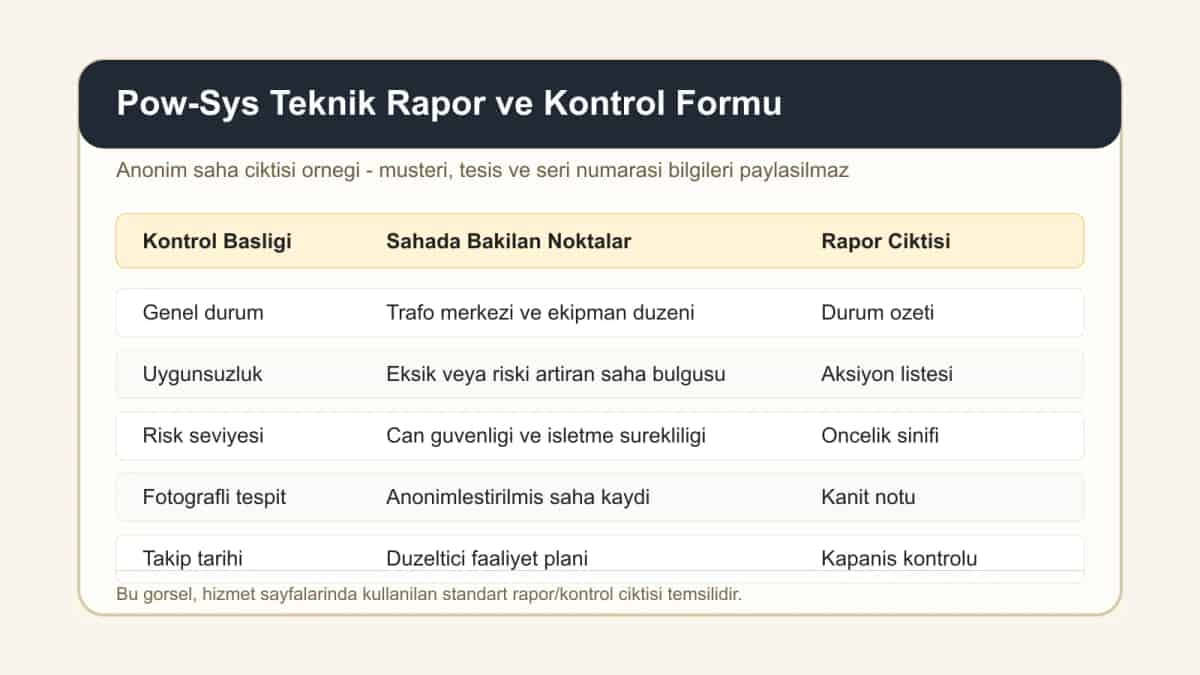
Sample Inspection Table
This table summarizes which headings are evaluated on site and which outputs may appear in the report.
| Inspected area | Checked criterion | Report output |
|---|---|---|
| Site and equipment condition | Existing equipment structure, access conditions, visible risks and operating conditions | Site inspection note and prioritized findings list |
| Document and project conformity | Single-line diagram, current project, labeling, reports and conformity with site implementation | Document conformity assessment and missing record list |
| Safety and operational risk | Life safety, equipment safety, energy continuity and maintenance access risk headings | Risk classification and corrective action recommendations |
| Measurement, test or inspection need | Measurement, test, visual inspection and technical review items required by the service scope | Measurement/test plan or inspection scope note |
| Reporting and follow-up | Nonconformity priority, follow-up date, responsibility allocation and next steps | Photo-supported report, action list and follow-up recommendation |
Transformer Substation Design Process Table
This flow clarifies how, in the transformer substation design process, an input turns into a technical check, which output is produced, and who follows up on the decision.
| Input | Calculation / check | Decision | Output / responsible party |
|---|---|---|---|
| Transformer power and load list | Load profile, simultaneity, capacity increase and voltage drop are checked. | Suitable / capacity revision required | Technical calculation note; the responsible engineer and facility representative follow up. |
| Existing single-line diagram | Compared with the site condition, switchgear arrangement, metering circuits and transformer protection structure. | Consistent with the site / revision required | Revised single-line list; added to the engineering file. |
| Cable route and distances | Cross-section, short-circuit withstand, voltage drop and installation condition are evaluated together. | Cross-section suitable / alternative cross-section required | Cable cross-section and voltage drop calculation output; added to the project file. |
| Utility documentation | Energy permit, connection opinion, project format, revision request and acceptance documents are reviewed. | File complete / missing documents | Revision tracking list; monitored by the applicant and Pow-Sys. |
| Relay and protection information | Current transformer ratio, protection relay curve, circuit breaker characteristic and selectivity scenario are examined. | Selective tripping suitable / coordination revision required | Protection selectivity check note; verified before commissioning. |
Agreed Project Scope and Additional Work
The design and approval tasks specified in the proposal belong to this service. Additional design scope, field implementation and testing are distinguished before work begins.
| Work item | Relationship to the service | Scope decision |
|---|---|---|
| Transformer substation design and coordination | Layouts, short-circuit and grounding calculations, relay coordination and approval files follow the agreed design scope. | The agreed project files and engineering calculations are delivered. |
| Additional capacity, layout or equipment changes | Changes outside the agreed design may require new calculations or drawings. | Additional scope, cost and timing are agreed before revision. |
| Physical installation and field tests | Construction, materials and commissioning measurements require their own work plan. | These are included only when expressly agreed in the proposal; design alone does not include installation. |

Official Regulatory Sources
- EMO certificate verification portal
Claim supported on this page: EMO registration, SMM and certificate verification transparency.
- TEDAŞ official website
Claim supported on this page: Distribution infrastructure, project/acceptance processes and technical specification context.
- TEİAŞ official website
Claim supported on this page: Transmission system, connection and high-voltage infrastructure context.
- Electrical High Current Installations Regulation
Claim supported on this page: Installation, operation, maintenance and safety of high-current electrical installations.
Frequently Asked Questions
What is transformer substation design?
Transformer substation design is the engineering preparation of a substation infrastructure suitable for a facility’s energy demand, including single-line diagram, MV switchgear arrangement, transformer layout, technical calculations, authority approval file and commissioning process.
What does a transformer substation project include?
A transformer substation project may include single-line diagram, load list, transformer capacity assessment, MV switchgear arrangement, cable route, cable sizing calculation, short-circuit calculation, voltage drop, grounding calculation, primary project, secondary project and relay coordination studies.
What should be considered in transformer substation design?
Transformer capacity, voltage level, short-circuit level, MV switchgear type, transformer cooling structure, ventilation, fire safety, maintenance access, switching safety, grounding system and protection coordination should be evaluated together.
What information is required for a transformer substation project?
Facility type, installed power, demand power, voltage level, transformer capacity, number of MV switchgear units, existing single-line diagram, machinery list, cable distances, site layout, authority approval requirement and capacity increase information are evaluated during the quotation and project process.
How are MV switchgear arrangement and single-line diagram prepared?
MV switchgear arrangement and single-line diagram are prepared by considering the facility’s supply structure, number of transformers, metering cubicle, incoming and outgoing cubicles, protection arrangement, redundancy requirement and official authority requirements.
Why are short-circuit and grounding calculations important?
Short-circuit calculation ensures correct equipment selection. Grounding calculation is important for safely transferring fault currents to earth, limiting step and touch voltages and ensuring life safety.
Why is relay coordination performed in transformer substation projects?
Relay coordination aims to disconnect only the relevant section during a fault while keeping healthy sections energized. This study is important for energy continuity, equipment safety and operational reliability.
Which technical deliverables can be prepared after transformer substation design?
Depending on the need, single-line diagrams, load lists, transformer layout plans, MV switchgear layouts, cable routes, short-circuit calculations, voltage drop calculations, grounding calculations, primary project, secondary project, relay coordination review, authority approval file and commissioning checklist can be prepared.