
Last updated: September 9, 2026
Reviewed by Hüseyin ÇOKAL, Electrical and Electronics Engineer. Updated: September 9, 2026.
What changed: Service scope, report outputs, official sources, pre-proposal information and technical transparency notes were reviewed for the current period.
Bursa Battery Periodic Inspection Summary
- Bursa battery periodic inspection covers visual inspection of batteries in UPS systems, rectifier and DC system battery groups, fire detection and alarm panel batteries, emergency lighting batteries, generator starter batteries and industrial energy storage systems; electrical tests with battery test and measurement devices such as voltage, internal resistance / impedance, load and capacity tests; and battery test reporting: every critical battery group verified, not just the UPS room
- Accumulator or battery periodic inspection and examination is an official periodic examination activity evaluated under Law No. 6331 on Occupational Health and Safety and the Regulation on Health and Safety Conditions in the Use of Work Equipment. Unless a different period is specified in the relevant standards or manufacturer requirements, the battery periodic inspection interval is planned no later than one year; battery periodic maintenance does not replace this statutory periodic examination: your legal obligation covered with the correct document, not a service invoice
- In UPS battery tests and industrial battery tests, open-circuit voltage measurement, float voltage check, internal resistance or impedance testing, battery load testing and, when required, full capacity / discharge tests are used. In this way, the actual capacity of the batteries, weakened cells and batteries carrying a critical fault risk are objectively identified; results are documented as a battery capacity status report and battery test report: weak cells are named before they take the load down
- During battery periodic inspection, not only the electrical performance of the batteries but also safety criteria such as ventilation of battery rooms and forklift battery charging areas, hydrogen accumulation risk, acid leakage, mechanical integrity of cables and busbars, grounding and equipotential bonding, and backup times of fire detection and alarm system supplies are evaluated by considering the relevant regulations and standards: room safety risks reach you in writing before they escalate
- We perform our Bursa battery periodic inspection, UPS battery periodic inspection and battery testing services in factories, data centers, hospitals, shopping centers, logistics warehouses, hotels and public institutions located in Nilufer OSB, DOSAB, Hasanaga, Kayapa, Kestel, Gursu, Inegol OSB and surrounding industrial zones, with a site-appropriate battery test plan, currently calibrated test devices and a detailed battery test report: a test plan shaped by your site, not a fixed checklist
- By integrating battery periodic inspection with our UPS periodic maintenance, UPS battery maintenance contract, grounding installation periodic inspection, electrical installation periodic inspection, fire detection system periodic maintenance and fire system battery maintenance services, we provide single-source, traceable and cost-effective solutions for UPS, battery and power systems periodic inspections in Bursa: one supplier, one outage window, one report set
Technically reviewed by
Bursa Battery Periodic Inspection Scope
What is battery periodic inspection in Bursa
Battery periodic inspection is the process of visually examining and electrically testing battery groups or accumulators used in a facility's uninterrupted power, emergency and safety systems at defined intervals. Businesses in Bursa often refer to this service as battery periodic examination, battery periodic maintenance, UPS battery test, battery test and measurement, battery load test, battery capacity test or battery test report. Their common purpose is to verify whether the battery systems that will operate during a power outage or emergency actually have sufficient capacity and operate safely.
Battery inspection and maintenance are different
Battery periodic inspection should not be confused with vehicle battery replacement or a simple service check. The aim here is to examine industrial battery groups behind critical systems such as UPS, rectifier, fire detection and emergency lighting according to regulations, standards and manufacturer catalogues, and to document the results with an official periodic inspection report. Battery periodic maintenance includes activities such as terminal cleaning, connection tightening, battery room cleaning and electrolyte level checks in flooded batteries; it does not replace the accumulator periodic inspection report by itself.
Legal basis and inspection scope
The legal basis for accumulator or battery periodic inspection and examination is Law No. 6331 on Occupational Health and Safety and the Regulation on Health and Safety Conditions in the Use of Work Equipment issued under this law. When determining the inspection interval for battery systems, relevant standards, manufacturer requirements, operating conditions and the facility risk assessment should be evaluated together. Unless a different period is specified in the relevant standards or manufacturer requirements, battery periodic inspection should be planned no later than once a year. Therefore, UPS batteries, rectifier-fed DC panels, fire detection and alarm system batteries, emergency lighting and exit sign batteries should be subjected to regular battery periodic examination.
Which battery systems are inspected
Our Bursa battery periodic inspection service covers, primarily, UPS systems and rectifier systems, as well as standby batteries of fire detection and alarm panels, gas detection and extinguishing panel batteries, emergency lighting and exit sign batteries, CCTV and security system batteries, data center and network rack batteries, DC supply batteries for command and control panels, energy storage systems and industrial battery groups used in critical processes. For forklift batteries, periodic inspection focuses especially on battery room and charging area safety, ventilation and electrical installation conformity.
Risks in UPS and rectifier batteries
UPS batteries and energy storage systems are components that often wait silently under normal grid conditions but carry the entire load during a power interruption. Hidden loss of battery capacity, early failure of a cell, corrosion at connections or incorrect charging voltage can unexpectedly cause the UPS to be unable to provide the required backup time, or cause the fire detection panel or emergency lighting systems to shut down. Regular battery periodic inspections and UPS battery tests detect these risks in advance and help prevent unexpected outages and business losses.
Site preparation and document review
In the field, battery periodic inspection is generally carried out in three stages: preliminary preparation and document review, visual inspection and electrical tests. During preparation, UPS and rectifier technical documents, battery catalogues, previous battery test reports and capacity status reports, UPS maintenance forms and the inspector’s EKİPNET registration are reviewed. The intended use of the facility, such as hospital, data center, industrial facility, warehouse or hotel, the autonomy required by critical loads, ambient temperature, battery room layout and fire safety conditions are evaluated; then the battery test plan and periodic inspection form to be applied on site are prepared.
Visual inspection and room conditions
During visual inspection, the physical condition of batteries such as swelling, cracks and leakage, oxidation and loose connections at terminals, cable cross-sections and insulation, busbar connections, inter-cell links, fuses and disconnectors are checked one by one. For the battery room or forklift battery charging area, topics such as natural or mechanical ventilation, hydrogen accumulation risk, measures against acid spills, chemical resistance and slope of the floor, eye-wash and personal protective equipment availability, warning signs and safety markings are also evaluated within the framework of the relevant regulations.
Battery autonomy testing and electrical measurements
During electrical testing, open-circuit voltages, charging or float voltages and voltage imbalances between cells are measured first. Then the internal condition of each battery is analyzed with a battery impedance test; this method is an internal resistance / impedance-based test method widely used in industry for UPS battery testing and battery health monitoring. When required, battery load tests and full capacity / autonomy tests are applied with a load bank on selected battery groups to verify whether the system can provide the duration specified in the catalogue. Test results are reported as battery capacity percentage, weak / monitor / replace classifications and recommended actions.
Which tests are performed during inspection
Depending on site conditions, open-circuit voltage measurement, float charging voltage check, voltage imbalance review between cells, internal resistance or impedance testing, connection and busbar continuity checks, thermal camera hot-spot scanning, load testing and, when required, full capacity or autonomy testing may be performed. In battery rooms and forklift charging areas, ventilation, hydrogen accumulation risk, acid leakage, fire detection, grounding and equipotential bonding are also included in the inspection scope.
Assessment of battery test results
UPS battery replacement should be planned by considering periodic inspection results and battery test reports. In practice, the life of many UPS batteries varies between 3 and 5 years depending on ambient temperature, charging conditions and number of cycles. Especially in UPS systems feeding critical loads, planned battery renewal is recommended before this period ends. During battery periodic inspection, batteries with increased internal resistance, significantly reduced capacity, voltage imbalance or physical deformation are classified with priority levels such as replace immediately or replace in the short term.
Battery periodic inspection interval
The battery periodic inspection interval is determined according to the relevant standards, manufacturer instructions, battery type, ambient temperature, discharge frequency, charging conditions and the risk level of the facility. If a different interval is not defined, the inspection period should be planned no later than once a year. For UPS, rectifier, fire detection and emergency lighting batteries feeding critical loads, this period may be shortened according to previous test results, capacity loss and operating risk.
Battery test report and capacity status report
The battery periodic inspection report includes visual inspection findings, voltage and internal resistance / impedance values measured for each battery or cell, results of battery load and capacity tests if applied, comparisons with relevant limit values and comments. Nonconformities detected in the battery room and charging area, points considered critical in terms of fire and explosion risk and recommended corrective actions are also clearly stated in the report. Thus, a guiding battery test report and battery capacity status report are produced for both your technical teams and your occupational safety specialist.
Authorized personnel and reporting
Battery periodic examination should be performed by electrical engineers, electrical-electronics engineers, electrical technicians or senior technicians who meet the competence requirements defined in the relevant legislation. The competence of the person performing the inspection, the calibration status of the test devices, clear reporting of measurement methods and presentation of results with technical interpretation are important for the report to be usable in official audits.
EKİPNET and OHS-KATIP processes
For mandatory battery inspections, the employer and authorized inspector must approve an İSG-KATİP contract at least one day before the inspection. EKİPNET records the authorized person. Keep the signed inspection report with the facility records; findings can support risk assessment and the maintenance plan.
Service scope for facilities in Bursa
In our Bursa battery periodic inspection service, we offer different scopes according to the condition of your UPS and battery systems on site. We can create options ranging from only battery test and measurement service to integrated packages that include UPS periodic maintenance, battery periodic maintenance, battery periodic inspection, grounding installation periodic inspection and electrical installation periodic inspection together. In this way, your UPS devices, batteries and related installations are checked during the same outage process and the integrity of the entire power chain can be seen in a single report set.
Nonconformities and improvement recommendations
Common nonconformities detected during battery periodic inspection include high internal resistance, low capacity, voltage imbalance between cells, swollen or cracked battery cases, oxidized terminals, loose connections, unsuitable cable cross-sections, inadequate ventilation, hydrogen accumulation risk, missing fire detection and insufficient battery room safety signage. These findings are classified by risk level in the report and corrective actions are prioritized.
Annual follow-up and measurement history
We configure battery periodic inspection as much as possible through annual or multi-year periodic inspection and UPS battery maintenance contracts rather than as a one-time service. Thus, internal resistance / impedance, capacity, voltage and temperature trends from previous years can be monitored for each battery group, and replacement times for critical batteries can be planned proactively. This approach provides important advantages in terms of both energy continuity and cost optimization, especially for large industrial facilities, data centers, hospitals and 24/7 businesses in Bursa.
Integrated periodic inspection plan
You can plan battery periodic inspection together with your other electrical periodic inspections when needed. For detailed information, you can also review our Bursa UPS periodic maintenance, Bursa fire detection system periodic inspection, Bursa electrical installation periodic inspection, Bursa grounding installation periodic inspection and Bursa lightning protection periodic inspection pages. To receive a proposal, share the number of UPS, rectifier and battery systems, the battery count and capacity in each group and the expected test scope; scope is clarified from this information, and before signing you see in writing what is included and what is planned as a separate service.
Reporting, Inspection and Proposal Preparation
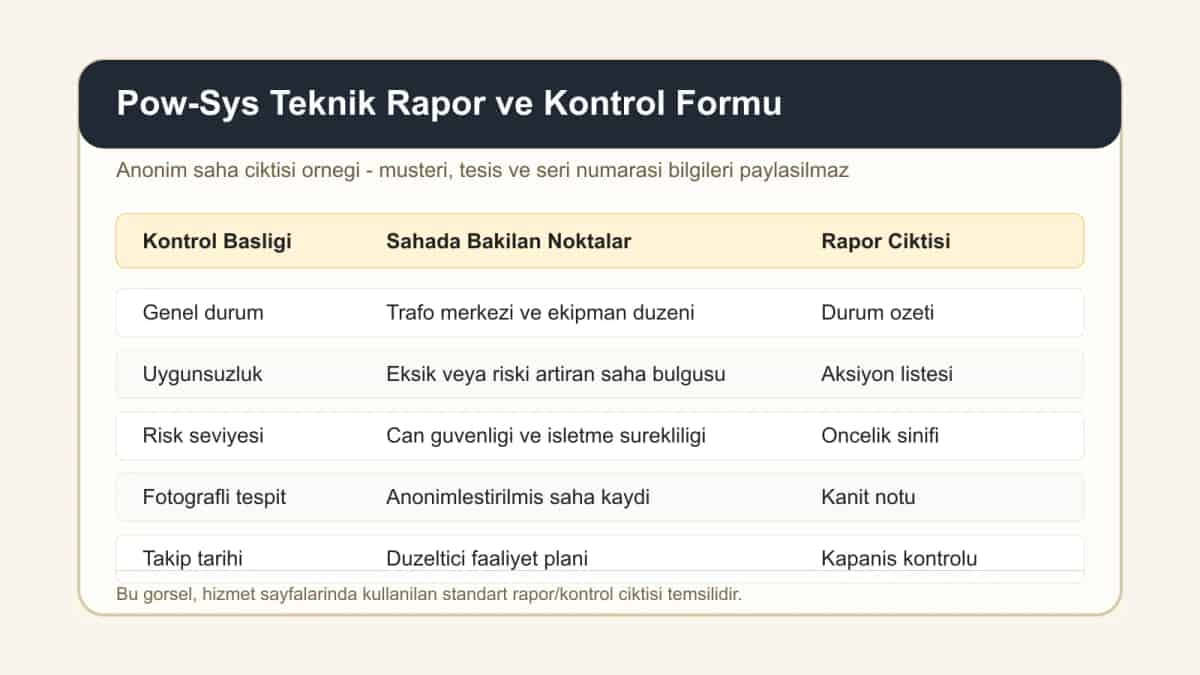
Sample Inspection Table
This table summarizes which headings are evaluated on site and which outputs may appear in the report.
| Inspected area | Checked criterion | Report output |
|---|---|---|
| Site and equipment condition | Existing equipment structure, access conditions, visible risks and operating conditions | Site inspection note and prioritized findings list |
| Document and project conformity | Single-line diagram, current project, labeling, reports and conformity with site implementation | Document conformity assessment and missing record list |
| Safety and operational risk | Life safety, equipment safety, energy continuity and maintenance access risk headings | Risk classification and corrective action recommendations |
| Measurement, test or inspection need | Measurement, test, visual inspection and technical review items required by the service scope | Measurement/test plan or inspection scope note |
| Reporting and follow-up | Nonconformity priority, follow-up date, responsibility allocation and next steps | Photo-supported report, action list and follow-up recommendation |
Out-of-Scope and Separately Planned Works
Bursa Battery Periodic Inspection produces technical follow-up, reporting, compliance assessment and risk notification. The following works are planned separately when required; final risk level, cost and scope are not confirmed without an on-site survey.
| Out-of-scope / separate work | Why is it evaluated separately? | Pow-Sys approach |
|---|---|---|
| Grounding measurement | It may require measurement equipment, site time and a separate report. | The need is stated in the main report; measurement work is planned separately. |
| Relay testing and selectivity | Relay settings, test equipment, outage planning and separate engineering assessment may be required. | Quoted as a separate testing/selectivity service when needed. |
| Thermal imaging inspection | It requires imaging under load and a separate thermal finding report. | Planned separately for panels, switchgear or connections where risk is observed. |
| Transformer maintenance and oil analysis | It may require maintenance crew, sampling, laboratory work or a separate test procedure. | The need is written in the technical report; maintenance/testing is prepared as a separate scope. |
| Project revision, implementation and physical remediation | It creates material, labor, authority process or implementation responsibility. | The main service reports the finding; implementation and contracting works are handled separately. |

Official Regulatory Sources
- EMO certificate verification portal
Claim supported on this page: EMO registration, SMM and certificate verification transparency.
- TEDAŞ official website
Claim supported on this page: Distribution infrastructure, project/acceptance processes and technical specification context.
- TEİAŞ official website
Claim supported on this page: Transmission system, connection and high-voltage infrastructure context.
- Electrical High Current Installations Regulation
Claim supported on this page: Installation, operation, maintenance and safety of high-current electrical installations.
Frequently Asked Questions
What is battery periodic inspection and which systems does it cover?
Battery periodic inspection is the visual inspection and electrical testing at defined intervals of industrial battery groups used in UPS systems, rectifier and DC panels, fire detection and alarm panels, emergency lighting and exit systems, security and CCTV systems, data center and network racks, energy storage systems, generator starter systems and similar critical processes. During the inspection, physical condition, connections, battery room or charging area conditions, voltage, internal resistance / impedance, load and capacity tests when required are evaluated; results are documented as a battery periodic inspection report and battery test report.
Are battery periodic inspection and battery periodic maintenance the same thing?
No. Battery periodic inspection or accumulator periodic examination is a mandatory examination, testing and reporting activity under the regulations and must be carried out by authorized engineers or accredited organizations. Battery periodic maintenance mostly covers operating and service activities such as terminal cleaning, tightening connections, ventilation and cleaning checks of the battery room, charging voltage adjustments and electrolyte level checks in flooded batteries. The healthiest approach is to confirm the system officially with an independent inspection, load / capacity tests and battery test report after maintenance activities.
What is the accumulator periodic inspection interval? How often should batteries be examined?
Unless a special period is defined in the relevant standards, the maximum inspection interval for accumulator or battery periodic inspection is accepted as one year. Therefore, battery groups used in critical systems such as UPS batteries, rectifier-fed DC panels, fire detection panels and emergency lighting batteries must be subjected to battery periodic inspection at least once a year. In facilities with high temperature, intensive discharge or charge cycles, chemical environments or explosive atmospheres, this interval can be shortened according to risk analysis and battery test results.
How is a UPS battery test performed? Which methods are used?
A UPS battery test begins with measuring open-circuit voltage, float charging voltage and voltage imbalances between cells. Then each battery's internal condition is analyzed with internal resistance / impedance tests; these tests are used to detect weakening batteries or batteries approaching failure at an early stage. When required, battery load tests and full capacity / autonomy tests are applied with a load bank to verify whether the system can provide the catalogue-specified runtime. In advanced applications, battery health is monitored with capacity status reports, trend tracking and continuous UPS battery monitoring solutions.
When should UPS batteries be replaced? How long is battery life?
The life of UPS batteries varies according to ambient temperature, charger settings, discharge frequency, battery type such as VRLA, AGM, gel, Ni-Cd or lithium-ion, and operating conditions; in practice it is planned between 3 and 5 years in many facilities. However, this period can be misleading if it is not supported by periodic tests and impedance trends. During inspections, batteries with significantly increased internal resistance, reduced capacity, physical deformation or values that differ strongly from others in the same string are classified as requiring immediate replacement and planned UPS battery renewal is recommended.
For which battery types do you provide periodic inspection and testing?
Our Bursa battery periodic inspection service covers VRLA maintenance-free lead-acid batteries, AGM and gel batteries, conventional flooded industrial batteries, Ni-Cd batteries, lithium-ion based energy storage systems, UPS battery groups, rectifier and DC panel batteries, fire detection panel and emergency lighting batteries, security and CCTV system batteries, generator starter batteries and similar industrial battery applications. Instead of classic vehicle battery replacement, we focus on critical battery and energy storage systems of the facility and battery room / charging area safety.
What is included in the battery test report? Is it valid in official inspections?
The battery test report includes inspection date and location, system definition such as UPS, rectifier or fire panel, battery test and measurement devices used and calibration information, voltage and internal resistance / impedance values measured for each battery or cell, results of load and capacity tests if applied, battery classification such as normal, monitor or replace, nonconformities detected in the battery room and charging area, and recommended corrective actions. The report is signed by the relevant engineer and can be used as a supporting document in official inspections for periodic inspection obligations under the Regulation on Health and Safety Conditions in the Use of Work Equipment.
Which checks are performed for battery rooms and forklift battery charging areas?
In battery room and forklift battery charging area inspections, the adequacy of natural or mechanical ventilation, hydrogen accumulation risk, temperature and humidity conditions, measures against acid spills, chemical resistance and slope of the floor, eye-wash and first-aid facilities, conformity of the electrical installation, grounding and equipotential bonding, status of fire detection and extinguishing systems, warning signs and safety markings are evaluated. Cables, connections, fuses and protection devices of forklift battery charging rectifiers are also checked and recorded in the inspection report.
How are Bursa battery periodic inspection prices determined?
The price is determined according to the number of UPS, rectifier and battery systems on site, number and capacity of batteries in each system, layout of battery groups, number of battery rooms and forklift charging areas, requested test scope such as only voltage and impedance measurement or additional load / capacity tests and thermal camera measurements, report language and facility location. After preliminary survey or project review, we offer different scenarios from narrow packages including only battery test and measurement to integrated packages that also include UPS periodic maintenance and other electrical periodic inspections.
How can I use battery reports in EKİPNET and OHS-KATIP processes?
For mandatory battery inspections, the employer and authorized inspector must approve an İSG-KATİP contract at least one day before the inspection. EKİPNET records the authorized person. Keep the signed inspection report with the facility records; findings can support risk assessment and the maintenance plan.
Why is the electrolyte level important in battery group maintenance?
In conventional flooded (vented) batteries, the electrolyte is the medium that carries the electrochemical reaction, so its level and condition directly affect capacity and service life. Electrolyte level checks are therefore a standard part of battery periodic maintenance for flooded battery groups: a level that has dropped below the recommended range reduces effective capacity and can permanently damage the exposed plates, while incorrect topping-up practices can disturb the electrolyte balance. Level checks also give early hints about overcharging or excessive gassing, which are evaluated together with charging voltage settings and battery room ventilation. Note that maintenance activities such as electrolyte checks do not replace the official periodic inspection; the battery group should still be verified with voltage, internal resistance and, when required, capacity tests.
Related Services
Related Blog Posts
- What Are Breaker Failure Protection and Busbar Protection Relays? What Do They Do, How Do They Work and Why Are They Used?
- What Is an MV XLPE Cable? What Does It Do, How Does It Work and What Structure Does It Have?
- What Is Metal-Clad Switchgear? What Does It Do, How Does It Work and What Features Does It Have?