
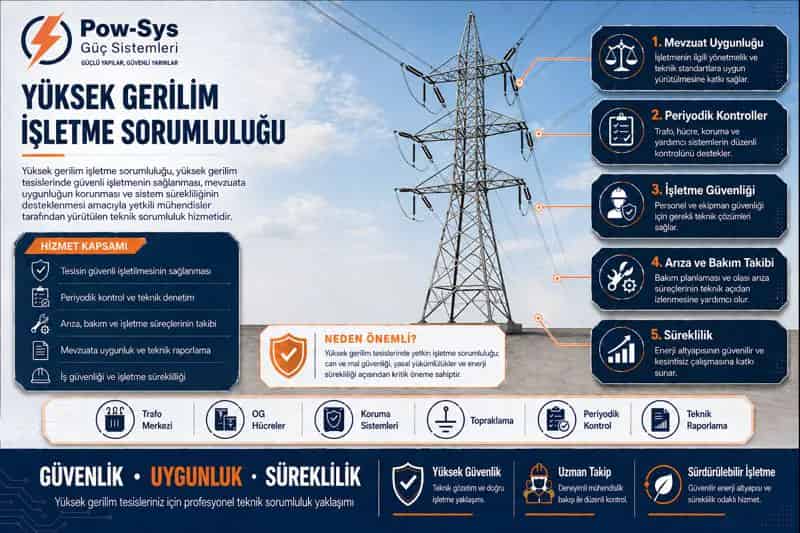
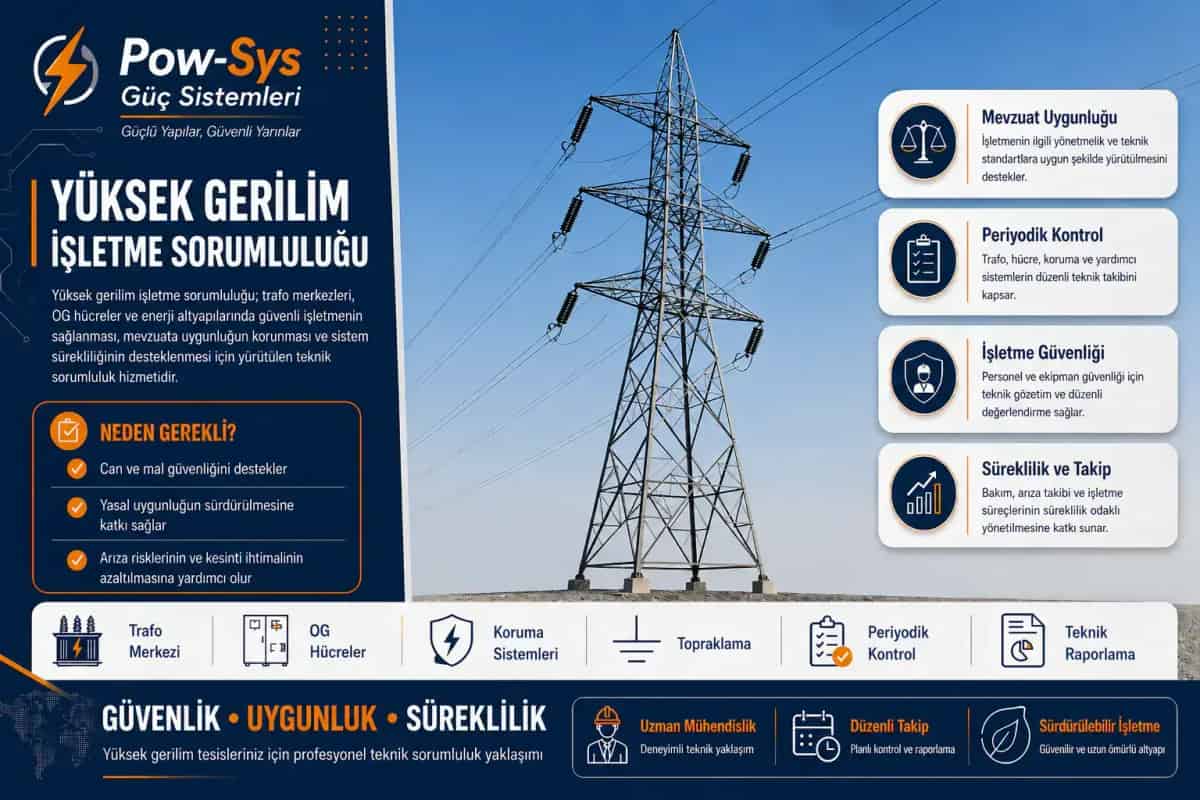
Summary Highlights
- What high voltage operation responsibility is: an engineering service that undertakes the safe and regulation-compliant operation of HV installations
- Why high voltage operation responsibility is necessary: protection of life and property safety, operational continuity and reduction of incorrect switching risk
- What is included in the service: facility inspection, single-line diagram, switching instructions, maintenance coordination and grounding follow-up
- Duties of the responsible operating engineer: evaluation of fault trips, coordination with the energy supplier and guidance of operating personnel
- Correct operation responsibility approach: carrying out regular inspection, written reporting, preventive maintenance planning and field discipline together
Article Details
High voltage operation responsibility is a technical responsibility service that undertakes the safe, continuous and regulation-compliant operation of electrical installations above 1 kV. In short, the answer to the question of what high voltage operation responsibility is: it is an engineering organization that ensures an HV installation not only remains energized but also operates with correct switching and under correct safety rules. This service aims to monitor the condition of field equipment, organize maintenance and operation processes and identify possible risks in advance.
The answer to why high voltage operation responsibility is necessary is not only legal obligation. Of course, the regulatory side is important; however, the main subject is operational safety. Incorrect switching, neglected maintenance, insufficient grounding, an outdated single-line diagram or inadequate personnel guidance in a high-voltage installation directly threatens both human life and facility integrity. Therefore, operation responsibility is not a paperwork completion task; it is the main backbone of safe energy management in the field.
Technical inspection is at the center of this service. After undertaking operation responsibility, the engineer examines the existing HV installation from an operational perspective, identifies defects and deficiencies and reports them to the employer. In this way, not only how the facility operates today but also which risks it carries become visible. This initial assessment forms the basis of the maintenance plan and safety approach to be applied in the following period.
One of the most important parts of the high voltage operation responsibility service is that the single-line diagram is up to date and accessible. It must be clearly visible in the field which cubicle supplies what, which disconnector is connected to which line, transformer and busbar relationships, metering and protection arrangement. An outdated single-line diagram increases the risk of incorrect intervention during a fault or maintenance. Therefore, a good operation responsibility service absolutely ensures that the schematic arrangement is compatible with the actual field condition.
Switching safety is one of the most critical headings of this service. The responsible operating engineer prepares switching instructions, gives them to the operating personnel against signature and ensures that these instructions are accessible where the HV cubicles are located. Because safety in high-voltage installations largely depends on operations performed in the correct sequence. When the circuit breaker will be opened, under which condition the disconnector will be operated, when the earthing switch will be engaged and how the equipment will be handed over to the maintenance team must be written and clear.
High voltage operation responsibility also covers personnel discipline. Operating personnel must be trained, guided in a way that does not lead to incorrect switching and have clearly defined duty limits. Many facilities that appear correct in theory become risky in practice due to lack of training. Therefore, the responsible operating engineer must focus not only on the equipment but also on the human factor that uses the equipment.
Another important pillar of the service is maintenance coordination. The day, time, scope and safety preparations of maintenance to be performed in HV installations are not determined randomly. The responsible operating engineer establishes the necessary coordination between the employer, maintenance team and energy supplier, ensures that equipment is isolated from voltage and handed over to the maintenance team, and manages controlled re-energization of the system after the work is completed. If this process is not managed correctly, maintenance activity may turn into a source of risk.
Fault trips are also a direct subject of high voltage operation responsibility. When a protection relay trips in the facility, it is necessary to evaluate the reason for this, make the necessary switching decision and prevent the system from being re-energized blindly. After every trip, focusing only on restoring power is not correct. First the cause of the trip must be understood, equipment safety and field conditions must be verified, and then a controlled decision must be made. One of the most important values of operation responsibility is this technical filter.
Grounding tests and general safety equipment are also an inseparable part of this service. Having grounding tests performed at intervals suitable for the operating conditions of the facility, keeping safety materials in adequate condition and notifying the employer of deficiencies are among the main duties of operation responsibility. Because in high-voltage installations it is not enough for only primary equipment to be healthy; safety equipment to be used by personnel and protective infrastructure must be monitored with the same seriousness.
High voltage operation responsibility service also includes the technical counterpart relationship with the energy supplier. Technical communication to be carried out on behalf of the facility regarding planned outage requests, re-energization, post-fault coordination and similar subjects should be performed regularly and competently. In this way, operating decisions on the facility side and applications on the external grid side become more compatible. This coordination is especially important in structures with multiple supplies, transformer substations or process dependency.
A well-executed operation responsibility service does not only react to faults; it tries to prevent faults. The condition of existing HV equipment is continuously monitored, findings requiring intervention are reported in writing and daily maintenance is ensured to be carried out by operating personnel. The purpose here is not only to make the facility appear compliant with regulations, but to establish a truly predictable and safe operating order.
Periodic reporting is also one of the strong sides of this service. The condition of the facility, works to be carried out, observed problems, solution proposals and measures to be taken are reported regularly. These reports make high voltage operation responsibility visible and measurable. Which equipment in the field carries risk, which maintenance is delayed and which safety gap exists can be clearly tracked only with this regular record structure.
In summary, high voltage operation responsibility is a comprehensive engineering service carried out for the safe operation of HV installations, correct switching, controlled execution of maintenance works, guidance of personnel and continuous monitoring of technical risks. Single-line diagram, switching instructions, fault evaluation, grounding follow-up, maintenance coordination and regular reporting are at the center of this service. If high voltage operation responsibility, MV/HV equipment checks, transformer substation safety and periodic field follow-up will be handled together in your facility, the aim in the Pow-Sys Power Systems approach is not only to assume the responsibility but to make the facility genuinely safe and manageable.
Related Blog Posts
Related Services
Frequently Asked Questions
What is high voltage operation responsibility?
High voltage operation responsibility is a technical engineering service that undertakes the safe, continuous and regulation-compliant operation of electrical installations above 1 kV. In practical terms, it is an engineering organization that ensures a high-voltage installation not only remains energized but also operates with correct switching and under correct safety rules. The service monitors the condition of field equipment, organizes maintenance and operation processes and aims to identify possible risks before they turn into failures. Its core elements include keeping the single-line diagram up to date, preparing switching instructions, coordinating maintenance, evaluating fault trips, following grounding tests and safety equipment, guiding operating personnel and producing regular reports. For any facility with installations above 1 kV, this responsibility forms the backbone of safe energy management rather than being a formality.
Why is high voltage operation responsibility necessary?
High voltage operation responsibility is necessary to protect life and property safety, reduce the risk of incorrect switching, organize maintenance processes and establish safe operating discipline in the facility. The legal and regulatory side matters, but the main subject is operational safety: in a high-voltage installation, incorrect switching, neglected maintenance, insufficient grounding, an outdated single-line diagram or inadequate personnel guidance directly threatens both human life and facility integrity. The service places a technical filter between the facility and these risks, ensuring that switching happens in the correct sequence, that maintenance is coordinated and controlled, and that fault trips are evaluated before the system is re-energized. Operation responsibility is therefore not a paperwork completion task; it is the main backbone of safe energy management in the field, and facilities that treat it as a formality carry real, avoidable risk.
Which works does the responsible operating engineer perform?
The responsible operating engineer carries out a wide range of connected works. The engineer examines the existing high-voltage installation from an operational perspective, identifies defects and deficiencies and reports them to the employer; ensures the single-line diagram is up to date and matches the actual field condition; and prepares switching instructions, gives them to operating personnel against signature and keeps them accessible where the HV cubicles are located. The engineer also establishes maintenance coordination between the employer, the maintenance team and the energy supplier, managing safe isolation, hand-over of equipment and controlled re-energization; evaluates fault trips and prevents blind re-energization; has grounding tests performed at suitable intervals; monitors safety equipment; trains and guides operating personnel; and produces regular written reports. Together, these duties turn operation responsibility into continuous technical supervision rather than a one-time inspection.
Is high voltage operation responsibility only paperwork?
No, high voltage operation responsibility is not only paperwork, and treating it as a contract or official registration process misses its real purpose. The real essence of the service is field switching safety, maintenance planning, technical inspection and operating discipline. A well-executed operation responsibility service does not merely react to faults; it works to prevent them by continuously monitoring the condition of HV equipment, reporting findings that require intervention in writing and ensuring that daily maintenance is carried out by operating personnel. Many facilities that appear correct in theory become risky in practice because of lack of training or outdated documentation, which is exactly what active operation responsibility prevents. The goal is not to make the facility appear compliant with regulations but to establish a genuinely predictable and safe operating order in the field.
Why is the single-line diagram so important?
The single-line diagram is important because the real structure of the system must be seen correctly during faults, maintenance and switching. It must be clearly visible in the field which cubicle supplies what, which disconnector is connected to which line, how the transformer and busbar relationships are arranged, and how the metering and protection arrangement is organized. An outdated single-line diagram increases the risk of incorrect intervention exactly at the moments when accuracy matters most: during a fault or a maintenance operation, personnel act on what the diagram tells them, so a diagram that no longer matches the actual field condition can make a switching step that looks safe on paper dangerous in reality. This is why a good operation responsibility service ensures the schematic arrangement stays compatible with the actual installation and remains accessible to those who operate it.
Why are switching instructions prepared?
Switching instructions are prepared because opening, closing and grounding operations in high-voltage installations must be performed in a safe, defined sequence, and safety in these installations largely depends on operations being carried out in the correct order. Written instructions standardize this process and reduce the risk of error by stating clearly when the circuit breaker will be opened, under which condition the disconnector will be operated, when the earthing switch will be engaged and how the equipment will be handed over to the maintenance team. The responsible operating engineer prepares these instructions, gives them to the operating personnel against signature and ensures they are accessible where the HV cubicles are located. In this way, switching stops depending on individual memory or habit and becomes a documented, repeatable procedure that protects both personnel and equipment.
Are grounding tests included in operation responsibility?
Yes, grounding tests are an inseparable part of high voltage operation responsibility. The service includes having grounding tests performed at intervals suitable for the operating conditions of the facility, keeping safety materials in adequate condition and notifying the employer of deficiencies. The reasoning is that in high-voltage installations it is not enough for the primary equipment alone to be healthy: the safety equipment used by personnel and the protective infrastructure must be monitored with the same seriousness, because insufficient grounding directly threatens both human life and facility integrity. Grounding follow-up therefore sits alongside the single-line diagram, switching instructions, maintenance coordination and fault evaluation among the core duties of the responsible operating engineer. A facility whose grounding status is tested, recorded and reported on a regular schedule is a measurably safer place to operate and maintain.
What is the role of the responsible operating engineer during fault trips?
When a protection relay trips in the facility, the responsible operating engineer technically evaluates the cause of the trip, makes the necessary switching decision and prevents the system from being re-energized in an uncontrolled way. After every trip, focusing only on restoring power as quickly as possible is not correct: first the cause of the trip must be understood, equipment safety and field conditions must be verified, and only then can a controlled re-energization decision be made. Re-energizing blindly onto an unresolved fault puts both personnel and equipment at risk. This technical filter between a trip and the decision to restore power is one of the most important values of high voltage operation responsibility, and it also connects to coordination with the energy supplier when the fault involves the external grid or requires planned outage arrangements.
Who carries out high voltage operation responsibility service?
High voltage operation responsibility service is carried out by engineers who meet the authorization conditions defined in the current regulations and hold a YGTIS certificate. Within this framework, the responsible operating engineer becomes the technical authority for the safe operation of the facility's installations above 1 kV: inspecting the installation, keeping the single-line diagram current, preparing switching instructions, coordinating maintenance with the employer, the maintenance team and the energy supplier, evaluating fault trips and reporting regularly. Because the role directly concerns life and property safety, it cannot be undertaken informally or assigned to unqualified staff; the authorization requirement exists precisely so that switching decisions and safety judgments in high-voltage installations rest with a qualified engineer. Facilities should therefore verify the credentials of the engineer or organization to which they entrust this responsibility.
Why is reporting important in operation responsibility?
Reporting is important because regular reports make observed deficiencies, works to be performed, maintenance needs and safety risks visible, which enables facility management to make healthier decisions. In a well-run service, the condition of the facility, the works to be carried out, the problems observed, solution proposals and the measures to be taken are reported at regular intervals. These reports make high voltage operation responsibility itself visible and measurable: which equipment in the field carries risk, which maintenance is delayed and which safety gap exists can be clearly tracked only with this regular record structure. Without written reporting, findings remain informal and are easily forgotten, and slowly developing problems surface only when they cause a failure. With it, the facility gains a documented history that supports preventive maintenance planning and shows that risks are being actively managed.