
Summary Highlights
- Importance of high-voltage line maintenance: energy continuity, field safety and reduction of fault risk
- Basic maintenance steps: line patrol, visual inspection, tower and foundation review, conductor and hardware assessment
- Checks to be performed: insulators, joint points, jumpers, vibration dampers, shield wire and grounding system
- Advanced diagnostic methods: thermal camera, UV inspection, sag and clearance assessment, critical-point-focused technical checks
- Corridor and record management: vegetation approach control, access safety, defect classification and tracking maintenance history
Article Details
High-voltage lines are transmission infrastructures that form the backbone of the power system, and reliable operation of these structures depends on a regular maintenance program. Therefore, the tests and maintenance required for high-voltage lines are not only actions performed after a fault occurs. The main purpose is to detect mechanical deterioration, electrical weaknesses, environmental risks and safety problems that may occur along the line before a fault happens. Because a small defect on a transmission line can turn from a local issue into a system-level problem over time.
The first step of maintenance is always safety and planning. According to the section where work will be carried out, operating preparation, access plan, approach distances, field permits and, if necessary, an outage scenario should be determined. Maintenance on a high-voltage line includes not only electrical risk, but also additional risks such as working at height, open terrain, wind, ground conditions and mechanical access. Therefore, the maintenance approach should cover electrical safety and field operation safety together.
Line patrols form the basis of the maintenance program. These patrols can be performed on foot, by vehicle, with aerial support when required or with technological monitoring methods. The purpose is to identify tower structures, conductor condition, insulator strings, shield wire, tree approach, environmental damage, corrosion and third-party intervention risks as early as possible. On a line where regular patrol is not performed, the fault is usually noticed for the first time at the moment of outage. A good maintenance system, however, aims to see line problems before the fault occurs.
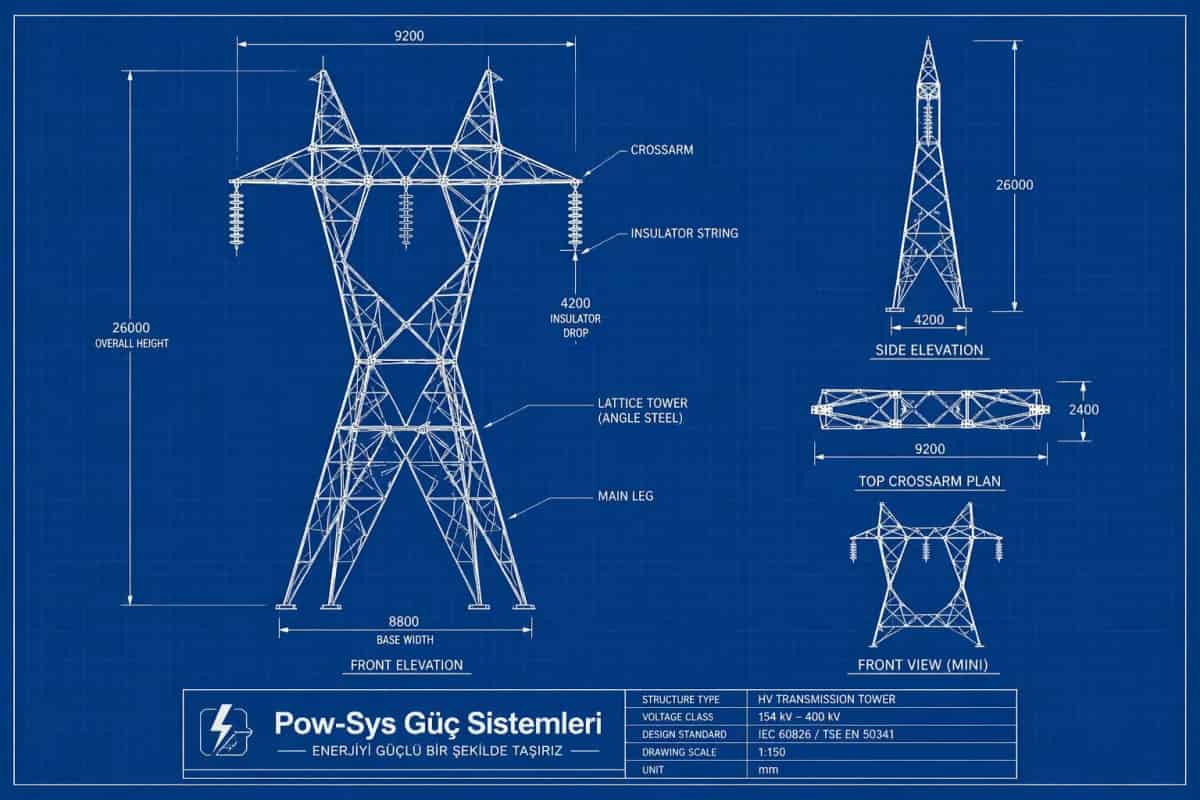
Inspection of tower and pole structures is one of the most critical headings in high-voltage line maintenance. Tower legs, connection bolts, crossarms, diagonal members, corroded areas, deformations, mechanical impact marks, anti-climbing structures and access elements such as ladders and platforms should be examined carefully. Foundation areas should also be checked for settlement, soil washout, erosion, concrete cracks or anchor looseness. Because weakness in the supporting structure of a transmission line can have consequences as serious as an electrical defect.
Conductors and conductor hardware are the electrical and mechanical center of maintenance. The conductor should be checked for broken strands, excessive wear, damage caused by birds or external effects, corrosion, out-of-lay condition, local burn marks and deterioration around joint areas. Jumpers, cable joints, dead-end and suspension hardware, spacers, vibration dampers and clamp connection areas are also part of this inspection. Because on a high-voltage line, the problem often appears not only on the conductor body, but also on the hardware that carries or connects the conductor.
Insulator strings are among the most sensitive elements of a high-voltage line. Defects such as contamination, cracks, broken units, surface tracking, corona signs, missing discs, fitting looseness, cuts or erosion on composite bodies should be monitored carefully. Especially in coastal, industrial or heavily polluted areas, the condition of the insulator surface directly affects line performance. When necessary, insulator cleaning should be handled as a special part of the maintenance plan. Because when surface contamination combines with moisture, it can significantly increase leakage current and flashover risk.
Shield wire or earth wire checks should not be neglected. This conductor not only provides protection against lightning, but is also part of the overall mechanical and protective behavior of the line. Defects such as broken strands, corrosion, looseness at joint areas, loss of connection or external damage in OPGW types should be evaluated carefully. Likewise, tower grounding connections, down conductors and grounding continuity should be included in the maintenance program. Because lightning performance depends not only on the upper wire, but also on how the current is transferred to earth.
Sag and clearance assessments are especially important in lines with temperature variation, heavy loading, icing or aging. Excessive conductor sag between towers, reduced approach distances to the environment or risky reduction of phase-to-phase distance are critical maintenance findings. Therefore, ground clearance, tree approach, structure approach and mechanical behavior in long spans should be monitored regularly along the line. Visible sag differences should be verified with more detailed measurement and engineering review when necessary.
Thermal inspection is a very valuable diagnostic tool in high-voltage line maintenance. Especially when joint points, jumper connections, clamp areas, terminal ends and metal-to-metal contact areas that may create high resistance are inspected with a thermal camera, hot spots that cannot be noticed visually can be detected at an early stage. In thermal assessment, the purpose is not an absolute temperature alone, but seeing differences between similar phases and similar hardware. A clear temperature difference often indicates loose connection, increased contact resistance or hardware deterioration.
In some cases, UV inspection also provides important support. Corona activity, surface deterioration or high electric field effects on insulators and hardware can become more visible with UV-based inspection. This method is useful especially on energized lines for evaluating some defects that are not clearly understood visually. However, UV inspection is not always sufficient alone; it gives stronger results when interpreted together with visual inspection and thermal assessment.
Vegetation and line corridor management is another main heading of high-voltage line maintenance. Tree approach, branch contact risk, vegetation preventing access to tower foundations, vegetation rubbing against guy wires and dense growth that makes maintenance access difficult should be checked regularly. Corridor maintenance is important not only for preventing outages, but also for fire risk, tower foundation inspection and access to grounding elements. The environmental safety of the line often depends on the quality of corridor management.
High-voltage line maintenance is not only mechanical inspection; external effects should also be evaluated. Bird-related contamination, hunting bullet damage, third-party intervention, unauthorized construction, agricultural equipment approach, road opening works and the effects of severe weather events should be included in maintenance records. Because such external effects can create risks that are not part of the original line design but seriously affect operating reliability.
Classification and prioritization of critical defects is a basic part of maintenance management. Not every defect is evaluated with the same severity. Some problems require immediate intervention, while others can be included in the planned maintenance schedule. Situations such as a broken insulator, shield wire close to failure, serious thermal anomaly, dangerous sag or structural risk at a tower foundation carry urgent priority. In contrast, light surface contamination or early-stage corrosion can be resolved within planned maintenance. Making this distinction correctly is also important for resource management.
At the end of maintenance, all findings should be recorded regularly. Patrol reports, photographs, thermal images, defect locations, tower numbers, environmental observations and corrective actions performed should be kept in a single maintenance history. Because high-voltage line problems often grow not suddenly, but through defects that develop over time. When trend tracking is performed, repeated problems on the same tower, corrosion concentrated in specific areas or environmental effects become clearer.
In summary, the tests and maintenance required for high-voltage lines consist of regular line patrols, tower and foundation inspections, conductor and hardware checks, insulator assessments, shield wire and grounding verifications, thermal and, when necessary, UV inspections, sag and clearance checks and corridor maintenance carried out together. A good maintenance system aims not only to correct faults, but to see the weak points of the line before a fault occurs. If high-voltage line connections, MV/HV field suitability, transmission equipment checks and maintenance planning in your facility will be evaluated together, it is possible to proceed in an integrated way with HV/MV testing, maintenance and repair, LV/MV/HV project design and consultancy on the project side and HV operation responsibility services in operation processes.

Related Blog Posts
Related Services
Frequently Asked Questions
Why is maintenance required on high-voltage lines?
Maintenance is required because high-voltage lines are the backbone of the power system, and their towers, conductors, insulators, shield wire and hardware deteriorate over time under environmental and mechanical effects. Without regular maintenance, the probability of outages, safety risks and equipment failure all increase, and a small defect on a transmission line can grow from a local issue into a system-level problem. The purpose of a maintenance program is therefore not simply to correct faults after they happen, but to detect mechanical deterioration, electrical weaknesses, environmental risks and safety problems along the line before a fault occurs. On a line without regular patrols, the fault is usually noticed for the first time at the moment of outage; a good maintenance system aims to see the weak points well before that moment.
Which checks are performed on high-voltage lines?
Depending on the application, high-voltage line maintenance includes regular line patrols, tower and foundation inspections, conductor and hardware checks, insulator assessments, shield wire and grounding verifications, thermal inspection, UV observation when needed, sag and clearance assessments and vegetation corridor checks. Patrols can be performed on foot, by vehicle, with aerial support or with technological monitoring methods. The program also covers external effects such as bird-related contamination, hunting bullet damage, third-party intervention, unauthorized construction and severe weather, since these create risks outside the original line design. Findings are classified and prioritized: a broken insulator, a shield wire close to failure, a serious thermal anomaly or dangerous sag demands urgent action, while light contamination or early-stage corrosion joins the planned schedule. Everything ends in recorded maintenance history.
Why is line patrol important?
Line patrol is important because many defects show visual signs at an early stage, and a regular patrol program is what catches them before they become outages. Patrols performed on foot, by vehicle, with aerial support or through technological monitoring identify tower structure problems, conductor condition, insulator string defects, shield wire damage, tree approach, environmental damage, corrosion and third-party intervention risks as early as possible. Broken insulators, loose hardware and vegetation creeping toward the conductors are exactly the kinds of findings a patrol notices in time. The alternative is expensive: on a line where regular patrol is not performed, the fault is usually noticed for the first time at the moment of outage. Patrols therefore form the base layer of the whole maintenance program, feeding the more specialized inspections.
What is checked in tower and foundation inspection?
Tower and foundation inspection examines the structural skeleton that carries the entire line. On the tower itself, the legs, connection bolts, crossarms, diagonal members, corroded areas, deformations, mechanical impact marks, anti-climbing structures and access elements such as ladders and platforms are checked carefully. At ground level, the foundation areas are reviewed for settlement, soil washout, erosion, concrete cracks and anchor looseness. This heading is treated as one of the most critical in high-voltage line maintenance because weakness in the supporting structure can have consequences as serious as an electrical defect: a compromised tower endangers the conductors, the insulators and everything the line feeds. Structural findings are recorded with tower numbers and photographs so repeated problems at the same location become visible through the maintenance history.
Which defects are searched for in conductor maintenance?
Conductor maintenance searches for broken strands, excessive wear, damage caused by birds or external effects, corrosion, out-of-lay condition, local burn marks and deterioration around joint areas. The inspection deliberately extends beyond the conductor body to the hardware that carries and connects it: jumpers, cable joints, dead-end and suspension hardware, spacers, vibration dampers and clamp connection areas, because on a high-voltage line the problem often appears in these components rather than in the conductor itself. Abnormal sag belongs to the same picture, since excessive sag between towers, reduced clearance to the environment or shrinking phase-to-phase distance are critical findings, especially on lines exposed to temperature variation, heavy loading, icing or aging. Visible sag differences are verified with more detailed measurement and engineering review when necessary.
Which maintenance headings are important for insulators?
For insulators on high-voltage lines, the most important maintenance headings are contamination, cracks, broken units and missing discs, surface tracking, corona signs, fitting looseness, and cuts or erosion on composite bodies. Insulator strings are among the most sensitive elements of a line, and in coastal, industrial or heavily polluted areas the condition of the insulator surface directly affects line performance. Cleaning is handled as a special part of the maintenance plan when required, because surface contamination combined with moisture can significantly increase leakage current and flashover risk. UV inspection provides useful support here, making corona activity and high electric field effects on insulators and hardware more visible on energized lines, especially for defects that cannot be clearly judged by visual inspection alone.
Why should the shield wire be checked?
The shield wire should be checked because it helps protect the line against lightning, and any breakage, corrosion or loss of connection weakens that protection. Maintenance looks for broken strands, corrosion, looseness at joint areas, loss of connection and, in OPGW types, external damage. The check does not stop at the wire itself: tower grounding connections, down conductors and grounding continuity are included in the same program, because lightning performance depends not only on the upper wire but on how the current is transferred to earth. The shield wire is also part of the line's overall mechanical and protective behavior, so its condition matters for more than lightning alone. Together, the shield wire and grounding verifications form one of the core headings of high-voltage line maintenance.
What does a thermal camera do on a high-voltage line?
A thermal camera detects abnormal heating on a high-voltage line at an early stage, before it can be noticed visually. The most valuable targets are joint points, jumper connections, clamp areas, terminal ends and metal-to-metal contact areas that may create high resistance; hot spots found there typically indicate loose connections, increased contact resistance or hardware deterioration. Interpretation relies on comparison rather than absolute values: the purpose is to see differences between similar phases and similar hardware, and a clear temperature difference is what signals a developing problem. Serious thermal anomalies are classified as urgent findings in maintenance management. Thermal assessment also works well alongside UV inspection and visual review, with the three methods together providing a much stronger diagnostic picture than any one of them alone.
Why is corridor maintenance part of the maintenance program?
Corridor maintenance is part of the program because tree and vegetation approach creates outage, fire and access risks. Branch contact risk, vegetation preventing access to tower foundations, growth rubbing against guy wires and dense cover that makes maintenance access difficult are all checked regularly. The corridor also has to stay manageable so that tower foundations and grounding elements can actually be inspected, which makes vegetation control a precondition for the rest of the maintenance program rather than a cosmetic task. Ground clearance and structure approach assessments depend on the same corridor discipline, since reduced approach distances are critical findings. In practice, the environmental safety of a high-voltage line often depends directly on the quality of its corridor management, which is why it stands as a main maintenance heading.
Why is record keeping important in high-voltage line maintenance?
Record keeping is important because changes in defects over time strengthen maintenance decisions in a way single observations cannot. Patrol reports, photographs, thermal images, defect locations, tower numbers, environmental observations and completed corrective actions should all be kept in a single maintenance history. High-voltage line problems typically grow through defects that develop gradually rather than appearing suddenly, and trend tracking is what reveals them: repeated problems on the same tower, corrosion concentrated in specific areas, increasing thermal deviations or environmental effects become clear only when records are compared across patrols. Good records also support the classification and prioritization of defects, helping distinguish findings that require immediate intervention from those that belong in the planned maintenance schedule, and making resource management decisions defensible with documented evidence.