
Summary Highlights
- What is a high voltage line: its basic definition as a transmission infrastructure in which electrical energy is transported over long distances.
- What does a high voltage line do: the task of ensuring the safe and efficient transmission of large power by reducing losses
- How does a high voltage line work: conductor, tower, insulator, ground wire and span distances and transmission logic
- High voltage line sections: conductors, poles or towers, sleepers, insulator strings, shield wire and fasteners
- Line selection and safety: voltage level, clearance, sag-tension, environmental conditions, safety distance and maintenance need
Content
High voltage line is a transmission system that allows electrical energy to be transported over long distances from production points to substations and different network nodes. Briefly, the answer to the question of what is a high voltage line is; It is an energy transmission infrastructure that delivers large amounts of electrical power to remote locations safely and with low loss. This structure does not consist only of wires; It is an engineering system in which conductors, towers, insulators, connection parts and protection elements work together.
The basic answer to the question of what a high voltage line does is efficiency. When electrical energy is transported at a higher voltage at the same power level, the current decreases. With the decrease in current, I²R losses on the line decrease and the energy can be transmitted to farther points more economically. For this reason, high voltage transmission is the basic approach in backbone systems established between electricity generation and end-use points. The critical transition line between the power plant and the distribution system is often established through these transmission lines.
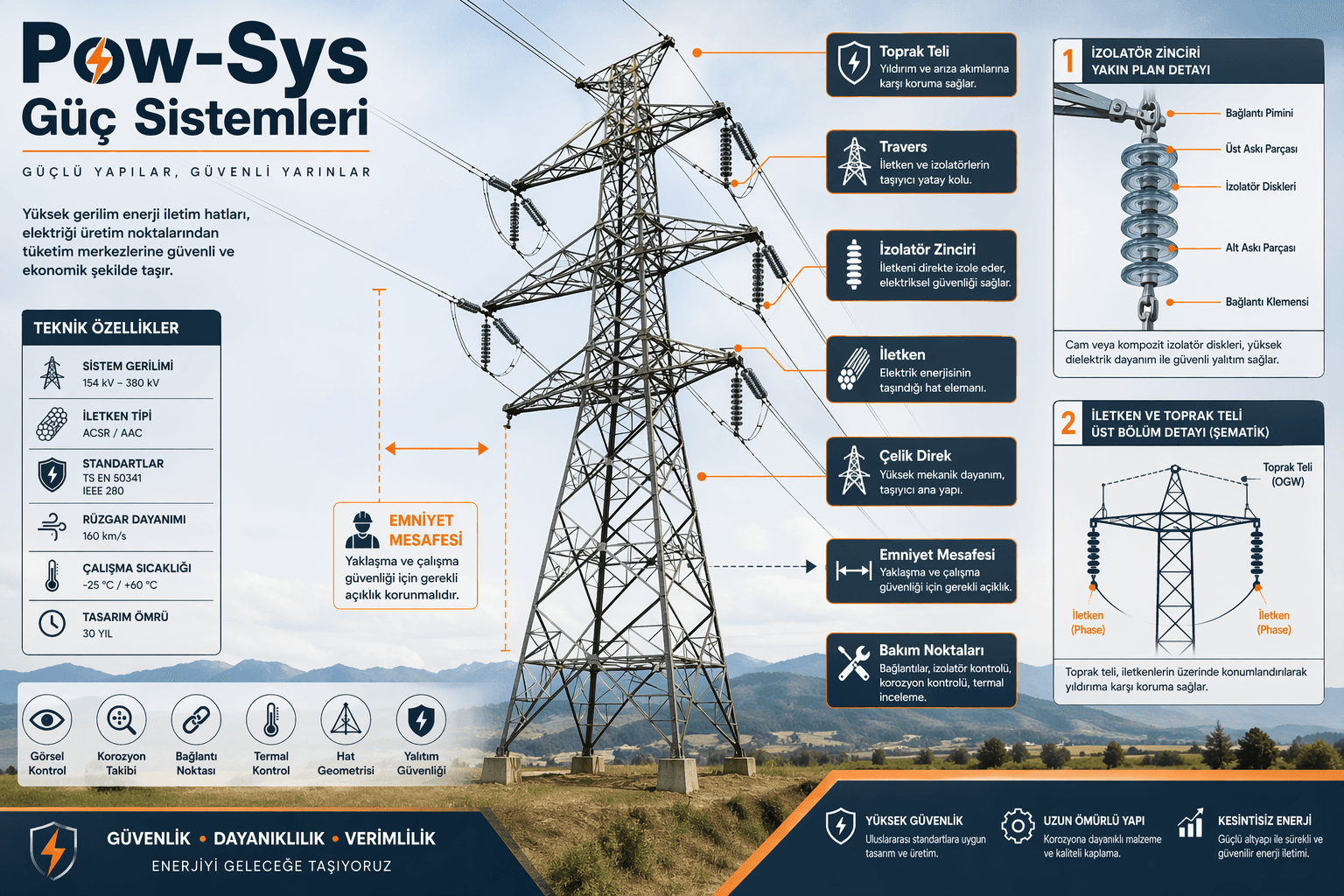
Considering the high voltage line operating logic, conductors are at the center of the system. These conductors carry electric current; towers or poles keep conductors at a safe distance from the ground and surrounding structures. Conductors are not directly connected to the tower, insulators intervene. Thus, the line voltage is carried safely without escaping to the tower body and ground. The clearance on the line, conductor oscillation, sagging amount and environmental distances are also part of system security.
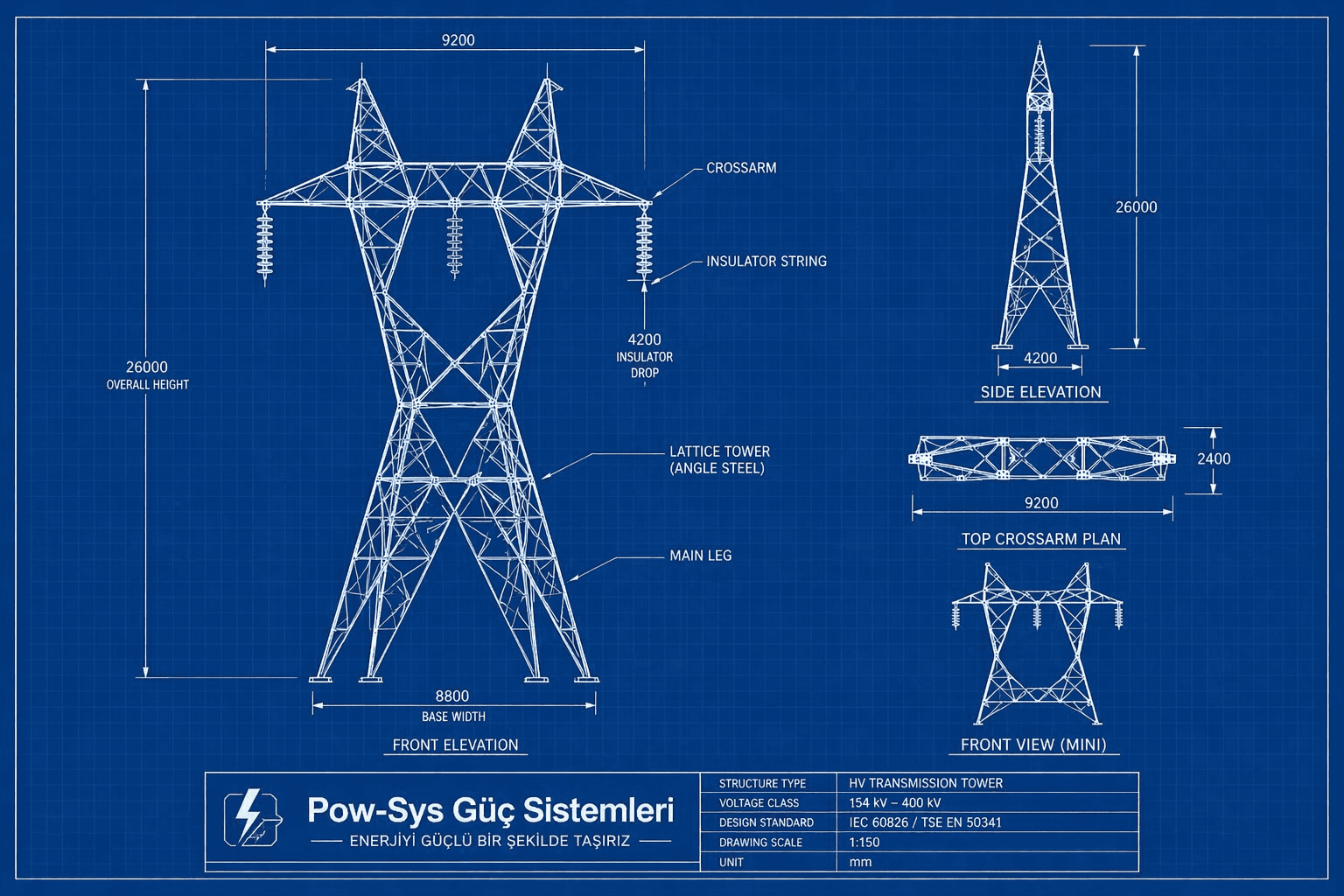
The most visible part of a high voltage line is the pole or tower structures. These structures are designed not only to keep the conductors up, but also to provide adequate clearance between phases and between the conductor and the environment. As the voltage level increases, tower height, phase clearance and insulator dimensions may increase accordingly. That's why not every high voltage line looks the same; Stress level, terrain structure, span length and mechanical loads directly affect the tower design.
Line conductors are often selected from aluminum-based materials, and some designs use steel-core structures to increase mechanical strength. Because the conductor not only carries electricity; It must also withstand mechanical stress caused by wind, ice load, temperature change and long spans. Therefore, when choosing a conductor, not only current carrying capacity but also mechanical behavior is taken into account.
Insulators are indispensable elements of high voltage lines. Their job is to electrically separate energized conductors from the tower or mast body. They also carry the mechanical load of the conductor. As the voltage level increases, the insulator string usually becomes longer or stronger designs are used. Because for safe insulation, both the air gap and the creepage distance on the insulator become critical. Therefore, the insulator in the high voltage line is not only an auxiliary part, but also one of the main elements of line safety.
In many high voltage lines, there is a ground wire or shield wire at the top of the phase conductors. This conductor helps protect the line against lightning strikes. The aim is to ensure that lightning strikes the protective line above, rather than directly to the phase conductors, and to distribute the energy in a more controlled manner through the grounding system. This protection approach is of great importance, especially in open terrain and long lines.
Sagging in high voltage lines is also one of the critical engineering topics. Conductors never lie completely flat between two towers; It sags a certain amount due to its own weight, temperature effect, wind and ice load. For this reason, minimum ground clearance, span length, maximum mechanical stress and environmental conditions are evaluated together in line design. An incorrectly calculated line may lose sufficient safety distance.
A high voltage line and a distribution line are not the same thing. Both carry energy; However, the high voltage line is generally the main backbone system established to transmit larger powers over longer distances. When the distribution level is approached, the voltage is reduced in the substations and the energy is distributed to residential areas with different infrastructures. Therefore, the high voltage line represents the backbone section of the network.
Although only overhead lines are considered when high voltage lines are mentioned in the field, underground transmission solutions can also be used in some regions. However, over large distances and in open fields, overhead high voltage lines are often the more common solution. The main reason for this is that overhead lines are more suitable in most applications in terms of wide span, maintenance access and cost balance in the transmission of large powers.
High voltage line safety is not limited to physical distances only. Underline approach distances, construction rules, equipment working limits, crane and construction equipment use, tree approach and maintenance procedures should be considered together. Because one of the biggest risks around high voltage lines is the dangerous electrical effect that may occur as a result of direct contact or close proximity. Therefore, site safety rules are important not only for electrical personnel, but also for anyone who approaches.
Regular maintenance is required for the healthy operation of the high voltage line. Tower foundations, connection bolts, conductor splices, insulator strings, vibration dampeners, earth wire, corrosion condition, thermal behavior and line corridor should be regularly monitored. Because small mechanical or electrical problems in these structures can turn into major outages over time. Especially in areas where environmental impacts are intense, the maintenance plan becomes more critical.
In summary, high voltage line; It is the main transmission infrastructure established to transport electrical energy over long distances in a safe, controlled and efficient manner. Poles, conductors, insulators, shield wire, connection equipment and safety distances work as a whole. A correctly designed and properly maintained high voltage line is indispensable for the continuity of the energy system. If high voltage line connections, substation integration, MV/HV field suitability or maintenance needs will be evaluated together in your facility HV/MV testing, maintenance and repair, on the project side LV/MV/HV project design and consultancy and business processes SA operation responsibility It is possible to progress in integration with services.
Frequently Asked Questions
What is a high voltage line?
High voltage line is a transmission infrastructure that allows electrical energy to be transported over long distances with lower losses. It consists of conductors, towers, insulators and protection elements.
What does a high voltage line do?
It transmits large amounts of electrical power from production points to substations and other main points of the network efficiently and safely.
How does a high voltage line work?
Conductors carry energy, towers keep these conductors at a safe height, insulators electrically separate the conductors from the tower body, and ground wires contribute to protection against lightning.
What are the basic components of a high voltage line?
The main components are conductors, pole or tower structures, crossbars, insulator strings, shield wire or ground wire, connection hardware and, in some applications, vibration dampeners.
What does the shield wire or ground wire do?
It is usually located at the top of the phase conductors and helps protect against lightning strikes. The aim is to reduce lightning reaching direct phase conductors.
Why are large insulators used on high voltage lines?
As the voltage level increases, more insulation distance is required. Therefore, longer or stronger insulator strings are used.
Why does sagging occur in high voltage lines?
Conductors sag a certain amount due to their own weight, temperature change, wind and ice load. Therefore, clearance and ground clearance calculations are made carefully in line design.
Are high voltage lines and distribution lines the same?
No. High voltage line is mostly used for main transmission purposes, to transport larger powers over long distances. Distribution lines deliver energy to points closer to the end user.
Which conductors are used in high voltage lines?
Aluminum-based conductors are preferred in many applications; Some designs use steel-core structures for mechanical strength.
Why does high voltage line require regular maintenance?
Because towers, conductors, insulators, fasteners and protection equipment may wear out over time under environmental and mechanical effects. Without regular maintenance, the risk of downtime and security increases.