
Summary Highlights
- What a circuit breaker is: its basic definition, duties and place in power systems
- What a circuit breaker does: safely opening and closing load current and short-circuit current
- Circuit breaker operating principle: contact structure, opening-closing mechanism and arc extinction logic
- Circuit breaker types: vacuum circuit breaker, SF6 circuit breaker and classification by voltage level
- Circuit breaker selection and use: rated voltage, rated current, short-circuit breaking capacity, mechanical life and field conditions
Article Details
A circuit breaker is switching equipment that can open and close a circuit under normal operating conditions and safely interrupt current under abnormal conditions such as short circuit or overcurrent during faults. This device is one of the most critical components of the grid, especially for energy continuity and equipment safety. In short, the answer to what a circuit breaker is: it is protection and control equipment that separates an electrical circuit in a controlled way when required and opens very quickly by command from the protection system when needed.
Answering the question of what a circuit breaker does only as cutting electricity would be insufficient. The duty of a circuit breaker is not only to disconnect energy, but to do this at the correct time, under the correct condition and safely. It can open and close under load in normal operation, helps isolate the line safely during maintenance, and protects the system by opening with a trip command from the relay during a fault. In this way, transformers, cables, busbars, motors, generators and other equipment are protected from short-circuit effects.
The operating principle of a circuit breaker is based on controlled separation of moving and fixed contacts. When the circuit is closed, current flows through the contacts. When an opening command is given, the contacts separate and an electric arc is formed during this separation. The real engineering value of the circuit breaker is its ability to extinguish this arc safely. If the arc cannot be extinguished effectively, the circuit cannot be fully interrupted and serious thermal and dielectric stresses may occur on the equipment. For this reason, each circuit breaker type has a different operating characteristic depending on the insulation and arc-extinguishing medium it uses.
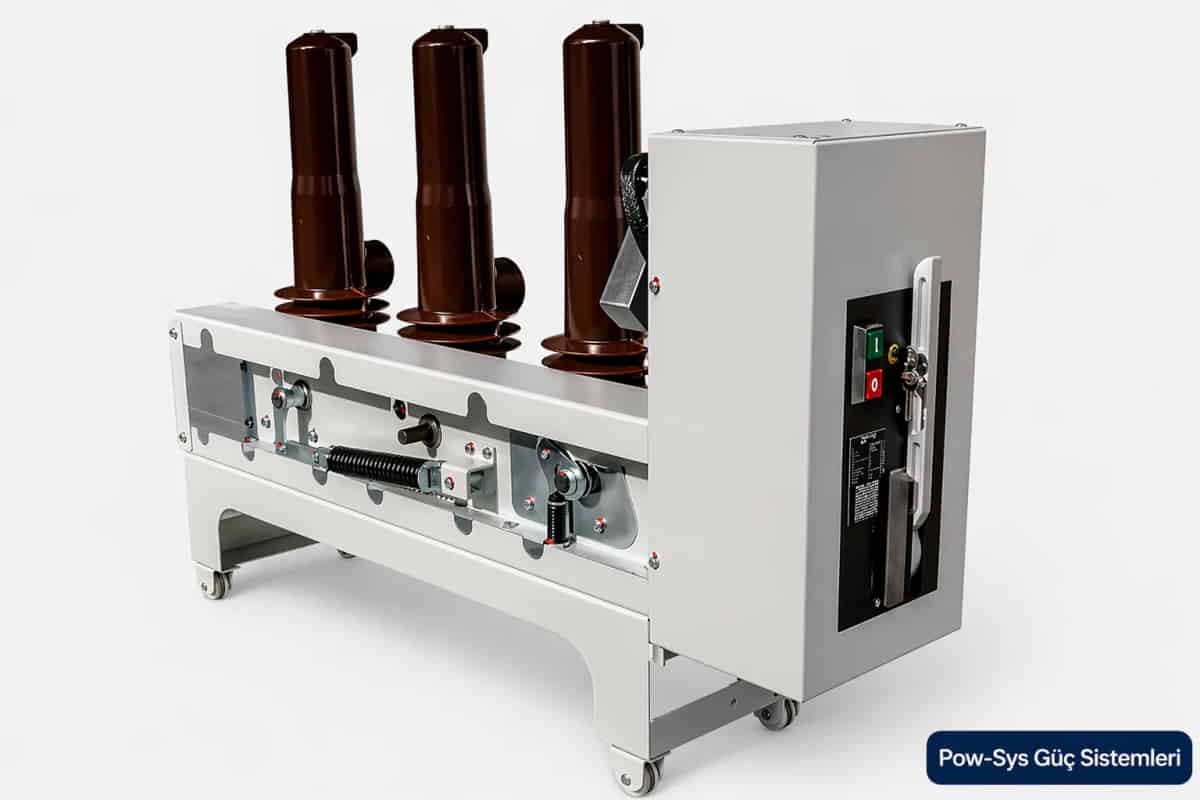
One of the most common circuit breaker types in medium-voltage systems is the vacuum circuit breaker. In vacuum circuit breakers, the arc is extinguished inside a vacuum interrupter. Because the vacuum medium does not contain ionizable gas, sustaining the arc becomes difficult and the interruption process becomes more controlled at current zero. For this reason, vacuum circuit breakers are very frequently preferred in MV switchgear, industrial facilities, distribution centers and applications requiring a high number of switching operations.
Another common circuit breaker type is the SF6 circuit breaker. In this structure, SF6 gas is used for arc extinction and insulation. This type, which was very common especially in medium- and high-voltage applications in the past, has found wide application because of its strong insulation properties. However, field selection should not be based only on habit; the system's technical needs, maintenance approach, environmental conditions and operating policy must be evaluated together.
A circuit breaker and a disconnector are not the same equipment, and this difference is very important. Disconnectors are generally used to isolate when there is no load, while circuit breakers are designed to open and close load current and fault currents within defined limits. Therefore, where there is a circuit breaker, there is protection and controlled opening-closing; in a disconnector, visible isolation and safety are the priority. Considering these two pieces of equipment as interchangeable in practice may cause serious operational and safety mistakes.
Circuit breakers are not equipment that operate only during faults. In daily operation, energizing, de-energizing, line transfer, maintenance switching and some load management operations are also carried out through circuit breakers. In this respect, a circuit breaker is an integrated system component that works together with protection relays, current and voltage transformers, busbar systems and control circuits. Reliable field operation of a circuit breaker depends not only on its mechanical strength but also on proper operation of its trip coil, closing coil, spring-charging system, auxiliary contacts and relay command chain.
Circuit breaker types can be classified by voltage level, place of use and arc-extinguishing medium. On the low-voltage side, molded-case circuit breakers, air circuit breakers and miniature circuit breakers are seen, while on the medium-voltage side fixed or withdrawable vacuum circuit breakers and, in some applications, SF6 circuit breakers are prominent. At high-voltage levels, different design approaches and field equipment come into use. For this reason, the term circuit breaker alone refers to a broad product family.
When selecting a circuit breaker, rated voltage, rated current, short-circuit breaking capacity, short-time withstand current, mechanical life, electrical life, switching frequency, mounting type and switchgear structure must be evaluated together. For example, a circuit breaker selected without determining the required breaking capacity according to the facility's short-circuit calculation may not deliver the expected performance during a fault. Similarly, choosing a solution with insufficient mechanical life in a system with frequent switching may create long-term operational problems.
Withdrawable circuit breakers used in medium-voltage switchgear provide important advantages for maintenance and testing. Operating states such as test position, service position and isolated position increase operational safety and make maintenance processes more controlled. However, in these systems, mechanical interlocks, switchgear door interlock structures and the relationship with the earthing switch must be designed correctly.
Circuit breakers are the visible face of the protection system. The relay detects the fault, but the circuit breaker is the equipment that performs the physical opening. Therefore, no matter how accurate the relay setting is, a circuit breaker with a failed trip coil or a mechanically stuck mechanism cannot provide the expected protection in the field. Likewise, nuisance trips, auxiliary contact faults or closing circuit problems may cause production loss and operational disorder. For this reason, the role of the circuit breaker is not only electrical but also operational.
On the maintenance and operation side, focusing only on the main contacts of the circuit breaker is not sufficient. The trip coil, closing coil, spring-charging motor, energy storage mechanism, auxiliary contacts, mechanical indicators and control circuit connections must be evaluated as a whole. Especially in MV systems, circuit breaker operation must be considered together with other equipment inside the switchgear; the earthing switch, current transformers, voltage transformers and protection relay chain must be handled together.
In summary, a circuit breaker is indispensable equipment for safe switching, fault isolation and operational continuity in electrical systems. Whether it is vacuum or SF6 type, fixed or withdrawable design, used at low- or medium-voltage level, its basic purpose is the same: to open the circuit safely when required and protect the system. If circuit breaker selection, MV switchgear suitability, equipment evaluation according to short-circuit level or operating safety of the existing system need to be examined together in your facility, it is possible to proceed in an integrated way with HV/MV testing, maintenance and repair, LV/MV/HV project design and consultancy and HV operation responsibility services.
Related Blog Posts
Related Services
Frequently Asked Questions
What is a circuit breaker?
A circuit breaker is switching and protection equipment that can open and close an electrical circuit under normal operating conditions and safely interrupt current under abnormal conditions such as short circuit or overcurrent during faults. It is one of the most critical components of the grid for energy continuity and equipment safety. Unlike a simple switch, a circuit breaker is designed to separate a circuit in a controlled way when required and to open very quickly on a command from the protection system when a fault occurs. In doing so, it protects transformers, cables, busbars, motors, generators and other equipment from short-circuit effects. Circuit breakers exist at low-, medium- and high-voltage levels in different designs, but their basic purpose is always the same: to open the circuit safely when required and protect the system.
What does a circuit breaker do?
A circuit breaker opens and closes a circuit at the correct time, under the correct condition and safely, which is much more than simply cutting electricity. In normal operation it can open and close under load, and it is used daily for energizing, de-energizing, line transfer, maintenance switching and some load management operations. During maintenance it helps isolate the line safely, and during a fault it protects the system by opening with a trip command from the protection relay. Through this combination of duties, transformers, cables, busbars, motors, generators and other equipment are protected from short-circuit effects while operational continuity is maintained. A circuit breaker is therefore both protection and operation equipment: it works as an integrated system component together with protection relays, current and voltage transformers, busbar systems and control circuits.
How does a circuit breaker work?
A circuit breaker works through the controlled separation of moving and fixed contacts. When the breaker is closed, current flows through the contacts; when an opening command is given, the contacts separate and an electric arc forms during this separation. The real engineering value of a circuit breaker lies in its ability to extinguish this arc safely, because if the arc is not extinguished effectively, the circuit is not fully interrupted and serious thermal and dielectric stresses can occur on the equipment. Depending on the technology, the arc is extinguished in a vacuum interrupter or in SF6 gas, and each breaker type has a different operating characteristic determined by its insulation and arc-extinguishing medium. Reliable operation also depends on the trip coil, closing coil, spring-charging system, auxiliary contacts and the relay command chain functioning correctly.
What is a vacuum circuit breaker?
A vacuum circuit breaker is a circuit breaker type, most common in medium-voltage systems, in which the electric arc is extinguished inside a vacuum interrupter. Because the vacuum medium does not contain ionizable gas, sustaining the arc becomes difficult and the interruption process becomes more controlled at current zero. This is why vacuum circuit breakers are very frequently preferred in MV switchgear, industrial facilities, distribution centers and applications requiring a high number of switching operations. In medium-voltage switchgear they may be installed as fixed or withdrawable designs, with the withdrawable version offering practical test, service and isolated positions for maintenance. When selecting a vacuum breaker, the standard criteria still apply: rated voltage, rated current, short-circuit breaking capacity, mechanical and electrical life, switching frequency and the structure of the switchgear must all be assessed together.
What is an SF6 circuit breaker?
An SF6 circuit breaker is a circuit breaker type that uses SF6 gas both for arc extinction and for insulation. Thanks to the strong insulation properties of this gas, SF6 breakers found wide application and were very common especially in medium- and high-voltage systems, where they have been used for many years. As in every circuit breaker, moving and fixed contacts separate on an opening command and the resulting arc must be extinguished, in this case in the gas medium. When deciding between SF6 and other technologies such as vacuum, the choice should not be based only on habit: the system's technical needs, maintenance approach, environmental conditions and operating policy must be evaluated together, along with standard selection criteria such as rated voltage, rated current and short-circuit breaking capacity.
What is the difference between a circuit breaker and a disconnector?
A circuit breaker and a disconnector are not the same equipment, and confusing them can cause serious operational and safety mistakes. A circuit breaker is designed to open and close load current and, within defined limits, fault currents; it provides protection and controlled opening and closing, and it opens on a trip command from the protection relay during a fault. A disconnector, by contrast, is generally used to isolate a circuit when there is no load, and its priority is visible isolation and safety, for example when preparing equipment for maintenance. In short, where there is a circuit breaker, there is protection and controlled switching; where there is a disconnector, there is visible separation. Treating these two pieces of equipment as interchangeable in practice is dangerous, so each must be operated strictly within its own role in the switching sequence.
What should be considered when selecting a circuit breaker?
Circuit breaker selection must bring together rated voltage, rated current, short-circuit breaking capacity, short-time withstand current, mechanical life, electrical life, switching frequency, mounting type and the structure of the switchgear it will be installed in. The short-circuit breaking capacity deserves particular attention: a breaker selected without determining the required capacity from the facility's short-circuit calculation may not deliver the expected performance during a fault. Similarly, choosing a breaker with insufficient mechanical life for a system with frequent switching creates long-term operational problems. The voltage level and application also shape the choice, from molded-case, air and miniature circuit breakers on the low-voltage side to fixed or withdrawable vacuum breakers and SF6 breakers at medium voltage. Field conditions and the facility's operating policy complete the picture, so selection is an engineering evaluation rather than a catalogue comparison.
Do circuit breakers operate only during faults?
No, circuit breakers are not equipment that operate only during faults. In daily operation, energizing, de-energizing, line transfer, maintenance switching and some load management operations are also carried out through circuit breakers, so they are constantly part of normal facility routines. During a fault, the breaker opens very quickly on a trip command from the protection relay and isolates the faulty section, protecting transformers, cables, busbars, motors and other equipment from short-circuit effects. This dual role makes the circuit breaker both protection and operation equipment. It also means reliability matters at all times, not only during emergencies: the trip coil, closing coil, spring-charging system, auxiliary contacts and relay command chain must all work properly, because nuisance trips, auxiliary contact faults or closing circuit problems can cause production loss and operational disorder even when no fault is present.
What advantage does a withdrawable circuit breaker provide?
A withdrawable circuit breaker provides important advantages for maintenance and testing, especially in medium-voltage switchgear. Its defined operating states, such as the test position, service position and isolated position, increase operational safety and make maintenance processes more controlled, because the breaker can be moved between clearly defined positions instead of being handled as a fixed part of the installation. This structure offers practical use in MV switchgear where breakers must be tested and maintained with minimal disruption to operation. For the arrangement to be safe, however, the mechanical interlocks, the switchgear door interlock structure and the relationship with the earthing switch must be designed correctly, since these interlocks are what prevent unsafe operations between positions. In short, a withdrawable design turns breaker maintenance into a controlled, position-based procedure, provided the interlock system is engineered and maintained properly.
What is the relationship between a circuit breaker and a protection relay?
The protection relay and the circuit breaker form a protection chain that only works as a whole: the relay detects the fault and produces the trip command, and the circuit breaker is the equipment that physically executes that command by opening the circuit. The circuit breaker is, in this sense, the visible face of the protection system. No matter how accurate the relay settings are, a breaker with a failed trip coil or a mechanically stuck mechanism cannot provide the expected protection in the field. That is why the trip coil, closing coil, spring-charging motor, auxiliary contacts and control circuit connections must be evaluated together with the relay chain, and why breaker condition must be considered alongside the earthing switch, current transformers and voltage transformers inside the switchgear. Protection performance is always the product of the relay and the breaker working together.